

Executive AI Assistants for Business Intelligence are AI-powered decision support systems that help business leaders monitor KPIs, analyze trends, identify risks, and recommend actions using natural language and real-time enterprise data. Unlike traditional dashboards, they proactively surface insights, explain business outcomes, and support faster, data-driven executive decisions.
Executive Summary
Business Intelligence (BI) has long helped organizations understand what happened through dashboards, reports, and KPIs. However, today’s executives need more than static reporting—they need intelligent systems that continuously monitor business performance, explain why metrics change, recommend actions, and answer complex business questions in natural language.
This is where Executive AI Assistants for Business Intelligence are transforming enterprise decision-making. Powered by Generative AI, enterprise data platforms, and AI agents, these assistants act as strategic advisors that synthesize information from multiple business systems, deliver personalized insights, and help leaders move from reactive reporting to proactive decision intelligence.
This guide explores how executive AI assistants work, their core capabilities, enterprise use cases, implementation best practices, and the governance required to build trusted AI-powered decision support systems.
TL;DR
- Executive AI Assistants transform traditional BI into proactive decision intelligence.
- They combine enterprise data, AI reasoning, and natural language interfaces to support executive decision-making.
- Unlike dashboards, they explain trends, identify risks, and recommend next actions.
- Success depends on trusted data, governance, semantic models, and human oversight.
- Organizations adopting AI-powered BI can improve decision speed, operational efficiency, and executive productivity.
Introduction
Modern enterprises generate enormous volumes of operational, financial, customer, and market data. While Business Intelligence platforms have made this information accessible through dashboards and reports, executives still spend significant time interpreting metrics, identifying root causes, and determining the best course of action.
Executive AI Assistants for Business Intelligence bridge this gap by combining conversational AI, enterprise analytics, and intelligent reasoning. Rather than waiting for leaders to search dashboards or manually analyze reports, these assistants proactively monitor business performance, explain key trends, answer strategic questions, and recommend actions based on trusted enterprise data.
As organizations adopt AI agents and Generative AI, executive AI assistants are becoming the next evolution of Business Intelligence—enabling leaders to move from reporting on past performance to making faster, more informed business decisions.
What Are Executive AI Assistants for Business Intelligence?
Executive AI Assistants for Business Intelligence are AI-powered digital assistants that analyze enterprise data, answer business questions, monitor KPIs, and provide actionable recommendations through natural language conversations. They combine analytics, AI reasoning, and enterprise knowledge to help executives make faster, data-driven decisions.
Modern Executive AI Assistants increasingly rely on Retrieval-Augmented Generation (RAG) to combine Large Language Models with trusted enterprise data, improving factual accuracy while reducing hallucinations.
Unlike traditional BI tools that require users to explore dashboards manually, executive AI assistants provide an intuitive, conversational experience that simplifies access to business insights.
These assistants can:
- Summarize executive dashboards in plain language.
- Monitor KPIs continuously and detect anomalies.
- Explain why business metrics have changed.
- Recommend next-best actions based on trends.
- Generate executive reports and meeting summaries.
- Answer follow-up questions conversationally.
- Surface opportunities and risks before they become critical.
Instead of navigating multiple reports, executives can ask questions such as:
- Why did quarterly revenue decline in the North America region?
- Which customers have the highest churn risk this month?
- What factors are affecting operating margins?
- Which business unit exceeded its forecast, and why?
By combining AI reasoning with enterprise data, executive AI assistants make business intelligence more accessible, actionable, and responsive.
Related Reading: Enterprise AI Strategy in 2026
Why Executive AI Assistants Are Transforming Business Intelligence
Executive AI Assistants enhance Business Intelligence by proactively monitoring enterprise data, identifying patterns, explaining business outcomes, and recommending actions. They help executives spend less time searching for information and more time making informed strategic decisions.
Traditional BI platforms answer questions like:
- What happened?
- Where did performance change?
- Which KPI is below target?
Executive AI assistants extend these capabilities by answering higher-value questions:
- Why did this happen?
- What business risks should I prioritize?
- What actions should I take next?
- What will happen if current trends continue?
This shift enables organizations to move from descriptive analytics to decision intelligence.
Key Business Benefits
- Faster executive decision-making
- Continuous KPI monitoring
- Reduced manual analysis
- Improved cross-functional visibility
- Proactive risk identification
- Natural language access to enterprise data
- Better alignment between business strategy and execution
Enterprise Insight: Competitive advantage increasingly depends not on how much data an organization collects, but on how quickly leaders can convert trusted data into confident business decisions. Executive AI assistants reduce the time between insight and action by delivering context-aware recommendations directly to decision-makers.
Executive AI Assistants vs Traditional BI Dashboards vs AI Agents
Traditional dashboards visualize business data, AI assistants provide conversational insights, and AI agents extend these capabilities by autonomously monitoring data, recommending actions, and executing predefined business workflows. Together, they represent the evolution from reporting to intelligent decision support.
| Capability | Traditional BI Dashboards | Executive AI Assistants | AI Agents |
|---|---|---|---|
| Data Visualization | ✔ | ✔ | Limited |
| Natural Language Queries | ✖ | ✔ | ✔ |
| Executive Summaries | ✖ | ✔ | ✔ |
| Root Cause Analysis | Manual | AI-Assisted | Autonomous |
| Action Recommendations | Limited | ✔ | ✔ |
| Workflow Automation | ✖ | Limited | ✔ |
| Continuous Monitoring | Alerts Only | ✔ | ✔ |
| Decision Support | Reactive | Proactive | Autonomous |
Rather than replacing dashboards, executive AI assistants enhance them by translating complex analytics into business-ready insights and recommendations. AI agents can then automate follow-up actions within defined governance boundaries.
Related Reading: How to Build AI-Ready Data Foundations: A Strategic Enterprise Guide.
Core Capabilities of Executive AI Assistants
Executive AI Assistants combine conversational AI, enterprise analytics, predictive insights, and business reasoning to help leaders understand performance, identify opportunities, and make informed decisions with greater speed and confidence.
The most effective executive AI assistants deliver a combination of analytical, conversational, and decision-support capabilities.
Natural Language Analytics
Executives can interact with business data using everyday language instead of SQL queries or complex dashboard filters.
KPI Monitoring
The assistant continuously monitors key performance indicators, highlighting trends, anomalies, and business risks in real time.
Automated Executive Summaries
AI generates concise summaries of financial performance, sales trends, operational metrics, and customer insights, reducing the time spent reviewing reports.
Root Cause Analysis
Instead of simply identifying performance changes, AI assistants analyze contributing factors by combining historical trends, business rules, and enterprise data.
Predictive Decision Support
By applying machine learning and predictive analytics, executive AI assistants forecast potential business outcomes and recommend proactive actions.
Enterprise Knowledge Integration
AI assistants combine structured business data with enterprise documents, policies, and reports using Retrieval-Augmented Generation (RAG), enabling richer and more context-aware responses.
Enterprise Insight: The most valuable executive AI assistants don’t just retrieve information—they synthesize structured data, business context, and organizational knowledge into recommendations that executives can act on with confidence.
Enterprise Use Cases for Executive AI Assistants
Executive AI Assistants deliver the greatest value when they provide proactive, role-specific insights across business functions. By combining enterprise data, AI reasoning, and natural language interactions, they help leaders make faster, more informed decisions while reducing manual analysis.
Unlike traditional dashboards that require users to search for insights, executive AI assistants proactively surface the information most relevant to each business leader.
| Executive Role | AI Assistant Capabilities | Business Value |
|---|---|---|
| CEO | Business health summaries, strategic risks, growth opportunities | Faster strategic decision-making |
| CFO | Revenue forecasts, cash flow analysis, budget variance, profitability insights | Improved financial planning |
| COO | Supply chain monitoring, operational KPIs, production efficiency | Better operational performance |
| Chief Sales Officer | Pipeline health, sales forecasting, regional performance | Increased revenue visibility |
| CMO | Campaign performance, customer segmentation, marketing ROI | Smarter marketing investments |
| CHRO | Workforce analytics, attrition trends, hiring metrics | Better workforce planning |
Enterprise Insight: The most effective executive AI assistants personalize insights based on business roles, ensuring every leader receives recommendations aligned with their strategic priorities.
Related Reading: RAG vs Fine-Tuning vs AI Agents: Choosing the Right LLM Strategy
Reference Architecture for Executive AI Assistants
Executive AI Assistants combine enterprise data, semantic models, Retrieval-Augmented Generation (RAG), Large Language Models (LLMs), and governance to deliver trusted, conversational business intelligence. A well-designed architecture ensures scalability, security, and reliable decision support.
Building an executive AI assistant requires more than integrating a chatbot with a BI platform. It requires a trusted data foundation, governed analytics, and AI orchestration.
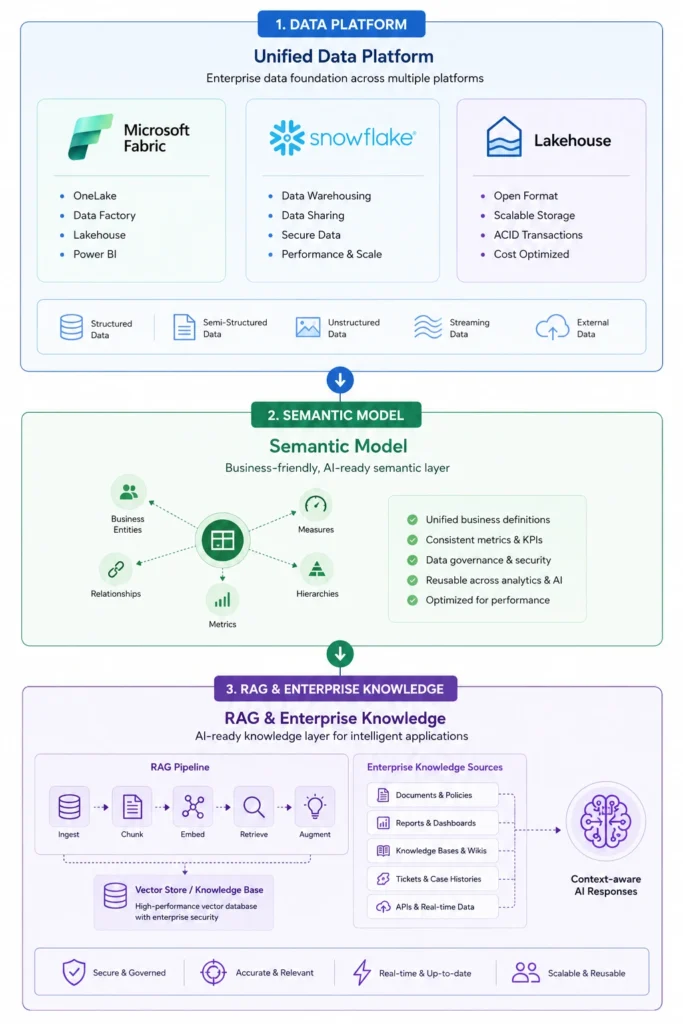
Core Architecture Components
| Layer | Purpose |
| Enterprise Data Sources | ERP, CRM, HRMS, Finance, Marketing, IoT |
| Data Platform | Data warehouse, lakehouse, Microsoft Fabric, Snowflake |
| Semantic Layer | Standardized business metrics and KPI definitions |
| RAG & Enterprise Knowledge | Policies, reports, documents, meeting notes |
| LLM & AI Assistant | Natural language reasoning and response generation |
| Business Applications | Microsoft Teams, Slack, Power BI, mobile apps |
A robust architecture ensures executives receive accurate, context-aware insights rather than disconnected data points.
Related Reading: AI Orchestration Platforms: The Enterprise Guide to Coordinating AI at Scale in 2026
Best Practices for Building Executive AI Assistant
Successful Executive AI Assistants are built on trusted data, governed metrics, secure AI models, and user-centric design. Organizations should prioritize business outcomes, explainability, and continuous improvement over deploying AI features alone.
To maximize adoption and business value, organizations should:
Start with High-Value Executive Use Cases
Focus on decisions that require frequent analysis, such as revenue forecasting, operational performance, financial planning, and customer retention.
Build on Trusted Data
AI assistants are only as reliable as the data they access. Integrate governed enterprise data sources and maintain consistent KPI definitions through a semantic layer.
Combine Structured and Unstructured Data
Merge transactional data with documents, policies, reports, and meeting notes using Retrieval-Augmented Generation (RAG) to provide richer business context.
Prioritize Explainability
Executives should understand why the AI generated a recommendation. Include supporting metrics, trend analysis, and source references whenever possible.
Keep Humans in the Loop
High-impact business decisions—such as pricing changes, financial approvals, or strategic investments—should always include executive review before action.
Continuously Improve Performance
Monitor user feedback, AI accuracy, and business outcomes to refine prompts, retrieval strategies, and recommendation quality over time.
Related Reading: How to Manage AI Agents Across Your Organization: Governance, Security & Best Practices
Governance, Security & Responsible AI
Executive AI Assistants must be governed with robust security, access controls, and Responsible AI practices. Identity management, data governance, auditability, and human oversight help ensure AI-generated insights remain trustworthy, secure, and compliant.
Executive AI assistants often access sensitive financial, customer, and operational data. Strong governance is therefore essential.
Key governance principles include:
- Implement role-based access control (RBAC) to ensure executives only access authorized data.
- Apply Zero Trust security principles for all AI interactions.
- Ground AI responses using approved enterprise knowledge sources.
- Maintain audit logs for AI-generated insights and user interactions.
- Establish approval workflows for high-risk recommendations.
- Align AI governance with frameworks such as the NIST AI Risk Management Framework (AI RMF) and the Microsoft Responsible AI Standard.
Enterprise Insight: Trust is the foundation of executive adoption. Leaders are more likely to rely on AI recommendations when every insight is transparent, explainable, and traceable to trusted enterprise data.
Measuring Success: Executive AI KPIs
Organizations should measure Executive AI Assistants using both business and operational metrics. Success extends beyond response accuracy to include faster decision-making, improved executive productivity, higher adoption, and measurable business impact.
Recommended KPI Framework
| Category | KPI | Business Outcome |
| Executive Productivity | Time spent preparing executive reports | Reduced manual effort |
| Decision Intelligence | Time from insight to decision | Faster strategic decisions |
| Operational Efficiency | Automated report generation | Improved efficiency |
| User Adoption | Active executive users | Increased AI adoption |
| AI Quality | Accuracy and relevance of recommendations | Greater trust in AI |
| Business Impact | Revenue growth, cost reduction, risk mitigation | Tangible ROI |
Rather than measuring AI usage alone, organizations should evaluate how effectively AI improves executive decision-making and business outcomes.
Common Challenges and How to Overcome Them
Organizations implementing Executive AI Assistants often face challenges related to data quality, inconsistent metrics, governance, and user trust. Addressing these issues with strong data foundations, semantic models, and Responsible AI practices improves adoption and long-term success.
| Challenge | Impact | Best Practice |
| Fragmented Data Sources | Incomplete insights | Build a unified enterprise data platform |
| Inconsistent KPI Definitions | Conflicting reports | Use a governed semantic layer |
| Poor Data Quality | Inaccurate recommendations | Establish data quality standards |
| Limited User Trust | Low adoption | Provide explainable AI responses |
| Security & Compliance Risks | Exposure of sensitive information | Implement RBAC, Zero Trust, and audit logging |
| Information Overload | Executive fatigue | Deliver personalized, role-based insights |
Enterprise Insight: Technology alone does not guarantee success. Organizations that combine trusted data, strong governance, and executive-centric user experiences are more likely to achieve sustained adoption and measurable business value.
Future Trends in Executive AI Assistants
Executive AI Assistants are evolving from conversational analytics tools into autonomous decision-support systems that proactively monitor business performance, collaborate with AI agents, and deliver contextual recommendations. Future innovations will focus on predictive intelligence, AI orchestration, and multimodal executive experiences.
The next generation of Business Intelligence will move beyond dashboards and static reports. Executive AI assistants will become intelligent business partners that continuously monitor enterprise operations, anticipate business risks, and recommend strategic actions before issues escalate.
AI Agents + Business Intelligence
Executive AI assistants will increasingly collaborate with specialized AI agents across finance, sales, operations, and customer service to deliver cross-functional insights and automate routine analytical tasks.
Predictive & Prescriptive Intelligence
Rather than simply reporting historical performance, future assistants will forecast business outcomes, simulate different scenarios, and recommend optimal actions based on organizational goals.
Multimodal Executive Experiences
Executives will interact with AI through voice, chat, dashboards, email summaries, and meeting copilots, making business intelligence accessible across multiple channels.
Personalized Decision Intelligence
AI assistants will adapt recommendations based on an executive’s role, strategic priorities, and historical decision patterns, providing highly relevant insights tailored to individual leadership needs.
Enterprise Insight: The future of Business Intelligence isn’t just conversational—it’s contextual, predictive, and proactive. Organizations that invest in trusted data, semantic models, and AI governance today will be best positioned to realize the full value of Executive AI Assistants.
Executive AI Assistants vs AI Agents for Business Intelligence
Executive AI Assistants and AI agents complement each other within modern Business Intelligence. While AI assistants help leaders understand business performance and make informed decisions, AI agents automate workflows and execute business processes based on predefined rules and governance policies.
| Capability | Executive AI Assistant | AI Agent |
|---|---|---|
| Conversational Business Insights | ✔ | Limited |
| Executive KPI Monitoring | ✔ | ✔ |
| Root Cause Analysis | ✔ | Limited |
| Strategic Recommendations | ✔ | Limited |
| Workflow Execution | Limited | ✔ |
| Process Automation | ✖ | ✔ |
| Human Decision Support | ✔ | Limited |
| Autonomous Task Execution | ✖ | ✔ |
Enterprise Recommendation
Use Executive AI Assistants for strategic decision support and executive insights, while leveraging AI Agents to automate operational workflows and routine business processes. Together, they create an intelligent decision-making ecosystem that combines human expertise with AI-driven automation.
Conclusion
Business Intelligence is entering a new era. While dashboards and reports remain essential, today’s executives require more than access to data—they need AI-powered systems that transform information into timely, actionable insights.
Executive AI Assistants bridge this gap by combining enterprise data, conversational AI, predictive analytics, and business context to help leaders understand what is happening, why it matters, and what actions to take next. When built on trusted data, governed semantic models, and Responsible AI principles, these assistants become a powerful enabler of faster, more confident decision-making.
As organizations embrace Enterprise AI, Executive AI Assistants will become a strategic capability—not replacing Business Intelligence platforms, but enhancing them with intelligence, context, and proactive recommendations.
At Techment, we help organizations build secure, enterprise-ready AI solutions by combining expertise in Enterprise AI, Microsoft Fabric, Data Engineering, AI Agents, Business Intelligence, and Responsible AI. Our approach enables enterprises to modernize analytics, improve executive decision-making, and unlock measurable business value through AI-powered intelligence.
Frequently Asked Questions (FAQs)
1. What is an Executive AI Assistant?
An Executive AI Assistant is an AI-powered decision support system that helps business leaders analyze enterprise data, monitor KPIs, answer business questions, and generate actionable recommendations through natural language interactions.
2. How is an Executive AI Assistant different from a BI dashboard?
Traditional BI dashboards visualize historical and current business metrics, whereas Executive AI Assistants interpret those metrics, explain trends, answer follow-up questions, and recommend actions using AI and enterprise knowledge.
3. What technologies power Executive AI Assistants?
Executive AI Assistants typically combine Large Language Models (LLMs), Retrieval-Augmented Generation (RAG), semantic models, enterprise data platforms, machine learning, conversational AI, and business intelligence tools.
4. Which industries benefit most from Executive AI Assistants?
Financial services, healthcare, retail, manufacturing, logistics, telecommunications, and professional services benefit significantly because executives rely on timely, data-driven decisions across complex operations.
5. How do Executive AI Assistants improve decision-making?
They reduce the time required to gather and interpret data by proactively surfacing business insights, identifying anomalies, explaining performance changes, and recommending next-best actions.
6. Are Executive AI Assistants secure?
Yes, when implemented using role-based access control (RBAC), Zero Trust security, enterprise identity management, audit logging, and Responsible AI governance frameworks.
7. Can Executive AI Assistants integrate with existing BI platforms?
Yes. They can integrate with platforms such as Microsoft Fabric, Power BI, Snowflake, Databricks, Tableau, SAP, Salesforce, and other enterprise data platforms through APIs, semantic models, and Retrieval-Augmented Generation (RAG).
8. What KPIs should organizations use to measure success?
Organizations should monitor executive productivity, decision-making speed, AI adoption, report automation, recommendation accuracy, user satisfaction, operational efficiency, and business outcomes such as revenue growth or cost savings.
Related Reads
- Enterprise AI Strategy in 2026
- How to Build AI-Ready Data Foundations: A Strategic Enterprise Guide.
- 7 Real-World Agentic AI Use Cases Transforming Enterprise Operations in 2026
- Agentic Workflow Solutions: The Future of Enterprise Automation in 2026
- Best Practices for Generative AI Implementation in Business
- How AI Agents Are Driving 10x Productivity for Modern Businesses
- Fabric AI Readiness: How to Prepare Your Data for Scalable AI Adoption.
- Agentic AI Orchestration: 7 Strategic Pillars for Scalable AI in 2026