
Data sensitivity classification is the process of categorizing business information according to how sensitive it is, the impact of unauthorized access or disclosure, and the level of protection it requires. A practical enterprise classification framework typically uses tiers such as Public, Internal, Confidential, and Restricted, with each tier mapped to specific access, encryption, sharing, retention, monitoring, and handling controls.
Classification is not simply a labeling exercise. A label has business value only when it changes how data is protected and governed.
For example:
Restricted data → named-user access → encryption → limited sharing → controlled APIs → enhanced monitoring → audit evidence
The reference implementation guide emphasizes a common enterprise problem: organizations may have well-written classification policies but fail to translate them into operational controls. It identifies organizational barriers, policy-practice gaps, and platform limitations as major reasons classification programs fail.
NIST’s FIPS 199 provides a different but complementary risk-based model for federal information systems, categorizing potential impact across confidentiality, integrity, and availability using Low, Moderate, and High impact levels.
For modern enterprises, the strongest approach is therefore:
Classify data → define business ownership → map classification to controls → automate enforcement → monitor continuously → reassess as business context changes.
TL;DR
Data sensitivity classification helps businesses determine how information should be accessed, shared, stored, protected, retained, and monitored based on its sensitivity and business impact.
A successful classification program requires more than labels. Businesses need:
- A clear classification taxonomy
- Business-owned classification decisions
- Defined handling requirements
- Classification-to-control mapping
- Automated discovery and labeling
- Access and encryption enforcement
- Continuous monitoring
- Periodic reassessment
- Audit evidence
- A process for handling misclassification and drift
Microsoft Purview, for example, supports manual classification, automated pattern matching, and trainable classifiers, allowing organizations to progressively automate classification and sensitivity labeling.
What Is Data Sensitivity Classification?
Data sensitivity classification is the practice of categorizing business information according to its sensitivity, business impact, regulatory obligations, and protection requirements. Organizations use classification levels to determine who can access data, how it can be shared, whether it requires encryption, how it should be retained, and how access should be monitored.
The fundamental question is:
“What would happen if this data were exposed, altered, unavailable, or accessed by the wrong person?”
Classification converts that answer into a practical handling level.
For example:
Public
Information intentionally made available outside the organization.
Internal
Information intended for employees or authorized internal users.
Confidential
Information where unauthorized disclosure could cause meaningful business, financial, privacy, contractual, or competitive harm.
Restricted
Information requiring the highest level of protection because unauthorized access, disclosure, modification, or loss could create severe consequences.
The exact names and number of levels should be customized to the organization’s risk profile. Microsoft itself gives Personal, Public, General, Confidential, and Highly Confidential as possible starting labels for sensitivity-taxonomy design.
Why Is Data Sensitivity Classification Important?
Data sensitivity classification gives organizations a consistent way to match protection controls to business risk. Without classification, companies often apply either insufficient protection to sensitive information or excessive controls to low-risk data, creating security exposure, unnecessary cost, and poor user adoption.
A classification program helps answer:
- What data do we have?
- Which data is sensitive?
- Who owns it?
- Who should access it?
- Where is it stored?
- Can it be shared externally?
- Does it require encryption?
- How long should it be retained?
- What should happen when it is copied?
- What monitoring is required?
- What happens if the classification is wrong?
This becomes increasingly important as data spreads across:
- SaaS applications
- Cloud platforms
- Data warehouses
- Data lakes
- Collaboration platforms
- APIs
- AI applications
- Enterprise search
- Analytics environments
- Employee devices
- Third-party systems
The data does not remain inside one application.
Therefore, classification should be designed around the data, not only the application where the data originated.
Data Classification vs Data Sensitivity Classification
These terms are often used interchangeably, but enterprises should distinguish them conceptually.
Data classification is the broader process of categorizing information.
Data sensitivity classification focuses specifically on the sensitivity and protection requirements associated with the data.
For example:
| Concept | Example |
|---|---|
| Data type | Customer record |
| Data classification | Customer information |
| Sensitivity | Confidential |
| Regulatory category | Personal data |
| Protection requirement | Encryption + restricted access |
| Retention | 7 years |
| Sharing | Authorized personnel only |
Modern data governance programs can therefore use multiple metadata dimensions rather than relying on one label.
Data Sensitivity Classification Levels
A four-tier model is a practical starting point for many commercial enterprises:
                 DATA SENSITIVITY
                       │
          ┌────────────┴────────────┐
          ▼                         ▼
        PUBLIC                   INTERNAL
          │                         │
          ▼                         ▼
     CONFIDENTIAL              RESTRICTED
                                  │
                                  ▼
                         Highest Protection
The levels should not be treated as universal legal categories.
They are an enterprise policy mechanism that translates risk into handling requirements.
A practical four-level model is:
| Level | Example | Typical Protection |
|---|---|---|
| Public | Published website content | Minimal restrictions |
| Internal | Internal procedures | Employee-only access |
| Confidential | Customer or financial data | Need-to-know access + encryption |
| Restricted | Highly sensitive PII, credentials, strategic data | Named-user access + strongest controls |
Data Classification Levels: Example Comparison
| Attribute | Public | Internal | Confidential | Restricted |
|---|---|---|---|---|
| External sharing | Allowed | Restricted | Exceptional | Generally prohibited |
| Access | Broad | Employees | Need-to-know | Named/approved users |
| Encryption | Standard | Standard | Required | Strongly required |
| API access | Open where appropriate | Controlled | Approved | Highly restricted |
| Monitoring | Standard | Standard | Enhanced | Highest priority |
| DLP | Usually unnecessary | Recommended | Required | Strongly required |
| Export | Allowed | Controlled | Restricted | Exceptional |
| Audit evidence | Basic | Standard | Enhanced | Detailed |
| Approval | Low | Moderate | High | Highest |
These are example enterprise controls, not universal regulatory requirements. Actual controls should be aligned with applicable laws, contractual obligations, security architecture, and business risk.
How to Choose the Right Data Classification Level
Classification should be based on business impact, not simply the presence of a keyword such as “customer” or “financial.”
A useful decision framework is:
Question 1: Who should access this data?
- Anyone
- Employees
- Specific teams
- Specific roles
- Named individuals
Question 2: What happens if it is disclosed?
- No meaningful impact
- Limited operational impact
- Significant business or privacy impact
- Severe legal, financial, security, or personal impact
Question 3: What happens if it is modified?
This introduces integrity risk.
For example, incorrect financial records may be more dangerous than merely exposing an internal document.
Question 4: What happens if it becomes unavailable?
This introduces availability risk.
A dataset may not be highly confidential but could be business-critical.
Question 5: Are there regulatory or contractual requirements?
Examples may include:
- Privacy obligations
- Financial regulations
- Healthcare requirements
- Contractual confidentiality
- Government requirements
- Industry-specific controls
Question 6: Does the data need special handling?
Examples:
- Encryption
- Masking
- Restricted exports
- Retention requirements
- Geographic restrictions
- Privileged access
A Better Classification Decision Matrix
Instead of classifying solely by data type, evaluate three dimensions:
                    DATA IMPACT
                         │
        ┌────────────────┼────────────────┐
        ▼                ▼                ▼
 Confidentiality      Integrity       Availability
        │                │                │
        ▼                ▼                ▼
 Unauthorized        Incorrect        Service
 Disclosure          Modification     Disruption
        │                │                │
        └────────────────┼────────────────┘
                         ▼
                  Overall Risk
                         │
                         ▼
                 Classification
This is particularly important for organizations using risk-based security frameworks.
NIST FIPS 199 evaluates security categorization across confidentiality, integrity, and availability, with Low, Moderate, and High potential-impact levels.
Data Classification Frameworks: ISO-Style vs NIST-Style Approaches
There is no single universal classification taxonomy for every organization.
Different frameworks solve different problems.
Commercial enterprise approach
Many businesses use sensitivity-based levels such as:
Public → Internal → Confidential → Restricted
The emphasis is on:
- Data sensitivity
- Business context
- Handling requirements
- Access
- Sharing
- Protection
NIST FIPS 199 approach
NIST FIPS 199 uses:
Low → Moderate → High
across:
- Confidentiality
- Integrity
- Availability
The framework is designed for categorizing federal information and information systems based on potential impact.
Important distinction
Do not force one framework into the other without understanding the purpose.
A commercial organization can use:
Public / Internal / Confidential / Restricted
as its user-facing classification taxonomy while separately using risk assessments based on:
Confidentiality / Integrity / Availability
This provides a more useful enterprise architecture.
Classification Taxonomy vs Security Controls
One of the most important principles in data classification is:
A classification label is not itself a security control.
A label says:
“This information is Confidential.”
A control answers:
“What happens because it is Confidential?”
For example:
CONFIDENTIAL
     │
     ├── Need-to-know access
     ├── Encryption
     ├── Restricted sharing
     ├── DLP policy
     ├── Approved APIs
     ├── Enhanced logging
     └── Periodic review
The reference source makes this distinction particularly important in Salesforce environments: classification metadata by itself does not automatically enforce field-level security, sharing restrictions, or encryption. Those controls must be separately configured.
This principle applies broadly across enterprise technology.
Who Is Responsible for Data Classification?
Data classification should not become an IT-only responsibility.
A strong governance model separates business ownership from technical enforcement.
| Role | Responsibility |
|---|---|
| Data Owner | Determines classification based on business context |
| Data Steward | Maintains classification quality |
| Data Custodian | Implements technical controls |
| Security Team | Defines and validates protection controls |
| Privacy Team | Maps privacy obligations |
| Compliance | Maps regulatory requirements |
| IT | Implements platforms and integrations |
| Executive Sponsor | Provides organizational authority |
The reference guide similarly distinguishes data owners, stewards, custodians, and compliance roles.
Why business ownership matters
Technical teams may know:
“This is a customer table.”
But the business owner may know:
“This dataset contains high-value customer information subject to contractual restrictions.”
Classification requires that business context.
How to Implement a Data Sensitivity Classification Program
A successful program should move through six major stages.
Step 1: Discover Your Data
Identify:
- Data stores
- Applications
- Databases
- Documents
- Emails
- SaaS systems
- Cloud storage
- Data lakes
- Data warehouses
- APIs
- AI platforms
Build an inventory before attempting to classify everything.
Step 2: Define the Taxonomy
Choose:
- Number of levels
- Names
- Definitions
- Examples
- Ownership
- Classification criteria
Keep the taxonomy simple enough for employees to understand.
A four-level model is often easier to operationalize than a complex framework with many overlapping categories.
Step 3: Define Handling Requirements
For every classification level, specify:
- Who can access it?
- Where can it be stored?
- Can it be emailed?
- Can it be externally shared?
- Is encryption required?
- Can it be copied?
- Can it be downloaded?
- Can it be sent to APIs?
- How long is it retained?
- How is it destroyed?
This transforms classification into policy.
Step 4: Map Classification to Technical Controls
Example:
Classification
      ↓
Access Control
      ↓
Encryption
      ↓
DLP
      ↓
Sharing Policy
      ↓
API Controls
      ↓
Monitoring
      ↓
Retention
The goal is to make the classification operational.
Step 5: Automate Classification
Manual classification does not scale across large enterprises.
Microsoft Purview provides three broad classification mechanisms:
- Manual classification
- Automated pattern matching
- Trainable classifiers
Pattern-based detection can identify information such as:
- Credit card numbers
- Bank account information
- Government identifiers
- Other sensitive information types
Trainable classifiers can recognize more contextual content using examples rather than relying only on patterns.
Step 6: Monitor and Reassess
Classification is not a one-time project.
Review classification when:
- New products launch
- New data fields are created
- Regulations change
- M&A introduces new datasets
- Data moves platforms
- Business processes change
- New AI applications consume data
- Security incidents occur
The reference implementation guide specifically identifies M&A, new products, regulatory changes, and changes in business context as triggers for reassessment.
How Automated Data Classification Works
Automated classification can use several detection approaches.
Pattern matching
Identify known patterns.
Example:
4111 1111 1111 1111Potentially matches a credit-card pattern.
Keyword + contextual detection
Combine:
- Keywords
- Metadata
- Proximity
- Patterns
- Confidence thresholds
Exact data matching
Compare content against known sensitive values.
Document fingerprinting
Recognize variations of known sensitive templates.
Machine-learning classifiers
Use examples to identify document categories.
Microsoft Purview currently supports pattern-based mechanisms, exact data matching, document fingerprinting, and trainable classifiers among its classification capabilities.
Read our blog on How to Build an Enterprise Context Layer for AI – techment.com
Manual vs Automated vs AI-Assisted Classification
| Approach | Strength | Weakness |
|---|---|---|
| Manual | Business context | Difficult to scale |
| Pattern-based | Fast and deterministic | Context can be limited |
| Rule-based | Predictable | Requires maintenance |
| Trainable classifier | Handles contextual content | Requires quality examples |
| AI-assisted | Strong semantic understanding | Requires validation and governance |
| Hybrid | Best balance | More complex architecture |
The strongest enterprise programs typically use a hybrid model.
For example:
Known PII
   ↓
Pattern Detection
   ↓
Known Financial Documents
   ↓
Classifier
   ↓
Business Context
   ↓
Data Owner Validation
   ↓
Sensitivity Label
Sensitivity Labels and Data Classification
Sensitivity labels provide a way to attach a business-facing protection classification to information.
For example:
Public
Internal
Confidential
Highly Confidential
Microsoft Purview distinguishes classifications from sensitivity labels: classifications identify data types or patterns, while sensitivity labels categorize information based on business impact and can be used to apply protection.
This distinction is important.
Classification
“This document contains a government identifier.”
Sensitivity label
“This document is Highly Confidential.”
The first identifies what is present.
The second communicates how the organization should handle it.
Automated Sensitivity Labeling
Modern classification programs can use detection rules to automatically recommend or apply labels.
Microsoft Purview supports automatic sensitivity labeling based on conditions such as sensitive information types and trainable classifiers.
A simplified workflow is:
Content Created
      ↓
Content Scanned
      ↓
Sensitive Information Detected
      ↓
Classification Rule
      ↓
Sensitivity Label
      ↓
Protection Policy
      ↓
Access / Encryption / DLP / Monitoring
However, automated labeling should be introduced progressively.
False positives can create user frustration, while false negatives can leave sensitive information underprotected.
Microsoft recommends testing and tailoring label policies and capturing test cases before broad deployment.
Read more on AI Context Engineering: The New Competitive Advantage for Enterprise AI
Data Classification and AI
Data classification becomes even more important when organizations introduce generative AI.
An AI application may access:
- Customer records
- Internal documents
- Contracts
- Financial information
- HR data
- Source code
- Security documentation
- Product strategy
- Knowledge bases
Without classification, an AI system may not know which information is appropriate to retrieve or expose.
AI-aware classification architecture
Enterprise Data
      │
      ▼
Data Classification
      │
      ├── Public
      ├── Internal
      ├── Confidential
      └── Restricted
              │
              ▼
       Access Policies
              │
              ▼
        AI Retrieval
              │
              ▼
       Context Filtering
              │
              ▼
         AI Response
This creates an important principle for enterprise RAG and AI agents:
AI access should inherit data authorization and sensitivity constraints rather than treating the enterprise knowledge base as one unrestricted corpus.
Classification can therefore become an important input to:
- RAG filtering
- AI agent permissions
- Data-loss prevention
- Retrieval authorization
- Prompt context controls
- Model access policies
- AI audit trails
Data Classification and Zero Trust
Classification can also strengthen Zero Trust architecture.
Instead of asking only:
“Is this user authenticated?”
the system can consider:
“Is this authenticated user authorized to access this classification of data for this purpose?”
For example:
User
 +
Identity
 +
Device
 +
Location
 +
Application
 +
Business Role
 +
Data Classification
 =
Access Decision
This moves security from simple identity verification toward context-aware authorization.
Data Classification and Data Governance
Data classification should connect with the wider data governance operating model.
Classification
What sensitivity level does the data have?
Ownership
Who is accountable?
Quality
Is the data accurate?
Lineage
Where did it come from?
Retention
How long should it exist?
Access
Who can use it?
Security
How should it be protected?
Lifecycle
When should it be archived or deleted?
This creates:
Classification → Governance → Protection → Lifecycle
Data Classification Policy: What Should It Contain?
A data classification policy should define at least:
1. Purpose
Why the organization classifies information.
2. Scope
Which data, systems, users, and business units are covered.
3. Classification levels
Definitions and examples.
4. Ownership
Who determines and maintains classifications.
5. Handling requirements
Access, storage, sharing, encryption, retention, and disposal.
6. Automated classification
Where detection and auto-labeling are permitted.
7. Exceptions
How exceptions are approved.
8. Monitoring
How compliance is measured.
9. Reclassification
When and how classifications change.
10. Enforcement
What happens when users or systems violate requirements.
Classification-to-Control Matrix
The most useful enterprise artifact is often a classification-to-control matrix.
| Classification | Access | Encryption | Sharing | DLP | Monitoring | Retention |
|---|---|---|---|---|---|---|
| Public | Broad | Standard | Allowed | Low | Standard | Business-defined |
| Internal | Employees | Standard | Controlled | Recommended | Standard | Business-defined |
| Confidential | Need-to-know | Required | Restricted | Required | Enhanced | Policy-defined |
| Restricted | Named users | Strong | Highly restricted | Strong | High priority | Strictly governed |
This matrix should be reviewed by:
- Security
- Privacy
- Compliance
- Data owners
- IT
- Legal where appropriate
The exact controls should reflect the organization’s regulatory and risk environment.
Common Data Classification Mistakes
1. Creating Too Many Classification Levels
If employees cannot distinguish between levels, adoption suffers.
Better: Start simple.
2. Making IT the Sole Classification Authority
Technical teams often lack business context.
Better: Data owners make business-context decisions; custodians enforce them.
3. Treating Labels as Controls
A “Confidential” tag does not automatically protect information.
Better: Map every classification level to actual controls.
4. Relying Entirely on Manual Classification
Manual classification becomes difficult at enterprise scale.
Better: Combine user input with automated detection.
5. Using Only Pattern Matching
A sensitive document may contain no obvious identifier.
Better: Combine patterns, metadata, contextual rules, and trainable classifiers where appropriate.
6. Ignoring False Positives
Overclassification creates unnecessary friction.
Better: Measure classification precision and tune detection rules.
7. Never Reassessing Classifications
Data sensitivity can change as business context changes.
Better: Establish scheduled and event-driven reassessment.
8. Ignoring Data in AI Systems
AI applications may replicate or retrieve sensitive information.
Better: Integrate classification into RAG, agent authorization, DLP, and AI governance.
9. Focusing Only on Confidentiality
Some information is dangerous to modify or lose even if it is not highly confidential.
Better: Consider confidentiality, integrity, and availability where appropriate. NIST FIPS 199 explicitly structures security categorization around these three objectives.
10. Treating Compliance Documentation as the End Goal
A policy document does not prove that controls are actually operating.
Better: Generate evidence from technical enforcement, monitoring, audit trails, and periodic validation.
Data Classification Readiness Assessment
Before launching an enterprise classification program, assess readiness across five areas.
Organizational Readiness
- Executive sponsor identified
- Business data owners identified
- Data stewards assigned
- Security team involved
- Compliance team involved
- Training plan created
Policy Readiness
- Classification levels defined
- Business-friendly criteria documented
- Examples provided
- Handling rules documented
- Retention requirements mapped
- Exceptions process established
Technical Readiness
- Data inventory available
- Data discovery capability exists
- Access controls mapped
- Encryption capabilities identified
- DLP capabilities assessed
- Audit logging enabled
Automation Readiness
- Sensitive information detection available
- Pattern rules defined
- Classification rules tested
- Trainable classifiers evaluated where appropriate
- Auto-labeling pilot established
- False-positive process defined
Operational Readiness
- Monitoring dashboards available
- Reassessment schedule established
- Incident response integrated
- Audit evidence accessible
- Reclassification process established
- Configuration/version control available
The reference guide uses a similar readiness model covering organizational, policy, technical, automation, and operational capabilities.
Data Sensitivity Classification Implementation Roadmap
A practical enterprise rollout can follow seven phases.
Phase 1: Discover
Inventory data assets and identify sensitive information.
Phase 2: Define
Create classification levels, definitions, examples, and ownership.
Phase 3: Map
Connect classification levels to security and governance controls.
Phase 4: Pilot
Test classification with one business unit or data domain.
Phase 5: Automate
Introduce pattern detection, rules, classifiers, and auto-labeling.
Phase 6: Enforce
Connect classification to:
- Access
- Encryption
- DLP
- Sharing
- APIs
- Retention
- Monitoring
Phase 7: Continuously Improve
Monitor:
- Classification accuracy
- Policy violations
- False positives
- False negatives
- Data movement
- New data types
- Regulatory changes
- Business changes
The architecture should separate:
Detection → Classification → Policy → Enforcement → Monitoring
This makes the program easier to operate and audit.
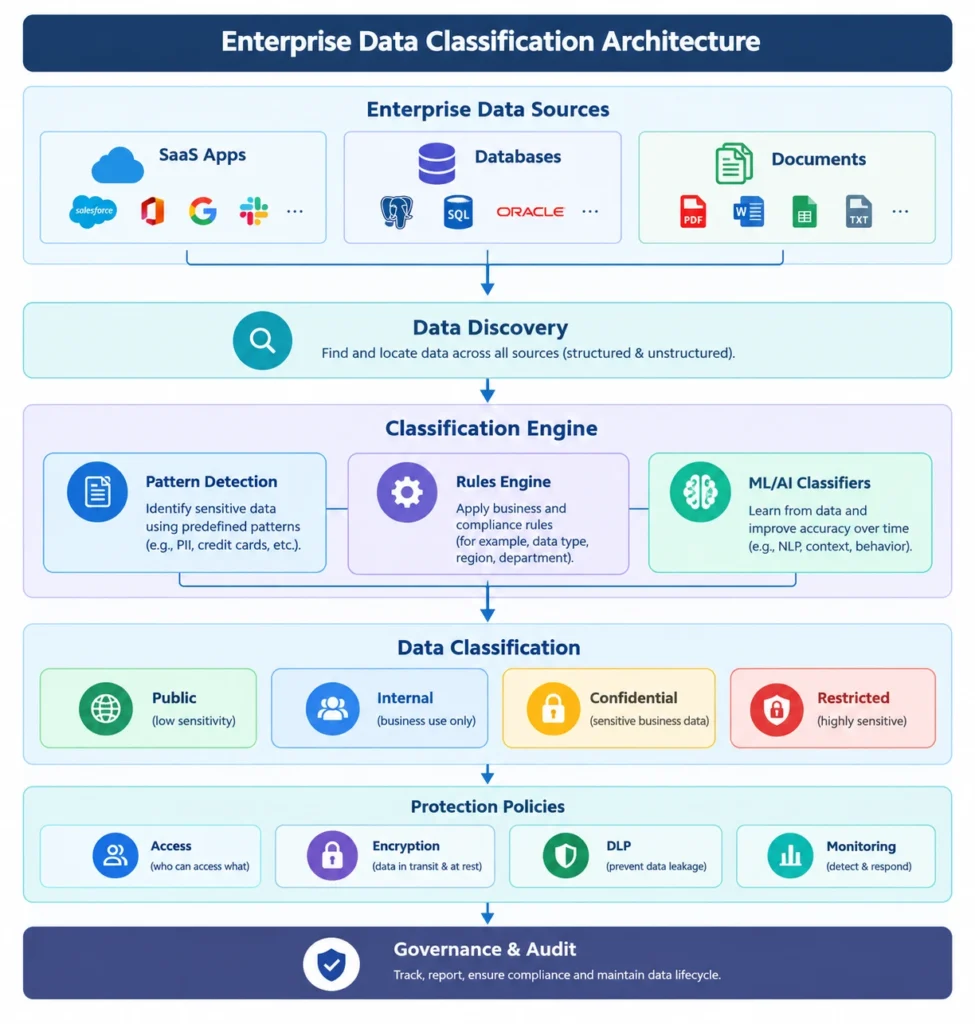
Measuring Data Classification Program Success
A classification program should have measurable outcomes.
Coverage
Percentage of data assets classified
Accuracy
Percentage of classifications validated as correct
Automation
Percentage of classifications automatically detected
False positives
Incorrectly classified data
False negatives
Sensitive data missed by classification
Enforcement
Percentage of classified data with appropriate controls
Compliance
Number of classification-related audit findings
Remediation
Average time to resolve classification violations
Adoption
Percentage of business units using the approved taxonomy
A mature program should track both classification quality and protection outcomes.
Read more on Why Data Pipelines Work in Development but Fail in Production: 6 Gaps to Test
Data Classification KPIs
A governance dashboard could include:
| KPI | Purpose |
|---|---|
| Classification Coverage | How much data is classified |
| Sensitive Data Discovery Rate | How much sensitive data is being found |
| Auto-Classification Rate | Level of automation |
| Classification Accuracy | Quality of labels |
| False Positive Rate | Detection quality |
| False Negative Rate | Missed sensitivity |
| Policy Violations | Enforcement effectiveness |
| Remediation Time | Response efficiency |
| Unclassified Sensitive Assets | Remaining exposure |
| Classification Drift | Governance stability |
This turns data classification into a measurable operating capability rather than an annual compliance exercise.
Data Sensitivity Classification for Enterprise AI
As enterprises deploy RAG systems and AI agents, classification should become part of the AI data-access architecture.
A secure enterprise RAG pipeline should look conceptually like:
User
  │
  ▼
Identity + Authorization
  │
  ▼
Query
  │
  ▼
Retrieval Layer
  │
  ├── Classification Filter
  ├── Access Filter
  └── Data Policy
  │
  ▼
Authorized Context
  │
  ▼
LLM / AI Agent
  │
  ▼
Response Policy
  │
  ▼
User
This prevents a common architecture mistake:
Retrieving information first and checking authorization afterward.
Authorization and sensitivity controls should influence what information can enter the model context in the first place.
This becomes particularly important for:
- Enterprise RAG
- AI copilots
- AI agents
- Data agents
- Internal search
- AI workflow automation
- Multi-agent systems
Read our blog on Essential Design Patterns in Modern Data Pipelines
The Future of Data Sensitivity Classification
Data classification is evolving from manual metadata tagging toward continuous, automated, context-aware data protection.
The progression is:
Manual classification
→ Rule-based classification
→ Automated sensitive-data detection
→ Trainable classifiers
→ Context-aware classification
→ Continuous classification
→ AI-aware data access controls
Microsoft’s current Purview capabilities already combine manual classification, pattern-based detection, and trainable classifiers, while its broader labeling capabilities allow organizations to automatically apply sensitivity labels under defined conditions.
The next stage is not simply:
“Can we classify more data?”
It is:
“Can the security and governance system continuously understand the sensitivity of data and enforce the appropriate controls wherever that data moves?”
That is especially important as data moves across cloud platforms, SaaS applications, analytics platforms, APIs, and AI systems.
Key Takeaways
- Data sensitivity classification determines how business information should be protected and handled based on sensitivity and impact.
- A practical enterprise taxonomy can use Public, Internal, Confidential, and Restricted levels.
- Classification labels are not security controls by themselves.
- Every classification level should map to access, encryption, sharing, DLP, monitoring, and retention requirements.
- Business data owners should determine classification based on context; IT and security teams should implement the controls.
- NIST FIPS 199 provides a complementary impact-based model using confidentiality, integrity, and availability.
- Manual classification alone does not scale across large data estates.
- Pattern matching, automated rules, and trainable classifiers can increase classification coverage.
- Sensitivity labels communicate how data should be handled, while classifications can identify what types of sensitive information are present.
- Classification should be continuously monitored and reassessed as business context changes.
- Data classification should increasingly become part of enterprise AI security, RAG authorization, and agent governance.
- The goal is not simply to label data—it is to connect sensitivity to enforceable protection and measurable governance outcomes.
Conclusion
Data sensitivity classification is the foundation for risk-based data protection.
Without a consistent classification framework, organizations struggle to determine which information requires stronger access controls, encryption, monitoring, retention rules, or restrictions on sharing.
But classification should never become a labeling exercise performed solely for compliance.
The mature model is:
Discover → Classify → Assign Ownership → Map Controls → Automate → Enforce → Monitor → Reassess
The distinction between policy and enforcement is particularly important. The reference implementation guide highlights how organizations can have comprehensive classification policies while still lacking evidence that those policies are technically enforced.
For modern enterprises, the classification program should therefore connect data governance, cybersecurity, privacy, compliance, cloud platforms, analytics, and AI.
NIST’s impact-based approach demonstrates why organizations should consider confidentiality, integrity, and availability rather than focusing exclusively on secrecy.
Meanwhile, modern data-security platforms such as Microsoft Purview demonstrate how classification can increasingly be automated through sensitive-information detection, pattern matching, trainable classifiers, and sensitivity labeling.
For enterprises modernizing their data estate, this creates an important principle:
The value of data classification is not the label itself. The value is what the organization can reliably do because the label exists.
Techment can help enterprises design and implement the broader data governance, data engineering, cloud, Microsoft Fabric, AI security, RAG, and enterprise AI architecture required to turn data classification policies into operational controls.
Frequently Asked Questions
1. What is data sensitivity classification?
Data sensitivity classification is the process of categorizing information based on how sensitive it is and the potential impact of unauthorized disclosure, modification, or loss. Organizations use classification levels to determine appropriate access, encryption, sharing, retention, and monitoring controls.
2. What are the four levels of data classification?
A common four-level enterprise model uses Public, Internal, Confidential, and Restricted. Public data can be openly shared, Internal data is intended for authorized users, Confidential data requires stronger controls, and Restricted data receives the highest level of protection.
3. Why is data classification important?
Data classification helps organizations apply security controls according to risk. It provides a consistent way to determine who can access data, how it can be shared, whether it requires encryption, how long it should be retained, and what monitoring is necessary.
4.What is the difference between data classification and sensitivity labels?
Data classification can identify the type or characteristics of information, while sensitivity labels communicate how the organization should treat the information based on business impact. Microsoft Purview distinguishes classifications from sensitivity labels in this way.
5. Who should classify business data?
Business data owners should generally determine classification because they understand the business context, regulatory obligations, and consequences of data exposure. Data stewards maintain classification quality, while IT and security teams implement technical controls.
6. Can data classification be automated?
Yes. Organizations can use pattern matching, sensitive-information types, rules, exact data matching, document fingerprinting, and trainable classifiers to automate portions of classification. Microsoft Purview supports several of these approaches.
7. How does data classification affect AI and RAG?
Classification can be used as an input to AI authorization and retrieval controls. RAG and AI-agent systems can filter information based on sensitivity and user authorization before sensitive content enters the model context.
Related Reads
- RAG in 2026
- How Context Engineering Reduces AI Hallucinations
- AI Context Engineering: The New Competitive Advantage for Enterprise AI
- RAG vs Fine-Tuning vs AI Agents: Choosing the Right LLM Strategy
- Best Practices for Generative AI Implementation in Business.
- Agentic AI
- Microsoft Fabric Readiness Assessment
- AI, data and analytics trends to rule in 2026
- Enterprise Data Quality Framework: Best Practices for Reliable Analytics and AI
- How to Evaluate Hallucinations, Bias, and Toxicity in Generative AI
- How to Manage AI Agents Across Your Organization: Governance, Security & Best Practices