
A multi-agent claims adjudication system uses specialized AI agents to handle different stages of the claims lifecycle—such as document intake, policy verification, coverage analysis, fraud screening, and decision preparation—while Microsoft Fabric provides the governed data foundation for claims, policy, customer, and historical data. Microsoft Foundry or Microsoft Agent Framework can orchestrate the agents, while Fabric can provide structured enterprise data and analytics.
Insurance claims are difficult to automate because a claim rarely depends on one document or one rule.
A typical claim may involve:
- FNOL information
- Policy and coverage details
- Claim history
- Documents and correspondence
- Repair estimates
- Medical information
- Payment records
- Fraud indicators
- External data
- Adjuster notes
A single AI model can attempt to process all of this, but a specialized multi-agent architecture provides a more controlled approach.
Instead of asking one agent to perform every task, different agents can specialize in:
Intake → Policy → Coverage → Fraud → Assessment → Decision Support
Microsoft has already demonstrated insurance-focused multi-agent patterns combining Azure AI/Fabric capabilities. Its current Marketplace example describes specialized agents for document ingestion, claim structuring, indexing, investigation support, and continuous claim-file preparation, integrated with Microsoft Fabric and enterprise content repositories.
The architecture proposed in this article builds on those capabilities into a practical enterprise reference pattern.
What Is a Multi-Agent Claims Adjudication System?
A multi-agent claims adjudication system is an AI architecture in which multiple specialized agents collaborate to process an insurance claim. Each agent performs a bounded task—such as extracting claim data, validating coverage, checking fraud indicators, or preparing an assessment—while an orchestration layer coordinates execution and a human claims professional retains authority over consequential decisions.
Instead of:
Claim
  ↓
One AI Agent
  ↓
Decision
use:
                     CLAIM
                       ↓
                Orchestrator
                       ↓
       ┌───────────────┼───────────────┐
       ↓               ↓               ↓
  Intake Agent    Policy Agent     Fraud Agent
       ↓               ↓               ↓
       └───────────────┼───────────────┘
                       ↓
                Coverage Agent
                       ↓
             Assessment Agent
                       ↓
             Decision Synthesizer
                       ↓
               Human Adjuster
This separation allows each agent to have a narrower responsibility, clearer tools, and more targeted evaluation.
Microsoft Agent Framework currently supports agents plus explicit workflows for connecting agents and functions through controlled execution paths, including sequential and concurrent patterns.
Why Use Multiple Agents for Claims Adjudication?
Multi-agent architecture is useful for claims when the workflow contains several distinct reasoning and data-access tasks that can be independently controlled, evaluated, and coordinated. Specialized agents can reduce the complexity of a single monolithic agent while making the overall process easier to trace, test, and govern.
Claims processing naturally breaks into specialized functions.
| Claims task | Potential agent |
|---|---|
| Document extraction | Intake Agent |
| Policy lookup | Policy Agent |
| Coverage analysis | Coverage Agent |
| Damage assessment | Assessment Agent |
| Fraud screening | Fraud Agent |
| Claims history | History Agent |
| Settlement preparation | Settlement Agent |
| Final synthesis | Decision Agent |
The objective is not to maximize the number of agents.
If a deterministic function can perform a task reliably, use a function or rules engine instead.
Microsoft’s Agent Framework explicitly recommends using an agent when autonomous reasoning/tool use is needed, while well-defined processes can be implemented as workflows.
Microsoft Fabric’s Role in Claims Adjudication
Microsoft Fabric should primarily serve as the governed data and analytics foundation of the claims architecture rather than as the sole agent runtime. Fabric can provide access to claims, policy, customer, and historical data through OneLake, Lakehouse, Warehouse, semantic models, Eventhouse, and Fabric Data Agents.
A useful separation is:
Microsoft Fabric
      ↓
Enterprise Data + Analytics + Governance

Microsoft Foundry / Agent Framework
      ↓
Agent Runtime + Orchestration + Tools

Claims Applications
      ↓
Workflow + Human Review + Business Actions
Fabric Data Agent can provide conversational access to data in Fabric Lakehouses, Warehouses, Power BI semantic models, KQL databases, ontologies, and Microsoft Graph.
This creates an important architectural distinction:
Fabric provides the trusted data foundation; the agent layer provides reasoning and orchestration.
Read our blog on Microsoft Fabric for Insurance: Reference Architecture
Reference Architecture for Multi-Agent Claims Adjudication
A practical Microsoft-based architecture combines insurance source systems and documents with Microsoft Fabric for governed data, Microsoft Foundry or Agent Framework for agent orchestration, Azure AI services for document intelligence, and enterprise workflow tools for human approval and downstream actions.
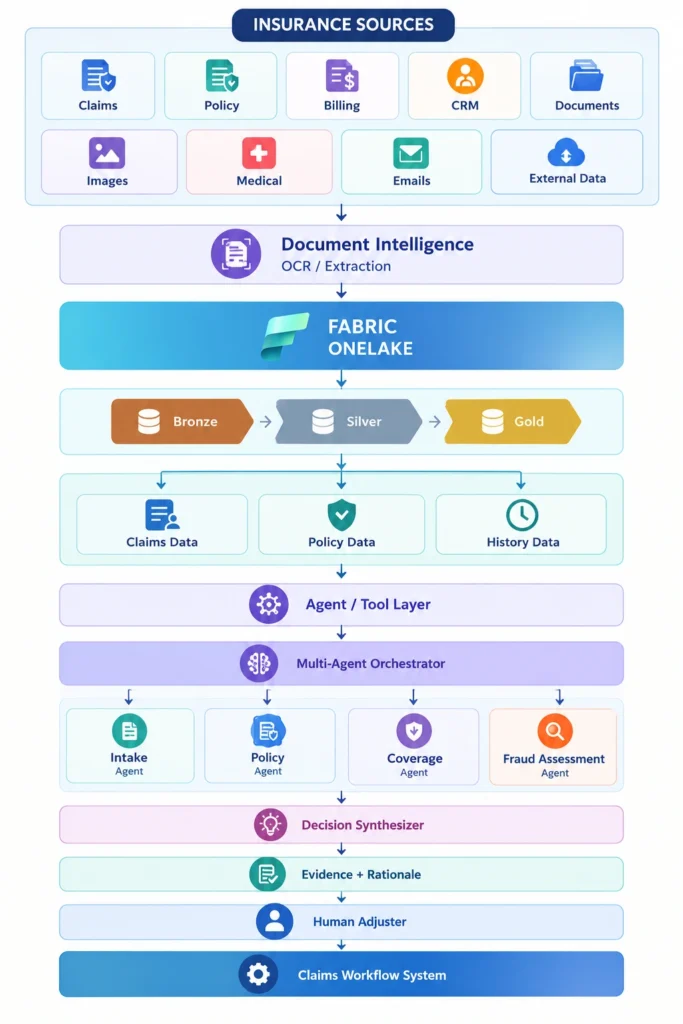
This is a proposed reference architecture, not an official Microsoft reference architecture.
Microsoft’s own claims-processing material demonstrates closely related building blocks, including Foundry agents, document processing, policy matching, coverage validation, evaluation, tracing, and multi-agent orchestration.
Read our blog on Microsoft Fabric Architecture Explained: Complete Enterprise Guide (2026)
The 6 Core Agents in a Claims Adjudication Workflow
1. Claims Intake Agent
The Intake Agent converts incoming claim documents and unstructured submissions into a normalized claim representation. It identifies required information, extracts relevant fields, classifies documents, and flags missing or inconsistent evidence for downstream processing.
Inputs can include:
- FNOL
- Claim forms
- Images
- PDFs
- Emails
- Repair estimates
- Medical documents
Outputs:
Claim ID
Incident Date
Loss Type
Claimant
Policy ID
Damage
Documents
Missing Information
Confidence
Microsoft’s claims-processing reference implementation demonstrates document-processing agents and structured outputs as part of a broader multi-agent workflow.
2. Policy Agent
The Policy Agent identifies the applicable policy and retrieves the relevant coverage, endorsements, limits, deductibles, and exclusions. Its job is evidence retrieval and policy interpretation—not final claim approval.
For example:
“Which policy and endorsement were active on the date of loss?”
The agent can retrieve:
- Policy version
- Effective dates
- Coverage
- Endorsements
- Limits
- Deductibles
- Exclusions
A RAG or enterprise-search layer should provide the supporting policy evidence.
3. Coverage Agent
The Coverage Agent compares claim facts against applicable policy provisions and prepares a structured coverage assessment. It should explicitly identify supporting clauses, exclusions, missing information, and uncertainty rather than simply returning an approve-or-deny answer.
Example output:
Coverage: Potentially Covered
Relevant Clause: Section 4.2
Deductible: $1,000
Exclusion: None identified
Missing Evidence: Repair estimate
Confidence: High
Human Review: Required
This evidence-first design makes the result more useful to adjusters and auditors.
4. Fraud Agent
The Fraud Agent evaluates claims for anomalies and indicators that may require investigation. It should surface evidence and risk signals rather than independently declare fraud, because fraud determinations can carry significant customer, regulatory, and legal consequences.
It can examine:
- Duplicate claims
- Suspicious timing
- Repeated entities
- Inconsistent statements
- Unusual claim amounts
- Historical patterns
- Document anomalies
Fabric can provide historical claims and analytical datasets, while specialized fraud models can provide risk signals.
5. Assessment Agent
The Assessment Agent combines validated claim information, policy coverage, evidence, and risk signals to prepare a structured assessment for the adjuster. It can identify potential severity, missing evidence, inconsistencies, and recommended next steps.
The agent should distinguish:
Fact
“The submitted estimate is $18,400.”
from:
Inference
“The estimated loss appears high relative to comparable claims.”
That distinction improves auditability.
6. Decision Synthesis Agent
The Decision Agent consolidates outputs from the specialist agents and prepares an evidence-backed recommendation such as approve, escalate, request information, or investigate. The final authority should remain with the claims professional according to the insurer’s governance and regulatory requirements.
Example:
Recommendation: Escalate

Reasons:
1. Coverage appears applicable.
2. Claim amount exceeds automated-review threshold.
3. Fraud Agent identified an anomaly.
4. Supporting repair documentation is incomplete.

Required Human Action:
Senior Adjuster Review
This is substantially safer than asking an autonomous agent to make an unexplained final decision.
How Microsoft Fabric Supports the Agents
Fabric can provide the shared data layer that allows agents to work from consistent claims and policy information. Instead of each agent maintaining a separate database, agents can access governed data products through Fabric, reducing duplication and helping establish consistent definitions across the workflow.
A practical data model might include:
Claims
- Claim ID
- Policy ID
- Loss date
- Claim type
- Status
- Amount
- Reserve
- Payment
Policy
- Policy ID
- Customer
- Product
- Coverage
- Limits
- Deductibles
- Endorsements
- Effective dates
Customer
- Customer ID
- Demographics
- Contact information
- Claim history
Evidence
- Document ID
- Claim ID
- Document type
- Source
- Timestamp
- Confidence
- Version
Fabric Data Agents can work over supported Fabric data sources including Lakehouses, Warehouses, Power BI semantic models, KQL databases, and other supported Fabric data artifacts.
Where RAG Fits Into the Architecture
RAG should provide the evidence-retrieval layer for unstructured insurance information such as policy documents, endorsements, correspondence, procedures, and claim attachments. Fabric can provide structured claim and policy data, while a retrieval layer can connect agents to relevant documents and return evidence with provenance.
The combined pattern becomes:
Structured Data
      ↓
Microsoft Fabric
      ↓
Claims / Policy / Customer Facts
      ↓
              ┌─────────────┐
Documents →   │ RAG Search  │
              └──────┬──────┘
                     ↓
             Policy Evidence
                     ↓
              Coverage Agent
                     ↓
             Assessment Agent
This is important because claims adjudication requires both:
structured facts + unstructured evidence.
A Fabric-only architecture does not eliminate the need for document intelligence and retrieval.
Reads our blog on RAG For Insurance
Multi-Agent Orchestration Pattern
Claims workflows should use explicit orchestration for predictable stages and parallelize independent tasks where appropriate. For example, policy verification and fraud screening can often run concurrently after claim extraction, while coverage assessment can wait for policy and claim facts to be available.
A practical workflow is:
Claim Submitted
      ↓
Intake Agent
      ↓
Claim Structured
      ↓
 ┌───────────────┬────────────────┐
 ↓               ↓                ↓
Policy Agent   History Agent   Fraud Agent
 └───────────────┴────────────────┘
                 ↓
          Coverage Agent
                 ↓
         Assessment Agent
                 ↓
        Decision Synthesizer
                 ↓
        ┌────────┴────────┐
        ↓                 ↓
   Low Risk            High Risk
        ↓                 ↓
 Adjuster Review     Specialist Review
Microsoft Agent Framework supports explicit workflow graphs and concurrent execution patterns, which are well suited to this type of orchestration.
Human-in-the-Loop Is a Design Requirement
A multi-agent claims system should automate evidence gathering and preparation before attempting autonomous decision-making. Human approval should remain mandatory for high-value, ambiguous, disputed, legally sensitive, or otherwise high-risk claims.
Define thresholds such as:
Low Risk + Low Value
        ↓
Automated Preparation
        ↓
Standard Review

Medium Risk
        ↓
Senior Adjuster

High Risk / Fraud / Dispute
        ↓
Specialist Investigation
The exact thresholds must be determined by the insurer’s risk and governance framework.
The Microsoft Marketplace’s current agentic claims example explicitly describes keeping adjusters in control of final decisions while agents structure claim information, assess exposure, surface coverage implications, and support investigation.
Security and Governance Architecture
Insurance agents require security controls at the user, agent, tool, data, and action layers. Fabric data permissions, Microsoft identity, agent authorization, tool restrictions, audit trails, and human approval gates should work together so that an agent cannot retrieve or change information outside its permitted scope.
Key controls include:
- Microsoft Entra identity
- RBAC
- Least privilege
- Data-level permissions
- Tool-level permissions
- PII protection
- Network controls
- Audit logging
- Human approval
- Agent versioning
- Prompt-injection defenses
- Evaluation and monitoring
Microsoft Foundry Agent Service currently provides managed agent hosting, tools, model access, observability, Entra identity, RBAC, content filters, and network isolation capabilities.
How to Evaluate a Claims Adjudication Agent
Each agent should be evaluated independently and as part of the complete workflow. A claims system can fail even when individual agents perform well—for example, if the wrong policy is retrieved, one agent misinterprets another agent’s output, or the orchestrator routes a high-risk claim incorrectly.
Evaluate:
| Layer | Key metrics |
|---|---|
| Intake | Extraction accuracy, missing-field detection |
| Policy | Correct policy retrieval, citation accuracy |
| Coverage | Assessment accuracy, evidence grounding |
| Fraud | Precision, recall, false-positive rate |
| Assessment | Completeness, factual accuracy |
| Decision | Recommendation accuracy, escalation accuracy |
| Workflow | Task completion, routing accuracy |
| System | Latency, cost, availability |
| Governance | Auditability, permission violations |
| Safety | Abstention, prompt-injection resilience |
Microsoft’s current claims-processing hackathon materials include continuous evaluation, OpenTelemetry tracing, application monitoring, and policy matching/coverage validation as parts of the production-oriented workflow.
A Production Readiness Checklist
Before deploying a multi-agent claims adjudication system, verify:
Data
- Claims and policy data have defined ownership.
- Policy versions and effective dates are available.
- Claim evidence is traceable to source documents.
- Data quality rules are automated.
Agents
- Every agent has a defined responsibility.
- Agent outputs use structured schemas.
- Agents have only the tools they need.
- Agents can abstain when evidence is insufficient.
Orchestration
- Workflow paths are explicit.
- Parallel tasks have clear dependencies.
- Retries are controlled.
- Failures route to defined recovery paths.
- Human approval gates are implemented.
Security
- Identity is enforced.
- Least privilege is implemented.
- Sensitive data is protected.
- Tool permissions are restricted.
- Agent actions are auditable.
AI quality
- Retrieval is evaluated.
- Agent outputs are evaluated.
- Regression tests exist.
- Prompt injection is tested.
- High-risk claims are escalated.
Operations
- End-to-end tracing exists.
- Model and agent versions are tracked.
- Latency and cost are monitored.
- Failed workflows can be replayed or investigated.
Common Mistakes
The biggest mistakes are creating too many agents, allowing agents unrestricted access to enterprise systems, treating generated recommendations as decisions, and building the AI layer before establishing trusted claims and policy data. Multi-agent architecture should reduce complexity—not create another distributed system that is impossible to govern.
Mistake 1: Too many agents
Create an agent only when specialization adds measurable value.
Mistake 2: One agent controls everything
Use bounded permissions and explicit tools.
Mistake 3: No source evidence
Every material recommendation should be traceable.
Mistake 4: Ignoring policy versions
The wrong policy can produce the wrong adjudication.
Mistake 5: No human escalation
Ambiguous and high-risk claims need defined review paths.
Mistake 6: Evaluating only the final answer
Evaluate retrieval, tool calls, routing, and individual agents.
Mistake 7: Treating Fabric as the agent runtime
Fabric is valuable as the data and analytics foundation; agent orchestration can be provided by Microsoft Agent Framework/Foundry or another appropriate runtime.
Recommended Implementation Roadmap
The safest path is to start with claims intelligence rather than full autonomous adjudication. Build the data foundation first, introduce document and policy agents, add fraud and assessment capabilities, then progressively automate low-risk workflows while retaining human controls for consequential decisions.
Phase 1 — Data foundation
Build:
Claims + Policy + Customer + Evidence
in governed Fabric data products.
Phase 2 — Document intelligence
Add:
- OCR
- Document classification
- Entity extraction
- Evidence indexing
Phase 3 — Specialist agents
Start with:
- Intake Agent
- Policy Agent
- Coverage Agent
Phase 4 — Investigation
Add:
- Fraud Agent
- Claims History Agent
- Assessment Agent
Phase 5 — Decision support
Introduce a Decision Synthesizer with explicit human approval.
Phase 6 — Selective automation
Automate only clearly defined low-risk workflows.
Phase 7 — Continuous evaluation
Monitor:
- Accuracy
- Retrieval
- Escalation
- Cost
- Latency
- Human overrides
- Business outcomes
Key Takeaways
- A multi-agent claims adjudication system divides complex claims work among specialized AI agents.
- Microsoft Fabric can provide the governed data foundation for claims, policy, customer, and historical information.
- Microsoft Foundry and Agent Framework can provide agent runtime and orchestration capabilities.
- RAG should connect agents to policy documents and other unstructured evidence.
- Specialist agents should have narrow responsibilities and controlled tools.
- Policy and coverage agents should provide evidence, not opaque decisions.
- Fraud agents should surface risk indicators rather than independently declare fraud.
- Human review remains essential for high-risk or consequential claims.
- Evaluate both individual agents and the complete workflow.
- Start with assistive claims intelligence, then expand toward controlled automation.
Conclusion
The future of AI-powered claims processing is unlikely to be a single giant claims chatbot.
A more practical enterprise architecture is:
specialized agents + governed insurance data + retrieval + explicit workflows + human oversight.
Microsoft Fabric can provide the data foundation, bringing claims, policy, customer, and historical information into a governed environment. Microsoft Foundry and Agent Framework can provide the agent and workflow layer, while document intelligence and RAG connect the system to unstructured evidence.
The result is not simply faster claims processing.
It can create a more traceable, evidence-driven and controllable adjudication workflow in which every recommendation can be connected to claim facts, policy terms, supporting documents, and the specialist agents that contributed to the assessment.
The key architectural principle is simple:
Let AI agents do the searching, extracting, comparing and preparing. Let governed workflows and qualified claims professionals control consequential decisions.
For insurance carriers moving toward AI-native claims operations, Techment can help design the underlying Microsoft Fabric data architecture, RAG layer, multi-agent workflows, AI governance, observability, and enterprise integration required to move from claims AI experimentation to production.
Frequently Asked Questions
1. What is a multi-agent claims adjudication system?
It is an AI architecture in which multiple specialized agents collaborate to process an insurance claim. Agents can handle intake, policy retrieval, coverage analysis, fraud screening, assessment, and decision preparation.
2. How does Microsoft Fabric support claims adjudication?
Fabric can provide governed access to claims, policy, customer, historical, and analytical data through OneLake and Fabric data services. Fabric Data Agents can also provide conversational access to supported Fabric data sources.
3. Can Microsoft Fabric adjudicate insurance claims by itself?
Fabric is primarily the data and analytics foundation in this architecture. Agent orchestration and workflow execution can be implemented with Microsoft Agent Framework, Foundry Agent Service, or another suitable agent runtime.
4. How many AI agents should a claims system have?
There is no universal number. Create separate agents when tasks require distinct expertise, tools, permissions, or evaluation criteria. Avoid creating agents simply to make the architecture appear more sophisticated.
5. Can AI automatically approve insurance claims?
It can be technically possible for narrowly defined, low-risk workflows, but whether autonomous approval is appropriate depends on the insurer’s regulatory, legal, risk, and governance requirements. High-impact decisions should have appropriate human oversight.
6. Where does RAG fit into claims adjudication?
RAG provides access to unstructured evidence such as policy documents, endorsements, correspondence, procedures, and claim attachments. It complements structured claims and policy data held in Fabric.
7. How do you evaluate AI agents for claims?
Evaluate extraction accuracy, policy retrieval, coverage assessment, fraud detection, tool usage, routing, task completion, groundedness, escalation accuracy, latency, cost, security, and auditability.
Related Reads
- What Is Microsoft Fabric? A Comprehensive Overview for Enterprise Leaders
- Microsoft Fabric vs Snowflake: A Data Management Showdown
- AI-Ready Enterprise Checklist with Microsoft Fabric
- RAG in 2026: How Retrieval-Augmented Generation Works for Enterprise AI
- RAG architectures
- Agentic AI Use Cases: 7 Enterprise Examples Driving Autonomous Operations
- Enterprise AI Strategy in 2026: A Practical Guide for CIOs and Data Leaders
- Is Your Enterprise AI-Ready? Explore our A Fabric-Focused Readiness Checklist
- RAG vs Knowledge Graphs: Which Performs Better for Enterprise AI?