
Eval-Driven Development (EDD) is an emerging software engineering practice in which evaluations—or evals—are defined early and continuously used to specify expected AI behavior, measure system quality, detect regressions, and guide development. Instead of asking whether an AI application “looks good,” engineering teams define measurable expectations and iterate until the system consistently meets them.
The practice is becoming increasingly important because AI applications are probabilistic, context-dependent, and capable of changing behavior when prompts, models, retrieval data, tools, or orchestration logic change.
OpenAI describes evals as structured tests for measuring model and application performance and explicitly recommends adopting eval-driven development: evaluate early and often, use task-specific evaluations, log behavior, automate scoring where possible, and continuously improve the evaluation suite.
Microsoft similarly positions evaluation across the AI application lifecycle—from model selection and pre-production testing through continuous production monitoring—with evaluators for quality, groundedness, relevance, safety, tool usage, and task completion.
For enterprise AI teams, EDD is therefore less about replacing software testing and more about adding a behavioral quality layer that traditional deterministic tests cannot fully provide
TL;DR
Eval-Driven Development is an AI engineering practice where teams define evaluations before or alongside implementation and use them continuously to determine whether an AI system behaves as intended.
The EDD loop is:
Specify → Build → Evaluate → Analyze → Improve → Repeat
Traditional tests remain essential for deterministic code.
Evals add another layer for questions such as:
- Is the answer factually correct?
- Is the response grounded in retrieved evidence?
- Did the agent use the correct tool?
- Did it complete the requested task?
- Did it follow business rules?
- Did it refuse when appropriate?
- Is the response relevant and complete?
- Did a model or prompt change introduce regressions?
- Does the system remain reliable against production-like inputs?
The goal is not simply a higher eval score.
The goal is measurable, repeatable, continuously improving AI behavior.
What Is Eval-Driven Development?
Eval-Driven Development is an emerging AI engineering practice in which evaluation criteria become an executable specification for AI behavior. Teams define representative scenarios, expected outcomes, scoring criteria, and acceptance thresholds early in development, then repeatedly run those evaluations as prompts, models, retrieval systems, tools, and application logic evolve.
The core idea is simple:
Do not build an AI application and evaluate it at the end. Build the evaluation system alongside the application.
Traditional software development often follows:
Requirements → Code → Tests → Release
EDD extends this for AI systems:
Behavioral requirements → Evals → AI implementation → Evaluation → Error analysis → Improvement
A useful mental model is:
                AI Requirements
                      |
                      ▼
               Define Evals
                      |
                      ▼
                 Build AI
                      |
                      ▼
              Run Evaluations
                      |
          +-----------+-----------+
          |                       |
        Pass                    Fail
          |                       |
          ▼                       ▼
       Release              Analyze Failure
                                  |
                                  ▼
                           Improve System
                                  |
                                  └──────► Run Evals Again
This approach is closely related to test-driven and behavior-driven development, but the object being evaluated is different.
OpenAI explicitly compares eval development with behavior-driven development and recommends evaluating early and often rather than waiting until deployment.
Why Traditional Software Testing Is Not Enough for AI Applications
Traditional software tests are extremely effective when expected behavior can be expressed deterministically.
For example:
assert calculate_tax(1000) == 100The output is expected to be exact.
But an AI application may produce:
“Based on the information provided, the customer appears eligible for the requested service.”
There may be multiple acceptable ways to express the correct answer.
A traditional string comparison may incorrectly classify a valid response as a failure.
At the same time, an answer can be grammatically perfect but factually wrong.
This creates a different testing problem.
Traditional software asks:
Did the function return the expected value?
AI engineering must also ask:
Did the system behave appropriately for this situation?
That can require evaluating:
- Semantic correctness
- Factuality
- Groundedness
- Relevance
- Completeness
- Safety
- Instruction adherence
- Tool selection
- Tool parameters
- Task completion
- Refusal behavior
- Consistency
- Business-rule compliance
Microsoft’s current evaluation framework explicitly separates system-level agent evaluation from process-level evaluation, including task completion, task adherence, tool selection, tool-call accuracy, tool-input accuracy, and tool-output utilization.
Read our blog on How to Test LLM Applications for Accuracy & Safety
Eval-Driven Development vs Test-Driven Development
EDD should not be positioned as the replacement for TDD.
It is better understood as an additional engineering layer for probabilistic behavior.
| Dimension | TDD | Eval-Driven Development |
|---|---|---|
| Primary target | Deterministic code | AI behavior |
| Expected output | Often exact | Often variable |
| Assertion | Usually binary | Binary, graded, or rubric-based |
| Typical tests | Unit/integration | Scenario, behavioral, quality, safety |
| Main signal | Pass/fail | Score, threshold, pass/fail, explanation |
| Test data | Fixtures | Curated + production-like datasets |
| Human judgment | Usually limited | Often important |
| LLM judge | Rare | Common for some criteria |
| Regression testing | Yes | Yes |
| Production evaluation | Optional by system | Essential for evolving AI |
| Error analysis | Debug code | Analyze behavior + context |
| Main challenge | Code correctness | Behavioral variability |
The important point is:
Use deterministic tests where behavior is deterministic and evals where quality is probabilistic.
A production AI application should generally have both.
Evals, Benchmarks and Tests Are Not the Same
One of the most important concepts in EDD is distinguishing benchmarks, tests, and application-specific evaluations.
Benchmarks
Benchmarks measure general model capabilities using standardized datasets.
Examples can include:
- General reasoning
- Coding
- Mathematical reasoning
- Knowledge
- Language understanding
Benchmarks help answer:
How does this model perform on a standardized task?
Tests
Tests verify specific technical behavior.
Examples:
- API returns HTTP 200
- Database transaction commits
- JSON conforms to schema
- Function returns expected value
Evals
Application-specific evals answer:
Does this AI system perform our business task correctly?
For example:
Customer-support AI
- Correctly identifies intent
- Retrieves the correct policy
- Provides accurate response
- Does not invent policy terms
- Escalates prohibited requests
- Maintains tone
- Completes the workflow
OpenAI distinguishes application-specific evals from general model benchmarks and recommends designing evaluations around real-world task distributions.
The Core Eval-Driven Development Loop
EDD can be implemented as a continuous engineering loop:
1. Specify
Define what good behavior means.
2. Build
Implement the AI application.
3. Evaluate
Run representative scenarios.
4. Analyze
Understand failures and their causes.
5. Improve
Change prompts, retrieval, tools, models, code, data, or policies.
6. Re-evaluate
Confirm that the change improved the target without introducing regressions.
         ┌───────────────┐
         │   Specify     │
         └───────┬───────┘
                 ▼
         ┌───────────────┐
         │     Build     │
         └───────┬───────┘
                 ▼
         ┌───────────────┐
         │   Evaluate    │
         └───────┬───────┘
                 ▼
         ┌───────────────┐
         │ Analyze Error │
         └───────┬───────┘
                 ▼
         ┌───────────────┐
         │    Improve    │
         └───────┬───────┘
                 │
                 └──────────────► Evaluate Again
OpenAI describes the broader eval process as Specify → Measure → Improve, emphasizing that evaluations should be tied to business objectives and continue after launch.
Step 1: Specify What “Good” Means
The hardest part of EDD is often not building the evaluator.
It is defining the expected behavior.
Consider an enterprise claims assistant.
A weak requirement is:
“The AI should provide accurate answers.”
A stronger specification is:
“For policy-coverage questions, the system must identify the applicable policy version, cite the relevant policy evidence, distinguish coverage facts from inference, avoid making a final claim decision, and escalate ambiguous cases.”
Now the requirement can become measurable.
Example eval specification
| Requirement | Evaluation |
|---|---|
| Correct policy | Policy identification accuracy |
| Correct evidence | Retrieval precision / relevance |
| Grounded answer | Groundedness |
| No unsupported claims | Hallucination / factuality check |
| Correct escalation | Escalation accuracy |
| Business-rule compliance | Custom rubric |
| Complete response | Completeness |
| Safe behavior | Safety evaluator |
This converts an abstract product requirement into an engineering artifact.
OpenAI notes that contextual evals help turn fuzzy goals into explicit expectations for specific workflows and business environments.
Step 2: Build an Evaluation Dataset
An evaluation dataset is the collection of scenarios against which the AI system will be tested.
A good dataset should not consist only of easy examples.
Include:
Normal cases
Typical user requests.
Edge cases
Unusual but valid scenarios.
Failure cases
Examples where previous versions failed.
Adversarial cases
Inputs designed to expose weaknesses.
Ambiguous cases
Requests where the correct behavior may be clarification or escalation.
Safety cases
Inputs involving sensitive or prohibited behavior.
Production-derived cases
Representative examples from real usage, appropriately protected and governed.
Microsoft recommends considering real-world, synthetic, and adversarial data when designing evaluations.
For teams implementing automated evaluation, Microsoft Learn: Evaluate generative AI applications provides guidance on evaluating generative AI applications using quality and safety metrics, custom evaluators, and representative datasets.
How Large Should an Eval Dataset Be?
There is no universal number.
The correct size depends on:
- Use-case complexity
- Failure frequency
- Risk level
- Number of behaviors being evaluated
- Diversity of production traffic
- Cost of evaluation
- Statistical confidence requirements
A better approach is to build a dataset that covers the important behavioral surface area.
For example:
100 Core Scenarios
+ 50 Edge Cases
+ 50 Historical Failures
+ 25 Adversarial Cases
+ 25 Safety Cases
-------------------
250 Evaluation Cases
This is an illustrative structure—not a universal recommendation.
As production usage grows, the dataset should evolve.
A valuable failure should become a permanent regression case.
Step 3: Choose the Right Evaluators
Not every AI behavior should be evaluated with an LLM judge.
A mature EDD system uses multiple evaluator types.
1. Deterministic Evaluators
Use exact rules where possible.
Examples:
- JSON schema validation
- Required fields
- Exact classification
- Numeric thresholds
- SQL result comparison
- API status
- Tool call parameters
These are generally cheap and highly reproducible.
2. Reference-Based Evaluators
Compare output with an expected answer or reference.
Useful for:
- Classification
- Structured extraction
- Known answers
- Code generation
- SQL generation
3. LLM-as-Judge Evaluators
An evaluator model scores another model’s output against a rubric.
Useful for:
- Relevance
- Coherence
- Completeness
- Tone
- Groundedness
- Instruction adherence
But the evaluator itself must be validated.
Microsoft’s evaluator framework includes general-purpose evaluators such as coherence and fluency and domain-specific evaluators for RAG and agent workflows.
4. Human Evaluation
Human experts remain important for:
- High-risk decisions
- Ambiguous outputs
- Evaluator calibration
- New failure modes
- Regulatory or domain-sensitive workflows
OpenAI explicitly recommends keeping domain experts involved in auditing LLM graders and reviewing system behavior.
A Practical Evaluation Stack
A production AI application might use:
                    AI Output
                       |
          ┌────────────┼────────────┐
          ▼            ▼            ▼
    Deterministic   Reference     LLM Judge
       Checks         Checks        Evals
          |            |            |
          └────────────┼────────────┘
                       ▼
                 Human Review
                       |
                       ▼
               Release Decision
The strongest systems do not ask:
“Which evaluator should we use?”
They ask:
“Which evaluator is appropriate for each requirement?”
Evaluating RAG Applications
RAG systems introduce additional evaluation layers because the final answer depends on retrieval as well as generation.
A RAG system can fail even when the underlying model is capable.
For example:
User Question
      ↓
Retriever
      ↓
Wrong Document
      ↓
LLM
      ↓
Plausible Answer
The output may sound correct but be unsupported.
Therefore, evaluate:
Retrieval
- Retrieval relevance
- Context precision
- Context coverage
- Correct document
- Correct chunk
- Ranking quality
Generation
- Groundedness
- Answer relevance
- Completeness
- Citation accuracy
- Factual correctness
Microsoft’s current evaluator guidance explicitly recommends combining retrieval, groundedness, relevance, and content-safety evaluators for RAG applications.
Evaluating AI Agents
Agent evaluation is more complex because the system is not simply generating text.
An agent may:
- Interpret the request
- Decide which tool to use
- Call the tool
- Read the result
- Decide what to do next
- Call another tool
- Produce a final answer
- Trigger a business action
Therefore:
Evaluate both the outcome and the process.
Microsoft’s agent evaluation guidance explicitly distinguishes system evaluation from process evaluation. System evaluation covers outcomes such as task completion and intent resolution, while process evaluation examines tool selection, tool-call accuracy, tool inputs, tool outputs, and tool-call success.
Agent evaluation matrix
| Layer | Example Metric |
|---|---|
| Intent | Intent resolution |
| Planning | Task adherence |
| Tool choice | Tool selection accuracy |
| Tool parameters | Tool input accuracy |
| Execution | Tool-call success |
| Evidence | Tool output utilization |
| Outcome | Task completion |
| Response | Relevance |
| Safety | Safety score |
| Efficiency | Navigation / step efficiency |
This is particularly important for multi-agent systems.
A final answer can be correct even when the agent takes an unnecessarily expensive or risky path.
Evaluating Multi-Agent AI Systems
Multi-agent systems introduce another dimension:
Which agent should do what?
Consider:
                 Orchestrator
                     |
        +------------+------------+
        |            |            |
        ▼            ▼            ▼
    Research       Policy       Fraud
      Agent        Agent        Agent
        |            |            |
        +------------+------------+
                     |
                     ▼
              Decision Agent
EDD should evaluate:
- Agent routing
- Handoff correctness
- Tool usage
- Inter-agent context
- State management
- Final synthesis
- Failure recovery
- Escalation behavior
A useful principle is:
Evaluate each important component independently, then evaluate the complete workflow end to end.
Evaluation Metrics That Matter
There is no universal AI quality metric.
The correct metrics depend on the application.
Quality Metrics
- Accuracy
- Relevance
- Completeness
- Groundedness
- Coherence
- Factuality
Safety Metrics
- Unsafe output rate
- Policy violations
- Prompt-injection resistance
- Sensitive-data leakage
- Harmful-response rate
- Appropriate refusal rate
Agent Metrics
- Task completion
- Tool-call accuracy
- Tool selection
- Tool input accuracy
- Tool output utilization
- Navigation efficiency
Operational Metrics
- Latency
- Token usage
- Cost per request
- Failure rate
- Retry rate
- Timeout rate
Business Metrics
- Resolution rate
- Escalation rate
- Customer satisfaction
- Conversion
- Claims cycle time
- Analyst productivity
- Cost per transaction
The most important principle:
AI quality metrics should connect to the business outcome the AI system is supposed to improve.
Why a Single “AI Accuracy Score” Is Dangerous
Suppose an application reports:
Overall AI Accuracy = 92%
That number may hide critical failures.
Consider:
| Dimension | Score |
|---|---|
| Factual correctness | 96% |
| Groundedness | 94% |
| Task completion | 91% |
| Safety | 99% |
| Tool accuracy | 78% |
| Escalation accuracy | 65% |
The overall average could still appear acceptable.
But an escalation accuracy of 65% may be unacceptable in a high-risk workflow.
Therefore:
Do not optimize a single aggregate score when different failure modes have different business consequences.
Use a multidimensional quality profile.
Setting Eval Thresholds
An evaluation becomes useful when it has a decision threshold.
For example:
Groundedness       ≥ 0.95
Task Completion    ≥ 0.90
Safety             ≥ 0.99
Tool Accuracy      ≥ 0.95
Critical Errors    = 0
These numbers are illustrative.
Production thresholds should be determined by:
- Business risk
- Regulatory requirements
- Historical performance
- Human review capacity
- Cost of failure
- Customer impact
A high-risk financial or healthcare workflow should generally have different release criteria from an internal brainstorming assistant.
Evals in CI/CD
EDD becomes a true engineering practice when evaluations are integrated into the software delivery lifecycle.
A typical pipeline can look like:
Developer Change
      |
      ▼
Unit Tests
      |
      ▼
Integration Tests
      |
      ▼
AI Eval Suite
      |
      ├── Quality
      ├── Safety
      ├── RAG
      ├── Agent
      └── Business Rules
      |
      ▼
Threshold Check
      |
   +--+--+
   |     |
 PASS   FAIL
   |     |
   ▼     ▼
Deploy  Block
For example:
A prompt update improves answer relevance from 91% to 94% but reduces groundedness from 97% to 91%.
The deployment should not automatically proceed simply because one metric improved.
This is where EDD changes engineering behavior.
Teams compare quality trade-offs across versions instead of relying on subjective review.
Microsoft documents evaluation approaches that can be integrated into development workflows and used to compare versions and establish acceptance thresholds.
EDD for Prompt Engineering
Prompt changes should be treated like code changes.
A prompt modification can affect:
- Accuracy
- Tone
- Safety
- Tool usage
- Output structure
- Retrieval behavior
- Token consumption
Instead of:
“The new prompt seems better.”
Use:
“The new prompt improved task completion by 3.2 percentage points without degrading safety or groundedness.”
This makes prompt engineering measurable.
Recommended workflow
Prompt v1
   ↓
Run Eval Suite
   ↓
Baseline
   ↓
Prompt v2
   ↓
Run Same Eval Suite
   ↓
Compare Metrics
   ↓
Accept / Reject
This also makes prompt changes reproducible and reviewable.
EDD for Model Upgrades
Model upgrades are another major source of regression.
A newer model may:
- Improve reasoning
- Improve coding
- Reduce latency
- Increase cost
- Change response style
- Alter tool usage
- Behave differently on edge cases
Therefore, model upgrades should be treated as controlled experiments.
Model upgrade gate
Current Model
      |
      ▼
Baseline Eval
      |
      ▼
Candidate Model
      |
      ▼
Same Eval Dataset
      |
      ▼
Compare
 ┌────┼─────┐
 ▼    ▼     ▼
Quality Cost Safety
 └────┼─────┘
      ▼
Release Decision
OpenAI’s current guidance emphasizes using evaluations when changing models and measuring performance against application-specific expectations.
EDD for RAG Changes
RAG systems can regress when:
- Documents change
- Chunking changes
- Embeddings change
- Retrieval parameters change
- Ranking changes
- Metadata filters change
- Indexes change
- Prompt templates change
A production RAG evaluation suite should therefore test both:
Retrieval quality
and
Answer quality
Example
Question
   ↓
Retriever
   ↓
Top-K Documents
   ↓
Context Evaluation
   ↓
LLM
   ↓
Answer Evaluation
This makes it possible to determine whether a failure originated in:
Retrieval → Context → Generation
rather than simply reporting:
“The answer was wrong.”
EDD for AI Coding Agents
AI coding agents create an especially strong case for EDD.
Traditional software tests can verify whether generated code compiles or passes existing tests.
But an enterprise coding agent may also need to:
- Follow architecture standards
- Modify only authorized files
- Avoid introducing vulnerabilities
- Preserve API contracts
- Follow coding conventions
- Update documentation
- Write appropriate tests
- Avoid unnecessary dependencies
These behaviors can require evaluation beyond compilation and unit tests.
A useful coding-agent evaluation could include:
| Requirement | Evaluation |
|---|---|
| Tests pass | Deterministic |
| Build succeeds | Deterministic |
| API unchanged | Contract test |
| Security | Static/security analysis |
| Architecture compliance | Rule-based + review |
| Documentation | Rubric |
| Change scope | Diff analysis |
| Task completion | Agent evaluator |
This creates an important distinction:
Code correctness is necessary, but it is not the complete definition of AI coding-agent quality.
EDD and Observability: Different but Connected
Evaluation and observability solve related but different problems.
Observability asks:
What is happening inside the system?
It captures:
- Logs
- Traces
- Inputs
- Outputs
- Tool calls
- Latency
- Errors
- Tokens
- Model versions
Evaluation asks:
Is the system behaving well?
It produces:
- Quality scores
- Safety scores
- Groundedness
- Task completion
- Tool accuracy
- Business metrics
Together
              AI Application
                    |
        +-----------+-----------+
        |                       |
        ▼                       ▼
   Observability            Evaluations
        |                       |
   Logs / Traces            Quality Scores
        |                       |
        +-----------+-----------+
                    |
                    ▼
               Error Analysis
                    |
                    ▼
             System Improvement
Microsoft explicitly connects evaluation, monitoring, tracing, and lifecycle observability as complementary capabilities for production AI systems.
Production EDD: Evaluation Does Not Stop at Deployment
One of the biggest mistakes is treating evaluation as a pre-launch activity.
AI applications can change after deployment because:
- User behavior changes
- Retrieval data changes
- Documents change
- Models are upgraded
- Prompts evolve
- Tool APIs change
- External systems change
- New failure modes appear
Therefore:
Pre-production evals + production monitoring + continuous evaluation
should form a single quality loop.
Microsoft’s current guidance describes three lifecycle stages: model selection, pre-production evaluation, and post-production monitoring, including continuous or scheduled evaluation of production behavior.
Turning Production Failures Into Regression Evals
This is one of the highest-value practices in EDD.
Suppose a customer reports:
“The assistant told me my policy covered an excluded event.”
Do not simply fix the prompt.
Convert the incident into an evaluation case.
Production Failure
       ↓
Root Cause Analysis
       ↓
Create Regression Case
       ↓
Add to Eval Dataset
       ↓
Fix System
       ↓
Run Full Eval Suite
       ↓
Deploy
       ↓
Monitor
Over time, the evaluation suite becomes an institutional memory of the AI system’s failures.
This is a major advantage over ad hoc testing.
The Eval Suite as an Executable Specification
Traditional software teams store:
- Requirements
- Code
- Tests
- Documentation
AI teams should increasingly store:
- Behavioral requirements
- Evaluation datasets
- Rubrics
- Graders
- Thresholds
- Failure cases
- Evaluation results
The result is an executable behavioral specification.
Business Requirement
        ↓
Behavioral Requirement
        ↓
Evaluation Case
        ↓
Evaluator
        ↓
Acceptance Threshold
        ↓
CI/CD Gate
This makes AI behavior more reviewable and governable.
The concept is particularly valuable because AI behavior is difficult to describe completely through implementation details alone.
OpenAI’s current work on Model Spec Evals similarly illustrates how explicit behavioral expectations can be represented and evaluated systematically.
How to Build an Eval-Driven Development Framework
A practical enterprise EDD framework can be implemented in eight stages.
Stage 1: Define Business Outcomes
Start with:
What is the AI system supposed to accomplish?
Not:
Which model are we using?
Stage 2: Identify Critical Behaviors
Document:
- Correctness
- Safety
- Grounding
- Task completion
- Escalation
- Tool usage
- Business rules
Stage 3: Build the Evaluation Dataset
Combine:
- Golden cases
- Real examples
- Synthetic cases
- Edge cases
- Adversarial cases
- Historical failures
Stage 4: Select Evaluators
Use:
- Deterministic checks
- Reference comparisons
- LLM graders
- Human review
Stage 5: Establish Baselines
Run the current implementation and record:
- Quality
- Safety
- Cost
- Latency
- Task success
Stage 6: Integrate Evals Into CI/CD
Run evaluation suites whenever significant changes occur:
- Prompt
- Model
- Retrieval
- Agent
- Tool
- Data
- Orchestration
Stage 7: Analyze Failures
Classify failures.
For example:
100 Failures
│
├── 32 Retrieval
├── 24 Prompt
├── 18 Model
├── 11 Tool Usage
├── 9 Data Quality
└── 6 Safety
Now engineering knows where to focus.
Stage 8: Continuously Expand the Eval Suite
Every meaningful production failure should become a candidate regression case.
This creates a continuous evaluation flywheel.
A Practical Enterprise EDD Architecture
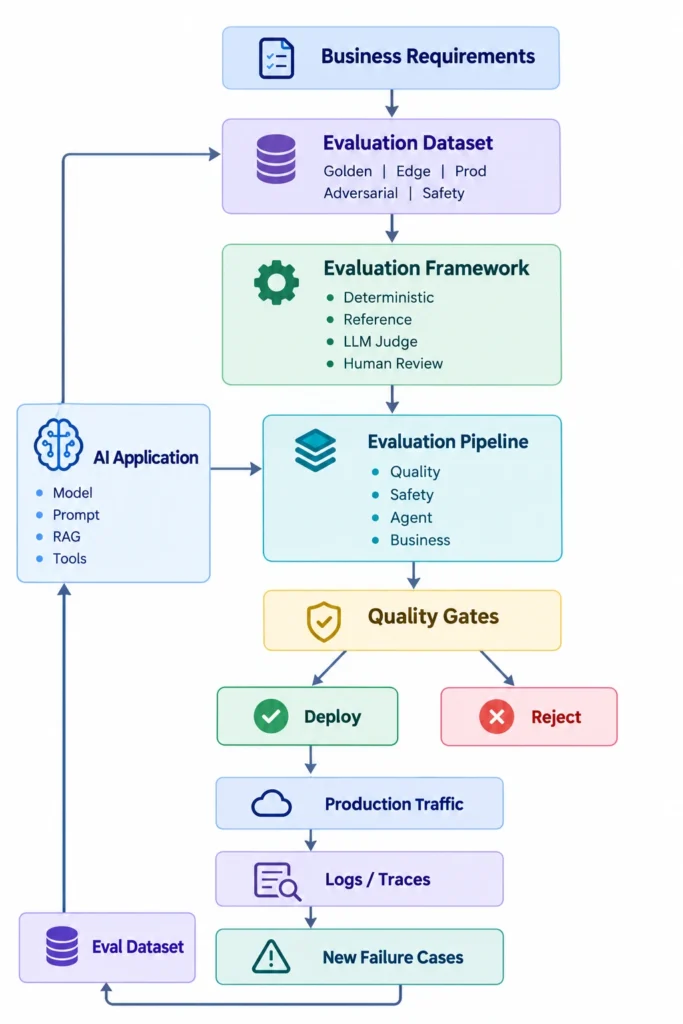
Common Eval-Driven Development Mistakes
1. Evaluating Too Late
Waiting until production means failures become customer incidents.
Better: Start with evals during design.
2. Testing Only Happy Paths
AI systems often fail at boundaries.
Better: Include edge, ambiguous, adversarial, and historical failure cases.
3. Using Only LLM-as-Judge
LLM judges can introduce their own errors and biases.
Better: Combine deterministic, reference-based, LLM-based, and human evaluation.
4. Optimizing One Score
A high average score can conceal critical failures.
Better: Track separate quality dimensions and critical-error gates.
5. Using Generic Benchmarks
A model can perform well on a benchmark and still fail your enterprise workflow.
Better: Build contextual evaluations around your actual task.
OpenAI specifically recommends task-specific evals that reflect real-world distributions rather than relying only on generic metrics.
6. Never Updating the Dataset
A static eval suite eventually becomes predictable and incomplete.
Better: Continuously add production failures and newly discovered edge cases.
7. Ignoring the Evaluator
A flawed evaluator can produce false confidence.
Better: Calibrate evaluators against expert human judgment.
8. Evaluating Only the Final Answer
This is especially dangerous for agents.
Better: Evaluate both the final outcome and the process that produced it.
9. Ignoring Cost and Latency
An AI system can improve quality while becoming economically impractical.
Better: Track quality, cost, latency, and reliability together.
10. Treating Evals as a One-Time Benchmark
EDD is a development discipline, not a benchmark report.
Better: Make evaluation continuous.
EDD Quality Gates for Enterprise AI
A useful enterprise release gate can look like this:
| Quality Gate | Example Requirement |
|---|---|
| Functional tests | 100% pass |
| Critical safety cases | 100% pass |
| Groundedness | Above approved threshold |
| Task completion | Above approved threshold |
| Tool accuracy | Above approved threshold |
| Regression cases | No critical regression |
| Cost | Within budget |
| Latency | Within SLA |
| Human review | Required for high-risk workflows |
| Auditability | Required |
The exact thresholds should be determined by the application’s risk profile rather than copied from another system.
EDD Maturity Model
Organizations can assess their maturity across five levels.
| Level | Description |
|---|---|
| Level 1 — Vibe-Based | Manual testing and subjective judgment |
| Level 2 — Basic Evals | Small curated evaluation dataset |
| Level 3 — Automated Evals | Repeatable automated evaluation pipeline |
| Level 4 — Continuous Evals | CI/CD + production evaluation + regression datasets |
| Level 5 — Adaptive EDD | Continuous evaluation, automated failure mining, risk-based gates, business metrics |
Level 1: “It Looks Good”
Developers manually test a few prompts.
Level 2: “We Have a Test Set”
A small evaluation dataset exists.
Level 3: “Evals Run Automatically”
Evals run as part of development.
Level 4: “Production Feeds Development”
Real failures become new evaluation cases.
Level 5: “Quality Is an Engineering Control”
Evaluation becomes part of release governance and product operations.
When Should Enterprises Adopt Eval-Driven Development
EDD becomes especially valuable when AI systems have meaningful business consequences.
Strong candidates include:
- Customer service agents
- Insurance claims AI
- Financial assistants
- Healthcare applications
- Enterprise RAG
- AI coding agents
- Document processing
- AI workflow automation
- Autonomous agents
- Multi-agent systems
- Decision-support applications
For low-risk experimentation, lightweight manual evaluation may be enough.
For production systems, especially those involving sensitive data or consequential decisions, systematic evaluation becomes much more important.
NIST’s AI Risk Management Framework emphasizes testing, evaluation, verification, and validation as part of operationalizing trustworthy AI risk management.
Read our blog on AI Agent Platform Evaluation: Enterprise Buyer’s Checklist
Eval-Driven Development and AI Governance
EDD also creates a bridge between engineering and AI governance.
Governance teams often ask:
- What does the AI system need to do?
- What could go wrong?
- How do you know it works?
- How is safety measured?
- What happens when performance degrades?
- How are changes validated?
- What evidence exists for release decisions?
An evaluation framework can provide evidence for these questions.
Governance artifact
AI Use Case
    ↓
Risk Classification
    ↓
Behavioral Requirements
    ↓
Evaluation Dataset
    ↓
Metrics + Thresholds
    ↓
Evaluation Results
    ↓
Release Decision
    ↓
Production Monitoring
    ↓
Periodic Re-evaluation
This creates a measurable connection between AI engineering, risk management, and enterprise governance.
What Eval-Driven Development Means for AI Engineering Teams
EDD changes the role of an AI engineer.
The engineer is no longer responsible only for:
- Prompt design
- Model selection
- RAG implementation
- Tool integration
- Application code
They also need to think about:
- Behavioral specifications
- Evaluation data
- Failure taxonomy
- Quality metrics
- Release thresholds
- Regression prevention
- Production feedback
This is why EDD should be viewed as an engineering practice, not simply an evaluation tool.
The Future of Eval-Driven Development
As AI systems become more agentic, evaluations will increasingly move from evaluating isolated model responses to evaluating complete system behavior.
The evolution is likely to look like:
Model Evaluation
→ Does the model produce a good response?
Application Evaluation
→ Does the application solve the task?
Agent Evaluation
→ Does the agent reason, use tools, and complete the task correctly?
Workflow Evaluation
→ Does the complete AI workflow achieve the desired business outcome?
Production Evaluation
→ Does the system continue to perform reliably with real users and changing conditions?
OpenAI’s recent evaluation work reflects this shift toward contextual evaluations and deployment-like assessment, while Microsoft’s agent evaluation framework similarly evaluates both end-to-end outcomes and intermediate tool-use processes.
The long-term opportunity is to make AI quality as measurable and continuously managed as software reliability.
An Enterprise Eval-Driven Development Checklist
Before deploying an AI application, ask:
Requirements
- Is the desired AI behavior explicitly defined?
- Are business outcomes measurable?
- Are high-risk behaviors identified?
Evaluation Data
- Do we have representative scenarios?
- Are edge cases included?
- Are adversarial cases included?
- Are historical failures included?
- Is production data appropriately governed?
Evaluators
- Are deterministic checks used where possible?
- Are LLM judges validated?
- Are human reviewers involved where needed?
- Are safety-specific evaluators included?
Engineering
- Do evals run during development?
- Do model changes trigger evaluation?
- Do prompt changes trigger evaluation?
- Do RAG changes trigger evaluation?
- Do agent/tool changes trigger evaluation?
Production
- Are AI outputs observable?
- Is production quality evaluated?
- Are regressions detected?
- Are failures converted into new eval cases?
Governance
- Are thresholds documented?
- Are evaluation results retained?
- Are release decisions auditable?
- Are high-risk actions subject to human oversight?
Key Takeaways
- Eval-Driven Development is an emerging engineering practice for building reliable AI applications by making evaluations part of development rather than an afterthought.
- EDD complements rather than replaces unit, integration, security, and performance testing.
- The fundamental loop is Specify → Build → Evaluate → Analyze → Improve.
- Application-specific evals are more useful for enterprise AI than relying exclusively on generic model benchmarks.
- Evaluation datasets should contain normal, edge, adversarial, safety, and production-derived scenarios.
- Deterministic checks should be used wherever behavior can be evaluated deterministically.
- LLM-as-judge evaluation can scale quality assessment but should be calibrated against human judgment.
- RAG systems require separate evaluation of retrieval and generation.
- AI agents require evaluation of both outcomes and intermediate tool-use processes.
- Production failures should become regression evaluation cases.
- Evaluation should be integrated into CI/CD and model, prompt, retrieval, and agent changes should be evaluated before release.
- AI quality should be measured across multiple dimensions rather than reduced to one “accuracy” score.
- EDD creates a measurable bridge between AI engineering, observability, governance, and business outcomes.
- The long-term goal is not merely higher eval scores—it is predictable, explainable, and continuously improving AI behavior.
Conclusion
Eval-Driven Development represents a significant shift in how teams should engineer production AI applications.
Traditional software engineering assumes that developers can often specify expected behavior precisely enough to write deterministic tests. AI applications challenge that assumption. Their outputs can vary, their behavior depends on context, and their performance can change when models, prompts, retrieval systems, tools, data, or orchestration logic change.
That does not make AI untestable.
It means testing has to evolve.
EDD provides the missing engineering loop:
Define what good looks like. Measure it. Find failures. Improve the system. Measure again.
The most mature teams will combine:
Software Tests + AI Evals + Observability + Human Judgment + Production Feedback
rather than relying on any one mechanism.
OpenAI’s current evaluation guidance recommends evaluating early and often, designing task-specific evaluations, automating where possible, logging behavior, and continuously improving evaluation suites. Microsoft similarly treats evaluation as a lifecycle capability spanning model selection, pre-production validation, and production monitoring.
For enterprises, this creates an important architectural principle:
The evaluation layer should become part of the AI application’s engineering architecture—not a spreadsheet maintained separately from development.
Techment can help enterprises establish this layer as part of broader Enterprise AI, AI modernization, RAG, AI agent, data engineering, and AI governance initiatives, connecting evaluation frameworks to CI/CD, observability, production workflows, and measurable business outcomes.
Frequently Asked Questions
1. What is Eval-Driven Development?
Eval-Driven Development is an engineering practice where evaluations are defined early and continuously used to specify, measure, and improve the behavior of AI applications.
2. Is Eval-Driven Development the same as Test-Driven Development?
No. EDD complements TDD. TDD primarily verifies deterministic software behavior, while EDD evaluates probabilistic AI behavior such as relevance, groundedness, task completion, safety, and tool usage.
3. Why are evals important for AI applications?
AI applications can produce variable outputs and can regress when models, prompts, retrieval systems, tools, or data change. Evals provide a repeatable way to measure whether the system continues to meet defined expectations.
4. What should an AI evaluation measure?
Depending on the application, evaluations can measure accuracy, relevance, groundedness, completeness, safety, task completion, instruction adherence, tool selection, tool-call accuracy, latency, cost, and business outcomes.
5. What is an LLM-as-a-judge evaluator?
An LLM-as-a-judge evaluator uses one AI model to assess another AI system’s output against a defined rubric or criteria. It can scale evaluation of qualitative characteristics but should be calibrated and validated against human judgment.
6. Can evals guarantee AI reliability?
No. Evals provide evidence and regression protection, but they cannot prove that an AI system will never fail. They should be combined with observability, security controls, human oversight, red teaming, production monitoring, and appropriate system design.
Related Reads
- Build vs Buy AI in 2026: A Strategic Enterprise Decision Guide
- A Complete Guide On Agentic AI Orchestration
- Enterprise AI Strategy in 2026
- Fabric AI Readiness: How to Prepare Your Data for Scalable AI Adoption.
- Agentic AI use cases
- 10 AI data analytics trends in 2026
- AI Agent Evaluation Frameworks Compared (2026)