Claude for insurance operations include use of Claude for summarizing claims files, extracting information from underwriting submissions, identifying missing documents, retrieving internal procedures, and drafting operational communications. When integrated with approved data sources and governed workflows, it helps claims professionals, underwriters, and operations teams reduce repetitive knowledge work while retaining human oversight over important decisions.
Executive Summary
Insurance companies manage large volumes of documents, policy information, customer communications, regulatory requirements, and operational decisions. Claims adjusters review loss reports and supporting documents. Underwriters evaluate submissions, assess risk information, and interpret policy conditions. Operations teams search across knowledge repositories, procedures, and internal systems to answer business questions and complete routine tasks.
Much of this work requires understanding unstructured information, connecting details across multiple sources, and applying business knowledge consistently. National Association of Insurance Commissioners (NAIC) – Model Bulletin on the Use of Artificial Intelligence Systems by Insurers (December 2023) Supports discussion of insurer AI governance, written AI Systems Programs, documentation, data governance, validation, testing, auditing, and third-party AI oversight.
Claude, Anthropic’s family of AI models, can support these activities through document understanding, summarization, information extraction, natural-language reasoning, structured output generation, and tool-enabled workflows. For insurers, this creates opportunities to reduce repetitive knowledge work, accelerate document-heavy processes, and give employees faster access to relevant information.
However, Claude should not be viewed as a replacement for claims professionals, underwriters, actuaries, compliance teams, or other accountable decision-makers. Its practical value comes from supporting people within controlled insurance workflows.
This article explores how insurance companies can use Claude across three important operational areas:
- Claims operations: Document intake, claim summarization, information extraction, coverage research support, and claims workflow assistance.
- Underwriting operations: Submission analysis, risk information extraction, appetite checks, document comparison, and underwriting preparation.
- Knowledge work: Policy and procedure search, regulatory research support, internal knowledge assistants, correspondence drafting, and operational reporting.
It also explains how Claude can integrate with existing insurance platforms, where human oversight is essential, how to measure business value, and what insurers should consider before moving from pilot projects to production deployments.
The central recommendation is to start with document-intensive, well-defined workflows where Claude can assist employees, where outputs can be validated, and where business outcomes can be measured.
TL;DR
Claude can help insurance companies improve claims, underwriting, and knowledge work by understanding complex documents, extracting structured information, summarizing records, retrieving relevant knowledge, and supporting controlled business workflows.
Practical applications include:
- Extracting claim information from reports, forms, photographs, and supporting documents.
- Preparing claim summaries for adjusters.
- Identifying missing information and potential inconsistencies.
- Organizing underwriting submissions.
- Extracting risk attributes from application documents.
- Comparing submissions against approved underwriting guidelines.
- Supporting policy and coverage research.
- Answering employee questions using approved internal knowledge sources.
- Drafting customer communications and operational reports.
- Supporting AI agents that interact with enterprise systems under defined permissions.
To deploy Claude responsibly, insurers should establish:
- Approved data sources and secure integration patterns.
- Human review for consequential decisions.
- Structured outputs and validation rules.
- Audit trails and model version tracking.
- Data privacy and access controls.
- Model evaluation and continuous monitoring.
- Clear ownership across business, technology, risk, and compliance teams.
The objective is not to automate every insurance decision. It is to help employees spend less time searching, reading, organizing, and preparing information—and more time applying professional judgment.
Why Claude For Insurance Operations Is Becoming Critical
Insurance operations depend heavily on information that is difficult to process through traditional automation alone.
A claims file may contain an incident report, policy documents, repair estimates, photographs, adjuster notes, invoices, correspondence, and legal documents. An underwriter may receive an application with supporting schedules, loss runs, inspection reports, property information, and broker correspondence.
These documents often contain overlapping information, inconsistent terminology, missing fields, and important details distributed across multiple pages or files.
Traditional rule-based automation works well when information follows predictable structures. However, it can become difficult to maintain when documents vary in format, language, complexity, or context.
This is where large language models (LLMs) such as Claude can provide additional capabilities.
Claude can help employees:
- Read and summarize lengthy documents.
- Extract relevant information from unstructured content.
- Identify missing or conflicting details.
- Compare information across documents.
- Answer questions using supplied context.
- Convert natural-language information into structured formats.
- Draft operational communications.
- Interact with connected tools through controlled workflows.
For example, instead of manually reviewing every page of a commercial insurance submission before preparing an underwriting summary, an underwriter could use a Claude-powered application to extract key risk information, identify missing documents, and prepare a structured review package.
The underwriter would still validate the information and make decisions within the organization’s authority framework.
This distinction is important. Claude is most useful when it reduces the effort required to understand and organize information without removing the accountability of insurance professionals.
Read our blog on Insurance Legacy System Modernization: A Practical Guide
What Is Claude and How Can It Support Insurance Operations?
Claude is a family of AI models developed by Anthropic. It can process and generate natural language, analyze supported document and image inputs, produce structured responses, and participate in tool-enabled applications through the Claude platform and API.
For insurance organizations, Claude can serve as an intelligence layer within existing business applications. It can interpret information from approved sources and help employees complete tasks that involve reading, reasoning, summarization, extraction, and knowledge retrieval.
Claude is not an insurance core system, policy administration platform, claims management application, or underwriting engine. It does not automatically know an insurer’s policy rules, underwriting appetite, product configurations, or internal procedures. Those capabilities must be supplied through approved data sources, business rules, retrieval systems, and application integrations.
Core Capabilities Relevant to Insurance
| Claude capability | What it does | Insurance application |
|---|---|---|
| Document understanding | Processes and interprets supported document content | Claims files, loss runs, applications, inspection reports |
| Summarization | Condenses lengthy information into structured summaries | Claim summaries and underwriting briefs |
| Information extraction | Identifies relevant entities, values, dates, and attributes | Policy numbers, loss dates, coverage details, risk characteristics |
| Natural-language reasoning | Helps interpret context and relationships in supplied information | Comparing documents and identifying inconsistencies |
| Structured outputs | Produces responses in predefined formats | Claim intake records and underwriting data structures |
| Retrieval-augmented generation (RAG) | Answers questions using approved external knowledge sources | Policy manuals, underwriting guidelines, procedures |
| Tool use | Interacts with connected applications and APIs under defined permissions | Retrieving policy records or initiating approved workflow steps |
| Multimodal processing | Works with supported combinations of text and visual inputs | Reviewing relevant information from supported images and documents |
Anthropic’s official documentation describes structured outputs for generating schema-constrained responses, which can help applications receive predictable JSON data for downstream processing.
Reference: Anthropic – Structured Outputs.
The key architectural principle is that Claude provides the language and reasoning capabilities, while the insurer’s applications, data services, business rules, and workflow controls determine what information it can access and what actions it can perform.
Read more about AI in Insurance: Benefits, Use Cases in 2026
Why Claims, Underwriting, and Knowledge Work Are Practical Starting Points
Claims, underwriting, and knowledge management share several characteristics that make them suitable areas for carefully designed generative AI applications.
They involve large volumes of unstructured information, repetitive document review, knowledge retrieval, and tasks where employees need to assemble information before taking action.
1. High Volumes of Document-Intensive Work
Insurance teams regularly review applications, claim forms, loss reports, policy documents, invoices, inspection reports, and correspondence.
Claude can help extract and organize relevant information, reducing the amount of manual reading and data preparation required.
2. Information Is Distributed Across Multiple Sources
Employees often need to search several systems to understand one claim, submission, or customer request.
A Claude-powered application can retrieve information from approved sources and present a consolidated summary, provided the relevant systems are integrated and access permissions are enforced.
3. Business Knowledge Is Difficult to Access
Underwriting guidelines, claims procedures, policy manuals, regulatory documents, and internal knowledge repositories may be distributed across document management systems, intranets, and shared folders.
A governed knowledge assistant can make approved information easier to retrieve through natural-language questions.
4. Many Tasks Support Human Judgment Rather Than Replace It
Document extraction, summarization, comparison, and drafting are often suitable for AI assistance because employees can review the results before taking action.
This creates a practical adoption path: automate information preparation first, then consider more advanced workflow orchestration as reliability and governance mature.
Practical Claude Use Cases in Claims Operations
Claims management is one of the most promising areas for applying Claude because the process involves substantial document handling, information extraction, communication, and coordination.
Claude can support multiple stages of the claims lifecycle, from first notice of loss (FNOL) through claim review and operational reporting.
1. First Notice of Loss (FNOL) Processing
FNOL is the initial reporting of an incident by a policyholder, broker, or another authorized party.
The information may arrive through online forms, email, call transcripts, scanned documents, or other channels.
A Claude-powered FNOL workflow can:
- Read the submitted incident description.
- Extract the reported date, location, and incident type.
- Identify the policy or claim reference where supplied.
- Extract involved parties and asset details.
- Summarize the reported circumstances.
- Identify missing information.
- Prepare a structured intake record.
- Route the submission to the appropriate claims team.
Example:
A policyholder submits a property damage report describing water damage following a pipe leak.
Claude can prepare a summary containing:
- Reported incident date.
- Property location.
- Description of the damage.
- Reported cause.
- Affected areas.
- Supporting documents received.
- Information requiring clarification.
The claims application can validate policy identifiers and create the relevant workflow record.
Business value: Reduced manual data entry, faster claim registration, and more consistent intake information.
Human oversight: Claims staff should validate critical extracted information and resolve missing or conflicting details.
2. Claims Document Classification and Information Extraction
Claims files may contain multiple document types, including:
- Claim forms.
- Police or incident reports.
- Repair estimates.
- Medical or supporting reports, where relevant and appropriately governed.
- Photographs.
- Invoices.
- Inspection reports.
- Correspondence.
- Legal documents.
Claude can help classify documents and extract relevant fields into predefined structures.
For example, an application could identify whether a submitted document is a repair estimate, invoice, or incident report and extract the relevant information.
A structured extraction output might contain:
| Field | Extracted information |
|---|---|
| Document type | Repair estimate |
| Claim reference | Extracted reference |
| Service provider | Extracted provider name |
| Estimate date | Extracted date |
| Estimated amount | Extracted amount |
| Damage description | Extracted summary |
| Missing information | Identified gaps |
| Review status | Pending validation |
Structured output capabilities can help enforce a predefined response schema, reducing formatting inconsistencies in downstream applications.
However, schema-valid output does not guarantee that extracted information is factually correct. The application must still validate values against source documents and business rules.
Business value: Reduced document handling effort and improved consistency in claims information capture.
Human oversight: Employees should review critical financial values, policy references, and other fields that can influence claims outcomes.
3. Claims File Summarization
Large claims files can require substantial time to review, particularly when information is spread across multiple documents and correspondence records.
Claude can prepare structured summaries that help adjusters understand the case before reviewing the underlying evidence.
A useful claims summary may include:
- Claim overview.
- Reported loss circumstances.
- Relevant policy information.
- Documents received.
- Important dates.
- Reported damage.
- Payments and estimates available in the supplied records.
- Outstanding information.
- Conflicting statements.
- Questions requiring adjuster review.
The summary should link important statements to the original document references wherever possible.
For example, if a claim contains several inspection reports, Claude can organize the findings chronologically and highlight differences that require investigation.
Business value: Less time spent searching and reading, faster case preparation, and improved access to relevant information.
Human oversight: Adjusters must verify the summary against original documents before relying on it for consequential decisions.
4. Missing Information and Inconsistency Detection
Incomplete submissions and conflicting records can delay claims processing.
Claude can compare information across supplied documents and identify potential issues such as:
- Different incident dates.
- Inconsistent property addresses.
- Missing claim references.
- Conflicting descriptions of damage.
- Missing invoices or estimates.
- Inconsistent asset identifiers.
- Unclear timelines.
- Differences between submitted forms and supporting documents.
The system can prepare an exception report for claims staff.
For example:
Potential inconsistency identified:
- Claim form reports the incident date as 12 March.
- Supporting incident report references 13 March.
- The discrepancy requires verification before the claim file proceeds.
This is an information-quality alert, not a determination that a claimant has provided incorrect information.
Business value: Earlier identification of missing and conflicting information, potentially reducing avoidable follow-up cycles.
Human oversight: Claims professionals should investigate exceptions and determine whether the differences are material.
5. Claims Communication Drafting
Claims teams regularly prepare communications requesting documents, explaining process requirements, confirming receipt, and providing status updates.
Claude can draft communications using approved templates and relevant claim information.
Possible applications include:
- Missing-document requests.
- Claim acknowledgment messages.
- Inspection scheduling communications.
- Status updates.
- Internal case notes.
- Summaries for supervisors.
- Customer response drafts.
The system should use approved communication templates and verified information from the claims platform.
Business value: Reduced drafting time and more consistent communication.
Human oversight: Sensitive, disputed, coverage-related, or potentially adverse communications should follow the insurer’s approval and review policies.
6. Claims Knowledge and Procedure Assistance
Claims professionals may need to locate internal procedures, escalation requirements, documentation standards, and product-specific guidance.
A Claude-powered knowledge assistant can retrieve relevant information from approved claims manuals and operational knowledge repositories.
Employees could ask:
- What documents are required for this claim category?
- What is the escalation process for a disputed estimate?
- Which internal procedure covers reopened claims?
- What information should be included in an inspection referral?
The assistant should provide source references so employees can verify the applicable procedure.
Business value: Faster access to internal knowledge and reduced dependence on manual document searches.
Human oversight: Employees should follow the current approved procedure and escalate questions when the retrieved information is incomplete or ambiguous.
AI claims automation must be supported by robust enterprise architecture. Techment’s AI-Ready Enterprise Checklist with Microsoft Fabric outlines readiness considerations.
Practical Claude Use Cases in Underwriting Operations
Underwriting involves evaluating submissions, understanding risk characteristics, reviewing supporting information, and applying product-specific guidelines.
Claude can support these activities by organizing information and preparing structured risk summaries for underwriters.
It should not independently determine whether a risk must be accepted, declined, or priced unless a separate, appropriately authorized system and process explicitly permit the action under applicable requirements.
1. Submission Intake and Triage
Commercial insurance submissions may arrive through brokers in different formats, with supporting schedules, applications, loss runs, and other documentation.
A Claude-powered workflow can:
- Classify incoming submission documents.
- Identify the line of business.
- Extract applicant information.
- Identify the requested coverage.
- Extract relevant dates and limits.
- Detect missing documents.
- Prepare a submission summary.
- Route the submission to the appropriate underwriting team.
For example, a commercial property submission could be organized into a structured intake package containing property locations, construction details, occupancy information, insured values, requested limits, and available loss history.
Business value: Reduced administrative effort and faster preparation of submissions for underwriting review.
Human oversight: Underwriting staff should verify critical submission information and confirm that the correct product and authority rules apply.
2. Risk Attribute Extraction
Underwriters often need to identify risk characteristics from lengthy application documents and supporting reports.
Claude can extract information such as:
- Business activity.
- Property construction details.
- Occupancy.
- Geographic location.
- Insured values.
- Requested coverage.
- Limits and deductibles.
- Loss history.
- Safety measures.
- Supporting risk documentation.
The extracted information can be mapped to the insurer’s approved underwriting data model.
For example, a property submission may contain building construction information across several schedules and inspection reports. Claude can consolidate the available attributes into a structured review document.
Business value: Less manual reading and rekeying, with more consistent preparation of risk information.
Human oversight: Underwriters must validate material risk attributes and resolve conflicting information.
3. Underwriting Guideline and Appetite Support
Underwriting guidelines may contain eligibility requirements, risk appetite statements, referral rules, limits, exclusions, and authority conditions.
Claude can retrieve relevant sections from approved guidelines and compare supplied submission information against those requirements.
For example, an underwriter may ask:
- Which guideline applies to this type of commercial property?
- What information is required before referral?
- Does the submission contain all required risk attributes?
- Which conditions require additional review?
The system can present the relevant guideline passages and identify potential gaps in the submission.
However, an AI-generated comparison should not be treated as an authoritative underwriting decision. Rules that determine eligibility, pricing, and authority should remain controlled through approved underwriting systems and governance processes.
Business value: Faster access to underwriting guidance and more consistent preparation of referral cases.
Human oversight: Underwriters retain responsibility for applying guidelines, exercising delegated authority, and making decisions.
4. Loss Run and Historical Experience Summarization
Loss runs and historical claims information are important inputs into underwriting reviews.
Claude can help summarize supplied loss information by organizing:
- Claim counts.
- Reported loss dates.
- Paid and outstanding amounts.
- Loss descriptions.
- Claim status.
- Available historical trends.
- Significant individual claims.
- Missing or inconsistent records.
It can also prepare a narrative summary that directs underwriters to claims requiring additional review.
Where calculations are involved, the application should use validated data processing and approved calculation logic rather than relying solely on generated text.
Business value: Faster understanding of historical loss information and reduced manual preparation effort.
Human oversight: Underwriters and actuarial professionals should verify the underlying data and interpret loss experience within the appropriate context.
5. Submission Comparison and Renewal Preparation
Underwriters often compare current submissions with prior policy information, renewal documents, and historical risk details.
Claude can support document comparison by identifying:
- Changes in insured values.
- New or removed locations.
- Coverage changes.
- Limit and deductible differences.
- Changes in business operations.
- Updated loss information.
- Missing supporting documentation.
A structured comparison can help the underwriter focus on material changes rather than manually reviewing every document from the beginning.
Business value: Faster renewal preparation and more focused underwriting review.
Human oversight: Material differences must be verified against source records and interpreted by the authorized underwriter.
6. Underwriting Referral Preparation
Complex or unusual submissions may require referral to senior underwriters or specialist teams.
Claude can prepare a referral package containing:
- Submission overview.
- Key risk characteristics.
- Relevant guideline references.
- Missing information.
- Potential exceptions.
- Historical loss summary.
- Questions requiring specialist review.
This can improve the completeness and consistency of information presented to decision-makers.
Business value: Better-prepared referral cases and reduced administrative back-and-forth.
Human oversight: The authorized underwriter or referral authority remains responsible for the final decision.
Practical Claude Use Cases in Insurance Knowledge Work
Claims and underwriting are important, but a significant portion of insurance employees’ time is also spent finding, understanding, and communicating information.
Knowledge work is therefore another strong area for Claude adoption.
1. Internal Insurance Knowledge Assistant
Insurance organizations maintain large collections of internal documents, including:
- Policy manuals.
- Underwriting guidelines.
- Claims procedures.
- Standard operating procedures.
- Product documentation.
- Training materials.
- Compliance policies.
- Operational circulars.
- Frequently asked questions.
Employees may struggle to locate the latest approved information, particularly when documents are spread across different repositories.
A Claude-powered knowledge assistant can use retrieval-augmented generation (RAG) to retrieve relevant content and generate answers grounded in approved documents.
For example, an employee could ask:
“What is the current process for escalating a disputed property damage estimate?”
The assistant can retrieve the relevant procedure, summarize the steps, and provide links or references to the source document.
Business value: Faster knowledge retrieval, improved employee productivity, and easier access to institutional knowledge.
Human oversight: The assistant should distinguish between current approved procedures and outdated or superseded documents. Employees should verify critical guidance against the authoritative source.
2. Regulatory and Policy Research Support
Insurance employees frequently need to review regulatory publications, internal compliance policies, product requirements, and procedural updates.
Claude can assist by:
- Summarizing supplied regulatory documents.
- Comparing different versions of internal policies.
- Extracting important dates and requirements.
- Identifying sections that may require review.
- Preparing research summaries.
- Organizing questions for legal and compliance teams.
For example, a compliance analyst could provide an updated regulatory document and ask Claude to summarize the changes against an existing internal procedure.
The output can help the analyst identify areas requiring investigation.
Business value: Faster initial review and more structured regulatory research.
Human oversight: Legal and compliance professionals must verify legal interpretations, determine applicability, and approve changes to internal policies.
3. Standard Operating Procedure (SOP) Search and Summarization
Employees often need quick answers to operational questions.
A knowledge assistant can retrieve the appropriate SOP and summarize the relevant steps.
Possible questions include:
- How should a reopened claim be handled?
- What is the escalation path for a disputed claim?
- Which approvals are required for a particular workflow?
- What information must be included in a renewal review?
- Which team handles a specific operational exception?
The system should provide the source document, section, and version where available.
Business value: Reduced time spent searching documents and more consistent access to internal processes.
4. Meeting and Case Discussion Summarization
Insurance teams hold operational reviews, claims discussions, underwriting meetings, and project calls.
Claude can help transform approved meeting transcripts or notes into:
- Key discussion points.
- Decisions recorded.
- Open questions.
- Action items.
- Assigned owners.
- Target dates.
- Escalation items.
The resulting summary can be used as a starting point for internal documentation.
Business value: Reduced administrative work and improved follow-up visibility.
Human oversight: Meeting participants should verify the accuracy of decisions, ownership, and commitments before the summary becomes an official record.
5. Email and Correspondence Drafting
Employees spend significant time preparing emails and internal communications.
Claude can assist with:
- Broker correspondence drafts.
- Internal status updates.
- Operational handover notes.
- Document request emails.
- Meeting summaries.
- Management updates.
- Knowledge articles.
- Standardized responses.
The system can adapt approved templates and use relevant context supplied by connected business applications.
Business value: Faster drafting and more consistent communication.
Human oversight: Employees should review messages for accuracy, tone, confidentiality, and compliance before sending them where required.
6. Management Reporting and Operational Insights
Claude can help transform structured operational data and approved reporting outputs into readable summaries.
For example, it can help prepare a narrative explaining:
- Changes in claims volumes.
- Differences in processing times.
- Major operational exceptions.
- Underwriting submission trends.
- Backlog movement.
- Emerging themes from customer interactions.
The underlying calculations should come from validated reporting systems, not from unverified numerical reasoning in a language model.
Business value: Faster preparation of management commentary and easier interpretation of operational information.
Human oversight: Business owners should validate the figures and approve the interpretation before management reporting is distributed.
Real-World Examples: How Claude Is Being Applied in Insurance
The following examples illustrate how organizations are applying Claude to insurance-related work. They are company-reported implementation examples, not guarantees that another insurer will achieve the same results.
1. DXC Technology: Claims Processing and Insurance Workflow Orchestration
DXC Technology describes integrating Claude into its Assure orchestration platform, which supports insurance operations across policy and claims environments.
Its published case study describes use cases involving:
- Claims document classification and intake.
- Underwriting submission analysis.
- Workflow routing.
- Workers’ compensation calculations.
- AI-assisted operational processes.
- Traceable agent actions and governance.
DXC reports that claims document backlogs that previously took days were reduced to minutes in the described implementation, with document classification occurring in under a second.
It also describes recording actions so that decisions can be reconstructed, including who or what performed an action and the basis for it.
These results reflect DXC’s reported implementation and operating environment. They should not be interpreted as expected results for every insurer.
Reference: Anthropic – DXC Brings Claude to the Insurance Backbone Running Billions of Policies.
2. AIG: AI-Assisted Underwriting
Anthropic’s published financial-services guide describes AIG’s early use of Claude in underwriting.
The reported early rollout outcomes include:
- Underwriting review timelines compressed by more than five times.
- Data accuracy increased from 75% to over 90%.
The example illustrates how AI can support the preparation and review of underwriting information.
These are company-reported early rollout figures. The precise workflow scope, measurement methodology, and applicability to other insurance environments should be evaluated before using them as benchmarks.
Reference: Anthropic – Building an AI-First Financial Enterprise: Real-World Examples.
3. Newfront: Insurance Document Processing and Employee Support
Newfront describes using Claude to automate insurance-related tasks, provide employee support, and assist with contract review.
Its published case study reports a 60% reduction in document processing costs through automation and describes an employee benefits assistant that provides access to coverage information.
The example highlights the potential of Claude for document-heavy knowledge work and insurance information retrieval.
These results are specific to Newfront’s implementation and should not be treated as general industry benchmarks.
Reference: Anthropic – Newfront Modernizes Insurance Experiences With Claude.
4. P&C Underwriting Analytics: Agentic AI on Amazon Bedrock
A separate insurance implementation described by LTM used Claude 3.5 Sonnet through Amazon Bedrock to help a large P&C insurer analyze external event data relevant to bond and specialty underwriting.
The solution included:
- Parsing external event information.
- Standardizing attributes.
- Supporting natural-language queries.
- Presenting information in structured tables.
- Helping underwriters access relevant data more quickly.
LTM reports that the solution reduced analysis time by 25%.
This example demonstrates how Claude can support underwriting knowledge and data preparation without replacing the insurer’s underwriting decision process.
Reference: LTM – Outcreating Underwriting Data Lag in P&C Insurance With Agentic AI on Amazon Bedrock.
How Claude Fits Into an Enterprise Insurance Technology Architecture
Claude should be integrated into an existing enterprise architecture rather than treated as a standalone replacement for insurance applications.
A practical architecture connects Claude to approved data sources, workflow orchestration, business rules, and employee-facing applications.
Layer 1: Insurance Source Systems
Relevant systems may include:
- Policy administration systems.
- Claims management platforms.
- Underwriting applications.
- Billing and financial systems.
- Customer relationship management platforms.
- Document management systems.
- Broker and distribution platforms.
- Enterprise knowledge repositories.
These systems remain the authoritative sources for their respective business records.
Layer 2: Data Integration and Governance
This layer prepares information for controlled AI consumption.
It may include:
- API integration.
- Data ingestion pipelines.
- Document processing.
- Data validation.
- Identity resolution.
- Access control.
- Data classification.
- Metadata and lineage.
- Approved enterprise data products.
Sensitive information should be made available only when the use case, user permissions, and processing environment allow it.
Layer 3: Claude and AI Services
Claude can be used for:
- Document understanding.
- Information extraction.
- Summarization.
- Knowledge retrieval.
- Structured output generation.
- Natural-language question answering.
- Tool-enabled workflow interactions.
The implementation may use the Claude API directly or access Claude through supported cloud and platform offerings, subject to the organization’s architecture, contractual, and compliance requirements.
Layer 4: Workflow Orchestration and Business Rules
This layer controls how AI outputs are used.
It determines:
- Which tasks Claude can perform.
- Which business rules must be applied.
- What validation is required.
- When a human must review an output.
- Which systems can be accessed.
- Which actions are permitted.
- How exceptions are escalated.
Business-critical calculations and authoritative decisions should remain within approved systems and processes.
Layer 5: Human Review and Approval
Employees interact with AI outputs through controlled applications.
They can:
- Review extracted information.
- Validate summaries.
- Correct errors.
- Request additional evidence.
- Approve permitted actions.
- Reject recommendations.
- Escalate exceptions.
Review requirements should be based on the risk and business impact of the workflow.
Layer 6: Monitoring, Audit, and Reporting
This layer captures operational evidence, including:
- Model and configuration versions.
- Input references.
- Generated outputs.
- Tool and API activity.
- Human interventions.
- Approval records.
- Workflow exceptions.
- Performance indicators.
- Security and access events.
This supports operational monitoring, incident investigation, and audit readiness.
Architecture principle: Claude should provide intelligence within controlled workflows. The insurer’s data, business rules, permissions, and workflow systems should determine what the model can access and what actions can be taken.
Claude Integration Options for Insurance Companies
Insurance companies can adopt Claude in different ways depending on their technical maturity, security requirements, and existing cloud investments.
1. Claude API Integration
The Claude API allows organizations to build custom applications that send approved content to Claude and receive model-generated responses.
Potential insurance applications include:
- Claims document extraction.
- Underwriting submission summarization.
- Knowledge assistants.
- Correspondence drafting.
- Structured data extraction.
- Operational workflow support.
This approach provides flexibility to design custom user experiences, validation logic, and integrations with existing insurance platforms.
Reference: Anthropic – Claude Platform Documentation.
2. Claude Through Amazon Bedrock
Organizations using AWS can evaluate Claude models through Amazon Bedrock, subject to regional availability, model support, service configuration, and contractual requirements.
This can be relevant when insurers want to integrate Claude into AWS-based applications and use their existing cloud architecture and governance practices.
Reference: AWS – Amazon Bedrock.
3. Claude Through Google Cloud
Organizations with Google Cloud investments can evaluate supported Claude models through the applicable Google Cloud platform offerings.
This may be useful when the insurer wants to connect AI capabilities with its existing cloud data, application, and security architecture.
Reference: Google Cloud – Anthropic Claude Models.
4. Claude Through Microsoft Foundry
Organizations using Microsoft cloud services can evaluate Claude availability through Microsoft Foundry, subject to the supported models, regional availability, and service configuration.
This can support enterprise AI architectures that use Microsoft data, security, and application services.
Reference: Microsoft Foundry Documentation.
Important: Availability, model versions, features, data handling, and contractual terms can differ across direct API and cloud-provider deployments. Insurers should validate the specific configuration before selecting an integration route.
Using Retrieval-Augmented Generation (RAG) With Claude for Insurance Knowledge
RAG is particularly useful when Claude needs to answer questions using an insurer’s internal documents and approved knowledge sources.
Instead of relying only on information learned during model training, a RAG application retrieves relevant content from a connected knowledge repository and supplies it as context for the response.
How an Insurance RAG Workflow Works
- Collect approved documents: Ingest underwriting guidelines, policy manuals, claims procedures, SOPs, and other authorized content.
- Prepare the content: Extract text, apply metadata, identify document versions, and divide content into suitable retrieval units.
- Create searchable representations: Generate embeddings or use an appropriate search index.
- Retrieve relevant information: Search the repository based on the employee’s question.
- Provide context to Claude: Supply the retrieved passages and instructions.
- Generate an answer: Claude prepares a response based on the supplied content.
- Provide references: The application displays relevant document names, sections, or links.
- Apply access controls: Ensure users receive only information they are authorized to access.
Example: Underwriting Guideline Assistant
An underwriter asks:
“What documentation is required before referring this commercial property submission?”
The application retrieves relevant sections from the approved underwriting guideline.
Claude can then summarize the requirements and present references to the source material.
The underwriter can open the original guideline to verify the answer.
Why RAG Matters for Insurance
RAG can help insurers:
- Use current internal knowledge.
- Reduce reliance on manual document searches.
- Provide source-grounded answers.
- Maintain separation between approved documents and general model knowledge.
- Improve knowledge accessibility across departments.
However, RAG does not guarantee correct answers. Retrieval can miss relevant documents, retrieve outdated information, or return conflicting passages.
Insurers should maintain document versioning, source permissions, retrieval evaluation, and human escalation for ambiguous or consequential questions.
Governance, Security, and Human Oversight for Claude in Insurance
Insurance companies operate with sensitive customer information, financial records, regulated processes, and business-critical decisions. Claude deployments should therefore follow enterprise AI governance and security requirements.
1. Define Approved Use Cases
Organizations should document:
- Intended business purpose.
- User groups.
- Data categories.
- Permitted tasks.
- Prohibited actions.
- Human review requirements.
- Business owner.
- Technical owner.
- Risk classification.
For example, a claims assistant may be approved to summarize claim documents but not to independently deny claims.
2. Establish Data Privacy and Security Controls
Before sending insurance information to any AI service, assess:
- Personal and sensitive information.
- Data minimization requirements.
- Encryption.
- Identity and access management.
- Retention and deletion.
- Data residency.
- Third-party processing.
- Contractual commitments.
- Incident response.
- Applicable regulatory requirements.
Anthropic’s commercial documentation describes its role as a processor for Claude for Work customers under its commercial terms, and states that commercial customer data is not used to train models unless the customer opts into the Development Partner Program.
However, insurers should not generalize this statement to every Claude product, deployment method, or third-party integration. They must review the specific commercial terms, technical configuration, and data processing arrangements applicable to their deployment.
References:
- Anthropic – Does Anthropic Act as a Data Processor or Controller?
- Anthropic – API and Data Retention.
3. Implement Role-Based Access Controls
Claude-powered applications should respect existing enterprise permissions.
For example:
- Claims employees should access only authorized claim information.
- Underwriters should access information relevant to their roles.
- Managers should have access according to delegated authority.
- External brokers should not receive access to internal-only underwriting guidance.
- AI agents should have only the permissions required for their specific tasks.
Access control must apply to retrieved information and connected tools, not just the application interface.
4. Maintain Human Oversight
Employees should review outputs that may affect consequential business decisions.
Human review is particularly important for:
- Coverage interpretation.
- Claims settlement recommendations.
- Underwriting eligibility and pricing.
- Fraud investigation outcomes.
- Customer complaints.
- Sensitive correspondence.
- Regulatory interpretation.
The reviewer should be able to inspect supporting evidence, correct errors, reject recommendations, and escalate uncertain cases.
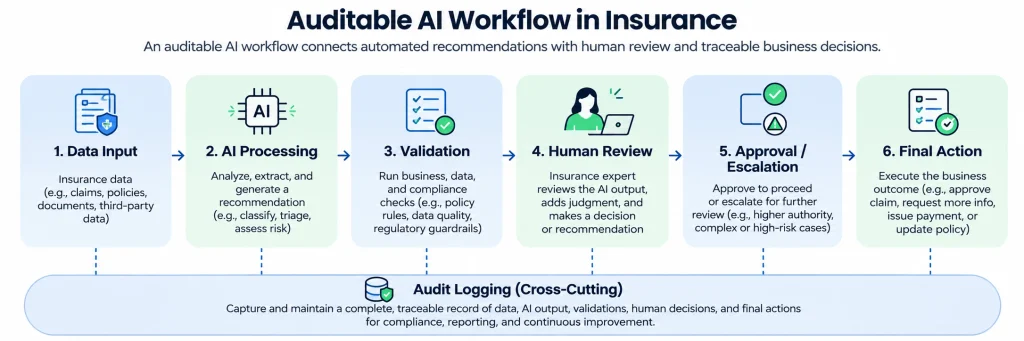
5. Establish Audit Trails
A production workflow should record:
- Workflow and business record identifiers.
- Input document references.
- Model and configuration versions.
- Relevant prompt or instruction versions.
- Retrieved knowledge sources.
- Generated output.
- Validation results.
- Tool and API calls.
- Human review actions.
- Final workflow outcome.
Logs should be protected against unauthorized modification and should follow the insurer’s retention and privacy requirements.
6. Monitor Performance and Model Limitations
Insurers should evaluate:
- Extraction accuracy.
- Summary completeness.
- Unsupported statements.
- Retrieval quality.
- Response consistency.
- Exception rates.
- Human correction rates.
- Workflow completion times.
- Data leakage risks.
- Prompt injection and other security risks.
Testing should include ordinary cases, incomplete documents, conflicting information, unusual submissions, and adversarial inputs.
7. Apply Third-Party Governance
If Claude is accessed through a cloud provider, software vendor, or system integrator, insurers should understand the responsibilities of each party.
Review:
- Data flow and processing locations.
- Subprocessors.
- Model access and versioning.
- Security controls.
- Incident notification.
- Service availability.
- Contractual audit provisions.
- Retention and deletion.
- Business continuity.
Practical recommendation: Treat Claude as one component of an enterprise AI system. Governance must cover the complete workflow, including data sources, retrieval systems, connected tools, business applications, and human decisions.
Limitations: Where Claude Should Not Be Used Without Additional Controls
Claude can support complex insurance workflows, but it has limitations that insurers must consider.
1. It Can Produce Incorrect or Unsupported Information
Claude may misunderstand documents, omit details, or generate an answer that is not supported by the available evidence.
Control: Use source references, validation rules, confidence or uncertainty handling where appropriate, and human review.
2. It Does Not Automatically Know the Insurer’s Current Business Rules
A model does not automatically have access to the latest underwriting guidelines, product configurations, or claims procedures.
Control: Connect approved and version-controlled knowledge sources through RAG and enterprise integrations.
3. It Should Not Replace Authoritative Calculations
Premium, reserve, deductible, settlement, and other financial calculations should use validated business logic and approved systems.
Control: Use Claude to explain, organize, or prepare inputs for calculations, while dedicated calculation services execute the authoritative logic.
4. It May Misinterpret Conflicting Documents
A claim file or submission may contain different dates, amounts, names, and descriptions.
Control: Design explicit inconsistency detection and exception workflows. Do not ask the model to silently resolve material conflicts.
5. Long Documents Still Require Context Management
Large claims files and extensive underwriting submissions can exceed practical processing limits or create retrieval and attention challenges.
Anthropic’s documentation explains that context windows vary by model and that a larger context window does not automatically guarantee better accuracy. Long-context applications still need careful information selection and context management.
Reference: Anthropic – Context Windows.
Control: Use document segmentation, retrieval, summarization, and targeted processing instead of assuming every document should be placed into one request.
6. AI Agents Can Introduce Additional Operational Risk
When Claude is connected to enterprise tools, the workflow may retrieve information or initiate actions.
Control: Apply least-privilege access, approved tool lists, action limits, approval gates, and detailed execution logs.
Implementation Roadmap: How Insurance Companies Can Start With Claude
Insurance companies should adopt Claude through a phased approach that prioritizes measurable business problems and controlled deployment.
| Phase | Focus | Key activities | Expected outcome |
|---|---|---|---|
| Phase 1: Discover | Identify opportunities | Map claims, underwriting, and knowledge workflows; identify repetitive tasks | Prioritized use-case inventory |
| Phase 2: Assess | Evaluate feasibility and risk | Review data quality, security, process complexity, and human oversight needs | Approved pilot scope |
| Phase 3: Design | Define the solution | Select integration approach, prompts, RAG design, structured outputs, and validation rules | Technical and workflow design |
| Phase 4: Build | Develop the pilot | Integrate Claude with approved data sources and employee applications | Working AI-assisted workflow |
| Phase 5: Validate | Test reliability | Evaluate accuracy, completeness, security, exceptions, and human review | Evidence-based deployment decision |
| Phase 6: Deploy | Introduce controlled production use | Train users, configure monitoring, establish support and audit processes | Production-ready application |
| Phase 7: Scale | Expand to other workflows | Reuse integrations, governance patterns, and evaluation frameworks | Broader enterprise adoption |
Recommended Pilot Use Cases
Start with a workflow where the value is visible and the risk can be controlled.
| Pilot | Why it is a practical starting point | Suggested success measures |
|---|---|---|
| Claims document summarization | High-volume reading and information preparation | Review time, summary completeness, correction rate |
| Underwriting submission extraction | Repetitive extraction of structured risk attributes | Field accuracy, processing time, exception rate |
| Internal knowledge assistant | Employees frequently search approved documents | Retrieval relevance, answer quality, source verification |
| Missing-document detection | Defined completeness rules can be tested | Detection accuracy, avoidable follow-up volume |
| Renewal comparison | Repetitive comparison of current and prior records | Comparison accuracy, review preparation time |
Suggested First 90 Days
Days 1–30: Discovery and design
- Select one claims, underwriting, or knowledge workflow.
- Map the current process.
- Identify source documents and systems.
- Define the intended AI task and prohibited actions.
- Establish baseline performance measures.
- Complete security and compliance assessment.
Days 31–60: Build and validate
- Connect Claude to approved data sources.
- Build prompts and structured output schemas.
- Implement retrieval and validation where required.
- Create the employee review interface.
- Test normal, incomplete, conflicting, and unusual cases.
- Record performance and error patterns.
Days 61–90: Pilot and evaluate
- Run a controlled pilot with selected users.
- Measure processing time and output quality.
- Monitor employee corrections and escalations.
- Review security and audit evidence.
- Collect user feedback.
- Decide whether to refine, scale, or stop the use case.
The 90-day period is an illustrative planning approach, not a guaranteed implementation timeline. Actual delivery depends on integration complexity, data readiness, security reviews, and organizational approvals.
How to Measure the Business Value of Claude in Insurance Operations
Claude adoption should be evaluated through measurable operational outcomes rather than the number of prompts, users, or AI-generated responses.
The right KPIs depend on the selected workflow.
| KPI | What it measures | Relevant workflow |
|---|---|---|
| Document processing time | Time required to review and prepare documents | Claims and underwriting |
| Information extraction accuracy | Percentage of extracted fields verified as correct | Claims intake and submission processing |
| Summary correction rate | Frequency of material human corrections | Claims and underwriting summaries |
| Missing-information detection rate | Accuracy in identifying incomplete submissions | Claims and underwriting |
| Knowledge retrieval success | Whether employees find relevant approved information | Knowledge work |
| First-pass review readiness | Percentage of AI-prepared records accepted for further review without substantial rework | Claims and underwriting |
| Human review time | Time spent validating AI-assisted outputs | All workflows |
| Exception rate | Percentage of cases requiring escalation or manual intervention | All workflows |
| Workflow completion time | End-to-end time required to complete the process | Claims and underwriting |
| Cost per processed document | Operational cost of document processing | Claims and underwriting |
| User adoption | Active use by intended employee groups | Knowledge work |
| Unsupported answer rate | Frequency of generated claims not supported by approved sources | Knowledge assistants |
Illustrative ROI Calculation
Insurers can estimate the potential value of a Claude-powered workflow by comparing the current process with the expected assisted process.
A simple annual productivity model is:
Annual time savings = Monthly volume × Minutes saved per item × 12 ÷ 60
Annual labor value = Annual time savings × Loaded hourly labor cost
For example, assume an insurer processes 10,000 documents each month and a controlled AI workflow saves an average of four minutes of employee handling time per document.
- Monthly documents: 10,000.
- Time saved per document: 4 minutes.
- Annual time savings: 8,000 hours.
If the loaded labor cost is $30 per hour, the illustrative annual labor capacity value is $240,000.
This is a capacity-value estimate, not automatically realized cash savings. The actual business case must account for model usage costs, integration, validation, human review, support, security, and change management.
Insurers should also evaluate whether the time released can be redirected toward higher-value work, faster customer service, or reduced operational backlogs.
Common Mistakes Insurance Companies Should Avoid
1. Starting With a General AI Assistant Instead of a Defined Business Problem
An unrestricted chatbot may generate interest but can be difficult to evaluate and govern.
Better approach: Select a specific workflow with clear users, approved information sources, defined outputs, and measurable outcomes.
2. Treating Claude as a Replacement for Insurance Core Systems
Claude does not replace policy administration, claims management, billing, rating, or underwriting platforms.
Better approach: Integrate Claude with existing systems through controlled APIs, data services, and workflow orchestration.
3. Assuming a Good Summary Is a Verified Decision
A well-written AI summary may still omit an important document or misinterpret a key fact.
Better approach: Preserve source references, validate critical fields, and require human review for consequential decisions.
4. Using Uncontrolled Internal Documents for RAG
Outdated, conflicting, or unauthorized documents can produce unreliable knowledge assistant responses.
Better approach: Establish document ownership, versioning, access controls, and approved knowledge repositories.
5. Ignoring Structured Data Validation
A model may return information in a technically valid format while the values are incorrect.
Better approach: Combine structured outputs with field-level validation, source checks, and business rules.
6. Giving AI Agents Excessive Access
An agent with broad access to claims, policy, or customer systems can create security and operational risks.
Better approach: Use least-privilege permissions, restricted tools, explicit action boundaries, and human approval for consequential actions.
7. Measuring Only Time Savings
Faster processing does not necessarily mean better insurance operations if output quality decreases.
Better approach: Measure speed alongside accuracy, completeness, correction rates, customer impact, and compliance.
8. Ignoring Employee Adoption
Employees may resist AI tools that add review work or do not fit existing processes.
Better approach: Involve claims professionals, underwriters, and operations teams in workflow design and evaluation.
Future Trends: Claude and the Evolution of Insurance Operations
The role of Claude in insurance is likely to expand as organizations move from isolated document assistants toward integrated AI-enabled workflows.
1. From Document Assistance to End-to-End Workflow Support
Initial applications may focus on reading, summarizing, and extracting information. Over time, insurers may connect these capabilities to workflow systems that route cases, request missing information, and prepare actions for human approval.
The important transition is from generating content to supporting controlled business processes.
2. Growth of AI Agents in Claims and Underwriting
AI agents can coordinate multiple steps, retrieve information, use approved tools, and prepare outputs for employees.
For example, an agent could retrieve a claim file, summarize supporting documents, check for missing information, and prepare a review package.
Production deployment requires identity controls, permission boundaries, monitoring, and human authorization for designated actions.
3. More Advanced Insurance Knowledge Assistants
RAG-based applications may evolve into enterprise knowledge services that connect policy documentation, claims procedures, underwriting guidelines, and regulatory materials.
This can help employees access information across business units while maintaining source-level traceability and role-based permissions.
4. More Structured AI Integration
Structured outputs and tool-use capabilities can help connect language models to enterprise applications more reliably.
However, structured output should be combined with application-level validation and business rules.
5. Greater Emphasis on Governance and Evaluation
As insurers expand AI use, governance will need to cover model performance, data handling, human oversight, auditability, vendor dependencies, and ongoing monitoring.
AI adoption will increasingly be evaluated by how reliably it operates within the enterprise—not simply by how impressive a demonstration appears.
Conclusion: Use Claude to Strengthen Insurance Workflows, Not Replace Insurance Judgment
Claude offers insurance companies practical opportunities to improve document-intensive and knowledge-heavy operations.
In claims, it can support FNOL processing, document extraction, case summarization, inconsistency detection, and communication drafting.
In underwriting, it can help organize submissions, extract risk attributes, compare documents, summarize loss information, and retrieve relevant guidelines.
In knowledge work, it can make internal procedures easier to access, support regulatory research, summarize meetings, draft communications, and prepare operational reporting.
The strongest implementations combine Claude’s language and reasoning capabilities with trusted enterprise data, controlled integrations, structured outputs, workflow orchestration, and human oversight.
Insurers should begin with specific, measurable use cases, establish clear governance, validate outputs against authoritative sources, and expand only when the results demonstrate reliable business value.
Techment’s capabilities across Enterprise AI, AI Strategy, Data Engineering, RAG, AI Agents, Microsoft Fabric, Cloud Modernization, and Enterprise Software Engineering can help insurers integrate Claude into existing technology environments and build AI-enabled workflows around real operational needs.
The opportunity is not simply to introduce another AI tool. It is to help claims professionals, underwriters, and insurance operations teams work with information more effectively—while preserving the expertise, controls, and accountability that insurance requires.
Frequently Asked Questions
1. How can Claude be used in insurance operations?
Claude can support insurance operations through document understanding, information extraction, summarization, knowledge retrieval, correspondence drafting, and workflow assistance. Common applications include claims intake, claims file summaries, underwriting submission analysis, policy knowledge assistants, and operational reporting.
2. Can Claude automate insurance claims processing?
Claude can automate or assist with selected claims activities such as document classification, information extraction, claim summarization, and missing-information detection. However, consequential claims decisions should follow the insurer’s approved business rules, authority framework, and human review requirements.
3. How can Claude help insurance underwriters?
Claude can help underwriters organize submissions, extract risk attributes, summarize loss runs, compare renewal documents, retrieve underwriting guidelines, and prepare referral packages. Underwriters remain responsible for validating information and making decisions within their delegated authority.
4. What is Claude RAG in insurance?
Claude RAG is an application architecture that combines Claude with retrieval-augmented generation. It retrieves relevant information from approved insurance documents, such as policy manuals, claims procedures, and underwriting guidelines, and supplies that information as context for generating answers with source references.
5. Can Claude read insurance documents and PDFs?
Claude supports document and image-based processing through its available interfaces and API capabilities. Insurers can evaluate it for tasks such as extracting information from supported documents, summarizing claims files, and analyzing submission materials. The exact file and format capabilities depend on the selected product and deployment configuration.
6. Can Claude make underwriting decisions?
Claude can assist with underwriting preparation and analysis, but it should not be treated as an automatically authorized underwriting decision-maker. Insurers should use approved underwriting rules, validated systems, delegated authority controls, and qualified human review for consequential decisions.
7. How can insurance companies integrate Claude with existing systems?
Insurers can integrate Claude through its API or supported cloud platforms, connecting it with policy administration, claims, underwriting, document management, and knowledge systems. Integration should use secure APIs, governed data access, workflow orchestration, and appropriate validation.
Related Reads
- AI-Ready Enterprise Checklist with Microsoft Fabric
- AI-Powered Risk Assessment in Insurance: Models & Use Cases
- RAG for Insurance: How Retrieval-Augmented AI Speeds Up Claims Processing
- Microsoft Fabric for Insurance Carriers: A Reference Architecture
- AI in Insurance: Benefits, Use Cases in 2026
- From Chatbots to Agents: The AI Maturity in Insurance