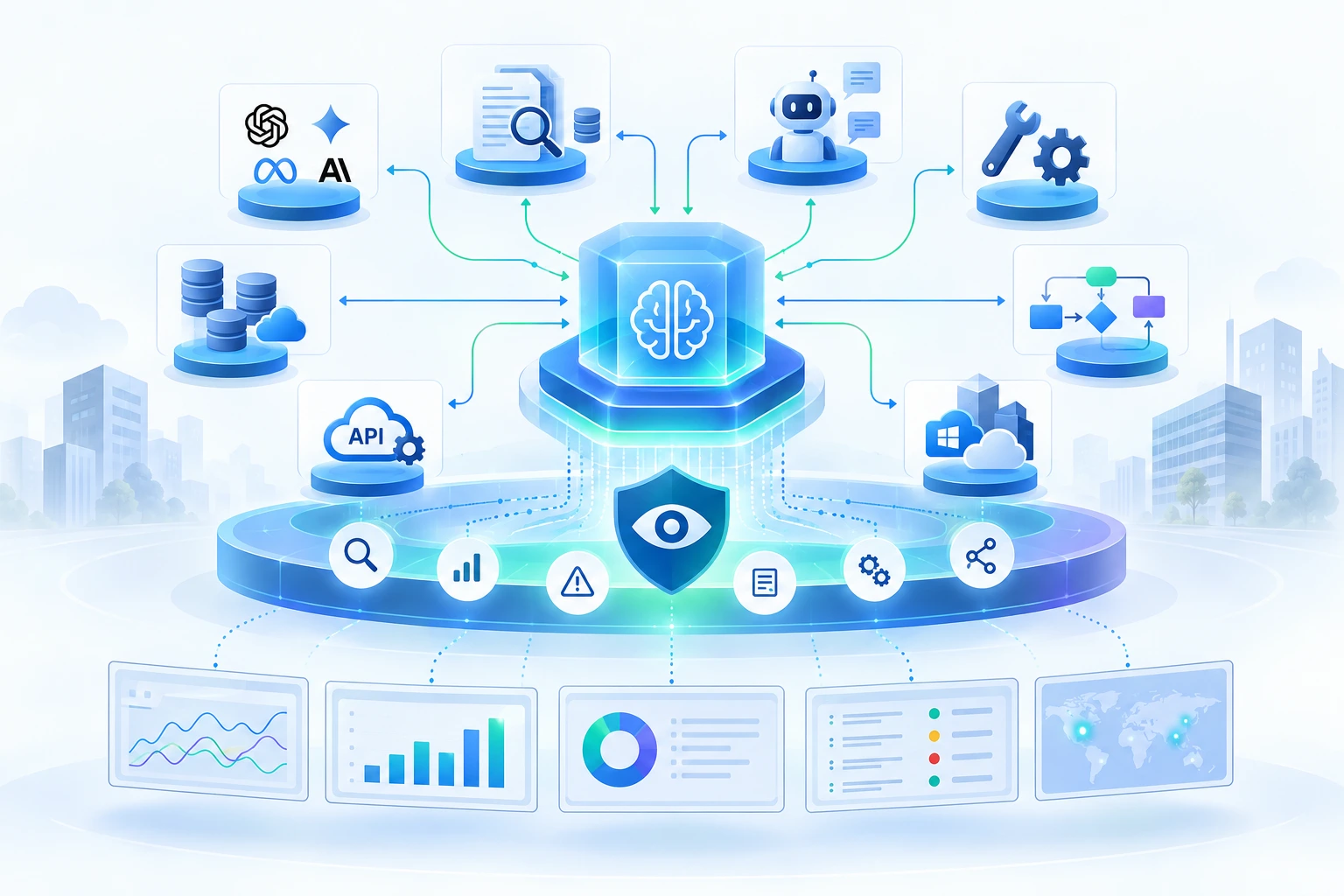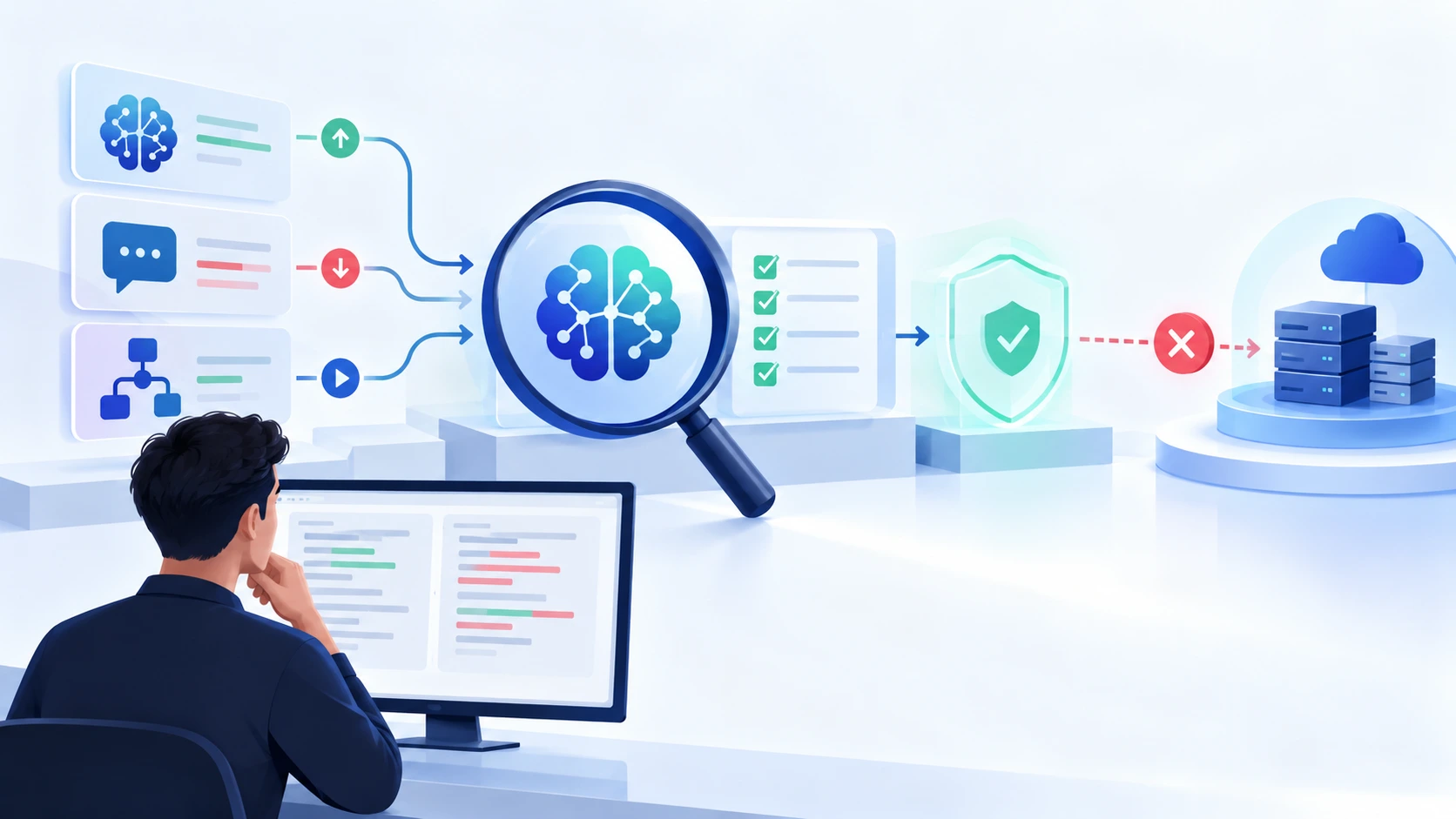
AI regression testing is the practice of comparing an AI application’s behavior against a known-good baseline after model, prompt, retrieval, tool, workflow, or code changes. It uses evaluation datasets, behavioral assertions, quality metrics, and release thresholds to detect unintended regressions before production.
A one-line prompt change can alter an AI application’s behavior across thousands of production interactions. A model upgrade can reduce answer quality without generating a single error. A retrieval or workflow change can cause an agent to select the wrong tool while every conventional API test remains green.
This is why AI regression testing has become an essential quality engineering practice for enterprises moving generative AI and agentic applications into production.
Traditional regression testing asks whether a software change broke functionality that previously worked. AI regression testing asks a broader question:
Did this change alter AI behavior in a way that makes a previously reliable workflow less accurate, safe, consistent, or useful?
The change may be in the model, prompt, retrieval pipeline, evaluation dataset, tool definition, agent workflow, guardrail, application code, or underlying data.
A production-ready AI regression strategy creates a known-good baseline, reruns representative scenarios against the new version, measures behavioral differences, and blocks releases when critical quality thresholds are breached.
This guide explains how enterprises can build that process for AI models, prompts, RAG systems, agents, and end-to-end AI workflows.
What Is AI Regression Testing?
AI regression testing is the practice of evaluating an AI application’s current behavior against a known-good baseline after a model, prompt, retrieval, workflow, tool, data, or code change.
Instead of checking whether an output exactly matches a previous response, AI regression testing evaluates whether the system still satisfies defined behavioral requirements such as:
- Accuracy
- Groundedness
- Task completion
- Tool-selection accuracy
- Safety
- Format compliance
- Policy adherence
- Response relevance
- Workflow completion
- Latency and cost thresholds
The goal is simple:
Detect unintended behavior changes before they reach production.
Read our blog on How to Test LLM Applications: Framework for Accuracy & Safety
AI Regression Testing at a Glance
| Change | Potential Regression | What to Test |
|---|---|---|
| Model upgrade | Accuracy or refusal behavior changes | Golden dataset + quality evaluation |
| Prompt change | Previously working behavior breaks | Prompt regression suite |
| RAG change | Relevant information is no longer retrieved | Retrieval + generation evaluation |
| Tool change | Agent selects the wrong function | Tool-call and schema tests |
| Workflow change | Agent skips or changes a required step | End-to-end trajectory evaluation |
| Guardrail change | Unsafe or non-compliant behavior appears | Safety and adversarial tests |
| Data/index change | Responses become less grounded | Retrieval and groundedness tests |
| Application code change | AI workflow behaves differently | End-to-end regression suite |
Why AI Regression Testing Is Different From Traditional Regression Testing
Traditional software often has deterministic contracts.
A function receives an input and returns an expected result. An API either satisfies its schema or it does not. A database query either returns the expected records or fails.
AI applications introduce another layer.
The same input can produce different valid responses. A model can change behavior without an application exception. A prompt can improve one scenario while degrading another. An agent can complete the same business task through a different tool sequence.
That creates three major testing challenges.
1. AI Outputs Are Probabilistic
A conventional test might assert:
expected_output == actual_output
That approach is often too restrictive for natural-language AI applications.
A better AI regression test evaluates behavioral properties:
- Was the answer factually correct?
- Was it grounded in the approved source?
- Did it follow the required policy?
- Were mandatory fields included?
- Was the correct tool selected?
- Did the workflow complete?
- Did the model refuse when it should?
- Did it avoid exposing sensitive information?
The objective is not identical wording. The objective is preserved behavior.
2. AI Regressions Can Be Silent
A conventional regression may produce a failed API call, exception, or broken UI.
AI regressions often produce a perfectly valid response.
For example:
A customer-support agent previously identified a refund request and called the refund_order tool.
A prompt update changes the agent’s reasoning.
The new version responds:
“You can request a refund through your account settings.”
No exception occurs.
The API is healthy.
The response is grammatically correct.
But the workflow has regressed.
This is why AI regression testing must evaluate behavior and outcomes, not simply application health.
3. One Change Can Have a Large Behavioral Blast Radius
A prompt used by multiple workflows can affect thousands of requests.
A model version can alter:
- Reasoning behavior
- Formatting
- Tool selection
- Refusal behavior
- Context interpretation
- Citation behavior
- Instruction following
A retrieval change can affect every answer that depends on the modified index or embedding configuration.
Therefore:
The smaller the technical change, the less safe it is to assume the behavioral impact is also small.
Read our blog on Agentic AI Testing with Playwright: A Practical Guide for Modern QA Teams.
What Can Cause an AI Regression?
AI regression testing should not be triggered only by application-code changes.
A useful enterprise trigger model covers the entire AI application stack.
1. Model Changes
Examples include:
- New model versions
- Provider migrations
- Model aliases changing underneath an application
- Fine-tuned model updates
- Quantized models
- Different inference configurations
A model can improve overall benchmark performance while becoming worse for a specific enterprise workflow.
Test for:
- Accuracy
- Task completion
- Safety
- Refusal behavior
- Structured output compliance
- Tool usage
- Latency
- Cost
2. Prompt Changes
Prompt changes are often treated as configuration edits rather than software changes.
That is a mistake.
A small instruction such as:
“Be concise.”
can change:
- Response completeness
- Required disclaimers
- Citation behavior
- Tool selection
- Escalation behavior
- Policy adherence
Treat prompts as versioned production artifacts.
Every meaningful prompt should have:
- A version
- An owner
- A change history
- Associated evaluation cases
- A known-good baseline
- Defined acceptance criteria
A prompt pull request should be capable of producing a meaningful regression report just like a code pull request.
3. Retrieval and RAG Changes
RAG applications introduce another regression surface.
A change to:
- Chunking
- Embeddings
- Retrieval ranking
- Search configuration
- Metadata filtering
- Vector index
- Source documents
- Retrieval thresholds
can change the information provided to the model.
The model may remain unchanged while answer quality falls.
Test RAG systems at two levels
Retrieval regression
Did the system retrieve the information required to answer the question?
Generation regression
Did the model produce a correct, grounded response from the retrieved information?
Testing only the final answer can hide the real cause.
4. Tool and Function-Calling Changes
Agentic systems add another dimension.
An agent may need to:
- Understand the request
- Select a tool
- Provide valid arguments
- Execute the tool
- Interpret the result
- Decide the next step
- Complete the task
A regression can occur at any point.
For example:
Expected
customer_request → verify_customer → check_order → refund_order
Regressed
customer_request → answer_from_model_memory
The application may still return HTTP 200.
The workflow is still broken.
Test:
- Tool selection
- Tool arguments
- Tool ordering
- Required tool usage
- Tool failure handling
- Retry behavior
- Final task completion
5. Workflow and Agent Changes
For agentic AI, testing the final response is not enough.
The trajectory matters.
Two agents may produce similar final messages but reach them through very different workflows.
One may have:
- Verified authorization
- Retrieved the correct policy
- Called the approved system
- Recorded the transaction
The other may simply generate a plausible response.
For high-risk workflows, regression testing should therefore evaluate:
Goal → Actions → Tool Calls → Intermediate Results → Final Outcome
This is especially important for customer service, financial operations, healthcare workflows, enterprise automation, and other systems where the action matters as much as the response.
Building an AI Regression Testing Framework
A practical framework can be built around seven components:
Baseline → Dataset → Evaluators → Thresholds → Test Execution → Release Gate → Production Feedback
Step 1: Establish a Known-Good Baseline
A regression cannot be measured without a reference point.
The baseline should represent the version that currently meets your acceptance criteria.
Record:
- Model version
- Prompt version
- Retrieval configuration
- Tool definitions
- Workflow version
- Evaluation dataset
- Evaluation criteria
- Quality scores
- Known exceptions
The baseline should be version controlled.
Important principle
Do not compare a candidate version against an undocumented idea of what “good” means. Compare it against an explicit, reviewable baseline.
Step 2: Build a Representative Regression Dataset
The regression dataset is the foundation of the entire system.
A strong dataset should contain more than generic questions.
Include:
Business-critical scenarios
Cases where failure affects revenue, customers, compliance, or operations.
Golden cases
Known examples where the correct behavior is well understood.
Historical failures
Every significant production incident should become a permanent regression case after remediation.
Edge cases
Examples involving:
- Missing information
- Ambiguous requests
- Long context
- Conflicting instructions
- Unusual inputs
- Empty tool responses
Adversarial cases
Include:
- Prompt injection
- Instruction conflicts
- Data-extraction attempts
- Policy bypass attempts
- Unsafe requests
Workflow cases
Test complete business journeys rather than isolated prompts.
Step 3: Version the Dataset Like Code
A regression suite becomes unreliable when its cases change without governance.
Track:
- Dataset version
- Case ID
- Business capability
- Expected behavior
- Evaluation criteria
- Risk classification
- Source
- Last review date
- Owner
When a production failure occurs:
Incident → Root cause → New regression case → Evaluation → Release gate
This creates a feedback loop where the system becomes harder to break over time.
Techment’s existing work on golden datasets provides a useful foundation for this approach.
Step 4: Define Behavioral Assertions
Avoid using exact text comparison unless exact text is genuinely required.
Instead, define assertions around behavior.
Example: Enterprise Knowledge Assistant
Input:
“What is our employee travel reimbursement limit?”
Instead of testing:
Expected response = exact sentence
Test:
- Correct policy retrieved
- Answer is supported by the source
- Reimbursement amount is correct
- Applicable conditions are included
- No unsupported policy is invented
- Citation is present when required
Example: Customer Support Agent
Test:
- Correct intent detected
- Customer identity verified
- Correct tool selected
- Tool arguments valid
- Policy followed
- Required escalation triggered
- Final response accurate
This makes the regression suite resilient to natural language variation.
Step 5: Combine Deterministic and AI-Based Evaluation
No single evaluator should determine whether an enterprise AI system is safe to release.
Use the right evaluator for the right requirement.
| Requirement | Preferred Evaluation |
|---|---|
| JSON schema | Deterministic assertion |
| Required field | Code assertion |
| API response | Automated test |
| Tool name | Exact assertion |
| Tool arguments | Schema/business-rule validation |
| Numerical result | Deterministic validation |
| Factual answer | Reference-based evaluation |
| Relevance | Semantic evaluation |
| Groundedness | Context-based evaluation |
| Tone | LLM judge + human calibration |
| Safety | Automated + adversarial + human review |
| End-to-end workflow | Trajectory + outcome evaluation |
The principle
Use deterministic tests wherever the requirement is deterministic. Use AI evaluation where language or behavior requires semantic judgment.
Step 6: Measure Regression, Not Just Quality
A candidate can improve its average score while still breaking critical workflows.
For example:
| Metric | Baseline | Candidate | Change |
|---|---|---|---|
| Overall quality | 91% | 93% | +2% |
| Accuracy | 94% | 95% | +1% |
| Groundedness | 96% | 95% | -1% |
| Tool accuracy | 99% | 94% | -5% |
| Critical workflow success | 100% | 92% | -8% |
The average score looks better.
The release should still be blocked.
Why?
Because enterprise regression testing should be risk-sensitive, not merely average-score driven.
A critical workflow failure should outweigh several minor improvements.
Step 7: Introduce Release Thresholds
Define release criteria before running the candidate evaluation.
A practical framework could include:
Hard blockers
- Critical safety failure
- Sensitive-data leakage
- Incorrect high-risk action
- Required tool not executed
- Policy violation
- Critical workflow failure
Quality thresholds
- Overall evaluation score must remain above baseline tolerance
- No critical category can fall below its minimum threshold
- Groundedness must remain above the defined business threshold
- Structured-output compliance must remain above the required threshold
Operational thresholds
- Latency within SLA
- Token usage within budget
- Cost per transaction within target
- Error rate within tolerance
The exact numbers should be determined by business risk rather than copied from another organization.
Read our blog on Building and Maintaining Reliable Golden Datasets for GenAI Testing: A Comprehensive Guide
A Practical AI Regression Test Matrix
A mature enterprise suite should cover multiple dimensions.
| Dimension | Regression Question |
|---|---|
| Accuracy | Did the system remain correct? |
| Groundedness | Are answers still supported by trusted sources? |
| Relevance | Does the response address the request? |
| Completeness | Did required information disappear? |
| Safety | Did unsafe behavior increase? |
| Security | Can protected information be exposed? |
| Tool usage | Is the correct function still selected? |
| Workflow | Does the complete task still succeed? |
| Format | Are output contracts still respected? |
| Reliability | Are critical behaviors stable? |
| Latency | Did response time exceed the SLA? |
| Cost | Did the change increase operating cost? |
This converts “AI quality” from a vague concept into a release-management system.
How to Detect Prompt Regressions Before Production
Prompt regression testing deserves its own process because prompt changes are frequent and often reviewed like ordinary text edits.
Recommended workflow
Prompt change → Regression dataset → Candidate evaluation → Diff analysis → Review → CI gate → Release
Compare:
- Old prompt
- New prompt
- Same test inputs
- Same model
- Same retrieval context
- Same tool responses
- Same evaluation criteria
This isolates the prompt as the variable.
If the prompt changes and the tool responses change simultaneously, it becomes much harder to determine what caused the regression.
How to Detect Model Regressions
Model upgrades require a separate evaluation procedure.
Before switching models:
- Freeze the evaluation dataset.
- Record the current model/version.
- Run the baseline.
- Run the candidate model.
- Compare quality by category.
- Review critical failures.
- Test latency and cost.
- Validate production-like workloads.
- Approve or reject the model migration.
- Store the evaluation results with the release.
Never rely solely on vendor benchmark scores.
A model can perform better on public benchmarks and worse on your enterprise’s specific workflows.
Your production workload is the benchmark that matters most for regression decisions.
Read our blog on How to Evaluate Hallucinations, Bias, and Toxicity in Generative AI
How to Detect Agent and Workflow Regressions
For AI agents, create tests around task trajectories.
Example:
Business objective
Cancel a customer’s eligible order.
Expected trajectory
- Identify customer
- Verify order
- Check cancellation eligibility
- Call cancellation tool
- Confirm result
- Communicate outcome
Regression examples
- Agent skips eligibility check
- Agent calls the wrong tool
- Agent supplies the wrong order ID
- Agent retries a failed transaction incorrectly
- Agent claims cancellation succeeded without tool confirmation
A final natural-language response may look acceptable in all five cases.
A trajectory-aware regression suite will identify them.
CI/CD: Turn AI Regression Tests Into a Release Gate
AI regression testing becomes significantly more valuable when it is integrated into the development lifecycle.
A practical pipeline is:
Pull Request
↓
Static checks
↓
Prompt/model/workflow detection
↓
Fast regression suite
↓
Quality evaluation
↓
Critical-case review
↓
Release decision
For larger suites:
PR suite → Staging suite → Full pre-production suite → Production monitoring
This allows enterprises to balance coverage, evaluation cost, and release speed.
Use Risk-Based Test Tiers
Running the entire evaluation suite for every commit can become expensive and slow.
Instead, create tiers.
Tier 1 — Every commit
Fast deterministic checks:
- Prompt syntax
- Required variables
- Tool schemas
- JSON structure
- Configuration validation
- Static policy checks
Tier 2 — Prompt/model/workflow changes
Run the critical regression suite:
- Business-critical cases
- Known production failures
- Golden cases
- High-risk workflows
- Tool-use cases
Tier 3 — Release and scheduled evaluation
Run the comprehensive suite:
- Full golden dataset
- Adversarial cases
- Long-context scenarios
- RAG evaluation
- Agent trajectories
- Human review samples
- Performance and cost evaluation
This prevents AI regression testing from becoming so slow or expensive that engineering teams bypass it.
What Should Block an AI Release?
Not every score change is a regression.
A useful release policy distinguishes between:
Hard regression
A previously passing critical behavior now fails.
Action: Block release.
Soft regression
A quality metric drops slightly but remains within tolerance.
Action: Review.
Improvement
A candidate fixes previously failing cases without introducing critical failures.
Action: Consider release.
Intentional behavior change
The expected behavior changed because the business requirement changed.
Action: Update the expectation separately, document the reason, then rerun the suite.
This last distinction is critical.
Do not modify the test expectation and the AI behavior in the same uncontrolled change.
Otherwise, teams can accidentally make the regression suite agree with the new behavior instead of detecting whether that behavior is actually correct.
Production Monitoring Completes the Regression Loop
Pre-production regression testing cannot detect everything.
Production introduces:
- New user behavior
- New documents
- New tool failures
- New data distributions
- New edge cases
- Provider-side model changes
- Unexpected agent trajectories
Therefore, regression testing should connect to production observability.
Recommended loop
Production trace → Failure detection → Case curation → Regression dataset → CI evaluation → Release
Every meaningful production AI failure should have the potential to become a permanent regression case.
This is how organizations move from repeatedly fixing the same AI defects to progressively strengthening the system.
AI Regression Testing for RAG Applications
RAG systems require additional regression dimensions.
Test:
Retrieval
- Was the correct document retrieved?
- Was the relevant chunk ranked highly enough?
- Did metadata filtering work?
- Did retrieval recall change?
Generation
- Was the answer grounded?
- Did the model use the retrieved information?
- Were unsupported claims introduced?
- Were citations accurate?
End-to-end outcome
- Did the user receive the correct answer?
A useful regression architecture is therefore:
Query → Retrieval evaluation → Context evaluation → Generation evaluation → Groundedness evaluation → Final answer
A final-answer-only test can miss retrieval degradation until the model begins hallucinating.
Common AI Regression Testing Mistakes
1. Testing only application code
Prompts, models, retrieval, tools, and data can change behavior without a code change.
2. Comparing exact LLM responses
Natural-language systems can produce multiple valid answers.
3. Using only average scores
Average quality can improve while a critical workflow gets worse.
4. Testing only happy paths
Production failures frequently occur at the edges.
5. Using only synthetic test cases
Production traces reveal failure modes that teams did not anticipate.
6. Relying entirely on an LLM judge
Judges should complement deterministic assertions and human review rather than replace them.
7. Updating the test and prompt simultaneously
This destroys the ability to determine whether the change actually caused the regression.
8. Running regression tests only before major releases
Prompt and model changes can happen continuously.
9. Ignoring cost and latency
A quality improvement that doubles inference cost may not be an acceptable production change.
10. Treating production monitoring as separate from testing
Production failures should feed the regression dataset.
Enterprise AI Regression Testing Architecture
A mature architecture connects five layers:
1. Change Layer
- Model
- Prompt
- RAG
- Tools
- Agent
- Workflow
- Application code
↓
2. Evaluation Layer
- Golden datasets
- Production traces
- Adversarial cases
- Synthetic edge cases
↓
3. Measurement Layer
- Accuracy
- Groundedness
- Safety
- Tool accuracy
- Task completion
- Latency
- Cost
↓
4. Governance Layer
- Thresholds
- Risk classification
- Approval
- Audit trail
- Versioning
↓
5. Delivery Layer
- CI/CD
- Release gates
- Staging
- Production monitoring
- Continuous feedback
The result is an AI delivery lifecycle in which behavioral changes become measurable before release rather than discovered through production incidents.
AI Regression Testing Checklist
Before releasing an AI model, prompt, or workflow change, ask:
Baseline
- Is the current production version recorded?
- Is the model version known?
- Is the prompt version known?
- Is the retrieval configuration captured?
- Are tool and workflow versions recorded?
Dataset
- Does the suite contain business-critical cases?
- Are historical failures included?
- Are edge cases represented?
- Are adversarial cases included?
- Are important agent workflows covered?
Evaluation
- Are deterministic checks used where possible?
- Are semantic evaluations defined?
- Are critical workflows evaluated separately?
- Are RAG retrieval and generation tested independently?
- Are tool calls evaluated?
Release Gate
- Are regression thresholds defined?
- Are critical failures hard blockers?
- Are cost and latency evaluated?
- Are evaluation results reviewable?
- Is the release decision recorded?
Production
- Is AI behavior monitored after deployment?
- Are user-reported failures captured?
- Are new production failures added to the regression suite?
- Are model/provider changes monitored?
AI Regression Testing vs Traditional Regression Testing
| Area | Traditional Regression Testing | AI Regression Testing |
|---|---|---|
| Output | Usually deterministic | Often probabilistic |
| Assertion | Exact result/schema | Behavior and quality |
| Test data | Functional cases | Golden + production + edge cases |
| Model changes | Usually not applicable | Major regression trigger |
| Prompt changes | Not applicable | Major regression trigger |
| Retrieval | Usually deterministic | Can change AI behavior |
| Agent workflow | Limited | Requires trajectory testing |
| Evaluation | Pass/fail | Metrics + thresholds + review |
| Production feedback | Defect tickets | Traces + failures + eval cases |
| Release gate | Test failures | Behavioral regression + risk thresholds |
The Future of AI Regression Testing
As enterprises move from isolated copilots to agentic workflows, regression testing will expand beyond individual model responses.
The testing unit will increasingly become the AI system behavior:
Model + Prompt + Context + Tools + Workflow + Data + Guardrails + User Outcome
This means future AI quality engineering will need to evaluate not only whether an AI system generates a good response, but whether it consistently completes the intended business task within defined safety, governance, performance, and cost boundaries.
The organizations that operationalize this discipline early will have an important advantage:
They can improve AI systems faster without making every improvement a production risk.
Conclusion
AI regression testing is the quality gate between AI experimentation and reliable production deployment.
A model upgrade, prompt edit, retrieval change, tool update, or agent workflow modification can introduce a regression even when traditional software tests remain green.
The solution is not to prevent AI systems from changing.
It is to make those changes measurable, reviewable, and reversible.
A strong enterprise AI regression strategy combines:
- Versioned models and prompts
- Representative golden datasets
- Production-derived test cases
- Deterministic assertions
- Semantic evaluation
- RAG and retrieval testing
- Tool and workflow evaluation
- Risk-based release thresholds
- CI/CD integration
- Production monitoring
- Continuous feedback into the regression suite
The ultimate goal is simple:
Every AI change should answer one question before production: what behavior changed, and did it get better or worse?
For enterprises scaling AI applications, Techment helps build the testing, quality engineering, evaluation, and AI-native DevOps practices required to make that answer measurable.b
FAQ: AI Regression Testing
1. What is AI regression testing?
AI regression testing evaluates an AI application’s behavior after a model, prompt, retrieval, tool, workflow, data, or code change and compares it with a known-good baseline. It identifies unintended quality, safety, accuracy, or workflow degradation before production.
2. How is AI regression testing different from traditional regression testing?
Traditional regression testing often relies on deterministic expected outputs. AI regression testing evaluates behavioral requirements and quality thresholds because LLM outputs can vary while still being valid.
3. How do you test a prompt for regression?
Run the old and new prompt against the same versioned test dataset and evaluation criteria, then compare accuracy, relevance, groundedness, policy adherence, tool usage, formatting, and other required behaviors.
4. How do you detect a model regression?
Run the candidate model against a representative golden dataset and compare its results with the current production model. Evaluate critical workflows separately from aggregate scores so an overall improvement cannot hide a high-risk regression.
5. What is a golden dataset in AI regression testing?
A golden dataset is a curated set of representative AI test cases with expected outcomes, behavioral criteria, or evaluation rules. It provides a known reference set for comparing model, prompt, and workflow changes.
6. Can AI regression testing be automated?
Yes. Much of the process can be automated through evaluation pipelines and CI/CD release gates. However, high-risk behavioral, safety, and nuanced quality cases may still require human review.
7. How often should AI regression tests run?
Run fast regression checks on relevant pull requests, deeper evaluations before production releases, and scheduled evaluations to detect changes caused by models, data, retrieval systems, or external providers.
8. What should trigger an AI regression test?
At minimum: model changes, prompt changes, RAG/retrieval changes, tool changes, agent workflow changes, guardrail changes, important data/index changes, and application changes that affect AI behavior.
Related Reads
- How to Test LLM Applications: Framework for Accuracy & Safety
- 7 Proven Strategies for LLM Regression Testing Using Golden Datasets vs Random Sampling
- How to Evaluate Hallucinations, Bias, and Toxicity in Generative AI
- Agentic AI Testing with Playwright: A Practical Guide for Modern QA Team
- How to Identify Processes Ready for Automation: A Step-by-Step Enterprise Guide