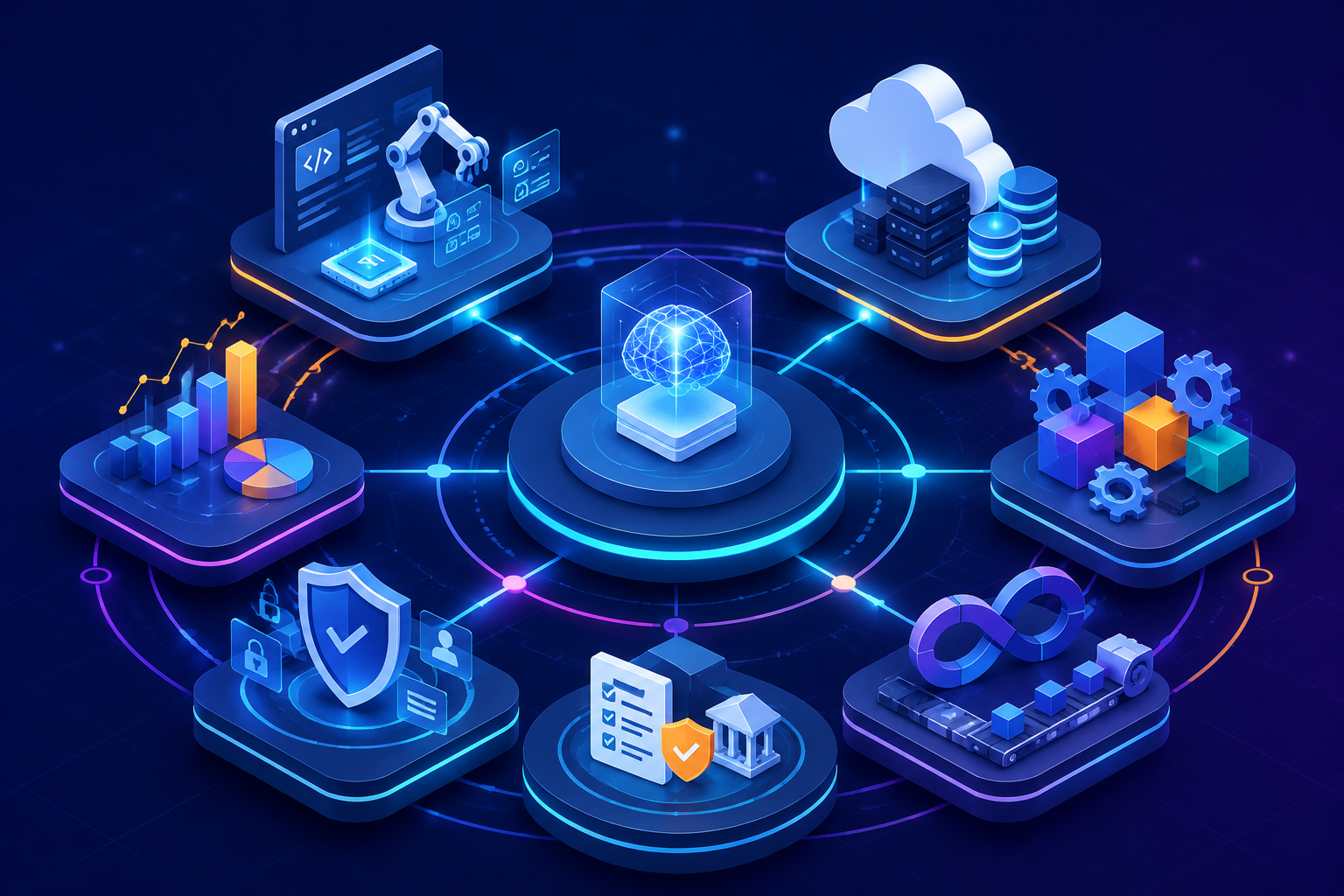
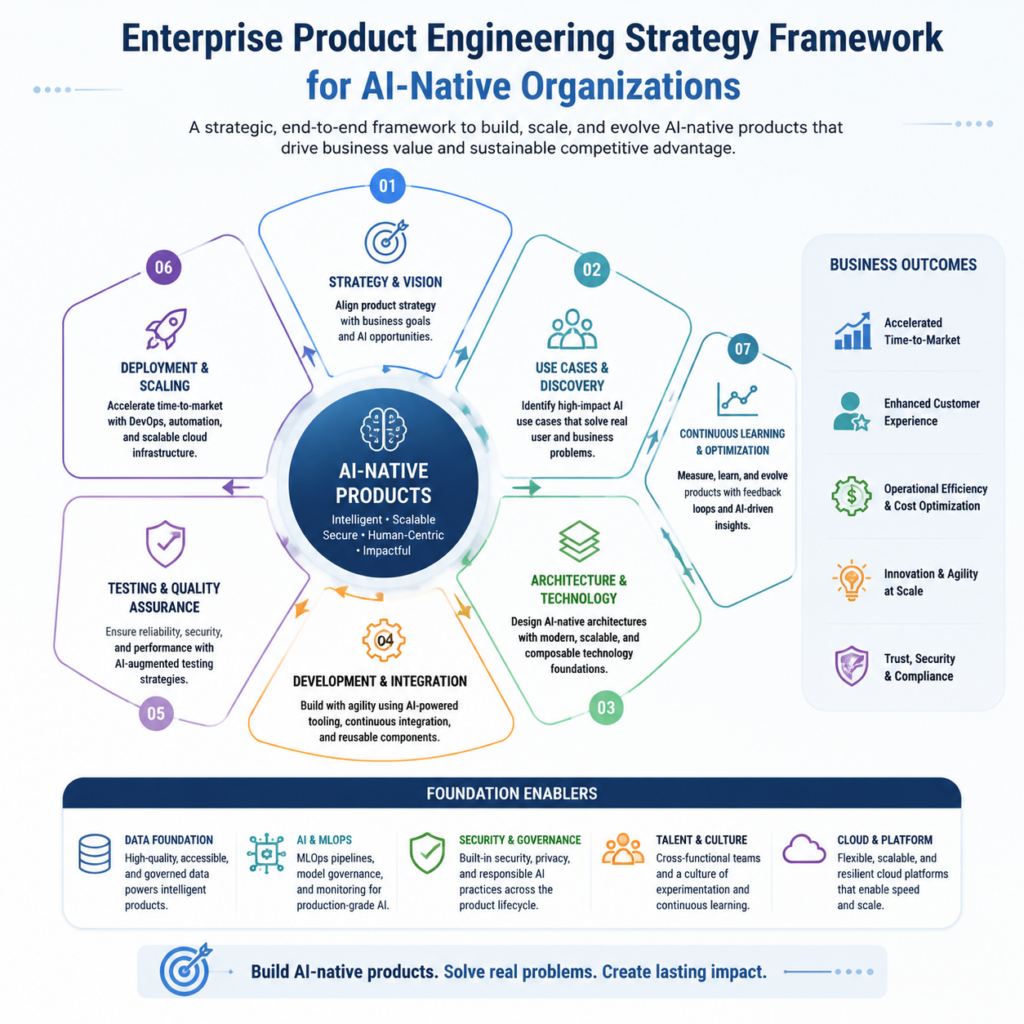
Product Engineering Strategy is a structured approach to designing, developing, modernizing, and continuously improving digital products using AI, cloud-native architectures, platform engineering, and DevSecOps. In 2026, successful enterprises prioritize sustainable architecture, governance, maintainability, and business outcomes over development velocity, enabling them to build scalable, secure, and AI-ready software products that evolve with changing customer and market demands.
Introduction
Product engineering is evolving from a delivery-focused discipline into a strategic capability that enables organizations to build scalable, intelligent, and resilient digital products. While AI-powered development tools have significantly accelerated software creation, they have also increased architectural complexity, technical debt, and operational costs.
A successful product engineering strategy in 2026 focuses on balancing AI-driven productivity with sustainable architecture, governance, platform engineering, and continuous modernization. Instead of optimizing solely for delivery velocity, enterprises must prioritize maintainability, security, cost efficiency, and long-term product evolution.
This article explores nine proven product engineering strategies that help technology leaders build AI-native products capable of adapting to changing business needs while maintaining architectural integrity and operational excellence.
TL; DR
- AI has accelerated software delivery, but sustainable product engineering now depends on architecture, governance, maintainability, and business alignment—not development speed alone.
- Modern product engineering strategies prioritize context optimization, architectural simplicity, token efficiency, and continuous refactoring to reduce long-term technical debt.
- Enterprises should treat AI as an engineering accelerator within well-defined architectural guardrails rather than a replacement for engineering discipline.
- Future-ready engineering organizations measure system maintainability, operational resilience, and developer comprehension alongside traditional delivery metrics.
- Organizations that combine AI, cloud-native engineering, platform engineering, and continuous modernization will be better positioned to scale innovation while controlling costs and complexity.
Why Product Engineering Needs a New Strategy
AI has fundamentally changed how software is built. Development teams can now generate code, automate testing, create documentation, and accelerate releases at unprecedented speed. However, faster development does not automatically translate into better software.
Many enterprises are discovering that rapid AI-assisted development often leads to fragmented architectures, duplicated logic, inconsistent coding patterns, growing infrastructure costs, and increasing technical debt. As applications become more distributed and AI-driven, maintaining system quality becomes more challenging than delivering new features.
This shift requires organizations to rethink product engineering beyond traditional software development practices. Modern product engineering is no longer measured only by how quickly teams ship features. Instead, it is evaluated by how effectively products can evolve, scale, integrate, and remain maintainable throughout their lifecycle.
Successful organizations are therefore investing in engineering practices that improve architectural consistency, governance, developer productivity, operational resilience, and AI readiness simultaneously.
The goal is no longer building software faster. The goal is building software that remains valuable, understandable, and adaptable for years.
Explore more about AI Native Product Engineering – Techment services.
How Is Product Engineering Strategy Different from Tradition Software Development Strategy
Unlike traditional software development—which often focuses on project delivery—modern product engineering emphasizes continuous product evolution through cloud-native architectures, DevSecOps, AI-assisted development, platform engineering, and data-driven decision-making.
| Traditional Software Development | Modern Product Engineering |
|---|---|
| Project-centric | Product-centric |
| Feature delivery | Continuous value delivery |
| Short-term releases | Long-term product evolution |
| Manual engineering | AI-assisted engineering |
| Velocity-focused | Sustainability-focused |
| Reactive maintenance | Continuous modernization |
For enterprise organizations, product engineering has become a strategic business capability that enables faster innovation without compromising architectural quality or operational resilience.
Read more about How LLMs Power Modern Enterprise Applications: Architecture, Use Cases & Implementation Guide
9 Product Engineering Strategies That Actually Work in 2026
1. Optimize Context, Not Context Windows
Increasing AI context windows does not automatically improve engineering outcomes. High-performing organizations focus on providing AI systems with precise, relevant, and task-specific context rather than exposing them to excessive information that increases latency, costs, and reasoning complexity.
Effective context optimization improves code quality while reducing inference costs and architectural noise.
Enterprise Recommendations
- Design modular architectures with clear service boundaries.
- Use semantic search and retrieval to provide only relevant information.
- Implement task-specific knowledge retrieval for AI-assisted development.
- Continuously refine documentation to improve AI context quality.
Example
Instead of allowing an AI assistant to analyze an entire enterprise codebase, provide only the relevant microservice, API specifications, architectural guidelines, and coding standards needed for the task.
2. Make Continuous Refactoring a Core Engineering Practice
AI generates software quickly, but it does not automatically eliminate unnecessary complexity. Without continuous refactoring, AI-generated applications gradually accumulate duplicated logic, redundant services, inconsistent abstractions, and growing maintenance overhead.
Leading engineering teams dedicate as much effort to simplifying software as they do to building new functionality.
Enterprise Recommendations
- Schedule continuous architecture reviews.
- Remove obsolete services and unused code.
- Simplify overly complex workflows.
- Automate dependency management.
- Maintain architecture documentation alongside code.
Example
An engineering team may allocate dedicated AI agents to identify redundant APIs, detect duplicate business logic, recommend code consolidation, and update technical documentation before each major release.
3. Treat AI Token Consumption as an Engineering Metric
As AI becomes embedded across development workflows, token consumption directly affects operational costs, application performance, and infrastructure scalability. Organizations should manage token usage with the same discipline applied to compute resources, storage, and network utilization.
Efficient AI systems are designed to maximize business value while minimizing unnecessary inference costs.
Enterprise Recommendations
- Monitor AI usage across engineering workflows.
- Route requests to the most appropriate model size.
- Cache repetitive AI responses where applicable.
- Optimize prompts to reduce unnecessary context.
- Continuously evaluate AI infrastructure costs.
Example
Simple documentation generation may only require a lightweight language model, while architectural design reviews can leverage larger reasoning models, reducing overall AI operating expenses.
4. Build Hybrid AI Architectures Instead of Cloud-Only Systems
Cloud-based AI provides significant scalability, but routing every request to centralized models increases latency, bandwidth consumption, operational costs, and privacy concerns. Modern product engineering increasingly combines edge intelligence with cloud-based reasoning.
Hybrid architectures improve responsiveness while optimizing infrastructure utilization.
Enterprise Recommendations
- Execute lightweight AI tasks closer to users or devices.
- Reserve cloud models for complex reasoning workloads.
- Design dynamic orchestration between edge and cloud environments.
- Prioritize privacy-sensitive processing locally whenever possible.
Example
A manufacturing application can perform anomaly detection on factory equipment locally while sending only complex predictive maintenance scenarios to cloud AI services for advanced analysis.
5. Prioritize Human Readability in AI-Generated Software
AI-generated code that functions correctly is not necessarily maintainable. Enterprise software must remain understandable for developers responsible for extending, securing, auditing, and supporting applications long after initial development.
Readability is becoming one of the most important indicators of software quality in AI-assisted engineering.
Enterprise Recommendations
- Establish consistent coding standards.
- Minimize unnecessary abstractions.
- Generate architectural documentation alongside code.
- Enforce meaningful naming conventions.
- Include readability reviews in pull request processes.
Example
Rather than accepting complex AI-generated abstractions, engineering teams simplify business logic into smaller, clearly documented modules that future developers can quickly understand and modify.
6. Establish AI Engineering Guardrails
As AI becomes an integral part of software development, engineering teams need governance that extends beyond coding standards. AI engineering guardrails define architectural boundaries, security policies, compliance requirements, and design principles that ensure AI-generated code aligns with enterprise standards without compromising quality or maintainability.
Organizations should establish AI governance frameworks aligned with industry best practices such as the OWASP Top 10 for LLM Applications and the NIST AI Risk Management Framework to improve security, compliance, and responsible AI adoption.
Enterprise Recommendations
- Define approved architectural patterns and technology stacks.
- Establish governance for AI-generated code reviews.
- Embed security, compliance, and quality checks into CI/CD pipelines.
- Use automated policy enforcement to maintain consistency across engineering teams.
- Regularly audit AI-generated code for security and architectural compliance.
Example
Before code is merged, automated governance workflows validate architecture patterns, coding standards, security policies, and compliance requirements to ensure enterprise-wide consistency.
7. Build Compute-Aware Engineering Practices
As AI adoption scales, compute resources become a strategic engineering concern. Enterprises must optimize infrastructure usage, inference costs, and energy consumption without compromising application performance or user experience.
Compute-aware engineering helps organizations balance performance, operational efficiency, and sustainability.
Enterprise Recommendations
- Continuously monitor AI infrastructure utilization.
- Optimize model selection based on workload complexity.
- Cache repetitive AI requests wherever possible.
- Schedule non-critical AI workloads during lower-demand periods.
- Include AI infrastructure efficiency as part of engineering KPIs.
Example
Customer-facing applications may leverage larger reasoning models only for complex workflows, while routine tasks are processed using smaller models, reducing operational costs without affecting user experience.
8. Design Smaller, Modular Services
Highly distributed architectures often introduce unnecessary operational complexity. Modern product engineering favors modular, independently deployable services with clearly defined responsibilities that simplify maintenance, testing, and future enhancements.

Smaller services also improve AI-assisted development by reducing the amount of contextual information required for development, testing, and troubleshooting.
Enterprise Recommendations
- Design services around business capabilities rather than technical layers.
- Minimize service dependencies.
- Keep APIs simple, well documented, and reusable.
- Regularly evaluate opportunities to consolidate redundant services.
- Prioritize simplicity over excessive architectural abstraction.
Example
Rather than creating multiple overlapping microservices, organizations can consolidate related capabilities into cohesive domain-focused services that are easier to understand, test, and evolve.
9. Measure Engineering by Mean Time to Comprehend (MTTC)
Traditional engineering metrics such as deployment frequency or release velocity provide limited visibility into long-term software health. As AI-generated codebases grow, the ability for engineers to quickly understand and safely modify software becomes a critical success factor.
Mean Time to Comprehend (MTTC) measures how quickly an engineer can understand a system well enough to implement changes confidently. Lower MTTC typically indicates better architecture, documentation, and maintainability.
Enterprise Recommendations
- Standardize architecture documentation.
- Maintain living technical documentation.
- Simplify overly complex service interactions.
- Continuously improve onboarding experiences.
- Track maintainability alongside traditional engineering metrics.
Example
If new engineers require several weeks to understand a product before contributing effectively, it signals opportunities to improve architecture, documentation, and system modularity.\
Learn more about Application Modernization Challenges: Top Obstacles, Strategies, and Best Practices.
Enterprise Implementation Roadmap
Modernizing product engineering requires a structured approach that aligns technology, processes, and governance. The following roadmap helps organizations adopt AI-native engineering practices while minimizing operational risk.
| Phase | Primary Focus | Expected Outcome |
|---|---|---|
| Assess | Evaluate architecture, engineering maturity, AI readiness, and technical debt | Establish modernization priorities |
| Modernize | Adopt cloud-native architectures, platform engineering, DevSecOps, and AI-assisted development | Improve scalability and developer productivity |
| Optimize | Enhance AI workflows, automate governance, optimize infrastructure, and reduce operational costs | Increase engineering efficiency and resilience |
| Govern | Measure maintainability, security, compliance, and engineering performance continuously | Enable sustainable long-term product evolution |

Best Practices vs Common Pitfalls
| Best Practices | Common Pitfalls |
|---|---|
| Optimize context quality instead of increasing AI context size | Rely solely on larger language models |
| Continuously refactor applications | Accumulate AI-generated technical debt |
| Standardize engineering governance | Allow inconsistent architectural decisions |
| Measure AI infrastructure efficiency | Ignore token consumption and inference costs |
| Design modular, business-aligned services | Over-engineer distributed architectures |
| Prioritize code readability and documentation | Accept complex AI-generated code without review |
| Balance automation with engineering oversight | Treat AI as a replacement for engineering discipline |
Read more about How to Build An AI-First Enterprise: A Complete Guide.
Why Choose Techment For Product Engineering Strategy?
Building AI-native digital products requires more than adopting new technologies—it requires a strategic engineering approach that balances innovation with scalability, governance, and long-term maintainability.
At Techment, we help enterprises modernize product engineering by combining deep expertise in Enterprise AI, Product Engineering, Cloud Modernization, Data Engineering, Platform Engineering, Microsoft Fabric, AI Agents, Retrieval-Augmented Generation (RAG), and DevSecOps. Our engineering teams focus on building intelligent, secure, and scalable software products that accelerate innovation while maintaining architectural integrity and operational excellence.
Whether modernizing legacy platforms, developing AI-powered applications, or establishing enterprise engineering governance, Techment enables organizations to build future-ready digital products with confidence.
Conclusion
Product engineering is no longer defined by how quickly software can be developed. In the AI era, competitive advantage comes from building products that remain scalable, maintainable, secure, and adaptable as technologies and business needs evolve.
Organizations that invest in AI-native engineering, platform engineering, cloud modernization, governance, and continuous optimization will be better positioned to deliver sustainable innovation while controlling technical debt and operational complexity.
By adopting these nine product engineering strategies, enterprise leaders can build resilient digital products that create long-term business value—not just faster software releases.
Looking to modernize your product engineering capabilities? Techment helps enterprises accelerate AI-driven innovation through product engineering, cloud modernization, data engineering, AI agents, Microsoft Fabric, and enterprise software engineering expertise.\
Key Takeaways
- AI is transforming product engineering, but sustainable success depends on balancing development speed with architectural quality, governance, and long-term maintainability.
- Modern product engineering strategies prioritize modular architectures, continuous refactoring, AI governance, and platform engineering to reduce technical debt and improve scalability.
- Engineering leaders should measure success using maintainability, operational resilience, AI infrastructure efficiency, and developer comprehension—not just delivery velocity.
- Hybrid AI architectures, optimized context management, and compute-aware engineering help enterprises improve performance, control costs, and build more resilient AI-native applications.
- Organizations that embed AI, cloud-native engineering, DevSecOps, and continuous modernization into their product engineering strategy will be better positioned to accelerate innovation while maintaining security, compliance, and business agility.
Frequently Asked Questions
1. What is product engineering strategy?
Product engineering strategy is a long-term approach to designing, developing, modernizing, governing, and continuously improving digital products while aligning technology investments with business objectives.
2. How is product engineering different from software development?
Software development primarily focuses on delivering applications, while product engineering manages the entire product lifecycle, including architecture, modernization, security, scalability, operations, and continuous innovation.
3. Why is AI changing product engineering?
AI accelerates software development but also increases architectural complexity, infrastructure costs, and governance requirements. Modern engineering strategies help organizations balance AI-driven productivity with maintainability and operational resilience.
4. What are the key components of modern product engineering?
Modern product engineering combines AI-assisted development, cloud-native architecture, DevSecOps, platform engineering, data-driven decision-making, automation, governance, and continuous modernization.
5. What metrics should engineering leaders track?
Beyond delivery metrics, organizations should monitor architecture quality, maintainability, developer productivity, AI infrastructure efficiency, technical debt, system reliability, security posture, and Mean Time to Comprehend (MTTC).
6. How does platform engineering improve product development?
Platform engineering provides standardized tools, infrastructure, and self-service capabilities that improve developer productivity, reduce operational complexity, and enable consistent software delivery across teams.
7. Why is continuous refactoring important in AI-assisted development?
Continuous refactoring prevents AI-generated technical debt, simplifies software architecture, improves maintainability, and ensures applications remain scalable as business requirements evolve.
8. How can enterprises adopt AI responsibly within product engineering?
Organizations should establish AI governance frameworks, implement architectural guardrails, continuously review AI-generated code, monitor AI infrastructure costs, and integrate security and compliance into every stage of the engineering lifecycle.
Related Reads
- How to Build An AI-First Enterprise: A Complete Guide
- AI Agent Evaluation Frameworks Compared: Choosing the Right Platform
- Application Modernization Challenges: Top Obstacles, Strategies, and Best Practices for Modernizing Legacy
- AI-Powered Testing vs. Traditional Load Testing: Transforming Performance
- How LLMs Power Modern Enterprise Applications: Architecture, Use Cases
- How to Build Enterprise AI Copilots: A Complete Guide for Business Leaders