
Medallion Architecture vs Lakehouse – Medallion architecture and lakehouse architecture are complementary, not competing models. A lakehouse provides the underlying enterprise data platform for scalable storage, processing, analytics, and AI, while Medallion organizes data into Bronze, Silver, and Gold layers to progressively improve quality and business readiness. Many enterprises therefore implement Medallion architecture on a lakehouse.
The decision therefore should not be:
Medallion or Lakehouse?
It should be:
Which lakehouse architecture, data-layer pattern, and serving model best fit our workloads, governance requirements, data types, and operating model?
TL;DR
- Lakehouse is an enterprise data architecture designed to support diverse data and analytical workloads on a unified data foundation.
- Medallion architecture is a layered data design pattern that progressively improves data quality from Bronze → Silver → Gold.
- A Medallion architecture can be implemented inside a lakehouse.
- Medallion is especially useful when an enterprise needs clear separation between raw ingestion, data quality/conformance, and business-ready datasets.
- A lakehouse without clear data-layer responsibilities can become difficult to govern and operate.
- A Medallion pattern without the right underlying platform may add layers without solving storage, compute, governance, or workload requirements.
- For most modern enterprise analytics platforms, lakehouse + Medallion is a strong starting architecture rather than choosing one over the other.
What Is Medallion Architecture?
Medallion architecture is a layered data design pattern that progressively improves data quality as information moves through Bronze, Silver, and Gold stages. Bronze preserves source-aligned raw data, Silver validates and conforms it, and Gold produces curated data optimized for analytics and business consumption.
The architecture typically consists of three logical layers:
| Layer | Primary Purpose | Typical Data State | Primary Users |
|---|---|---|---|
| Bronze | Raw ingestion | Source-aligned, minimally transformed | Data engineers, operations, audit |
| Silver | Validation and conformance | Cleaned, standardized, integrated | Data engineers, analysts, data scientists |
| Gold | Business consumption | Curated, modeled, aggregated | BI teams, business users, executives |
Bronze Layer: Preserve the Source
The Bronze layer is the landing and preservation layer.
Typical responsibilities include:
- Ingesting data from operational databases
- Capturing APIs and files
- Preserving source-level records
- Supporting incremental ingestion and CDC
- Retaining invalid records when required
- Maintaining historical traceability
- Enabling replay and reprocessing
The objective is not to make Bronze business-ready.
Bronze should preserve what arrived from the source with enough metadata and lineage to explain where the data came from and how it entered the platform.
Silver Layer: Validate and Conform
The Silver layer is where data quality and integration become central.
Typical transformations include:
- Deduplication
- Data type standardization
- Null and quality validation
- Business-rule validation
- Schema normalization
- Cross-system joins
- Key standardization
- Historical processing
- Entity resolution
- Conformed dimensions
The result is a reusable data foundation that multiple downstream applications and analytics workloads can consume.
Gold Layer: Deliver Business-Ready Data
The Gold layer transforms conformed data into datasets designed around business requirements.
Typical Gold models include:
- Star schemas
- Data marts
- Aggregated tables
- Domain-specific data products
- Executive reporting datasets
- KPI datasets
- Analytical models
Microsoft’s current Fabric guidance describes Gold as the consumption-oriented layer and notes that curated Gold models can support Power BI, Copilot, data agents, and other enterprise consumption experiences.
Read more on Medallion Architecture in Microsoft Fabric: Best Practices for Bronze, Silver, and Gold Layers.
What Is a Lakehouse Architecture?
A lakehouse is a data architecture that combines characteristics of data lakes and data warehouses, providing scalable storage and processing for structured, semi-structured, and unstructured data while supporting analytics, BI, data science, and machine learning workloads.
A traditional data lake primarily emphasizes flexible, scalable storage.
A traditional data warehouse primarily emphasizes structured, governed analytical workloads.
A lakehouse aims to bring these capabilities together around a more unified data foundation.
Typical Lakehouse Capabilities
An enterprise lakehouse may provide:
- Scalable object-based storage
- Structured and semi-structured data support
- Transactional table formats
- SQL analytics
- Distributed processing
- Data engineering
- BI and reporting
- Machine learning
- Streaming or near-real-time processing
- Data sharing
- Governance and lineage
Platforms such as Microsoft Fabric and Databricks support lakehouse architectures, although implementation details, services, governance models, and workload capabilities differ by platform.
As highlighted in enterprise AI strategy discussions , organizations that underestimate this complexity often face delays, cost overruns, and scalability challenges.
Medallion Architecture vs Lakehouse: The Core Difference
The simplest distinction is this: a lakehouse describes the broader data platform architecture, while Medallion describes how data is logically organized and refined within that environment. Therefore, comparing them as mutually exclusive architectures can lead to the wrong enterprise decision. A lakehouse can use Medallion architecture as its data-processing and organization pattern.
| Dimension | Medallion Architecture | Lakehouse Architecture |
|---|---|---|
| What it is | Data design pattern | Data architecture |
| Primary concept | Progressive data refinement | Unified analytical data platform |
| Typical structure | Bronze → Silver → Gold | Storage + processing + analytics + governance |
| Main concern | Data quality and lifecycle stages | Platform capabilities and workload convergence |
| Storage model | Platform-dependent | Typically scalable lake/object storage |
| Data types | Depends on implementation | Structured, semi-structured, and often unstructured |
| BI support | Usually through Gold | Native or integrated BI capabilities |
| Data science/ML | Can consume Silver/Gold | Common lakehouse workload |
| Governance | Layer-level governance | Platform-wide and data-level governance |
| Can they coexist? | Yes | Yes |
| Best interpretation | How data is refined | Where/how enterprise data workloads operate |
The Most Important Point
Medallion is not a replacement for a lakehouse.
In a modern architecture:
Source Systems → Lakehouse → Bronze → Silver → Gold → Semantic Model → BI / AI / Applications
The lakehouse provides the underlying environment.
The Medallion pattern establishes responsibilities for the data as it moves through that environment.
Read more on How to Build an AI-Ready Data Lakehouse: Proven Steps for Enterprise AI Success
Medallion vs Lakehouse Architecture Diagram
A useful enterprise architecture looks like this:
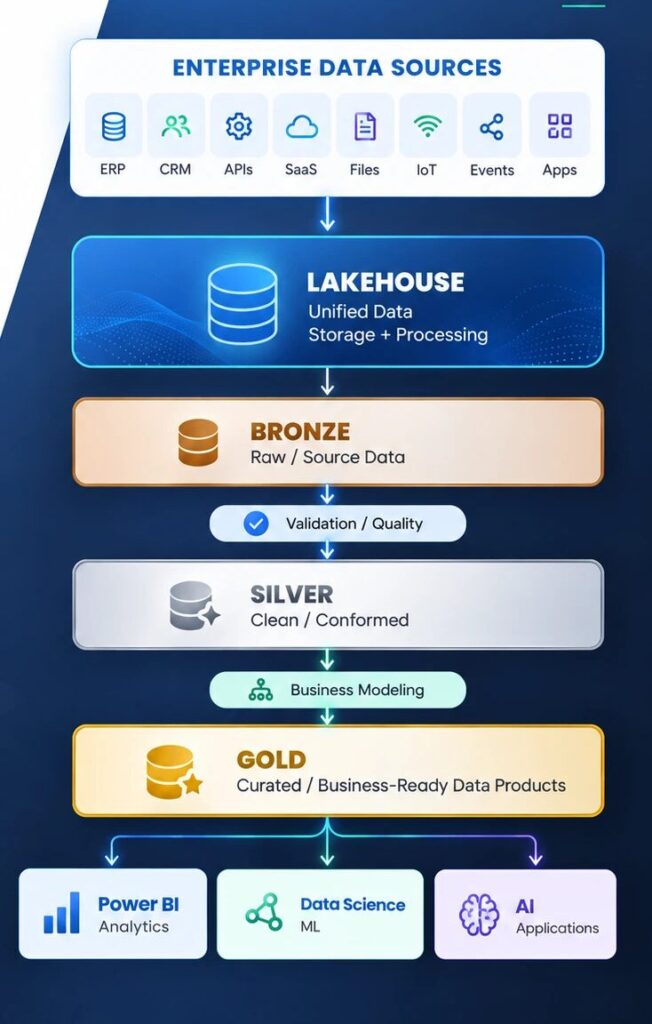
This illustrates why the two concepts should normally be considered complementary.
Why Enterprises Use Medallion Architecture on a Lakehouse
The combination provides both platform flexibility and data discipline. The lakehouse provides scalable storage and processing for multiple workloads, while Medallion establishes clear boundaries for ingestion, quality, conformance, and consumption. This reduces the risk of allowing a flexible data lake environment to become an unmanaged collection of datasets.
1. Clear Data Responsibilities
Each layer has an explicit purpose.
For example:
- Bronze owns ingestion and source preservation.
- Silver owns quality and conformance.
- Gold owns business-oriented consumption models.
This makes architecture decisions easier to communicate across data engineering, analytics, governance, and business teams.
2. Better Data Quality Control
Instead of applying every transformation during ingestion, enterprises can progressively improve data quality.
Raw
 ↓
Validated
 ↓
Standardized
 ↓
Conformed
 ↓
Business-ready
This creates a traceable path between source records and analytical outputs.
3. Reusable Data Products
A well-designed Silver layer can support multiple Gold datasets rather than rebuilding the same transformations for every report.
For example:
Customer Silver
       │
       ├── Customer 360 Gold
       ├── Sales Gold
       ├── Retention Gold
       └── Service Gold
This reduces duplicated transformation logic.
4. Easier Troubleshooting
When a KPI changes unexpectedly, teams can trace the issue through:
Gold → Silver → Bronze → Source
Rather than debugging a single large transformation pipeline with no clear data boundaries.
5. Better Support for Multiple Consumers
A lakehouse may serve:
- BI
- Data science
- Machine learning
- AI applications
- Operational analytics
- Data products
- Ad hoc analysis
Medallion layers allow different consumers to use appropriate levels of data refinement.
When Should You Choose a Lakehouse?
Choose a lakehouse architecture when the enterprise needs one scalable data foundation for diverse data types and workloads, particularly when BI, data engineering, data science, machine learning, and large-scale analytical processing need to coexist. A lakehouse is particularly useful when separate data lakes and warehouses are creating duplicated pipelines, duplicated storage, or fragmented governance.
A lakehouse is a strong candidate when your organization has:
- Large data volumes
- Structured and semi-structured data
- Multiple analytical workloads
- Data science and ML requirements
- Streaming or event data
- Cloud-scale processing needs
- A need to reduce data duplication
- Multiple consuming applications
- An enterprise data platform strategy
Example
A global enterprise may have:
- SAP ERP data
- Salesforce CRM data
- Customer interaction data
- Application logs
- IoT events
- CSV files
- JSON APIs
- Documents
- Machine-learning datasets
A lakehouse can provide a common analytical foundation for these workloads rather than forcing every dataset into a traditional relational warehouse structure.
When Should You Use Medallion Architecture?
Use Medallion architecture when the enterprise needs explicit stages for raw data preservation, validation, conformance, and business-ready consumption. It is especially valuable when data arrives from many systems and must pass through repeatable quality, transformation, and governance processes before reaching analysts or applications.
Medallion is particularly useful when you need:
- Source-data traceability
- Reprocessing and replay
- Standardized data quality
- Reusable transformations
- Domain-level data products
- Strong lineage
- Controlled analytical consumption
- Clear ownership between engineering stages
However, Medallion should not be added simply because Bronze, Silver, and Gold are popular terminology.
Every additional layer creates:
- Storage
- Processing
- Pipeline dependencies
- Monitoring requirements
- Governance overhead
- Operational complexity
The architecture should therefore reflect actual business and technical requirements.
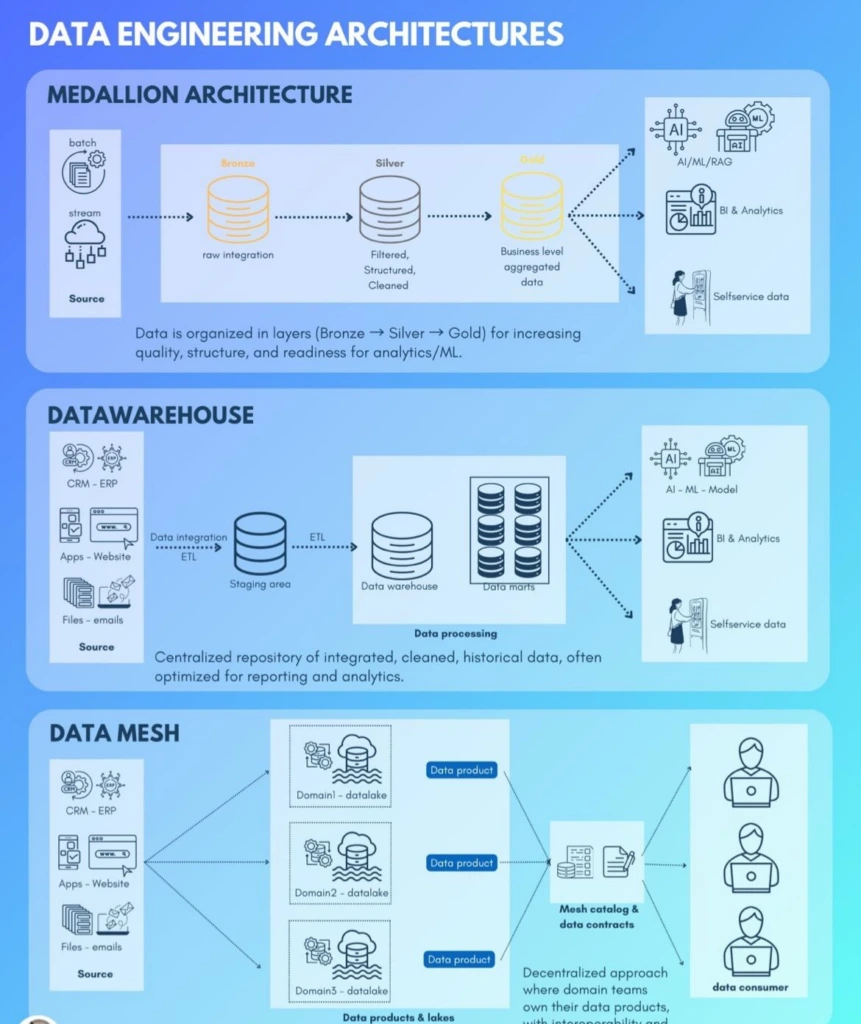
Medallion Architecture vs Lakehouse: Which Is Better?
Neither is inherently better because they solve different architectural problems. A lakehouse answers the question, “What type of enterprise data platform should we operate?” Medallion answers, *“How should data be progressively organized and refined within that platform?” For many enterprises, the practical answer is a lakehouse implemented with an appropriate Medallion pattern.
Enterprise Decision Matrix
| Enterprise Requirement | Recommended Direction |
|---|---|
| Need scalable unified data platform | Lakehouse |
| Need Bronze/Silver/Gold data boundaries | Medallion |
| Need BI + ML + data engineering | Lakehouse |
| Need progressive data quality | Medallion |
| Need raw-data preservation | Medallion |
| Need structured + semi-structured data | Lakehouse |
| Need reusable conformed datasets | Medallion |
| Need one platform for diverse analytical workloads | Lakehouse |
| Need clear transformation ownership | Medallion |
| Need both platform scalability and governed data refinement | Lakehouse + Medallion |
Lakehouse Without Medallion: When It Can Make Sense
A lakehouse does not automatically require Bronze, Silver, and Gold.
Some workloads may be simpler.
For example:
Source
  ↓
Lakehouse Table
  ↓
Analytics
This may be sufficient when:
- The data pipeline is simple.
- Data has a single primary consumer.
- Transformations are minimal.
- Source data is already high quality.
- There is limited need for multiple downstream products.
- Operational complexity must remain low.
Microsoft’s current Fabric guidance explicitly notes that there is no single correct Medallion design. Bronze, Silver, and Gold can use lakehouses, warehouses, or combinations depending on where data lands, how transformations are executed, and how curated data is served.
Medallion Architecture Without a Lakehouse?
Medallion architecture is a logical design pattern, so it does not inherently require a specific lakehouse platform. Bronze, Silver, and Gold can be implemented using different storage and processing technologies, including combinations of lakehouse and warehouse technologies. The important consideration is whether each layer has a clear responsibility and whether the overall design meets workload and governance requirements.
For example:
Bronze Lakehouse
      ↓
Silver Lakehouse
      ↓
Gold Warehouse
      ↓
Semantic Model
      ↓
Power BI
This hybrid model can be appropriate when:
- Raw and semi-structured data require lakehouse capabilities.
- SQL-first analytics dominate the Gold layer.
- BI workloads require highly relational models.
- Existing warehouse investments need to be preserved.
Microsoft’s current architecture guidance describes both lakehouse-first and hybrid patterns, including lakehouses for Bronze/Silver and a warehouse for Gold when SQL-first serving or relational modeling is appropriate.
How to Choose Between Lakehouse-First, Warehouse-First, and Hybrid
The decision should be driven by workload—not architecture fashion.
| Decision Factor | Lakehouse-First | Warehouse-First | Hybrid |
|---|---|---|---|
| Unstructured data | Excellent fit | Limited | Excellent |
| Semi-structured data | Strong | Moderate | Strong |
| SQL-heavy BI | Strong | Excellent | Excellent |
| Data science | Excellent | Moderate | Excellent |
| ML workloads | Excellent | Moderate | Excellent |
| Large-scale Spark processing | Strong | Limited | Strong |
| Existing EDW investment | Moderate | Excellent | Excellent |
| Complex relational serving | Good | Excellent | Excellent |
| Open data formats | Strong | Platform-dependent | Strong |
| Enterprise migration | Moderate | Easier for existing DW | Often practical |
| Architectural complexity | Moderate | Moderate | Higher |
The key question is not:
“Which architecture is modern?”
The better question is:
“Which architecture minimizes unnecessary complexity while supporting our highest-value workloads?”
Medallion Architecture in Microsoft Fabric
Microsoft Fabric supports Medallion architecture through lakehouses, warehouses, OneLake, Data Factory, notebooks, semantic models, Power BI, and other workloads. Microsoft describes OneLake as the unified logical data lake for Fabric and provides implementation patterns where Bronze, Silver, and Gold can be built with lakehouses, warehouses, or combinations of both.
A typical Fabric implementation can look like:
Operational Systems
        ↓
Fabric Data Factory / Mirroring
        ↓
OneLake
        ↓
Bronze Lakehouse
        ↓
Silver Lakehouse
        ↓
Gold Lakehouse / Warehouse
        ↓
Semantic Model
        ↓
Power BI / AI / Data Agents
The exact implementation should depend on workload requirements rather than assuming every layer must use the same Fabric item type.
Microsoft’s reference architecture also recommends treating governance as a cross-cutting concern, including identity, RBAC, lineage, deployment pipelines, and certified semantic models.
Medallion Architecture in Databricks
Databricks treats Medallion architecture as a data design pattern for progressively improving data quality inside a lakehouse. Its current documentation describes Bronze as raw, Silver as validated, and Gold as enriched data, with the pattern supporting a single source of truth for enterprise data products.
A typical Databricks-oriented design is:
Cloud Storage / Applications / Streaming
                 ↓
              Bronze
                 ↓
        Validation & Quality
                 ↓
              Silver
                 ↓
      Business Transformation
                 ↓
               Gold
                 ↓
       BI / ML / AI / Applications
The important point remains the same:
Databricks lakehouse is the platform architecture; Medallion is the logical data refinement pattern.
Common Enterprise Mistakes
1. Treating Medallion and Lakehouse as Competitors
This is the most fundamental mistake.
They operate at different architectural levels.
Lakehouse = platform/data architecture
Medallion = data organization pattern\
2. Creating Bronze, Silver, and Gold Without Clear Responsibilities
Simply naming three folders or schemas Bronze, Silver, and Gold does not create a Medallion architecture.
Each layer should have explicit rules for:
- Data ownership
- Quality
- Transformation
- Schema changes
- Access
- Retention
- Lineage
- Consumption
3. Making Silver a Copy of Bronze
Silver should add meaningful value.
Typical Silver responsibilities include:
- Validation
- Standardization
- Deduplication
- Conformance
- Integration
- Historization
If Silver is simply another copy of Bronze, the architecture adds cost without improving data usability.
4. Putting Everything Into Gold
Gold should represent curated business consumption.
It should not become a dumping ground for every dataset that someone might eventually use.
Use Gold for clearly defined analytical and business requirements.
5. Assuming Every Workload Needs Three Layers
Not every dataset needs a complex Bronze → Silver → Gold journey.
For smaller or simpler workloads, fewer transformations may be more appropriate.
Architectural maturity is not measured by the number of layers.
6. Ignoring the Serving Layer
Gold data alone does not automatically create a governed analytics experience.
Enterprise architectures often still require:
- Semantic models
- Business definitions
- Security
- Row-level access
- Data catalogs
- Lineage
- BI governance
- API or application access
Enterprise Implementation Roadmap
Step 1: Classify Workloads
Document:
- BI
- Reporting
- Data science
- Machine learning
- AI
- Streaming
- Operational analytics
- Data products
Do not select the architecture before understanding the workloads.
Step 2: Classify Data
Identify:
- Structured data
- Semi-structured data
- Unstructured data
- Streaming data
- Historical data
- Sensitive data
Step 3: Define Data-Layer Responsibilities
If using Medallion, explicitly define:
Bronze → What do we preserve?
Silver → What do we validate and standardize?
Gold → What business-ready data do we publish?
Step 4: Select the Storage and Processing Model
Choose among:
- Lakehouse-first
- Warehouse-first
- Hybrid
based on workload requirements.
Step 5: Establish Governance
Define:
- Ownership
- Access controls
- Data classification
- Lineage
- Quality rules
- Retention
- Auditability
- Change management
Step 6: Build a Domain-Oriented Pilot
Start with one business domain such as:
- Customer
- Finance
- Supply chain
- Claims
- Sales
- Product
Measure:
- Data quality
- Pipeline reliability
- Query performance
- Cost
- Time to insight
- Reusability
Step 7: Scale the Pattern
Only standardize the architecture after the pilot demonstrates measurable value.
A Practical Enterprise Decision Framework
Use these five questions before selecting the architecture:
Question 1: Do we need a unified platform for diverse data workloads?
Yes → Consider a lakehouse.
Question 2: Do we need progressive data refinement and clear data boundaries?
Yes → Add a Medallion pattern.
Question 3: Are our analytical workloads primarily relational and SQL-driven?
Yes → Evaluate a warehouse-first or hybrid model.
Question 4: Do data science, ML, AI, or semi-structured data represent significant workloads?
Yes → Give strong consideration to lakehouse-first architecture.
Question 5: Are we adding layers because the business needs them—or because the architecture diagram looks better?
If the answer is the latter, simplify.
The Recommended Enterprise Pattern
For many organizations modernizing their data platform, a practical target architecture is:
                ENTERPRISE SOURCES
                       │
                       ▼
              ┌─────────────────┐
              │  DATA PLATFORM  │
              │    LAKEHOUSE    │
              └────────┬────────┘
                       │
                       ▼
              ┌─────────────────┐
              │     BRONZE      │
              │ Source-Aligned  │
              └────────┬────────┘
                       │
                       ▼
              ┌─────────────────┐
              │     SILVER      │
              │ Validated +     │
              │ Conformed       │
              └────────┬────────┘
                       │
                       ▼
              ┌─────────────────┐
              │      GOLD       │
              │ Business-Ready  │
              │ Data Products   │
              └────────┬────────┘
                       │
             ┌─────────┼─────────┐
             ▼         ▼         ▼
          BI / KPIs   AI / ML   Apps
This model separates two architectural decisions:
- Lakehouse: the underlying enterprise data platform.
- Medallion: the logical method used to refine and publish data.
That separation makes the architecture easier to evolve.
Medallion Architecture vs Lakehouse: Final Verdict
For most modern enterprise data platforms, Medallion architecture and lakehouse architecture should not be viewed as an either-or decision. A lakehouse provides the scalable data foundation, while Medallion provides a disciplined approach to moving data from raw ingestion to validated and business-ready datasets. The best architecture combines both where the workload justifies the additional layers.
The right design depends on:
- Data diversity
- Analytical workloads
- Data volume
- Processing requirements
- Governance
- Existing investments
- BI requirements
- AI/ML requirements
- Operational complexity
- Cost and scalability
The strongest architecture is therefore not necessarily the one with the most layers or the newest platform.
It is the architecture that creates the clearest path from enterprise data to trusted business outcomes with the least unnecessary complexity.
For organizations modernizing enterprise data platforms, Techment can help assess lakehouse, warehouse, and hybrid architectures; design governed Medallion data layers; and build scalable data engineering foundations for analytics and AI.
Key Takeaways
- Lakehouse and Medallion architecture solve different problems.
- A lakehouse is an enterprise data architecture; Medallion is a data design pattern.
- Medallion commonly organizes data into Bronze, Silver, and Gold.
- Lakehouses support diverse workloads across data engineering, BI, data science, ML, and AI.
- A lakehouse can be implemented with or without Medallion.
- Medallion can be implemented using lakehouses, warehouses, or hybrid architectures.
- Lakehouse + Medallion is often a strong enterprise pattern when multiple data workloads and progressive data refinement are required.
- Do not create layers without clear business, quality, governance, or operational justification.
- Choose the architecture based on workloads, data characteristics, governance, existing investments, and operating complexity.
Frequently Asked Questions
1. Is Medallion Architecture the same as a Lakehouse?
No. Medallion Architecture is a data organization and refinement pattern, while a lakehouse is a broader data platform architecture. Medallion typically organizes data into Bronze, Silver, and Gold layers, whereas a lakehouse provides the underlying environment for storing, processing, analyzing, and serving enterprise data.
2. What is the difference between Medallion Architecture and Lakehouse Architecture?
The primary difference is their architectural scope. Lakehouse architecture defines the enterprise data platform, while Medallion Architecture defines how data moves through refinement stages within that platform. A lakehouse can therefore implement Bronze, Silver, and Gold layers without the two concepts being competing alternatives.
3. Can Medallion Architecture be implemented on a Lakehouse?
Yes. Medallion Architecture is commonly implemented on lakehouse platforms. Raw source data can be stored in the Bronze layer, validated and conformed data in Silver, and curated business-ready datasets in Gold. Platforms such as Microsoft Fabric and Databricks support this architectural pattern.
4. What are the Bronze, Silver, and Gold layers?
Bronze contains raw or source-aligned data, Silver contains validated and conformed data, and Gold contains curated data designed for business consumption. These layers create a controlled progression from ingestion to analytics while improving data quality, consistency, and usability.
5. Do all Lakehouse architectures need Bronze, Silver, and Gold layers?
No. A lakehouse does not require a Medallion structure. Bronze, Silver, and Gold should be introduced when they provide meaningful benefits such as data quality management, traceability, reusable transformations, governance, or multiple downstream data products. Simpler workloads may not require all three layers.
6. Which is better for enterprise data: Lakehouse or Medallion Architecture?
Neither is inherently better because they solve different problems. A lakehouse provides the underlying data platform, while Medallion provides a structured approach to data refinement. For many enterprises, combining a lakehouse with an appropriately designed Medallion architecture provides a scalable and governed foundation.
7. Can Medallion Architecture use a data warehouse?
Yes. Medallion layers can be implemented using lakehouses, warehouses, or a combination of both. For example, an organization may use a lakehouse for Bronze and Silver processing and a warehouse for Gold data when SQL-heavy analytics and relational serving requirements make a warehouse more appropriate.
Related Reads
- Medallion Architecture Explained: Bronze, Silver, Gold Data Layers
- How to Build an AI-Ready Data Lakehouse: Proven Steps for Enterprise AI Success
- Enterprise AI Strategy in 2026
- Microsoft Fabric Data Quality & Purview Governance Guide.
- Microsoft Fabric vs Snowflake: Data Management Showdown
- What Is Microsoft Fabric? A Comprehensive Overview