Agent-to-Agent (A2A) Protocol vs MCP
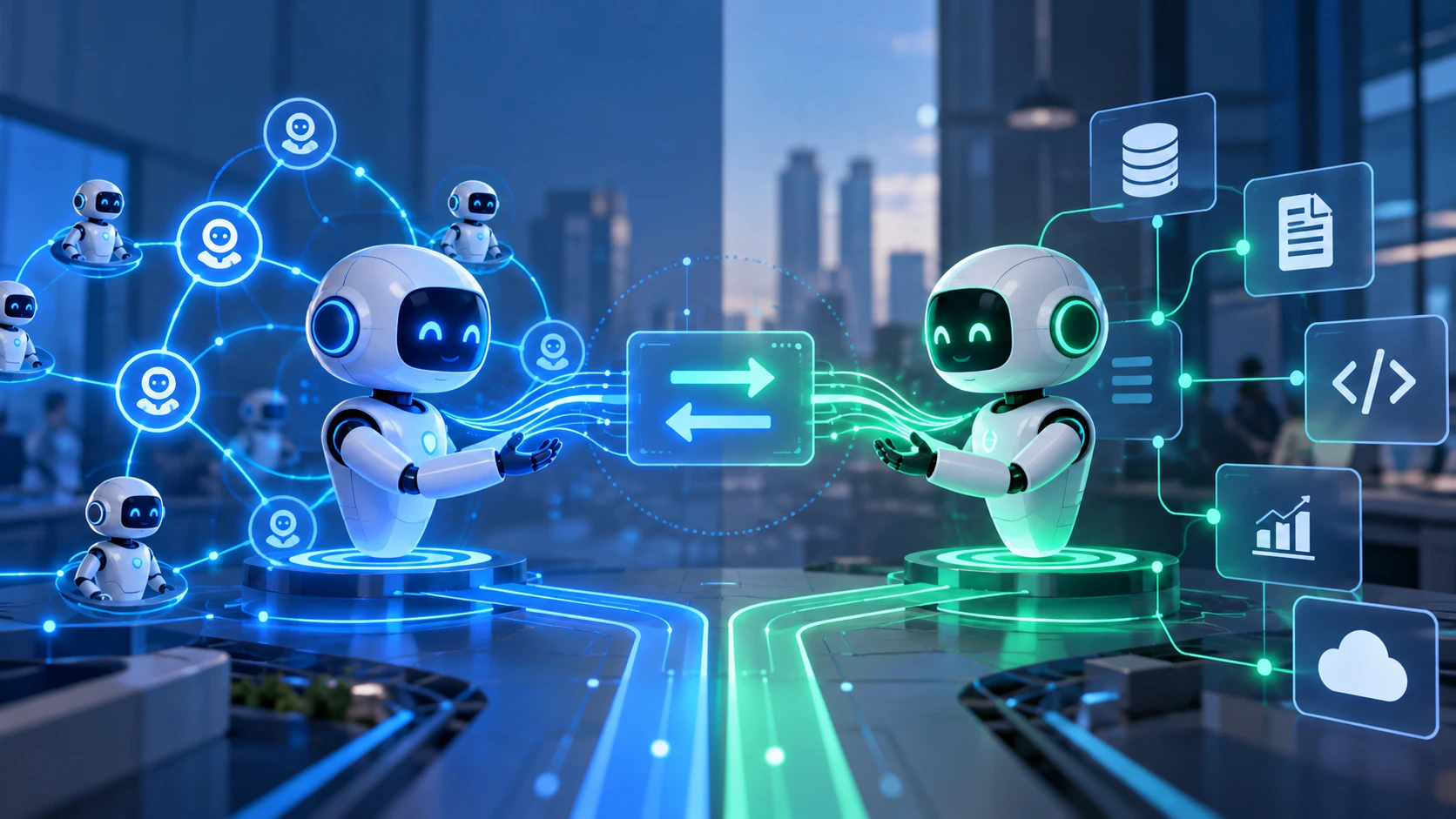
A2A and MCP solve different interoperability problems in enterprise AI. The Model Context Protocol (MCP) standardizes how an AI application or agent connects to tools, data, and external resources. The Agent2Agent (A2A) Protocol standardizes how independent AI agents discover one another, communicate, delegate work, manage tasks, and exchange results. Enterprises building multi-agent systems will often use MCP for agent-to-tool connectivity and A2A for agent-to-agent collaboration.
The simplest mental model is:
MCP connects agents to capabilities. A2A connects agents to other agents.
This distinction matters because enterprises increasingly operate AI agents across different teams, applications, frameworks, cloud platforms, and vendors. A2A was originally developed by Google and is now hosted through the Linux Foundation ecosystem, while MCP has evolved into a broader open protocol for connecting AI applications with tools and data.
TL;DR: A2A vs MCP
| A2A Protocol | MCP | |
|---|---|---|
| Full name | Agent2Agent Protocol | Model Context Protocol |
| Primary purpose | Agent-to-agent collaboration | Agent-to-tool/data connectivity |
| Connects | Agent ↔ Agent | Agent ↔ Tool / Data / Resource |
| Architectural direction | Horizontal | Vertical |
| Core concept | Delegation and collaboration | Context and capability access |
| Key objects | Agent Card, Message, Task, Artifact | Tools, Resources, Prompts |
| Best for | Multi-agent workflows | Tool and data integration |
| Long-running work | Designed around stateful Tasks | Supported through evolving task/extension mechanisms |
| Cross-vendor agents | Yes | Not its primary purpose |
| Should enterprises use both? | Often | Often |
The official A2A documentation describes MCP as connecting agents to tools and data while A2A enables agents to communicate with other agents.
What Is the A2A Protocol?
The Agent2Agent (A2A) Protocol is an open standard for communication and interoperability between independent AI agents. It enables agents built with different frameworks, languages, platforms, or vendors to discover capabilities, communicate, delegate tasks, exchange information, and collaborate without requiring access to each other’s internal state, memory, or tools.
A2A addresses a problem that becomes increasingly important as enterprises move from single agents to multi-agent architectures.
For example:
Customer Service Agent
        │
        │ A2A
        ▼
Billing Agent
        │
        │ A2A
        ▼
Fraud Agent
        │
        │ A2A
        ▼
Claims Agent
Each agent can remain independently implemented and governed while participating in a larger workflow.
What A2A Enables
A2A provides mechanisms for:
- Agent discovery
- Capability discovery
- Agent-to-agent messaging
- Task delegation
- Stateful task management
- Context continuity
- Streaming updates
- Artifact exchange
- Long-running workflows
- Authentication and authorization
- Cross-framework interoperability
A2A’s current specification defines Messages, Tasks, Parts, Artifacts, contexts, streaming, and push notifications as core concepts for agent interaction.
What Is MCP?
The Model Context Protocol (MCP) is an open protocol for connecting AI applications and agents with external tools, resources, and contextual data. MCP standardizes how clients discover and interact with server-provided capabilities such as tools, resources, and prompts instead of requiring custom integration logic for every connection.
A simplified MCP workflow looks like:

ApplicationMCP servers can expose capabilities through three major primitives:
- Tools — executable functions that an AI model or agent can invoke.
- Resources — contextual data or content that the application can retrieve.
- Prompts — predefined interaction templates or instructions.
The MCP specification distinguishes these primitives by their control model: tools are model-controlled, resources are application-controlled, and prompts are user-controlled.
Read more about What is Model Context Protocol (MCP)? – techment.com
A2A Protocol vs MCP: What Is the Difference?
The fundamental difference is the endpoint being connected. MCP connects an AI application or agent to tools, data, and resources; A2A connects one independent agent to another. MCP extends what an agent can access, while A2A extends what an agent can collaborate with. The two protocols therefore operate at different layers and are generally complementary rather than competing technologies.
The simplest distinction
MCP:
“Agent, here is a capability you can use.”
A2A:
“Agent, here is another agent you can collaborate with.”
Architectural View
                    ENTERPRISE AI SYSTEM
                            │
             ┌──────────────┴──────────────┐
             │                             │
        A2A — Horizontal              MCP — Vertical
             │                             │
     Agent ↔ Agent                  Agent ↔ Capability
             │                             │
     ┌───────┼───────┐           ┌─────────┼─────────┐
     ▼       ▼       ▼           ▼         ▼         ▼
  Claims  Finance  HR         API      Database    SaaS
  Agent    Agent  Agent
The A2A documentation explicitly describes this distinction as horizontal agent collaboration versus vertical connectivity to tools and resources.
A2A vs MCP Comparison
| Capability | A2A | MCP |
|---|---|---|
| Connect two independent agents | Yes | Not its primary purpose |
| Connect agent to database | Not its primary purpose | Yes |
| Connect agent to API | Not its primary purpose | Yes |
| Agent discovery | Yes | Server capability discovery |
| Tool discovery | Not the core abstraction | Yes |
| Task delegation | Yes | Not the primary model |
| Stateful agent collaboration | Yes | Different model |
| Cross-agent communication | Yes | No |
| Context/data access | Through agent interaction | Core capability |
| Long-running agent task | Core concept | Supported through MCP capabilities/extensions depending on implementation |
| Artifact exchange | Yes | Tool/resource outputs |
| Multi-agent orchestration | Yes | Supports the individual agent’s capabilities |
| Cross-vendor agent interoperability | Core objective | Primarily capability interoperability |
| Best architectural role | Agent collaboration layer | Tool/context integration layer |
How Does A2A Work?
A2A begins with agent discovery and capability negotiation, then allows an agent to send messages, create or continue tasks, receive progress updates, and retrieve artifacts from another agent. A2A uses an Agent Card to describe an agent’s capabilities, supported interfaces, authentication requirements, and skills so clients can determine how to interact with it.
A simplified flow is:
1. Discover Agent
        ↓
2. Read Agent Card
        ↓
3. Understand Capabilities
        ↓
4. Send Message
        ↓
5. Create / Continue Task
        ↓
6. Receive Status Updates
        ↓
7. Receive Artifact
        ↓
8. Complete Task
Agent Cards
An Agent Card provides structured information about an A2A agent, including capabilities, supported protocols, authentication requirements, and available skills. The A2A specification also defines a standardized .well-known/agent-card.json location for discovery.
This is important in enterprise environments because an agent does not need to know the internal implementation of another agent before interacting with it.
How Does MCP Work?
MCP uses a client-server model in which an AI application connects to MCP servers that expose tools, resources, and prompts. The client can discover available capabilities and invoke tools or retrieve resources using standardized protocol interactions rather than building custom integrations for each system.
A simplified MCP flow is:
AI Application / Agent
          │
          ▼
      MCP Client
          │
          ▼
       MCP Server
          │
    ┌─────┼─────┐
    ▼     ▼     ▼
  Tools Resources Prompts
    │
    ▼
Enterprise Systems
For example, an MCP server could expose:
lookup_customer()
get_invoice()
search_policy()
create_ticket()
query_database()
The agent can discover and invoke these capabilities through MCP rather than requiring a custom integration for every tool.
Can A2A and MCP Be Used Together?
Yes. A2A and MCP are designed to solve complementary interoperability problems and can be used together in the same enterprise agent architecture. An agent can use MCP to access its internal tools and enterprise systems while using A2A to delegate work to another specialized agent.
Consider an insurance claims workflow:
                 Claims Agent
                 /          \
              MCP            A2A
               /              \
              ▼                ▼
       Claims Database     Fraud Agent
       Policy System            │
       Payment API              │ MCP
                                ▼
                           Fraud Systems
The Claims Agent uses MCP vertically to access its tools and data.
It uses A2A horizontally to collaborate with the Fraud Agent.
The Fraud Agent independently uses MCP to access its own tools and resources.
This creates a layered architecture:
              Agent Layer
 ┌──────────────────────────────────┐
 │ Claims │ Fraud │ Billing │ Legal │
 └────┬────────┬────────┬───────────┘
      │        │        │
      └──────── A2A ─────┘
      │        │        │
     MCP      MCP      MCP
      │        │        │
 ┌────▼────────▼────────▼───────────┐
 │ APIs │ Databases │ SaaS │ Apps  │
 └──────────────────────────────────┘
When Should Enterprises Use A2A?
Use A2A when independent agents need to collaborate, delegate tasks, exchange information, or coordinate long-running work across organizational, application, framework, or vendor boundaries. A2A is particularly valuable when wrapping another agent as a simple tool would hide the agent’s ability to reason, negotiate, maintain task state, or produce complex artifacts.
Strong A2A Use Cases
Multi-Agent Enterprise Workflows
Customer Agent
      ↓
Eligibility Agent
      ↓
Pricing Agent
      ↓
Underwriting Agent
      ↓
Decision Agent
Cross-Department Agent Collaboration
A sales agent may delegate:
- Pricing → Pricing Agent
- Contract review → Legal Agent
- Credit assessment → Finance Agent
- Customer onboarding → Operations Agent
Cross-Organization Collaboration
A company agent may communicate with:
- Supplier agents
- Logistics agents
- Banking agents
- Insurance agents
- Partner agents
Long-Running Workflows
A2A’s Task model supports stateful work that may require progress updates, additional input, authentication, or eventual completion.
When Should Enterprises Use MCP?
Use MCP when an AI agent needs standardized access to enterprise tools, APIs, databases, files, applications, or contextual resources. MCP is especially useful for reducing the custom integration work required when agents need to interact with many enterprise systems.
Strong MCP Use Cases
- Database queries
- CRM access
- ERP operations
- File and document retrieval
- Internal APIs
- SaaS applications
- Search systems
- Business applications
- Enterprise knowledge repositories
- Developer tools
- Data platforms
For example:
Finance Agent
      │
      └── MCP
           ├── ERP
           ├── Accounts Database
           ├── Payment API
           └── Financial Reports
MCP gives the agent standardized interfaces to those capabilities.
A2A vs MCP: Which Protocol Should Your Enterprise Choose?
The decision depends on what your AI system needs to communicate with. Choose MCP for agent-to-tool, agent-to-data, and agent-to-resource connectivity; choose A2A for agent-to-agent collaboration and delegation. If the enterprise is building a multi-agent system, using both is often more appropriate than choosing one.
| Enterprise Requirement | Recommended Protocol |
|---|---|
| Agent needs database access | MCP |
| Agent needs API access | MCP |
| Agent needs CRM/ERP access | MCP |
| Agent needs enterprise files | MCP |
| Agent needs another specialized agent | A2A |
| Agents need task delegation | A2A |
| Agents need cross-vendor collaboration | A2A |
| Long-running agent-to-agent task | A2A |
| Multiple agents each need enterprise tools | A2A + MCP |
| Multi-agent enterprise architecture | A2A + MCP |
A2A + MCP Enterprise Architecture
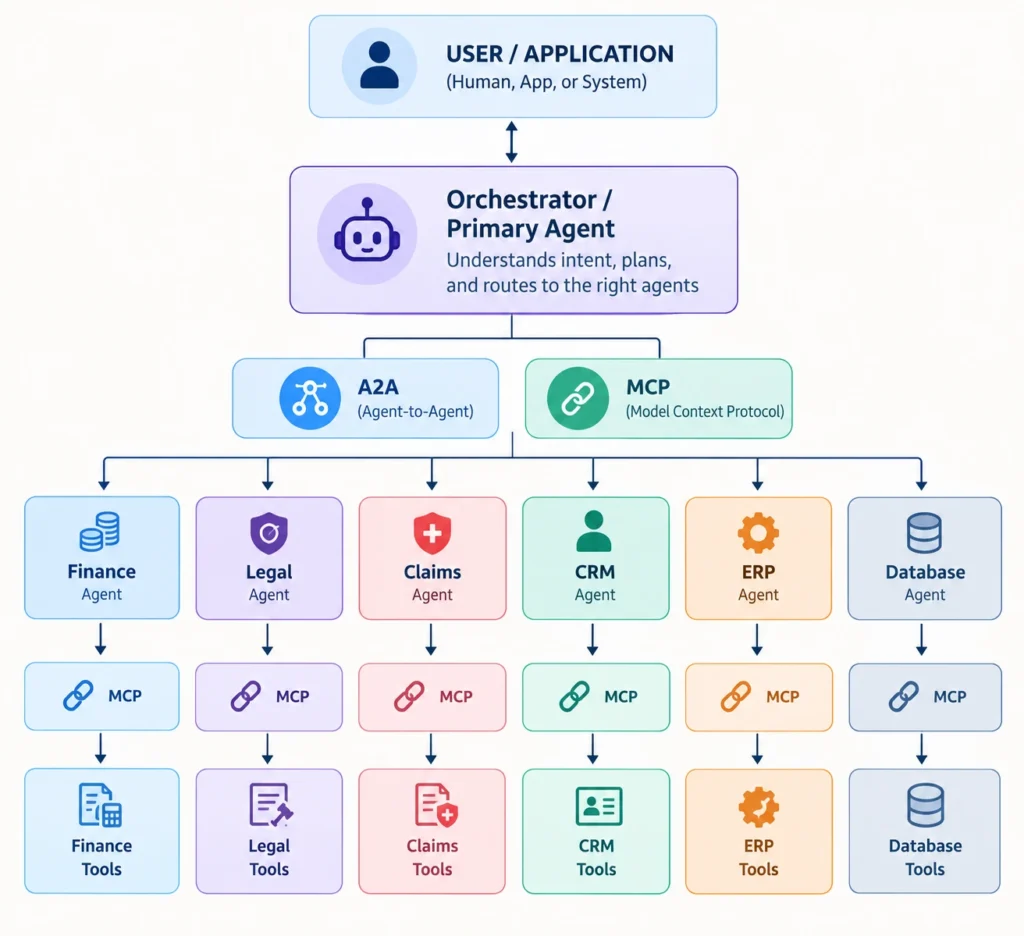
A mature enterprise architecture can combine the two protocols:
Architectural Principle
Use A2A at the agent boundary and MCP at the capability boundary.
This gives each agent autonomy over its internal tools and implementation while allowing agents to collaborate through a standardized external interface.
A2A and MCP for Enterprise Security
Protocol interoperability does not automatically provide enterprise security. Organizations still need identity, authentication, authorization, least privilege, data protection, auditability, network controls, monitoring, and policy enforcement around both A2A and MCP deployments.
MCP Security Considerations
MCP deployments should address:
- Authentication
- Authorization
- OAuth/OIDC integration
- Tool permissions
- Sensitive data access
- Server trust
- Input validation
- Output handling
- Audit logging
- Network isolation
- Tool-level risk
The MCP project has continued strengthening enterprise authorization. The July 2026 specification introduced additional authorization hardening, while Enterprise-Managed Authorization became a stable MCP extension for centrally provisioning access to MCP servers through an organization’s identity provider.
A2A Security Considerations
A2A deployments should address:
- Agent identity
- Agent authentication
- Authorization
- Agent discovery trust
- Task-level permissions
- Data minimization
- Artifact protection
- Context isolation
- Cross-organization trust
- Auditability
- Secure transport
A2A Agent Cards can expose capability and authentication information, but they should not expose sensitive credentials or internal implementation details. The current specification also describes mechanisms for protecting and, where applicable, signing Agent Cards.
Read our blog on RAG in 2026: How Retrieval-Augmented Generation Works for Enterprise AI
Enterprise Governance for A2A and MCP
The protocol should not become the governance boundary by itself.
Enterprises should establish governance at four levels:
| Governance Layer | Key Controls |
|---|---|
| Agent Identity | Identity, authentication, ownership |
| Capability Access | Tools, APIs, data permissions |
| Agent Collaboration | A2A trust, delegation, task authorization |
| Data Governance | Classification, privacy, retention, audit |
| Operational Governance | Monitoring, tracing, incident response |
A practical enterprise policy is:
Every agent should have a defined identity, owner, purpose, allowed capabilities, data boundaries, and audit trail.
A2A vs MCP: Common Enterprise Mistakes
1. Treating A2A and MCP as Competitors
They address different interaction patterns.
MCP = agent ↔ capability
A2A = agent ↔ agent
2. Wrapping Every Agent as an MCP Tool
An agent is not always equivalent to a deterministic tool.
An independent agent may need to:
- Negotiate
- Ask questions
- Maintain task state
- Provide progress
- Delegate further
- Produce multiple artifacts
A2A is designed to preserve this richer agent interaction model.
3. Using A2A for Every Integration
If an agent simply needs to query a database or invoke an API, introducing another agent may add unnecessary complexity.
Use MCP when the requirement is primarily tool or resource access.
4. Ignoring Authorization
Connecting an agent to an enterprise system can create a new path to sensitive data and business actions.
Authorization must be designed before exposing production capabilities.
5. Building Agent Meshes Without Observability
As agents delegate to other agents and those agents call tools, failures can span multiple protocol boundaries.
Enterprise implementations should therefore correlate:
User Request
   ↓
Agent
   ↓
A2A Task
   ↓
Remote Agent
   ↓
MCP Tool
   ↓
Enterprise API
Tracing and auditability should follow the complete execution path.
A Practical A2A + MCP Implementation Roadmap
1. Identify Agent Boundaries
Determine which capabilities should remain inside one agent and which should become independent agents.
2. Identify Tool and Data Boundaries
For each agent, document:
- APIs
- Databases
- SaaS systems
- Files
- Search systems
- Enterprise applications
These are MCP candidates.
3. Define Agent-to-Agent Workflows
Identify where agents need:
- Delegation
- Collaboration
- Negotiation
- Long-running tasks
- Cross-team communication
These are A2A candidates.
4. Establish Identity and Authorization
Define:
- Agent identity
- User identity
- Service identity
- Tool permissions
- Agent permissions
- Data access
- Cross-organization trust
5. Implement MCP Capability Servers
Expose enterprise capabilities through governed MCP servers rather than creating uncontrolled direct integrations.
6. Implement A2A Agent Interfaces
Publish agent capabilities through appropriate A2A discovery mechanisms and define which tasks each agent accepts.
7. Add Observability
Track:
- Agent requests
- A2A messages
- Task lifecycle
- MCP tool calls
- Latency
- Errors
- Authorization decisions
- Business outcomes
8. Start With One High-Value Workflow
Avoid building an enterprise-wide agent mesh immediately.
Start with a workflow where:
multiple specialized agents + shared enterprise tools = measurable business value.
A2A vs MCP: Enterprise Decision Framework
Ask these questions:
Does the agent need another agent?
Yes → A2A
Does the agent need a database, API, file, or application?
Yes → MCP
Does the remote capability need its own reasoning and task lifecycle?
Yes → A2A
Is the capability primarily a well-defined function?
Yes → MCP
Do multiple specialized agents need to collaborate?
Yes → A2A
Does each agent need access to enterprise systems?
Yes → MCP
Does the architecture require both?
Yes → Use A2A + MCP together.
The Future Enterprise Agent Architecture
The direction of enterprise agent architecture is moving from isolated AI applications toward interoperable agent ecosystems.
A mature architecture can be represented as:
                         HUMAN / BUSINESS APP
                                  │
                                  ▼
                       ┌─────────────────────┐
                       │   Primary Agent     │
                       └──────────┬──────────┘
                                  │
                           A2A Collaboration
                                  │
             ┌────────────────────┼────────────────────┐
             ▼                    ▼                    ▼
        Specialist Agent    Specialist Agent    Specialist Agent
             │                    │                    │
            MCP                  MCP                  MCP
             │                    │                    │
       Enterprise Tools     Enterprise Tools     Enterprise Tools
             │                    │                    │
             └────────────────────┼────────────────────┘
                                  ▼
                       Enterprise Data / Systems
This separation allows enterprises to evolve agents and tools independently.
The A2A ecosystem has also moved toward broader industry governance. In 2025, Google announced that A2A was being transferred to the Linux Foundation with participation from organizations including AWS, Cisco, Microsoft, Salesforce, SAP, and ServiceNow. In 2026, the Linux Foundation reported more than 150 organizations supporting A2A and production adoption across several industries.
A2A Protocol vs MCP: Final Verdict
A2A and MCP are complementary protocols, not direct competitors. MCP standardizes how agents access tools, APIs, data, and resources; A2A standardizes how independent agents discover, communicate, delegate, and collaborate. For a simple AI assistant that only needs enterprise tools, MCP may be sufficient. For a multi-agent enterprise system, A2A and MCP can work together: A2A handles agent collaboration while MCP handles each agent’s access to enterprise capabilities.
The practical rule is:
Use MCP to give an agent capabilities. Use A2A to give an agent collaborators.
For enterprises building production-grade AI agents, the architectural decision should therefore focus less on A2A vs MCP and more on defining clear boundaries between:
Agents → Agent Collaboration → Tools → Data → Enterprise Systems
Techment can help enterprises design this architecture, establish governed MCP integrations, implement interoperable A2A-based agent workflows, and build production-ready multi-agent systems across enterprise data and applications.
Key Takeaways
- A2A and MCP solve different interoperability problems.
- MCP connects AI agents to tools, data, and resources.
- A2A connects independent AI agents to one another.
- MCP is primarily a vertical capability integration layer.
- A2A is primarily a horizontal agent collaboration layer.
- A2A supports agent discovery, delegation, task management, context, streaming, and artifacts.
- MCP exposes capabilities such as tools, resources, and prompts.
- Enterprises can use A2A and MCP together in multi-agent architectures.
- Security, identity, authorization, governance, and observability remain enterprise responsibilities.
- The right question is not “A2A or MCP?” but “Where is the agent boundary, and where is the capability boundary?”
FAQs
1. What is the difference between A2A and MCP?
A2A enables communication and collaboration between independent AI agents, while MCP enables AI agents to interact with tools, data, and external resources. A2A is designed around agent-to-agent interoperability; MCP is designed around agent-to-capability interoperability.
2. Is A2A better than MCP?
No. A2A and MCP are designed for different purposes. MCP is better suited to connecting agents with tools and enterprise resources, while A2A is better suited to communication and task delegation between independent agents.
3. Can A2A and MCP be used together?
Yes. An enterprise agent can use MCP to access databases, APIs, and business applications while using A2A to delegate work to specialized agents. This combination is well suited to multi-agent enterprise architectures.
4. Is A2A a replacement for MCP?
No. A2A does not replace MCP. A2A focuses on agent-to-agent collaboration, while MCP focuses on agent access to tools, data, and resources. They address complementary layers of an agentic architecture.
5. What is MCP used for?
MCP is used to standardize how AI applications and agents connect to tools, databases, APIs, files, enterprise applications, resources, and prompts. Its standardized capability model reduces the need for custom integration logic for every system.
6. What is A2A used for?
A2A is used for agent discovery, communication, delegation, collaboration, task management, and interoperability between independent AI agents. It is particularly useful when agents operate across different applications, teams, frameworks, or vendors.
7. When should an enterprise use A2A instead of MCP?
Use A2A when the remote capability is itself an independent agent that needs to reason, collaborate, negotiate, manage tasks, or maintain an interaction lifecycle. Use MCP when the remote capability is primarily a tool, API, database, or resource.
8. What is the best protocol for a multi-agent enterprise architecture?
A2A + MCP is often the strongest combination. Use A2A for communication and delegation between agents and MCP for each agent’s access to enterprise tools, APIs, data, and applications.
Related Reads
- RAG in 2026
- What is Model Context Protocol (MCP)? A Complete Enterprise Guide
- RAG vs Fine-Tuning vs AI Agents: Choosing the Right LLM Strategy
- Best Practices for Generative AI Implementation in Business.
- Agentic AI
- Microsoft Fabric Readiness Assessment
- AI, data and analytics trends to rule in 2026
- Enterprise Data Quality Framework: Best Practices for Reliable Analytics and AI
- How to Manage AI Agents Across Your Organization: Governance, Security & Best Practices