

Introduction
Enterprise leaders have no shortage of dashboards in 2026.
Revenue metrics, customer acquisition, pipeline performance, retention, operational KPIs—everything is measurable. Yet when an executive asks a simple question—
“Why did this number change?”
—the answer often takes days.
The problem is not a lack of data.
It is decision latency.
Traditional dashboards show what happened, but they rarely explain why it happened or what should happen next. Answers still depend on analyst tickets, manual reporting, and fragmented systems.
This is where conversational analytics changes the equation.
Conversational analytics allows enterprise teams to ask business questions in plain language and receive trusted answers from live enterprise data. Instead of navigating reports or writing SQL, leaders can ask:
“Why did pipeline slow in EMEA?”
“Which channels increased CAC this quarter?”
“What caused churn to rise among enterprise accounts?”
And get answers instantly.
More importantly, conversational analytics transforms analytics from static reporting into real-time decision intelligence.
In this guide, we explore what conversational analytics is, how it works, where it creates enterprise value, and what leaders must do to adopt it successfully in 2026.
TL;DR
- Conversational analytics turns enterprise data into a queryable intelligence layer, allowing leaders to ask business questions in plain language and receive trusted answers instantly.
- Traditional dashboards explain what happened. Conversational analytics helps leaders understand why it happened and what to do next.
- Enterprise adoption is accelerating as AI reshapes analytics workflows, reducing analyst bottlenecks and improving decision speed.
- The difference between reliable and unreliable systems comes down to architecture: trusted conversational analytics retrieves answers from governed enterprise data, not AI guesses.
- Organizations with inconsistent metric definitions, fragmented data, or weak governance will struggle unless they first establish semantic consistency.
- Conversational analytics does not replace dashboards. It augments them, turning static reporting into dynamic investigation.
What Makes Conversational Analytics Different? It’s a Query Model, Not a Dashboard Feature
Most enterprise leaders misunderstand conversational analytics because vendors position it as an AI enhancement layered onto dashboards.
That framing misses the bigger shift.
Conversational analytics is not a reporting feature. It is a fundamentally different query model.
Traditional business intelligence assumes users know what they are looking for before opening a dashboard.
You select filters.
Choose dimensions.
Adjust timeframes.
Interpret charts.
The burden sits with the user to discover meaning.
Conversational analytics flips this model entirely.
Instead of navigating interfaces, leaders ask questions the same way they would speak to a business analyst.
From Static Reporting to Dynamic Investigation
Consider how traditional analytics works in practice.
A dashboard might reveal:
- Marketing-qualified leads declined 22%
- Revenue conversion slowed
- Regional growth underperformed
Useful?
Yes.
Actionable?
Not necessarily.
Dashboards explain what changed.
They rarely explain why it changed.
Enterprise leaders operate in environments where decisions cannot wait for a reporting cycle.
The modern executive challenge is no longer information scarcity.
It is interpretation speed.
Conversational analytics compresses the path between question and insight.
Instead of opening six reports to investigate performance, leaders can ask:
“Why did MQL performance decline in APAC?”
A mature conversational analytics platform may respond:
MQL volume declined 19% due to reduced paid search conversions and weaker webinar engagement. Paid social traffic increased but converted below historical benchmarks.
The distinction matters.
Traditional BI surfaces metrics.
Conversational analytics surfaces business explanations.
Why the Market Is Accelerating
Enterprise demand for conversational analytics is growing because executive decision cycles continue to shrink.
According to market forecasts, conversational AI markets are expected to exceed $40 billion by the end of the decade as enterprises integrate natural language interfaces into business systems.
However, this trend is not about replacing analysts.
It is about changing how organizations access analytical intelligence.
Enterprise teams increasingly expect data accessibility to function the same way information retrieval works elsewhere:
Ask a question.
Get an answer.
Continue the conversation.
This expectation is shaping the future of analytics.
The Enterprise Shift: From Dashboards to Decision Intelligence
The long-term implication is larger than reporting efficiency.
Conversational analytics represents a move toward decision intelligence systems.
In practice, this means:
- Less dashboard dependency
- Faster executive alignment
- Reduced analyst bottlenecks
- Improved cross-functional collaboration
- Greater accessibility for non-technical teams
Organizations investing in AI-enabled analytics are increasingly treating conversational interfaces as part of their broader enterprise intelligence architecture. Gartner predicts conversational AI will become a primary customer interaction channel for many enterprises by the end of the decade.
Organizations modernizing their data ecosystems are increasingly integrating conversational intelligence into broader AI and analytics strategies, similar to the approaches discussed in Enterprise AI Strategy in 2026.
Traditional Analytics vs Conversational Analytics
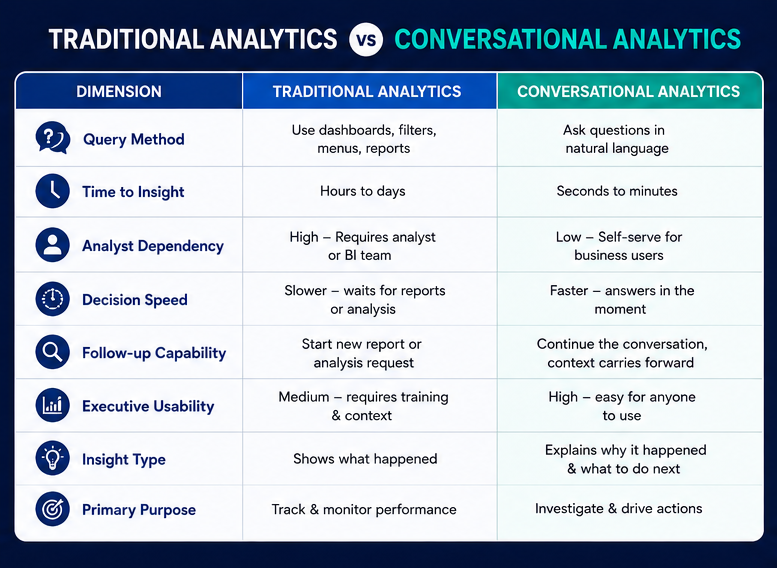
Explore the strategic differences between conversational analytics and traditional web analytics for better insights.
Dashboards Track. Conversational Analytics Investigates. Enterprise Teams Need Both.
The debate between dashboards and conversational analytics often gets framed incorrectly.
This is not a replacement story.
It is an evolution story.
Dashboards remain essential enterprise infrastructure.
But they solve a different problem.
What Dashboards Still Do Exceptionally Well
Dashboards provide organizational alignment.
They establish:
- Common KPIs
- Shared visibility
- Historical tracking
- Performance benchmarking
A weekly executive dashboard ensures everyone works from the same numbers.
Revenue.
Pipeline.
Retention.
Campaign performance.
Operational efficiency.
That consistency matters.
Without dashboards, organizations lose reporting discipline.
But dashboards have limits.
The moment an executive asks an unplanned question, the system breaks.
Questions like:
“Why did enterprise conversion rates fall after our pricing update?”
or
“Which acquisition channels drove margin erosion?”
rarely have a prebuilt answer.
Someone has to investigate.
That process introduces delay.
The Hidden Cost of Decision Latency
Here is the real enterprise problem:
Insight latency becomes decision latency.
When answers arrive three days later:
- Budgets remain frozen
- Campaigns continue underperforming
- Opportunities get missed
- Leadership alignment weakens
The consequence is rarely visible on a dashboard itself.
But it compounds operational inefficiency.
Organizations often assume slow decisions result from governance or bureaucracy.
In reality, delayed analytics is frequently the hidden bottleneck.
Conversational analytics solves this by shortening the distance between uncertainty and clarity.
Instead of creating a ticket for a BI analyst, leaders ask:
“Break enterprise pipeline decline down by geography.”
Then follow up:
“Which channels underperformed?”
Then:
“Compare performance to last quarter.”
The interaction becomes investigative rather than procedural.
Conversational Analytics as a Layer—Not a Replacement
The most successful enterprises are not abandoning dashboards.
They are layering conversational analytics on top of them.
Think of it this way:
Dashboards = Scoreboard
Conversational Analytics = Analyst
One shows the score.
The other explains the score.
Enterprise leaders need both.
Without dashboards, organizations lose visibility.
Without conversational analytics, they lose responsiveness.
The Future Operating Model
In 2026, leading enterprises increasingly operate with a hybrid intelligence model:
- Dashboards for monitoring
- Conversational AI for investigation
- Analysts for strategic interpretation
This creates a much healthier analytics operating model.
Analysts stop spending hours answering repetitive questions like:
“What was MQL growth last month?”
Instead, they focus on:
- forecasting
- modeling
- experimentation
- strategic interpretation
- governance
That shift raises enterprise analytics maturity significantly.
Organizations modernizing their data ecosystems are increasingly integrating conversational intelligence into broader AI and analytics strategies, similar to the approaches discussed in Enterprise AI Strategy in 2026.
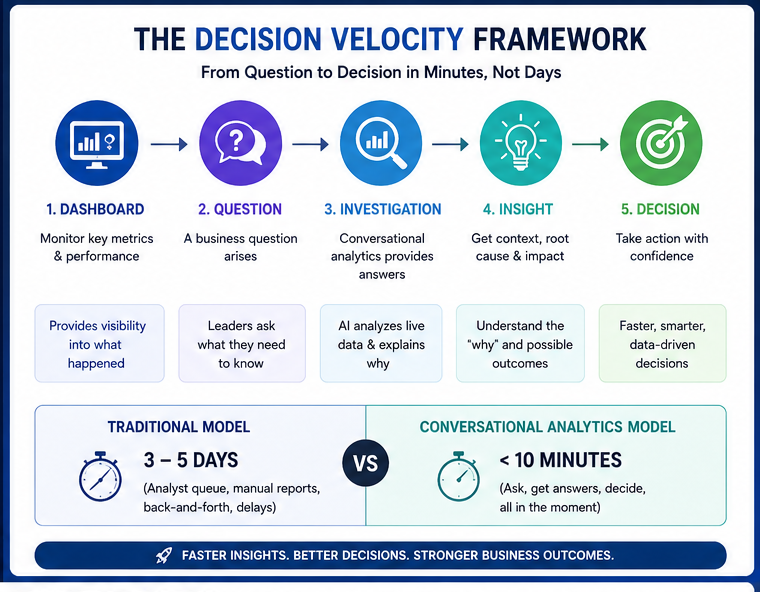
How Conversational Analytics Actually Works ?
Enterprise leaders are increasingly enthusiastic about AI-powered analytics.
They are also increasingly skeptical.
And for good reason.
Many executives have already experimented with generative AI tools and encountered the same frustrating pattern:
The answer sounds convincing.
But the numbers are wrong.
That experience creates trust problems.
For conversational analytics to become enterprise infrastructure, organizations must understand an important truth:
Not all conversational analytics systems are architected the same way.
The difference between trusted decision intelligence and AI-generated guesswork comes down to how the system handles data, language, and mathematics.
The Critical Distinction: Prediction vs Retrieval
Here is the question every enterprise buyer should ask vendors:
“Does the AI model calculate my business metrics—or retrieve them from governed systems?”
That distinction changes everything.
In many generic AI implementations, the large language model (LLM) attempts to interpret numbers, summarize trends, and infer outcomes.
This creates a major enterprise risk.
The model is generating statistically plausible responses, not necessarily accurate business truths.
For example:
An executive asks:
“How did customer acquisition cost change in North America last quarter?”
A generic AI system may approximate an answer based on uploaded files or fragmented context.
A conversational analytics platform, however, should:
- query live CRM data
- retrieve actual financial metrics
- validate semantic definitions
- apply governed calculations
- return the verified answer
The LLM’s role should be limited to translation and explanation, not mathematical computation.
This distinction dramatically improves reliability.
The Enterprise Architecture Behind Trusted Conversational Analytics
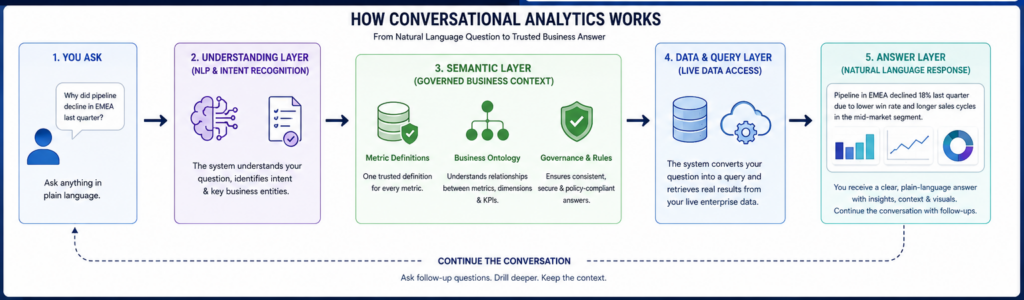
A mature conversational analytics platform typically operates across five layers.
1. Natural Language Interface
The process begins with the question.
Executives interact naturally:
“Why did marketing pipeline decline in EMEA?”
No SQL.
No report building.
No dashboard configuration.
This dramatically lowers analytical friction across business teams.
2. Natural Language Processing (NLP)
The system interprets meaning.
It identifies:
- intent
- business entities
- timeframes
- metrics
- comparative logic
For example:
The system recognizes:
- metric: pipeline
- region: EMEA
- intent: causal analysis
- time period: current vs prior quarter
This step converts human language into structured analytical logic.
3. Semantic Layer
This is arguably the most important enterprise component.
The semantic layer acts as the organization’s single source of metric truth.
It standardizes business definitions such as:
- CAC
- MQL
- ARR
- Churn
- Pipeline coverage
- Marketing attribution
Without a semantic layer, conversational analytics becomes dangerous.
Different teams inevitably define metrics differently.
Marketing may calculate CAC one way.
Finance may calculate it another.
Revenue operations may use a third definition.
A governed semantic layer eliminates inconsistency.
The result:
Every executive receives the same answer to the same question.
That trust becomes foundational for enterprise AI.
4. Live Data Query Layer
The system then queries connected enterprise systems:
- CRM platforms
- ERP systems
- Marketing automation
- Cloud warehouses
- BI environments
- Ad platforms
- Operational databases
This ensures answers are retrieved from live business systems, not generated from memory.
5. Natural Language Response Layer
Finally, the AI explains the findings.
Instead of simply returning numbers, conversational analytics provides context:
Pipeline declined 18% due to reduced paid search conversion in Germany and lower webinar attendance among mid-market accounts.
Then executives can follow up:
“Break that down by acquisition channel.”
The conversation continues naturally.
That continuity is what makes conversational analytics powerful.
Organizations modernizing legacy analytics infrastructures are increasingly exploring integrated data strategies similar to those outlined in: Leveraging Data Transformation for Modern Analytics


Five Enterprise Questions Leaders Can Ask Right Now
Most conversations around conversational analytics remain theoretical.
Enterprise adoption accelerates only when leaders understand practical workflows.
Here are five real enterprise scenarios where conversational analytics immediately changes decision-making velocity.

What Conversational Analytics Actually Changes for Enterprise Leaders
Most AI analytics conversations focus on efficiency.
That framing is incomplete.
The real value is not faster reporting.
It is better organizational decision-making.
1. Decision Velocity Increases
Enterprise performance increasingly depends on speed.
When answers arrive immediately:
- meetings become action-oriented
- budget decisions accelerate
- operational risks surface sooner
- experimentation cycles shorten
Organizations stop waiting for Wednesday’s report.
2. Analyst Bottlenecks Decrease
Highly paid analysts spend too much time answering repetitive questions:
“What happened last month?”
Conversational analytics automates routine inquiry.
Analysts can instead focus on:
- predictive modeling
- experimentation
- business interpretation
- strategic forecasting
This creates higher-value analytics functions.
3. Data Literacy Expands
One of the largest enterprise barriers remains accessibility.
Technical complexity prevents non-technical leaders from engaging with data.
Conversational analytics removes this friction.
Instead of SQL skills, leaders need curiosity.
This expands enterprise data maturity significantly.
4. Cross-Functional Alignment Improves
The most overlooked benefit is organizational trust.
When everyone accesses the same governed answers:
- finance aligns with marketing
- operations align with sales
- executives align around evidence
Data stops becoming political.
It becomes operational.

What Enterprise Leaders Must Watch Out For
Conversational analytics is transformative.
It is not magical.
Three enterprise risks matter most.
Hallucination Risk
Generic AI systems may invent answers.
If the model calculates business logic itself, trust collapses.
Always validate:
Does the system retrieve answers—or generate assumptions?
Governance Gaps
Broken metric definitions destroy trust.
Conversational analytics exposes governance weaknesses.
It does not fix them.
Organizations must standardize definitions before scaling.
Relevant governance strategies are explored in Data Governance for Data Quality: Future-Proofing Enterprise Data
Data Quality Failures
Poor-quality data produces poor-quality answers.
AI cannot rescue fragmented systems.
Organizations should prioritize:
- clean data pipelines
- metric standardization
- metadata governance
- semantic consistency
Suggested Visual
How Techment Helps Enterprises Build Trusted Conversational Analytic
Enterprise conversational analytics succeeds only when the underlying data ecosystem is trusted.
This is where many initiatives fail.
Organizations often deploy AI before modernizing data foundations.
At Techment, we help enterprises bridge this gap through:
- Data modernization strategies
- Microsoft Fabric implementation
- AI-ready semantic architecture
- Governed analytics ecosystems
- Enterprise-grade data quality frameworks
- Scalable AI enablement
Our approach combines:
Roadmap → Architecture → Implementation → Optimization
Whether organizations are modernizing analytics platforms or preparing for conversational AI adoption, success depends on reliable data foundations—not just AI interfaces.
Conclusion
Enterprise analytics is entering a new phase.
The challenge is no longer access to dashboards.
It is access to answers.
Organizations capable of asking business questions directly—and receiving trusted, governed explanations instantly—will operate faster than competitors still trapped in reporting cycles.
Conversational analytics does not replace enterprise BI.
It elevates it.
Dashboards still show what happened.
But conversational analytics explains why it happened, what changed, and increasingly, what to do next.
In 2026, the organizations that win will not simply have more data.
They will have faster understanding.
And faster understanding becomes competitive advantage.
Explore how Techment helps enterprises modernize data, strengthen governance, and prepare for AI-powered analytics transformation.
Frequently Asked Questions
1. Can conversational analytics replace dashboards entirely?
No.
Dashboards provide monitoring.
Conversational analytics provides investigation.
Modern enterprises need both.
2. Do organizations need a data warehouse first?
Not always.
Many platforms connect directly to operational systems.
However, governed data architecture significantly improves trust and scalability.
2. How accurate is conversational analytics?
Accuracy depends on architecture.
Trusted systems retrieve answers from governed enterprise data instead of generating estimates.
3. Why is a semantic layer important?
Semantic layers standardize metric definitions across teams, ensuring every executive sees the same answer.
4. What is the best first use case?
Start with recurring executive questions:
“Why did revenue decline?”
“Which channel performed best?”
“What changed this quarter?”