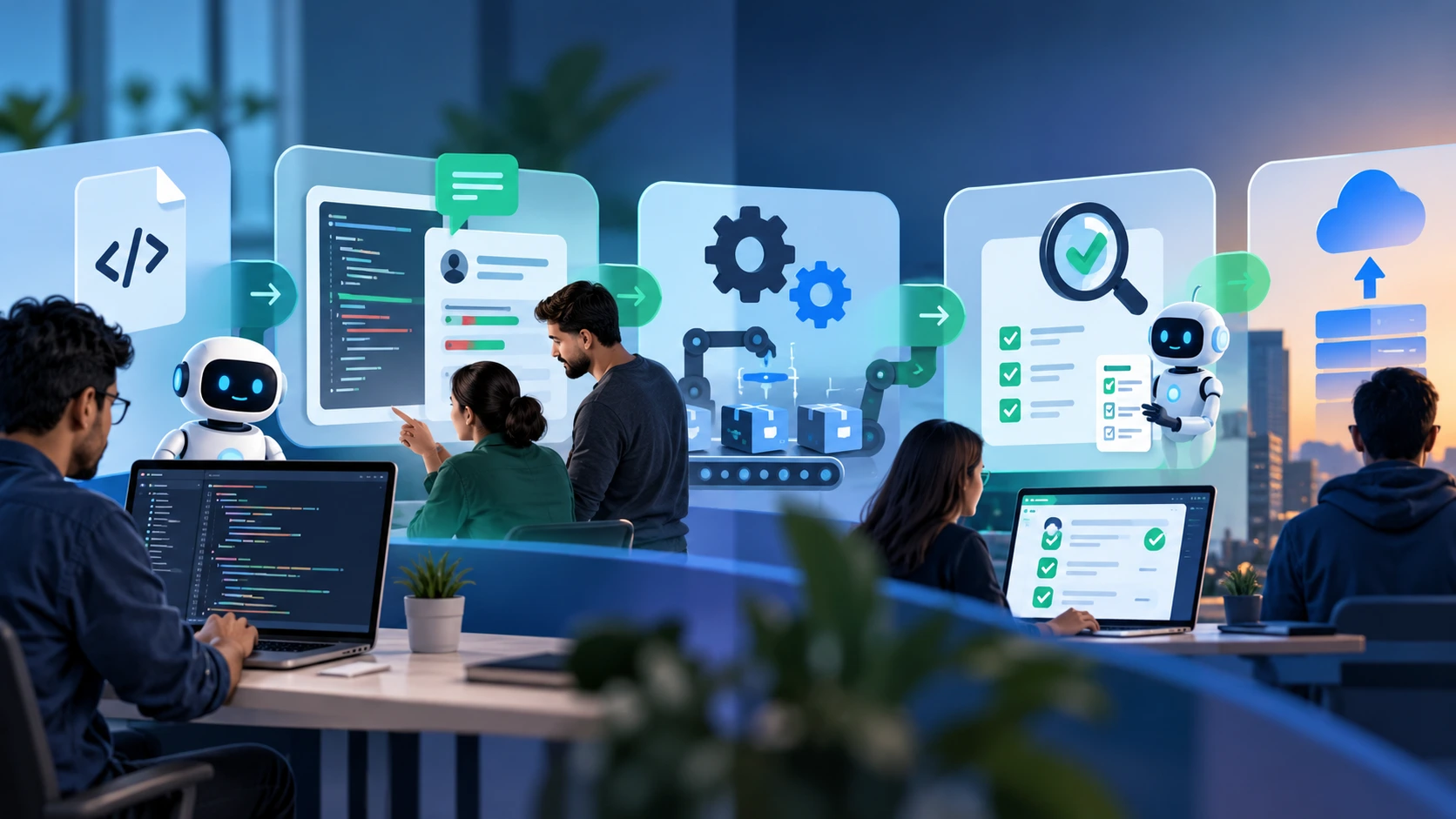
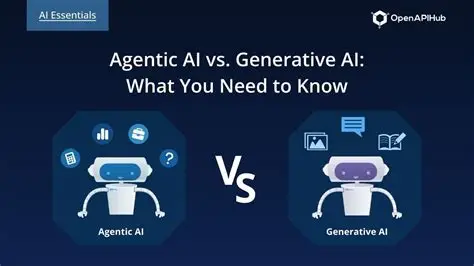
Agentic AI vs Generative AI describes the difference between AI systems that generate content and insights for humans and AI systems that autonomously plan, decide, and execute actions across enterprise workflows.
Enterprise AI has entered a new phase—one that extends far beyond chatbots and content generation. Over the past two years, generative AI has rapidly moved from experimentation to board-level priority. Yet a new paradigm is emerging that fundamentally changes how AI operates inside organizations: Agentic AI vs Generative AI.
While generative AI focuses on producing text, code, insights, and recommendations, agentic AI introduces systems capable of planning, reasoning, taking actions, and coordinating workflows autonomously. This distinction is not academic. For CTOs, CDOs, and data architects, it directly impacts enterprise AI decision-making, governance, risk exposure, and long-term operating models.
Enterprises evaluating agentic AI for enterprises are asking harder questions:
Can AI safely make decisions? How do autonomous agents interact with core systems? Where do humans remain in the loop? And how does this reshape enterprise AI strategy?
This blog provides a deep, executive-level analysis of Agentic AI vs Generative AI—covering architecture, real-world enterprise use cases, benefits, risks, and strategic implications. It is written for leaders responsible for scaling AI beyond pilots into mission-critical operations, grounded in proven enterprise data and AI practices.
From defining your AI vision to deploying intelligent automation at scale, we support every step of your AI-powered transformation journey with our AI services.
TL;DR Summary
- Agentic AI vs Generative AI represents a fundamental shift from AI that assists humans to AI that acts on their behalf.
- Generative AI excels at content, insight generation, and copilots, while agentic AI focuses on autonomous execution and decision-making.
- Enterprises must rethink governance, risk, architecture, and operating models before deploying autonomous AI agents.
- The future enterprise AI strategy will combine both—copilots for augmentation and agents for orchestration and automation.
Why Agentic AI vs Generative AI Matters Now for Enterprises?
The urgency around Agentic AI vs Generative AI is driven by a convergence of market forces rather than hype cycles.
Enterprise AI Has Moved Beyond Experimentation
According to leading analyst perspectives from organizations such as McKinsey & Company, generative AI adoption has expanded rapidly, with approximately 71% of enterprises now using generative AI in at least one business function. However, fewer than 15% have achieved measurable, scalable business outcomes. The gap is not model capability—it is execution.
Generative AI produces outputs. Enterprises need outcomes
This is where autonomous AI agents in business begin to matter. Instead of generating recommendations that humans must manually act on, agentic systems can execute multi-step workflows across systems—within defined constraints.
Rising Complexity of Enterprise Operations
Modern enterprises operate across fragmented data platforms, SaaS tools, cloud services, and regulatory boundaries. Human-driven coordination is increasingly brittle and slow. Agentic AI introduces the ability to orchestrate tasks, data flows, and decisions dynamically—an essential capability for AI orchestration and workflow automation at scale.
Competitive Pressure and Time-to-Value
Enterprises that rely solely on copilots risk incremental gains. Those that master agentic systems can compress decision cycles, automate cross-functional workflows, and unlock entirely new operating models. The strategic conversation is no longer about whether to use AI, but how autonomous it should be.
This is why Agentic AI vs Generative AI has become a board-level discussion rather than a technical one.
For a broader enterprise lens on this shift, see Techment’s perspective on Enterprise AI Strategy in 2026.
Defining Generative AI in the Enterprise Context
Before comparing Agentic AI vs Generative AI, it is essential to ground what generative AI actually represents in enterprise environments.
What Generative AI Is—and Is Not?
?Generative AI refers to models—primarily large language models (LLMs)—that generate new content based on learned patterns. In enterprises, this includes:
- Text generation (reports, summaries, emails)
- Code generation and assistance
- Data insights and narrative explanations
- Conversational interfaces and copilots
These systems are probabilistic, not deterministic. They respond to prompts, but they do not independently decide what to do next.
Generative AI as an Augmentation Layer
In practice, generative AI functions as an augmentation layer over human decision-making. This is why so many enterprise deployments take the form of copilots embedded in tools like CRM, ERP, analytics platforms, and developer environments.
From an architectural standpoint, generative AI sits close to users, abstracting complexity but remaining reactive.
This distinction is critical when evaluating AI agents vs large language models. LLMs generate reasoning artifacts. Agents operationalize them.
For a deeper view on enterprise-grade generative AI adoption, refer to Best Practices for Generative AI Implementation in Business.
Enterprise Strengths of Generative AI
Generative AI excels in:
- Knowledge work acceleration
- Human-in-the-loop decision support
- Natural language access to enterprise data
- Productivity gains across engineering, finance, HR, and operations
However, these strengths also define its limits. Generative AI does not own workflows. It does not validate downstream impacts. And it does not inherently enforce governance.
Those limitations become apparent when enterprises attempt to scale beyond assistance into automation—setting the stage for Agentic AI vs Generative AI.
Establish a strategic AI vision, identify ROI-positive use cases, and build a prioritized execution roadmap with our AI strategy road mapping services.
What Is Agentic AI? A New Enterprise Paradigm
Agentic AI represents a structural evolution in how AI systems behave inside enterprises.
Agentic AI systems are designed to:
- Set goals
- Plan sequences of actions
- Invoke tools, APIs, and systems
- Observe outcomes
- Adjust behavior dynamically
Unlike generative AI, agentic systems are not limited to producing outputs. They act within defined boundaries.
This distinction is central to understanding generative AI vs autonomous AI. Generative AI generates possibilities. Agentic AI executes decisions.
Core Components of Agentic Systems
An enterprise-grade agentic AI architecture typically includes:
Reasoning Engine – Often powered by LLMs, but enhanced with memory, context management, and planning logic.
Tool Invocation Layer – Secure access to enterprise systems—databases, APIs, SaaS tools, cloud services.
Orchestration Framework – Manages task sequencing, dependencies, retries, and exception handling.
Governance and Control Plane – Defines permissions, constraints, auditability, and human override mechanisms.
These components transform AI from a passive assistant into an active participant in enterprise workflows.
Why Agentic AI Changes Enterprise AI Decision-Making?
Agentic systems can autonomously:
- Resolve service tickets
- Trigger remediation workflows
- Optimize supply chain decisions
- Coordinate data pipelines
- Execute compliance checks
This elevates AI from insight generation to operational execution—dramatically increasing both value and risk.
Understanding Agentic AI vs Generative AI is therefore essential not just for architects, but for risk, compliance, and executive leadership.
For a platform-oriented view, explore Techment’s analysis of Microsoft Fabric Architecture for CTOs.
Agentic AI vs Generative AI: Architectural Differences That Matter
At an enterprise scale, Agentic AI vs Generative AI is primarily an architectural distinction—not a model comparison.
Control Flow vs Content Flow
Generative AI operates on content flow. A prompt goes in, content comes out.
Agentic AI operates on control flow. Decisions determine actions, actions affect systems, and outcomes feed back into decision loops.
This difference has massive implications for reliability, observability, and governance.
Statefulness and Memory
Generative AI interactions are largely stateless unless explicitly engineered otherwise.
Agentic AI systems are inherently stateful. They maintain:
- Task context
- Execution history
- Environmental feedback
This statefulness enables autonomy but increases complexity and failure modes.
Integration Depth
Generative AI integrates at the interface level—chat, search, analytics.
Agentic AI integrates at the process level, touching core enterprise systems. This is why AI orchestration and workflow automation becomes a foundational requirement.
For data leaders, this raises immediate questions about data quality, lineage, and trust. Techment addresses these challenges in Data Quality for AI in 2026.
| Dimension | Generative AI | Agentic AI |
|---|---|---|
| Primary role | Content & insight generation | Autonomous execution |
| Autonomy level | Human-initiated | Goal-driven |
| Workflow ownership | Human | AI system |
| Risk exposure | Lower | Higher |
| Governance complexity | Moderate | High |
| Best use | Copilots & augmentation | Orchestration & automation |
AI Copilots vs Agentic Systems: Enterprise Trade-Offs
The comparison between AI copilots vs agentic systems is where most enterprise confusion arises.
Copilots: Safer, Faster, Limited
AI copilots are easier to deploy and govern. They:
- Enhance productivity
- Reduce cognitive load
- Maintain clear human accountability
However, copilots scale linearly with human capacity.
Agentic Systems: Scalable, Powerful, Risk-Intensive
Agentic systems introduce non-linear scale. One agent can coordinate thousands of actions. But autonomy introduces:
- Systemic risk
- Compliance challenges
- Complex failure propagation
This is why enterprises must not treat Agentic AI vs Generative AI as a binary choice. The optimal strategy blends both.
A phased approach is outlined in Techment’s AI-Ready Enterprise Checklist.
Real-World Enterprise Use Cases: Where Agentic AI Creates Tangible Value
Understanding Agentic AI vs Generative AI becomes concrete when examined through real enterprise operating scenarios. While generative AI improves productivity, agentic AI fundamentally reshapes how work gets done.
Autonomous Operations and IT Service Management
One of the most mature use cases for autonomous AI agents in business is IT operations.
Traditional generative AI copilots assist engineers by summarizing logs or suggesting remediation steps. Agentic AI systems go further by:
- Monitoring infrastructure telemetry continuously
- Diagnosing root causes using contextual reasoning
- Executing remediation playbooks autonomously
- Escalating to humans only when confidence thresholds are breached
This shift reduces mean time to resolution (MTTR) dramatically. More importantly, it changes the enterprise cost structure by automating work that previously required 24×7 human intervention.
However, these systems require deep integration with monitoring tools, ticketing platforms, and cloud environments—underscoring why AI orchestration and workflow automation is central to agentic deployments.
For data-driven enterprises modernizing their platforms, Techment’s insights on Microsoft Azure for Enterprises: Cloud AI Modernization provide architectural guidance.
Finance, Risk, and Compliance Automation
Finance functions highlight the sharp contrast in Agentic AI vs Generative AI capabilities.
Generative AI supports:
- Financial narrative generation
- Variance explanations
- Policy interpretation
Agentic AI enables:
- Continuous compliance monitoring
- Automated controls testing
- Exception-driven approvals
- Regulatory reporting workflows
In regulated industries, agentic AI agents can continuously scan transactions, trigger investigations, and coordinate responses—while maintaining full audit trails.
This is where enterprise AI decision-making intersects with governance. Autonomous action without explainability or lineage is unacceptable. Enterprises must embed strong control planes from day one.
Techment explores these foundations in Data Governance for Data Quality.
Supply Chain and Operations Optimization
Supply chains are inherently multi-agent systems involving suppliers, logistics providers, warehouses, and demand signals.
Generative AI improves forecasting narratives and scenario explanations.
Agentic AI goes further by:
- Coordinating procurement decisions
- Adjusting inventory policies dynamically
- Triggering supplier negotiations
- Optimizing logistics routes in real time
Here, AI agents vs large language models becomes a practical distinction. LLMs reason; agents act across systems with economic impact.
This autonomy creates value—but also amplifies risk if data quality, latency, or governance are weak.
Governance, Risk, and Control in Agentic AI Systems
No discussion of Agentic AI vs Generative AI is complete without addressing risk.
Why Traditional AI Governance Breaks Down
Most enterprise AI governance frameworks were designed for:
- Predictive models
- Batch analytics
- Human-reviewed outputs
Agentic AI invalidates these assumptions.
Autonomous agents:
- Act continuously
- Affect multiple systems
- Make chained decisions
- Create emergent behaviors
This means governance must shift from static approval to dynamic control.
Key Governance Principles for Agentic AI
Human-in-the-Loop (HITL) Design
Not every decision requires human approval, but every agent must have defined escalation paths.
Bounded Autonomy
Agents must operate within strict policy, cost, and risk constraints.
Observability and Explainability
Enterprises must understand why an agent acted—not just what it did.
Auditability and Compliance
Every action must be logged, attributable, and reviewable.
This governance layer is often more complex than the AI itself—making platform choices critical.
For a deeper view on how to build trusted, governed data that fuels secure intelligence and analytics, see our data governance page.
Operating Model Implications for CTOs and CDOs
The shift from generative AI to agentic AI is not just technical—it is organizational.
New Roles and Responsibilities
Enterprises adopting agentic AI for enterprises must evolve their operating models:
- AI product owners define agent objectives and constraints
- Platform teams manage orchestration and integration layers
- Risk and compliance teams become continuous stakeholders
- Data teams own quality, lineage, and trust signals
This is a material shift from project-based AI delivery to product-centric AI operations.
From Use Cases to Capabilities
One of the most common enterprise mistakes is deploying agents as isolated experiments.
High-performing organizations instead invest in:
- Shared orchestration frameworks
- Reusable agent components
- Centralized governance services
This approach aligns with long-term enterprise AI strategy rather than short-term wins.
Techment’s point of view on this evolution is detailed in What a Microsoft Data and AI Partner Brings to Your Data Strategy.
Choosing Between Agentic AI vs Generative AI: A Strategic Framework
Executives often ask: Which should we invest in first?
The answer is not binary.
When Generative AI Is the Right Choice
Generative AI is optimal when:
- Human judgment must remain central
- Outputs require creativity or nuance
- Risk tolerance is low
- Time-to-value is critical
Copilots remain the fastest way to unlock productivity gains.
When Agentic AI Makes Strategic Sense
Agentic AI is appropriate when:
- Processes are repetitive and rule-bound
- Speed and scale matter more than creativity
- Decisions must occur continuously
- Human bottlenecks constrain growth
This is where autonomous AI agents in business create asymmetric advantage.
A Phased Enterprise Adoption Model
Most enterprises should follow a three-stage path:
- Augmentation – Generative AI copilots
- Assisted Automation – Human-supervised agents
- Bounded Autonomy – Fully agentic workflows
This staged model reduces risk while building organizational maturity.
For a deeper look at how data strategy underpins this shift, Techment outlines the foundational principles in Unleashing the Power of Data: Building a Winning Data Strategy.
How Techment Helps Enterprises Navigate Agentic AI vs Generative AI
Techment works with enterprises at every stage of the Agentic AI vs Generative AI journey—combining strategic advisory with hands-on implementation.
Enterprise AI Strategy and Roadmapping
Techment helps leaders define:
- Where generative AI delivers immediate ROI
- Which processes are candidates for agentic automation
- How to balance autonomy, risk, and compliance
This ensures AI investments align with business priorities rather than experimentation.
Data and Platform Readiness
Agentic AI is only as reliable as the data beneath it. Techment supports:
- Data modernization on Microsoft Fabric and Azure
- Unified analytics and AI-ready architectures
- Governance, lineage, and quality frameworks
Explore how this foundation is built in Microsoft Fabric AI Solutions for Enterprise Intelligence.
Responsible AI and Governance Enablement
Techment embeds:
- Human-in-the-loop controls
- Policy-driven orchestration
- Audit-ready monitoring frameworks
This enables safe adoption of enterprise AI decision-making systems at scale.
Techment provides a detailed framework in Data Governance for Data Quality : Future-Proofing Enterprise Data.
Conclusion: The Strategic Imperative of Agentic AI vs Generative AI
The distinction between Agentic AI vs Generative AI marks a defining moment in enterprise technology strategy.
Generative AI transformed how knowledge work is done. Agentic AI will transform how enterprises operate.
For CTOs, CDOs, and data architects, the challenge is not choosing sides—but designing systems where autonomy is earned, governed, and aligned with business intent. Enterprises that master this balance will move faster, operate leaner, and compete on an entirely new axis.
As AI continues to evolve from assistant to actor, Techment remains a trusted partner in helping enterprises navigate this transition—responsibly, strategically, and at scale.
Begin your modernization roadmap and automate governance across all platforms with our data solutions.
Frequently Asked Questions (FAQ)
Is agentic AI replacing generative AI?
No. Agentic AI vs Generative AI is not a replacement dynamic. Agentic systems often rely on generative models for reasoning and language while adding autonomy and execution.
Are autonomous AI agents safe for enterprises?
They can be—if deployed with strong governance, bounded autonomy, and continuous monitoring.
Do enterprises need new platforms for agentic AI?
Often yes. Agentic AI requires orchestration, integration, and control layers not needed for standalone generative AI.
How long does it take to deploy agentic AI?
Most enterprises take 6–18 months to move from pilots to production-grade agentic systems, depending on data maturity and governance readiness.
Which industries benefit most?
Finance, manufacturing, healthcare, logistics, and technology-led enterprises see the fastest value from autonomous agents.
For pipeline modernization perspectives, refer to Leveraging data transformation for modern analytics.