
For decades, finance technology has focused primarily on efficiency. Automation tools promised faster reconciliations, fewer manual errors, and streamlined reporting cycles. While these improvements delivered measurable gains, they rarely changed the fundamental structure of financial operations.
That reality is rapidly shifting.
In 2026, AI in financial workflows is redefining how finance teams operate, make decisions, and interact with enterprise systems. Instead of simply automating predefined rules, modern AI systems are beginning to understand intent, context, and strategic objectives.
This shift is powered by advances in agentic AI, explainable machine learning, and enterprise data platforms capable of integrating financial signals across ERP systems, operational databases, and real-time analytics pipelines.
The result is a new generation of financial workflows that are:
- Context-aware
- Continuously learning
- Strategically aligned with business goals
Rather than waiting for month-end close cycles or scheduled reporting intervals, intelligent systems now monitor financial operations continuously—identifying anomalies, recommending corrective actions, and even executing transactions within controlled boundaries.
For enterprise leaders, the implications are profound. According to industry analyses from organizations such as Gartner and McKinsey, AI-enabled finance functions can reduce operational costs by up to 40% while improving decision speed and forecasting accuracy.
But the transformation goes beyond efficiency.
AI is reshaping finance into a real-time strategic decision engine.
This article explores how AI in financial workflows is transforming enterprise finance operations in 2026, covering:
- The shift from rule-based automation to agentic AI
- The rise of explainable AI in financial decision-making
- Architecture patterns for intelligent finance platforms
- Governance and compliance frameworks for AI-enabled finance
- Strategic implementation approaches for enterprises
TL;DR
- AI in financial workflows is shifting finance from rule-based automation to intent-driven decision systems.
- Agentic AI enables finance systems to interpret goals, recommend actions, and orchestrate processes autonomously.
- Explainable AI and governance frameworks are becoming critical for compliance and regulatory transparency.
- Finance leaders are redesigning workflows around continuous intelligence instead of periodic reporting cycles.
- Enterprises that invest in data governance, AI-ready architecture, and decision automation will gain strategic financial agility.
The Evolution of Financial Workflows: From Automation to Intelligence
Why Traditional Finance Automation Is Reaching Its Limits
For years, finance modernization initiatives focused on process automation. Industry research highlights the growing strategic importance of artificial intelligence in finance. According to a McKinsey analysis, AI technologies can automate up to 42% of finance activities while augmenting another 19%, allowing finance professionals to focus more on strategic decision-making and value creation. These findings reinforce why enterprises are increasingly investing in AI in financial workflows as a foundation for intelligent financial operations.
Robotic Process Automation (RPA), workflow engines, and ERP integrations helped streamline tasks like:
- Invoice processing
- Account reconciliations
- Expense management
- Financial reporting
While these technologies improved operational efficiency, they had a fundamental limitation: they relied on predefined rules and static logic.
Traditional automation works well when processes are predictable. However, financial operations are rarely static. They involve:
- Complex intercompany relationships
- Dynamic regulatory requirements
- Market volatility
- Multi-system data dependencies
This rigidity often creates operational blind spots.
For example:
- Reconciliation tools can identify mismatches but cannot determine root causes.
- Reporting systems provide historical insights but cannot anticipate financial risks.
- Compliance systems enforce policies but lack contextual understanding.
This is where AI in financial workflows introduces a new paradigm.
Instead of relying solely on deterministic rules, AI-powered finance platforms can analyze patterns, interpret context, and recommend actions.
Traditional Finance vs AI-Driven Financial Workflows
As organizations modernize their finance operations, the differences between traditional finance processes and AI in financial workflows become increasingly evident. Traditional finance systems rely heavily on static rules, manual reviews, and periodic reporting cycles. In contrast, AI-powered financial workflows enable real-time analysis, automated anomaly detection, and predictive decision-making. The comparison below highlights how artificial intelligence is transforming finance from a reactive operational function into a proactive strategic capability.
Comparison: Traditional Finance vs AI-Driven Financial Workflows
| Dimension | Traditional Finance Workflows | AI-Driven Financial Workflows |
|---|---|---|
| Process Design | Rule-based automation and manual workflows | Intent-driven and adaptive workflows |
| Decision Speed | Periodic (monthly/quarterly cycles) | Real-time and continuous |
| Reconciliation | Manual exception handling | Autonomous anomaly detection and resolution |
| Forecasting | Historical trend analysis | AI-powered predictive and scenario modeling |
| Compliance Monitoring | Scheduled audits and manual checks | Continuous monitoring with AI risk detection |
| Data Integration | Fragmented across systems | Unified data fabric or lakehouse architecture |
| Operational Efficiency | Incremental efficiency improvements | Exponential productivity gains |
| Strategic Value | Operational support function | Strategic decision intelligence platform |
Finance workflows are no longer static sequences of steps.
They are becoming adaptive decision systems.
Enterprise Implication
Organizations that rely exclusively on rule-based automation risk falling behind competitors adopting AI-driven finance systems capable of continuous operational intelligence.
Modern finance transformation strategies increasingly incorporate AI-ready data platforms and analytics ecosystems, as discussed in Techment’s guide to Microsoft Fabric architecture for modern analytics and AI .
The Rise of Agentic AI in Financial Workflows
One of the most transformative developments in enterprise AI is the emergence of agentic AI systems.
Unlike traditional AI models that generate predictions or insights, AI agents can interpret objectives and execute actions.
In financial workflows, this capability unlocks entirely new operational models.
Instead of performing a single task, AI agents can orchestrate entire financial processes.
For example, an AI agent monitoring financial transactions might:
- Detect an anomaly in revenue recognition.
- Analyze transaction history across multiple systems.
- Identify the root cause.
- Propose corrective adjustments.
- Trigger compliance checks.
- Execute the adjustment if it meets policy thresholds.
This shift transforms financial systems into continuous decision environments.
Example: AI Agent in Reconciliation
Traditional reconciliation systems:
- Compare records
- Identify mismatches
- Flag exceptions
Agentic AI systems can:
- Analyze transaction lineage
- Detect causal relationships
- Recommend adjustments
- Execute reconciliations automatically
The workflow evolves from detection → human action to detection → reasoning → resolution.
Why Agentic Finance Matters
Agentic AI introduces three capabilities critical to enterprise finance:
1. Contextual Awareness
AI agents can analyze financial signals across systems, including ERP, CRM, supply chain platforms, and payment networks.
2. Continuous Monitoring
Instead of periodic reviews, AI systems operate 24/7, identifying financial risks in real time.
3. Goal-Oriented Execution
Agents operate based on strategic objectives, such as optimizing cash flow or reducing reconciliation delays.
This evolution mirrors broader enterprise AI trends discussed in Techment’s enterprise guide to AI strategy for enterprises in 2026 .
AI Impact Across Major Finance Functions
Artificial intelligence is reshaping multiple core functions within enterprise finance teams. From reconciliation and forecasting to fraud detection and compliance monitoring, AI in financial workflows introduces new levels of automation, accuracy, and strategic insight. The table below illustrates how key finance processes are evolving as organizations integrate machine learning, predictive analytics, and intelligent automation into their financial systems.
Key Finance Processes Being Transformed by AI
| Finance Function | Traditional Approach | AI-Enabled Approach | Enterprise Benefit |
|---|---|---|---|
| Account Reconciliation | Manual matching and exception review | Machine learning–driven transaction matching | Faster financial close cycles |
| Financial Forecasting | Spreadsheet-based models | Predictive analytics with real-time signals | Improved forecast accuracy |
| Fraud Detection | Rule-based alerts | AI anomaly detection models | Early fraud identification |
| Compliance Monitoring | Periodic audits | Continuous AI monitoring | Reduced regulatory risk |
| Cash Flow Management | Static projections | AI-driven liquidity optimization | Better capital utilization |
| Expense Management | Manual approvals | Intelligent expense classification | Reduced operational overhead |
Explainable AI: The Foundation of Trust in Financial Systems
Why Explainability Is Non-Negotiable in Finance
Finance operates under strict regulatory oversight.
Every financial decision must be:
- Traceable
- Auditable
- Justifiable
Traditional AI models often function as black boxes, producing predictions without clear reasoning.
This lack of transparency creates unacceptable risks for financial operations.
If an AI system flags a transaction as fraudulent or recommends a financial adjustment, auditors and regulators must understand:
- Why the decision was made
- What data influenced the outcome
- What rules or constraints were applied
This requirement has led to the rapid adoption of Explainable AI (XAI) in financial workflows.
Explainable AI ensures that AI-driven decisions remain transparent, traceable, and defensible.
Decision Traceability in AI-Driven Finance
Explainability in finance extends beyond simple model transparency.
In modern AI-enabled workflows, organizations must track complete decision pathways.
A decision trace might include:
- Data inputs used by the model
- Feature weighting and model reasoning
- Contextual signals from other systems
- Policy checks applied to the recommendation
- Execution authorization
This full audit trail ensures that financial AI systems meet regulatory expectations.
Example: AI-Based Fraud Detection
A compliant AI system must record:
- Transaction features analyzed
- Anomaly score
- Threshold triggers
- Historical comparison data
- Risk classification logic
Such traceability enables organizations to demonstrate algorithmic accountability.
AI Control Planes for Financial Governance
To ensure trustworthy AI operations, enterprises are implementing AI control planes.
These governance frameworks define how AI systems operate within financial workflows.
Typical components include:
1. Policy Enforcement Layers
AI systems validate actions against financial policies before execution.
2. Risk-Based Action Thresholds
High-risk actions require human approval.
3. Immutable Audit Logs
All AI decisions are recorded for compliance reviews.
4. Behavioral Monitoring
Systems monitor AI agents to detect unexpected behavior.
Such governance frameworks align closely with best practices outlined in Techment’s article on data governance strategies for enterprise data quality .
Core Finance Functions Being Transformed by AI
AI in financial workflows is already reshaping multiple core finance functions.
Rather than isolated automation tools, enterprises are deploying integrated AI-powered finance platforms.
Below are the most impactful areas of transformation.
AI-Powered Reconciliation
Reconciliation remains one of the most labor-intensive processes in finance.
Large enterprises reconcile millions of transactions across:
- ERP systems
- Banking platforms
- payment processors
- subsidiary systems
AI significantly improves reconciliation accuracy and speed.
Key Capabilities
1. Intelligent Matching
Machine learning models match transactions even when data formats differ.
2. Root Cause Analysis
AI identifies causes of mismatches rather than simply flagging them.
3. Predictive Exception Handling
Systems anticipate reconciliation failures before they occur.
Enterprise Impact
Organizations deploying AI-powered reconciliation systems report:
- Up to 70% reduction in manual reconciliation work
- Faster month-end close cycles
- Improved financial accuracy
AI-Driven Financial Forecasting
Financial forecasting traditionally relies on historical data and static models.
AI introduces dynamic forecasting capabilities.
Modern AI forecasting models incorporate:
- Market indicators
- operational metrics
- macroeconomic signals
- supply chain data
These signals enable finance teams to generate real-time financial projections.
Example Use Cases
- Revenue forecasting
- Cash flow optimization
- demand forecasting
- risk analysis
Advanced analytics platforms like Microsoft Fabric enable integrated forecasting pipelines across enterprise data ecosystems, as discussed in Techment’s analysis of what Microsoft Fabric is and how it supports modern analytics .
AI in Compliance and Risk Management
Regulatory compliance represents one of the most complex areas of financial operations.
Financial institutions must monitor:
- Anti-money laundering (AML) risks
- Fraud detection
- regulatory reporting
- financial disclosure accuracy
AI dramatically improves compliance monitoring capabilities.
Key Benefits
Real-Time Risk Detection
AI models identify suspicious transactions instantly.
Pattern Recognition
Machine learning detects subtle fraud patterns humans might miss.
Continuous Regulatory Monitoring
AI systems track compliance metrics continuously rather than periodically.
Strategic Advantage
AI-driven compliance systems reduce:
- regulatory risk
- manual auditing workloads
- compliance reporting delays
Architecture for AI-Driven Financial Workflows
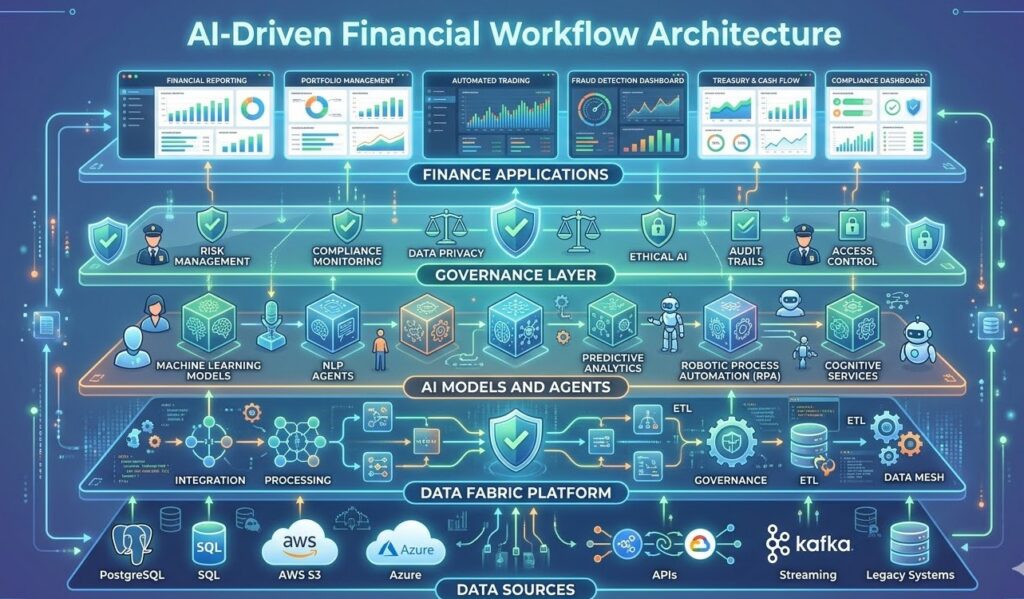
Enterprise Architecture for AI-Driven Finance
Successfully implementing AI in financial workflows requires a modern technology architecture capable of integrating financial data, AI models, governance frameworks, and workflow orchestration. Enterprises must move beyond isolated analytics tools toward unified data and AI platforms that support continuous intelligence across finance operations. The architecture framework below outlines the key technology layers required to support scalable AI-driven finance systems.
Architecture Layers for AI in Financial Workflows
| Architecture Layer | Key Technologies | Purpose |
|---|---|---|
| Data Foundation | Data lakehouse, ERP integrations, data fabric | Consolidate enterprise financial data |
| Data Governance | Data lineage, data quality monitoring, master data management | Ensure trustworthy financial data |
| AI Model Layer | Predictive analytics, anomaly detection models, LLMs | Generate financial insights |
| Agent Orchestration | AI agents, workflow orchestration engines | Execute financial decisions autonomously |
| Governance & Control | Policy enforcement engines, audit logging, compliance monitoring | Ensure regulatory compliance and traceability |
Data Foundations for Intelligent Finance
AI-driven finance requires a strong data architecture foundation.
Financial data typically exists across fragmented systems:
- ERP platforms
- accounting systems
- CRM platforms
- banking systems
- external market data feeds
Without unified data infrastructure, AI systems cannot operate effectively.
Modern enterprises are adopting data fabric architectures to solve this challenge.
Data fabrics enable:
- unified data access
- real-time data pipelines
- integrated analytics environments
Techment explores these architectural patterns in its article on Microsoft Data Fabric vs traditional data warehousing .
Enterprise Finance Operations Before vs After AI
| Function | Traditional Workflow | AI-Driven Workflow |
|---|---|---|
| Reconciliation | Manual exception handling | Autonomous resolution |
| Forecasting | Periodic reporting | Continuous prediction |
| Compliance | Periodic audits | Real-time monitoring |
| Risk management | Reactive | Predictive |
Implementing AI in Financial Workflows: A Practical Enterprise Framework
Moving from Pilot Projects to Enterprise Finance Transformation
While many organizations experiment with artificial intelligence through small automation pilots, scaling AI in financial workflows requires a far more strategic approach.
Finance operations touch nearly every part of the enterprise — from procurement and payroll to revenue recognition and regulatory reporting. Introducing AI into this ecosystem requires careful orchestration across technology, governance, and organizational processes.
The most successful enterprises approach AI-driven finance transformation through a phased framework.
Rather than attempting a large-scale overhaul, they begin by identifying high-impact financial processes where AI can deliver measurable value while minimizing operational risk.
Typical entry points include:
- Reconciliation and transaction matching
- Financial forecasting and scenario planning
- Fraud detection and compliance monitoring
- Cash flow optimization
- Expense and invoice processing
These use cases share a common characteristic: they involve large volumes of data and repeatable analytical decisions, making them well suited for AI models.
However, successful enterprise deployment requires more than just machine learning models. Organizations must also build the supporting infrastructure needed to operate AI systems reliably.
This includes:
- Data governance frameworks
- Model monitoring capabilities
- explainability mechanisms
- operational control layers
Modern enterprise data platforms play a critical role in this transition. Unified analytics environments allow organizations to combine financial, operational, and market data into a single decision layer.
For example, Techment’s exploration of modern analytics architectures using Microsoft Fabric illustrates how unified data platforms enable scalable AI adoption across enterprise finance ecosystems.
By combining data engineering, analytics, and AI services in one environment, enterprises can dramatically accelerate the deployment of intelligent financial workflows.
A Five-Layer Architecture for AI-Driven Finance
Implementing AI in financial workflows requires a layered architecture designed for reliability, transparency, and scalability.
Below is a recommended architecture model used by many modern enterprises.
1. Data Foundation Layer
The first layer consolidates financial data from across the organization.
Typical sources include:
- ERP systems
- payment gateways
- accounting platforms
- CRM systems
- banking networks
- operational databases
A data fabric or lakehouse architecture enables unified data access across these sources.
This foundation ensures AI systems operate on consistent, trusted financial data.
Organizations implementing these architectures often reference modern approaches such as those outlined in Techment’s guide to Microsoft Fabric vs traditional data warehousing.
2. Data Quality and Governance Layer
AI systems are only as reliable as the data they analyze.
Poor data quality can produce incorrect financial insights, leading to operational risks.
As a result, enterprises must establish robust data governance frameworks before deploying AI-driven financial systems.
Core governance capabilities include:
- Data lineage tracking
- automated quality validation
- schema enforcement
- master data management
- compliance monitoring
Techment explores these governance challenges in depth in its enterprise guide on data quality for AI adoption.
Organizations that invest in strong data governance foundations typically achieve significantly higher success rates with AI initiatives.
3. AI Model Layer
The AI model layer contains the machine learning systems responsible for financial intelligence.
These models perform tasks such as:
- anomaly detection
- forecasting
- classification
- risk scoring
- recommendation generation
Modern enterprise finance systems often combine multiple model types, including:
Predictive Models
Used for forecasting financial outcomes such as revenue, expenses, or market risks.
Anomaly Detection Models
Identify irregular patterns in transactions or financial data.
Large Language Models
Support natural-language financial analysis and reporting.
4. Agent Orchestration Layer
The most transformative element of modern finance platforms is the AI agent orchestration layer.
Instead of individual models operating independently, AI agents coordinate workflows across systems.
Agents can:
- interpret business objectives
- analyze financial signals
- trigger actions across systems
- escalate decisions when required
For example, an AI agent responsible for revenue monitoring might:
- Detect a revenue variance anomaly.
- Analyze underlying transaction records.
- Compare results against historical patterns.
- Generate a variance explanation.
- Propose corrective accounting entries.
This orchestration layer effectively transforms financial systems into autonomous decision platforms.
5. Governance and Control Layer
Given the regulatory sensitivity of financial operations, AI systems must operate within strict governance frameworks.
This layer enforces:
- policy constraints
- compliance checks
- human approval thresholds
- audit trail generation
Many organizations now deploy AI control planes to manage these governance processes.
These control planes monitor AI systems continuously to ensure compliance with regulatory requirements.
AI Maturity Model for Financial Workflows
Most enterprises do not transition to AI-driven finance operations overnight. Instead, organizations progress through several stages of AI maturity as they modernize data infrastructure, analytics capabilities, and governance frameworks. Understanding these stages helps finance leaders plan long-term transformation strategies and identify the investments required to scale AI in financial workflows across the enterprise.
Enterprise AI Maturity in Financial Workflows
| Maturity Stage | Characteristics | Typical Technologies |
|---|---|---|
| Level 1: Automation | RPA and workflow automation | ERP integrations, RPA |
| Level 2: Analytics | Business intelligence and reporting | BI dashboards, data warehouses |
| Level 3: Predictive Finance | AI forecasting and anomaly detection | Machine learning models |
| Level 4: Agentic Finance | Autonomous AI agents executing workflows | AI orchestration platforms |
| Level 5: Autonomous Finance | Self-optimizing financial operations | Agentic AI ecosystems |
Organizational Changes Required for AI-Enabled Finance
The Rise of the “AI-Augmented Finance Team
Technology alone will not transform financial workflows.
Organizations must also rethink how finance teams interact with AI systems.
Instead of replacing human expertise, AI augments financial professionals, enabling them to focus on strategic analysis rather than routine operations.
Traditional finance teams often spend a significant portion of their time on tasks such as:
- manual reconciliations
- data validation
- report generation
- compliance documentation
AI automation dramatically reduces the time required for these activities.
As a result, finance professionals can shift their focus toward higher-value responsibilities.
These include:
- strategic financial planning
- investment analysis
- risk management
- business advisory roles
Finance leaders increasingly describe this shift as the emergence of the AI-augmented finance team.
In this model, AI handles operational execution while humans provide strategic judgment.
New Skills Finance Professionals Must Develop
The adoption of AI in financial workflows also changes the skills required within finance organizations.
Future-ready finance professionals must understand both financial principles and AI-enabled analytics.
Key skill areas include:
Data Literacy
Finance professionals must be able to interpret data outputs and validate AI-driven insights.
AI Governance Awareness
Understanding how AI systems operate, including their limitations and risks.
Scenario Modeling
Using AI-generated forecasts to evaluate strategic scenarios.
Cross-Functional Collaboration
Working closely with data scientists, engineers, and technology leaders.
Finance leaders who invest in workforce upskilling will gain a significant competitive advantage.
Governance, Risk, and Compliance in AI-Powered Finance
The Challenge of AI Accountability
Financial institutions operate under strict regulatory oversight.
Regulators increasingly expect organizations to demonstrate algorithmic accountability.
This means enterprises must prove that AI-driven financial decisions are:
- transparent
- fair
- explainable
- compliant with regulations
Organizations implementing AI in financial workflows must therefore build governance frameworks that extend beyond traditional IT controls.
The Emergence of AI Risk Management Frameworks
To address these challenges, enterprises are adopting specialized AI risk management frameworks.
These frameworks focus on several critical areas.
Model Validation
Ensuring machine learning models produce reliable results.
Bias Detection
Identifying unintended biases in AI-driven financial decisions.
Decision Traceability
Maintaining detailed logs of AI reasoning pathways.
Operational Monitoring
Detecting abnormal behavior in AI agents.
These governance models are increasingly becoming mandatory in regulated industries.
Organizations implementing AI without proper governance risk facing regulatory penalties and reputational damage.
Future Trends: What Finance Leaders Should Expect by 2030
AI adoption in finance is still in its early stages.
Over the next several years, several major trends are expected to reshape financial workflows even further.
Autonomous Finance Operations
AI agents will manage entire financial processes with minimal human intervention.
Continuous Financial Close
Real-time transaction analysis will eliminate traditional month-end close cycles.
Predictive Risk Intelligence
AI will forecast financial risks before they impact business performance.
Conversational Financial Interfaces
Executives will interact with financial systems through natural language.
For example, finance leaders may ask:
“Explain the revenue variance in the European market this quarter.”
AI systems will generate real-time analytical reports instantly.
Such capabilities are becoming increasingly possible with advances in conversational AI and enterprise data platforms.
How Techment Helps Enterprises Transform Financial Workflows with AI
Implementing AI in financial workflows requires deep expertise in data architecture, AI engineering, and governance.
Techment supports enterprises throughout this transformation journey by helping organizations design, build, and scale intelligent financial systems.
Techment’s services focus on several critical areas.
Data Modernization for AI-Ready Finance
AI-driven finance systems depend on unified, high-quality data.
Techment helps organizations modernize data architectures through:
- data lakehouse implementations
- enterprise data fabric architectures
- scalable analytics platforms
These foundations enable organizations to integrate financial data from across ERP systems, operational databases, and external data sources.
AI Platform Implementation
Techment helps enterprises deploy advanced AI solutions across finance operations, including:
- financial anomaly detection
- forecasting models
- intelligent reconciliation systems
- conversational analytics assistants
Leveraging platforms such as Microsoft Fabric and Azure AI, Techment builds scalable AI environments capable of supporting enterprise financial workflows.
Governance and Compliance Frameworks
Financial organizations must operate under strict regulatory controls.
Techment helps enterprises implement:
- AI governance frameworks
- data lineage tracking
- compliance monitoring
- explainable AI systems
These capabilities ensure AI adoption does not compromise financial accountability or regulatory compliance.
End-to-End Enterprise AI Roadmaps
From strategy development to operational deployment, Techment provides end-to-end support for AI transformation initiatives.
This includes:
- AI readiness assessments
- architecture design
- platform implementation
- governance frameworks
- operational optimization
Through this approach, Techment enables organizations to deploy AI-powered financial workflows that are scalable, transparent, and compliant.
Conclusion
Artificial intelligence is fundamentally transforming how financial organizations operate.
What began as a tool for automation is rapidly evolving into a strategic decision infrastructure capable of reshaping enterprise finance.
By 2026, AI in financial workflows is enabling organizations to move beyond rule-based automation toward intelligent systems that understand context, anticipate risks, and support strategic decision-making.
Yet the success of these systems depends on more than advanced algorithms.
Enterprises must also invest in:
- modern data architectures
- AI governance frameworks
- explainable decision systems
- workforce transformation
Organizations that take this holistic approach will unlock a powerful new operating model for finance — one defined by continuous intelligence, operational resilience, and strategic agility.
As enterprises navigate this transformation, experienced technology partners play a crucial role in ensuring AI adoption remains scalable, secure, and compliant.
With deep expertise in data platforms, enterprise AI, and financial analytics modernization, Techment helps organizations turn AI innovation into measurable business outcomes.
The future of finance is intelligent — and the transformation has already begun
FAQs: AI in Financial Workflows
1. What is AI in financial workflows?
AI in financial workflows refers to the use of machine learning, predictive analytics, and intelligent automation to manage financial processes such as reconciliation, forecasting, compliance monitoring, and financial analysis.
2. How does AI improve finance operations?
AI improves finance operations by automating repetitive tasks, detecting anomalies in financial data, forecasting financial outcomes, and providing real-time insights that support better decision-making.
3. What is agentic AI in finance?
Agentic AI refers to autonomous AI systems capable of interpreting objectives, making decisions, and executing actions across financial systems while operating within governance constraints.
4. Why is explainable AI important in finance?
Explainable AI ensures that AI-driven financial decisions can be understood, audited, and justified to regulators, auditors, and internal stakeholders.
5. How long does it take to implement AI in finance operations?
Enterprise AI deployments typically take 6–18 months, depending on data maturity, infrastructure readiness, and governance requirements.
Related Reads
- 12 Proven RAG Optimization Techniques for Production
- 5 Proven RAG Best Practices to Build Production-Ready Enterprise AI Systems
- Migrating from Azure Data and AI Stack to Microsoft Fabric
- Enterprise Data Access Control Model for Unified Analytics and AI Security
- AI Strategy Consulting: Frameworks, Benefits, and Enterprise Best Practices