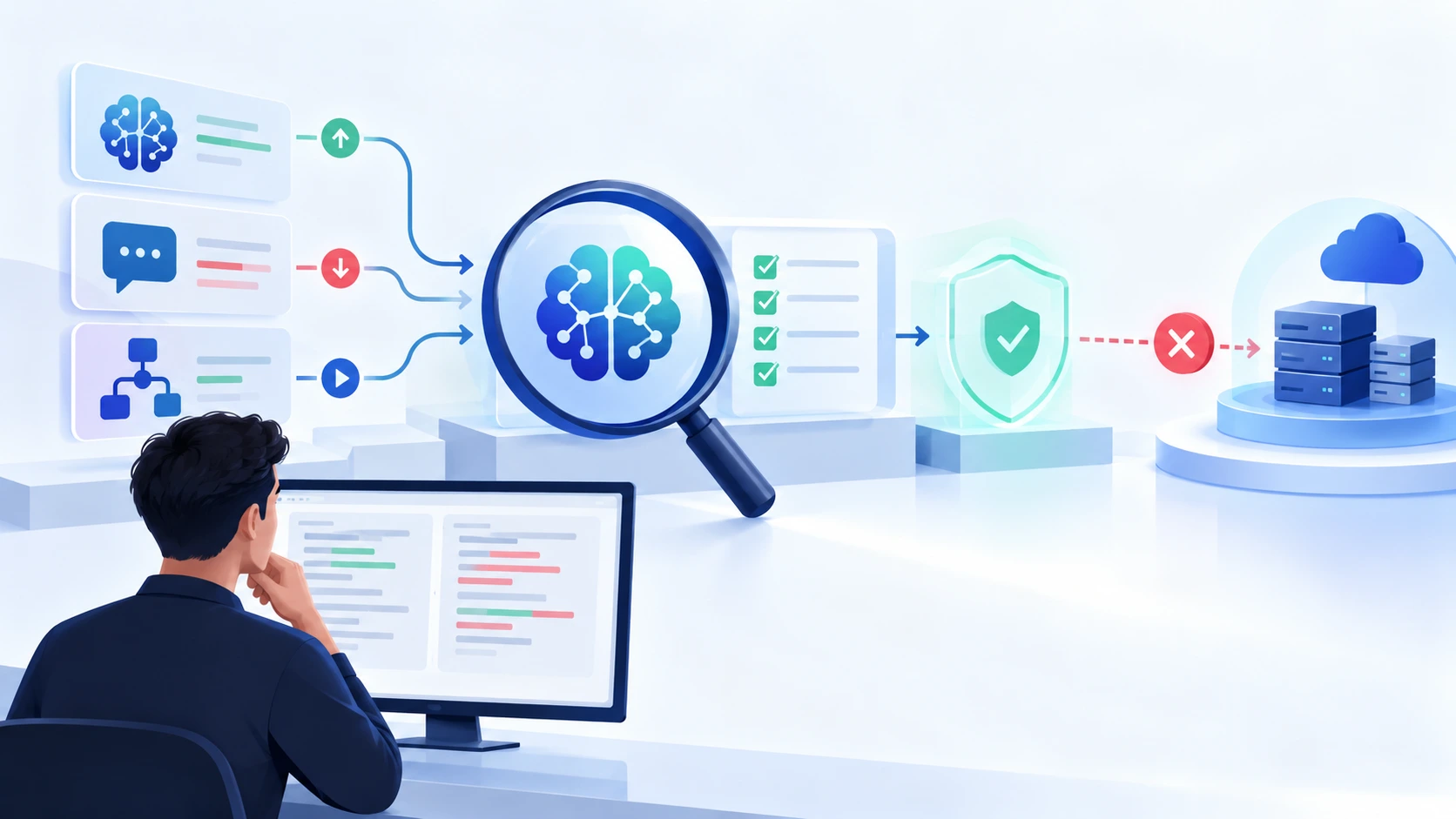

An AI governance checklist helps organizations scale artificial intelligence responsibly by establishing accountability, regulatory compliance, risk management, secure development, continuous monitoring, and human oversight. A strong governance framework reduces operational risk, builds trust, and enables enterprises to deploy AI confidently across business functions.
TL;DR
- AI governance is the foundation for scaling enterprise AI, ensuring systems remain secure, compliant, transparent, and aligned with business objectives.
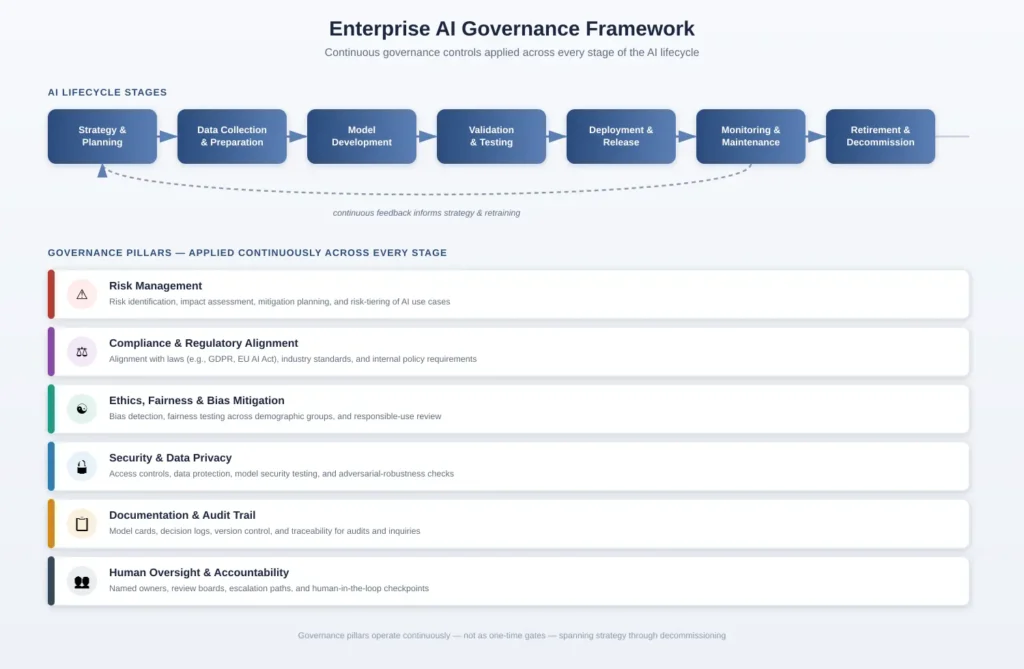
- Governance should be embedded across the entire AI lifecycle—from planning and development to deployment, monitoring, and retirement—not treated as a one-time compliance activity.
- Adopt a comprehensive governance framework that includes regulatory compliance, business accountability, data governance, model governance, secure AI development, runtime monitoring, and responsible AI practices.
- Align your governance strategy with globally recognized standards such as the EU AI Act, NIST AI Risk Management Framework (AI RMF), ISO/IEC 42001, ISO/IEC 23894, and the OECD AI Principles to strengthen compliance and future-proof your AI initiatives.
- Clearly define ownership and accountability by assigning business owners, risk owners, and governance boards for every AI system to eliminate decision-making gaps.
- Integrate governance into AI development workflows by incorporating security testing, red teaming, model evaluations, explainability, and human oversight before deployment.
- Continuously monitor AI systems in production for model drift, hallucinations, bias, prompt injection attacks, policy violations, security risks, and performance degradation.
- Maintain audit-ready documentation with AI inventories, model versions, data lineage, risk assessments, and governance decisions to simplify regulatory reporting.
- Measure your AI governance maturity and continuously improve processes as AI adoption expands across business functions.
- Organizations that invest in governance early can scale AI faster, reduce operational and compliance risks, improve stakeholder trust, and achieve sustainable enterprise AI transformation.
Introduction
Your organization has successfully deployed its first AI application.
The pilot delivered measurable business value, stakeholders are enthusiastic, and leadership wants AI integrated across more teams and business processes.
Then comes the question every CIO, CTO, or Chief AI Officer eventually asks:
“Can we deploy the next 50 AI applications with the same level of control, transparency, and confidence?”
For many organizations, the answer is uncertain.
The challenge isn’t building another AI solution—it’s governing dozens of AI systems consistently while managing risk, maintaining compliance, and preserving stakeholder trust.
Without governance, AI adoption becomes fragmented. Different teams implement different controls, documentation becomes inconsistent, ownership becomes unclear, and regulatory obligations become increasingly difficult to manage.
This is why enterprise AI governance has become one of the most important strategic capabilities for organizations embracing Generative AI, AI agents, predictive analytics, and intelligent automation.
This guide provides a practical AI governance checklist that enterprises can use to scale AI responsibly while aligning with global standards such as the EU AI Act, NIST AI Risk Management Framework (AI RMF), and ISO/IEC 42001.
What Is AI Governance?
AI governance is the framework of policies, processes, technologies, and accountability that ensures AI systems are developed, deployed, monitored, and retired responsibly. It helps organizations manage risk, maintain regulatory compliance, improve transparency, and ensure AI remains aligned with business objectives throughout its lifecycle.
AI governance establishes how organizations:
- Develop AI responsibly
- Manage AI risks
- Protect sensitive data
- Ensure fairness and transparency
- Monitor AI continuously
- Meet evolving regulatory requirements
Rather than being a one-time compliance exercise, governance is an ongoing operational capability that supports every stage of the AI lifecycle.
Why AI Governance Matters Before Scaling
AI governance becomes increasingly important as organizations move from isolated AI pilots to enterprise-wide deployments. Standardized governance reduces operational risk, improves compliance, enables consistent decision-making, and ensures AI systems remain trustworthy as adoption grows across business units.
The risks associated with enterprise AI grow exponentially as organizations deploy more models.
These include:
- Regulatory violations
- Hallucinations
- Data leakage
- Model drift
- Prompt injection attacks
- Biased outcomes
- Security vulnerabilities
- Shadow AI
- Poor documentation
- Unclear ownership
Leading governance frameworks—including the EU AI Act, ISO/IEC 42001, NIST AI RMF, ISO 23894, and OECD AI Principles—all emphasize lifecycle governance rather than point-in-time compliance.
Successful organizations shift from asking:
“Is this AI system compliant today?”
to
“Can every AI system remain compliant tomorrow?”
That shift is what enables AI to scale safely.
Read further in our blog on Enterprise AI Governance Framework: Complete 2026 Guide for Responsible AI.
The Enterprise AI Governance Checklist
An enterprise AI governance checklist provides a structured approach for managing AI across its lifecycle. It covers regulatory compliance, business ownership, data governance, secure AI development, runtime monitoring, responsible AI, and continuous improvement to help organizations scale AI with confidence.
1. Regulatory & Compliance Governance
Regulatory governance ensures every AI system complies with applicable laws, standards, and industry regulations. Organizations should classify AI risks, identify legal obligations, assign compliance owners, and maintain documentation that supports audits and continuous regulatory readiness.
Before deploying AI, determine which regulations apply.
Your Checklist
✔ Identify applicable regulations
- EU AI Act
- GDPR
- DORA
- HIPAA
- PCI DSS
- Industry regulations
✔ Classify system risk
- High Risk
- Limited Risk
- Minimal Risk
✔ Document
- Risk assessments
- Technical documentation
- Data sources
- Human oversight
- AI inventory
✔ Assign regulatory ownership
Questions to ask:
- Who owns compliance?
- Who tracks changing regulations?
- Can documentation be produced during an audit?
2. Business Governance & Accountability
Business governance defines who owns AI systems, approves deployments, accepts risk, and makes strategic decisions. Clearly assigned accountability ensures AI initiatives remain aligned with business objectives while reducing governance gaps across the organization.
Every AI system should have named ownership.
Assign:
- Executive Sponsor
- Business Owner
- Product Owner
- AI System Owner
- Risk Owner
Establish:
- AI Governance Board
- Approval workflow
- Risk acceptance process
- Escalation path
Document:
- Deployment approvals
- Risk decisions
- Governance reviews
- Business KPIs
Remember:
AI owned by everyone is ultimately owned by no one.
3. Data Governance
Data governance ensures AI systems are trained and operated using accurate, secure, and trustworthy data. Strong data governance improves model quality, regulatory compliance, explainability, and long-term operational reliability.
Checklist:
✔ Data lineage
✔ Metadata management
✔ Data quality monitoring
✔ Access controls
✔ Privacy controls
✔ Consent management
✔ Data retention
✔ Data classification
✔ Sensitive data handling
Questions
- Can every dataset be traced?
- Who owns the data?
- Is sensitive information protected?
4. Model Governance
Model governance manages AI models throughout their lifecycle, from development to retirement. Organizations should validate models, monitor bias, maintain version control, document performance, and establish retraining policies to ensure AI systems remain reliable and compliant.
Checklist
✔ Model validation
✔ Version control
✔ Explainability
✔ Bias testing
✔ Performance benchmarks
✔ Retraining strategy
✔ Retirement policy
✔ Documentation
Measure:
- Accuracy
- Drift
- Precision
- Recall
- Hallucination rate
- Fairness metrics
Read our blog on Human-in-the-Loop Agentic AI: Why Autonomous Doesn’t Mean Uncontrolled.
5. Secure AI Development (AI SDLC)
Secure AI development embeds governance into the AI software development lifecycle. Security reviews, prompt testing, red teaming, model evaluations, and human oversight should be integrated before deployment rather than added later.
Every release should include:
✔ Prompt testing
✔ AI red teaming
✔ Security assessment
✔ Threat modeling
✔ Evaluation benchmarks
✔ Human review
✔ Logging enabled
✔ Audit trail
✔ Release approval
Governance should become part of the Definition of Done—not an afterthought.
6. Runtime Monitoring & AI Operations
Runtime AI governance continuously monitors deployed AI systems for performance issues, policy violations, security threats, and model degradation. Continuous monitoring enables faster incident response, improves compliance, and helps maintain trust in AI-driven decisions.
Monitor continuously:
✔ Model drift
✔ Hallucinations
✔ Prompt injection
✔ Data leakage
✔ Response quality
✔ Latency
✔ User feedback
✔ Policy violations
✔ Security events
Create:
- Alert thresholds
- Incident playbooks
- Human escalation
- Rollback procedures
Every alert should have an owner.
7. Responsible AI & Human Oversight
Responsible AI governance ensures AI systems remain ethical, transparent, explainable, and accountable. Human oversight should be incorporated into high-impact decisions to reduce bias, improve trust, and meet emerging global AI regulations.
Implement:
✔ Human-in-the-loop
✔ Explainability
✔ Transparency
✔ Bias monitoring
✔ Accessibility
✔ Appeal mechanisms
✔ Incident reporting
✔ Ethics reviews
AI should support human decision-making—not replace accountability.
For further information, read our blog on Enterprise AI Governance Framework: Complete 2026 Guide for Responsible AI.
Enterprise AI Governance Maturity Model
An AI governance maturity model helps organizations evaluate how effectively governance practices support enterprise AI adoption. As maturity increases, governance becomes standardized, automated, continuously monitored, and embedded throughout the AI lifecycle.
| Level | Maturity |
|---|---|
| Level 1 | AI Pilots |
| Level 2 | Governance Policies |
| Level 3 | Standardized AI Processes |
| Level 4 | Enterprise AI Governance Platform |
| Level 5 | Automated Continuous Governance |
Organizations at higher maturity levels integrate governance into DevSecOps, MLOps, and AI operations rather than relying on manual reviews.
Common AI Governance Mistakes
The most common AI governance mistakes include unclear ownership, manual compliance processes, missing runtime monitoring, poor documentation, and treating governance as a one-time activity. Addressing these issues early helps organizations scale AI more efficiently and reduce long-term risk.
Avoid these common pitfalls:
❌ No AI inventory
❌ Missing business ownership
❌ Weak documentation
❌ No model versioning
❌ Limited monitoring
❌ Inconsistent approvals
❌ Poor audit readiness
❌ Ignoring responsible AI
❌ Governance added after deployment
AI Governance Implementation Roadmap
An AI governance roadmap helps organizations implement governance systematically by assessing current capabilities, designing governance frameworks, operationalizing controls, and continuously improving governance as AI adoption expands.
Phase 1 – Assess
- Inventory AI systems
- Identify regulations
- Evaluate governance maturity
Phase 2 – Design
- Governance framework
- Roles and responsibilities
- Policies
- Risk framework
Phase 3 – Implement
- AI inventory
- Approval workflows
- Monitoring
- Automation
- Documentation
Phase 4 – Optimize
- Continuous monitoring
- Governance KPIs
- Regulatory updates
- Continuous improvement
Read more in our blog on How to Build AI-Native Applications for Enterprise Scale.
Enterprise AI Governance Checklist
Before scaling AI, verify you can confidently answer Yes to each of the following:
Governance
- Have all AI systems been inventoried?
- Is governance standardized across business units?
- Is ownership clearly assigned?
Compliance
- Are applicable regulations documented?
- Are compliance obligations mapped?
- Can audit evidence be generated quickly?
Data
- Is data lineage maintained?
- Are privacy controls implemented?
- Is data quality monitored continuously?
Models
- Are models version-controlled?
- Are models explainable?
- Are models evaluated regularly?
Security
- Has AI security testing been completed?
- Are prompt injection defenses implemented?
- Is logging enabled?
Operations
- Are AI systems monitored continuously?
- Are incidents tracked?
- Are rollback procedures documented?
Responsible AI
- Is human oversight defined?
- Are fairness and bias monitored?
- Are ethical reviews conducted?
If any answer is No, strengthen governance before expanding AI across the enterprise.
Benefits of Strong AI Governance
Strong AI governance enables organizations to scale AI responsibly by improving regulatory compliance, reducing operational risk, increasing transparency, accelerating approvals, and building trust with customers, employees, and regulators.
Organizations with mature governance can:
- Accelerate AI adoption safely
- Improve regulatory readiness
- Reduce operational risk
- Increase stakeholder trust
- Improve audit efficiency
- Reduce AI incidents
- Enable responsible innovation
- Standardize AI deployment across teams
- Build scalable AI operations
Governance becomes a competitive advantage—not an obstacle to innovation.
Conclusion
Enterprise AI success isn’t determined by how quickly organizations build their first AI application.
It’s determined by how confidently they deploy the next hundred.
A comprehensive AI governance framework transforms governance from a compliance requirement into a strategic capability. By embedding accountability, security, data governance, model governance, and continuous monitoring into every stage of the AI lifecycle, organizations can scale AI faster while maintaining trust, transparency, and regulatory compliance.
As AI regulations continue to evolve, enterprises that invest in governance today will be better positioned to innovate responsibly, reduce risk, and unlock long-term business value.
At Techment, we help enterprises design and implement scalable AI governance frameworks that align with global standards, integrate with modern AI platforms, and support secure, responsible AI adoption. Whether you’re building Generative AI applications, AI agents, Retrieval-Augmented Generation (RAG) solutions, or enterprise AI platforms, establishing governance early creates the foundation for sustainable AI transformation.
Frequently Asked Questions
1. What is an AI governance checklist?
An AI governance checklist is a structured framework that helps organizations manage AI risk, ensure regulatory compliance, assign accountability, and monitor AI systems throughout their lifecycle.
2. Why is AI governance important?
AI governance helps organizations reduce risk, comply with regulations, improve transparency, strengthen security, and scale AI responsibly across the enterprise.
3.Which AI governance frameworks should enterprises follow?
The most widely recognized frameworks include the EU AI Act, NIST AI Risk Management Framework (AI RMF 1.0), ISO/IEC 42001, ISO/IEC 23894, and the OECD AI Principles.
4.What should an enterprise AI governance framework include?
A comprehensive framework should include regulatory compliance, business governance, data governance, model governance, secure AI development, runtime monitoring, responsible AI practices, audit readiness, and continuous improvement.
5. How does AI governance support enterprise AI adoption?
By standardizing policies, roles, controls, and monitoring across the AI lifecycle, governance enables organizations to deploy AI consistently, demonstrate compliance, reduce operational risk, and build trust among customers, employees, and regulators.