An enterprise AI agent platform should be evaluated on more than model quality or demo performance. Buyers should assess how well the platform handles real workflows, enterprise integrations, identity and permissions, tool execution, knowledge grounding, evaluation, observability, security, scalability, deployment flexibility, cost, and vendor lock-in. The strongest evaluation method is a controlled pilot using a real business workflow and representative data.
AI agent platforms are moving from experimentation toward production use.
But buying an agent platform is fundamentally different from buying a conventional SaaS application.
An agent may:
- Retrieve enterprise information
- Call APIs
- Execute business actions
- Maintain state
- Use multiple tools
- Delegate work to other agents
- Make decisions within defined boundaries
- Operate asynchronously
- Interact with sensitive enterprise systems
That means the platform becomes part of the organization’s operating and control layer, not simply another AI development tool.
Current enterprise evaluation guides consistently emphasize that buyers should evaluate the platform behind the demonstration: governance, integrations, autonomy, observability, evaluation, economics, and operational maturity.
The central buying question is therefore:
Can this platform safely execute our real business workflows at production scale—not merely demonstrate an impressive agent?
What Is an Enterprise AI Agent Platform?
An enterprise AI agent platform is a technology foundation for building, deploying, integrating, governing, monitoring, and scaling AI agents that can reason over information and use tools to perform business tasks. Unlike a basic chatbot platform, it must manage identity, permissions, tools, state, evaluation, observability, security, and operational lifecycle.
A production agent typically looks like:
User / Event
     ↓
Agent
     ↓
Model
     ↓
Planning / Orchestration
     ↓
Knowledge + Memory
     ↓
Tools / APIs
     ↓
Enterprise Systems
     ↓
Action / Result
The platform sits around these components and provides the controls required to operate them.
For example, Microsoft Foundry currently combines agents, models, tools, RBAC, networking, policies, tracing, monitoring, and evaluation capabilities within its platform.
AWS similarly describes enterprise agentic architecture as multiple layers with security, observability, and governance spanning the system rather than being isolated features.
How Should Enterprises Evaluate an AI Agent Platform?
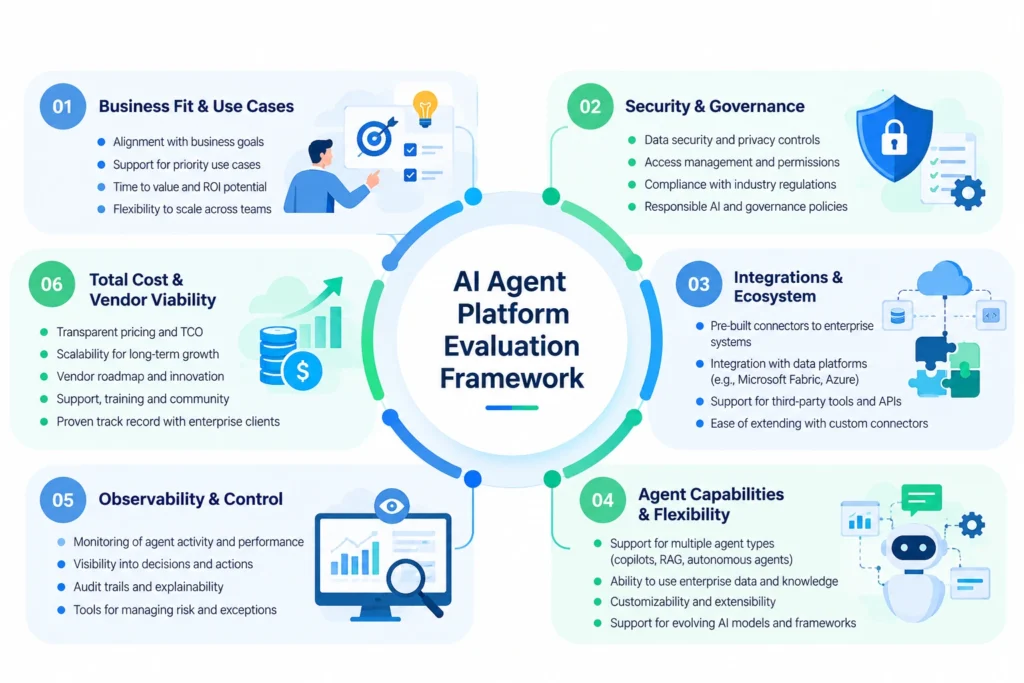
The best way to evaluate an AI agent platform is to start with one real business workflow, define measurable success criteria and risk boundaries, then test each shortlisted platform against the same data, integrations, permissions, failure scenarios, and operational requirements. Feature lists and scripted demos should support the evaluation—not replace it.
A practical evaluation framework has 10 dimensions:
- Business and workflow fit
- Agent orchestration
- Enterprise integrations
- Knowledge and context
- Security and identity
- Governance and human oversight
- Evaluation and testing
- Observability and operations
- Deployment and scalability
- Economics and vendor risk
1. Business and Workflow Fit
The first question is not which AI agent platform has the most features. It is whether the platform can solve a defined business problem with measurable outcomes. Start with the workflow, required data, actions, exceptions, users, and risk level before comparing vendors.
Define the workflow:
- What starts the process?
- What information does the agent need?
- Which systems must it access?
- Which actions can it perform?
- Which actions require approval?
- What happens when information is missing?
- What constitutes successful completion?
- What happens when the agent fails?
For example:
Weak evaluation
“Build us an impressive customer-service agent.”
Strong evaluation
“Resolve a customer billing request using CRM, billing, and policy systems, with no unauthorized write operations, human approval for refunds, complete action tracing, and a defined response-time target.”
The second scenario gives vendors something measurable to prove.
2. Agent Orchestration and Autonomy
An enterprise agent platform should provide controlled orchestration rather than unrestricted model-driven execution. Evaluate planning, task decomposition, tool selection, state management, retries, handoffs, asynchronous execution, and configurable autonomy boundaries.
Ask vendors:
- Can agents execute multi-step workflows?
- Can they maintain state?
- Can agents hand work to other agents?
- Can workflows combine deterministic steps with AI decisions?
- Can tool execution require approval?
- Can autonomy levels be configured?
- Can failed steps be retried safely?
- Can workflows resume after interruption?
A useful enterprise model is:
Assist
  ↓
Recommend
  ↓
Prepare
  ↓
Request Approval
  ↓
Execute
  ↓
Execute Automatically
Not every workflow should reach the final stage.
The platform should allow autonomy to be graduated according to business risk.
3. Enterprise Integrations and Tool Execution
Integration depth is one of the most important criteria for an enterprise AI agent platform. An agent that cannot reliably access the systems where business work actually occurs will remain a demonstration layer rather than an operational capability.
Evaluate integrations with:
- REST APIs
- GraphQL
- Databases
- SaaS applications
- ERP
- CRM
- ITSM
- Data warehouses
- File systems
- Enterprise search
- MCP servers
- Internal applications
- Event platforms
Do not ask only:
“Does the platform integrate with Salesforce?”
Ask:
“Can the agent securely retrieve and update the exact Salesforce objects required by this workflow, under the user’s or agent’s authorized identity, with complete auditability?”
Tool evaluation checklist
- Typed inputs and outputs
- Authentication
- Authorization
- Versioning
- Timeouts
- Retries
- Error handling
- Rate limits
- Idempotency
- Audit logs
Current enterprise buyer frameworks emphasize integration depth and reliable tool execution as major differentiators between production platforms and demo-oriented systems.
4. Knowledge, RAG and Context Management
Enterprise agents need reliable access to organizational knowledge, not just a capable language model. Evaluate how the platform handles RAG, structured data, enterprise search, metadata filtering, citations, memory, context windows, document permissions, and knowledge freshness.
Ask:
- Can the platform connect to existing enterprise knowledge?
- Does retrieval support semantic and keyword search?
- Can access permissions flow into retrieval?
- Are citations available?
- How is stale information handled?
- Can agents use structured and unstructured data?
- Can short-term and long-term memory be controlled?
- Can memory be deleted or updated?
- Can retrieval quality be evaluated independently?
For many enterprise use cases, context quality will matter as much as model quality.
A smarter model cannot reliably compensate for missing or unauthorized enterprise data.
5. Security and Identity
Security should be evaluated at the agent, user, tool, data, and action levels. An enterprise agent should have controlled identity and least-privilege access rather than operating as a shared administrator or inheriting unrestricted user permissions.
Evaluate:
Identity
- SSO
- Enterprise identity providers
- Agent identities
- Workload identities
- Credential rotation
Authorization
- RBAC
- ABAC where required
- Least privilege
- Resource-level permissions
- Tool-level permissions
Data security
- Encryption
- Data residency
- Network isolation
- Private connectivity
- Tenant isolation
- PII controls
Action security
- Tool allowlists
- Approval gates
- Transaction limits
- Write restrictions
- Kill switches
Read our blog on AI Coding Agents in Enterprise Software Development: Use Cases, Risks & Best Practices
Microsoft Foundry, for example, documents Entra identity, RBAC, content filtering, network isolation, and policy capabilities as part of its enterprise platform.
AWS likewise documents security and guardrail capabilities around Bedrock and its agent ecosystem.
6. Governance and Human Oversight
Enterprise AI governance must control what agents are allowed to do, not simply record what they did afterward. Evaluate policy enforcement, approval workflows, agent ownership, auditability, version control, exception handling, and the ability to suspend or revoke agent access.
A production governance model should answer:
| Question | Required capability |
|---|---|
| Who owns the agent? | Named business + technical owner |
| What can it access? | Scoped permissions |
| What can it change? | Explicit tool/action policy |
| Which actions require approval? | Human-in-the-loop controls |
| What happened? | Immutable or controlled audit trail |
| Which version acted? | Agent/model/prompt versioning |
| Can it be stopped? | Disable/kill capability |
| What happens after failure? | Escalation and recovery |
AWS’s enterprise agent architecture guidance treats security, observability, and governance as cross-cutting concerns across the architecture rather than isolated components.
7. Evaluation and Testing
An enterprise AI agent platform should provide repeatable evaluation rather than relying on manual prompts and subjective review. Buyers should test both the final outcome and the agent’s process, including tool selection, tool inputs, tool outputs, task completion, safety, and failure behavior.
This is one of the most important procurement criteria.
Microsoft’s current Foundry evaluation tooling supports agent evaluation using datasets and evaluators, including task completion and process-level metrics such as tool selection, tool-input accuracy, tool-output utilization, and tool-call success.
Ask vendors:
- Can I create evaluation datasets?
- Can evaluations run automatically?
- Can I test tool selection?
- Can I test incorrect tool arguments?
- Can I measure task completion?
- Can I test safety?
- Can I regression-test new models?
- Can evaluations run in CI/CD?
- Can I compare agent versions?
Minimum evaluation lifecycle
Test Dataset
     ↓
Agent Version A
     ↓
Evaluation
     ↓
Metrics
     ↓
Change Model / Prompt / Tool
     ↓
Agent Version B
     ↓
Regression Evaluation
     ↓
Production
Do not buy an agent platform without understanding how you will prove that a new model or prompt did not make the system worse.
8. Observability and Traceability
Agent observability must expose more than application uptime. Buyers should be able to reconstruct what the agent did, which model and tools it used, what information it retrieved, where latency occurred, what failed, and how much the interaction cost.
At minimum, evaluate:
- End-to-end traces
- Model calls
- Tool calls
- Retrieval operations
- Agent handoffs
- Latency
- Errors
- Token usage
- Cost
- Session history
- Evaluation scores
Microsoft Foundry’s current tracing capabilities capture telemetry such as latency, exceptions, prompts, retrieval operations, tool invocations, and agent execution flows.
AWS AgentCore also supports online evaluation of deployed agents using sampled production interactions.
The key question
If an agent makes a wrong decision at 2:00 AM, can your team reconstruct why?
If the answer is no, the platform is not operationally mature enough for high-impact workflows.
9. Deployment, Scalability and Reliability
An enterprise agent platform must fit the organization’s deployment, networking, data-residency, reliability, and scalability requirements. Evaluate cloud, hybrid, private-network, regional, and containerized deployment options according to the workloads being considered.
Ask:
- Where does the agent execute?
- Where is data processed?
- Can it operate inside private networks?
- What regions are supported?
- What are the availability commitments?
- How does scaling work?
- Are asynchronous jobs supported?
- How are long-running tasks handled?
- What happens during provider outages?
- Can workloads fail over?
- Can the platform integrate with existing CI/CD?
Do not assume that a platform’s “enterprise” label means it satisfies your deployment requirements.
Test the actual topology.
10. Economics and Vendor Lock-In
AI agent economics extend beyond platform licensing. Buyers should model model-inference costs, tool calls, retrieval, storage, observability, human review, infrastructure, support, and engineering effort. They should also assess how difficult it would be to change models or platforms later.
Build a total-cost model:
TCO =
Platform
+ Model Inference
+ Tool/API Usage
+ Data / Storage
+ Observability
+ Infrastructure
+ Engineering
+ Human Review
+ Support
+ Migration / Exit Cost
Then test different usage scenarios:
- 1,000 tasks/month
- 100,000 tasks/month
- Peak-period usage
- Long-running agent workflows
- Multi-agent workflows
Evaluate lock-in
Ask:
- Can I use multiple models?
- Can I bring my own model?
- Can agents run on another runtime?
- Are prompts exportable?
- Are workflows portable?
- Are tool definitions portable?
- Can traces be exported?
- Can evaluation datasets be exported?
- What happens if pricing changes?
Microsoft Foundry, for example, currently documents access to models from multiple providers and agent deployment options ranging from managed prompt agents to hosted code-based agents.
The Enterprise AI Agent Platform Buyer’s Checklist
Use the following checklist during vendor evaluation.
| Category | Questions to ask |
|---|---|
| Business fit | Does it solve our defined workflow? |
| Orchestration | Can it handle multi-step tasks and state? |
| Tools | Can it securely execute our required APIs? |
| Knowledge | Can it ground responses in enterprise data? |
| Identity | Does every agent/action have controlled identity? |
| Security | Can permissions be enforced at runtime? |
| Governance | Can risky actions require approval? |
| Evaluation | Can agent behavior be tested systematically? |
| Observability | Can every important action be traced? |
| Reliability | What happens when tools, models or APIs fail? |
| Deployment | Does it meet our network and residency requirements? |
| Models | Can we use multiple models? |
| Scalability | Can it handle production workloads? |
| Economics | Can we predict cost at scale? |
| Portability | Can we export workflows, data and evaluations? |
| Support | What enterprise support and SLAs exist? |
A Practical AI Agent Platform Scorecard
A scorecard is useful only when it is tied to the organization’s workflow and risk profile. Instead of choosing a platform because it receives the highest generic score, weight the criteria according to the workload being deployed and establish mandatory requirements that vendors must satisfy.
A useful starting template is:
| Evaluation Area | Suggested Weight |
|---|---|
| Business/workflow fit | 15% |
| Integration and tools | 15% |
| Security and identity | 15% |
| Governance | 10% |
| Evaluation/testing | 10% |
| Observability | 10% |
| Orchestration/autonomy | 10% |
| Deployment/scalability | 5% |
| Model flexibility | 5% |
| Economics/TCO | 5% |
Do not treat these percentages as universal. A regulated financial-services workflow may place substantially more weight on security, governance, auditability, and deployment controls, while an internal productivity workflow may emphasize integrations, usability, and economics.
More importantly, establish non-negotiable gates.
For example:
Mandatory Requirements
        ↓
Security
Identity
Auditability
Required Integrations
Deployment Requirements
        ↓
Shortlist
        ↓
Weighted Evaluation
        ↓
Real-World Pilot
        ↓
Procurement
A high overall score should not compensate for failure on a mandatory security or integration requirement.
How to Run an AI Agent Platform Proof of Concept
The best proof of concept uses a real enterprise workflow, representative data, actual integrations, and realistic failure scenarios. The objective is not to prove that the agent can complete a happy-path demonstration; it is to determine whether it remains useful, controllable, observable, and economical when conditions become messy.
Test these scenarios:
Happy path
Can the agent complete the normal workflow?
Missing information
What happens when required data is unavailable?
Incorrect information
Does the agent detect contradictions?
Tool failure
What happens when an API times out?
Permission failure
Does the agent stop safely?
Ambiguous request
Does it ask for clarification?
High-risk action
Does it request human approval?
Model failure
Can the workflow recover?
Prompt injection
Can untrusted content manipulate tool execution?
High volume
Does latency and cost remain acceptable?
The most useful POC is therefore:
real workflow + real data + real systems + real controls + realistic failure conditions.
Current enterprise buyer guidance similarly recommends evaluating platforms against actual workflows rather than relying on scripted vendor demonstrations.
Red Flags During Vendor Evaluation
Certain vendor responses should trigger deeper technical investigation: vague security claims, demonstrations that avoid real integrations, inability to show agent traces, no repeatable evaluation framework, unclear pricing, unrestricted agent permissions, and heavy dependence on proprietary components that cannot be exported.
Watch for:
“Our model is accurate.”
Ask:
How do you measure task completion and tool-call accuracy on our workflow?
“We integrate with everything.”
Ask:
Show the exact API, authentication, authorization, error-handling and write-operation path.
“The agent is autonomous.”
Ask:
Which actions are autonomous, and which require approval?
“We have enterprise security.”
Ask:
Show the runtime authorization model and audit trail.
“Our AI improves over time.”
Ask:
How is regression testing performed before a model or prompt change reaches production?
“Pricing is usage-based.”
Ask:
Model the monthly TCO for our expected workflow volume, including tools, retrieval, observability and support.
Build vs Buy an AI Agent Platform
Enterprises should consider buying a platform when they need standardized governance, integrations, observability, evaluation, and operational controls across multiple agent workloads. Building may be appropriate when agent behavior or infrastructure requires highly specialized control, but the organization must be prepared to own the surrounding platform capabilities.
Buy when you need:
- Faster time to production
- Managed runtime
- Enterprise security
- Built-in evaluation
- Observability
- Standard integrations
- Vendor support
Build when you need:
- Highly specialized orchestration
- Unique deployment requirements
- Deep infrastructure control
- Custom agent runtime behavior
- Specialized IP
The hidden cost of building is often everything around the agent:
identity + governance + evaluation + observability + deployment + lifecycle management.
That should be included in the comparison.
Read our blog on Build vs Buy AI in 2026: A Strategic Enterprise Decision Guide
What Should an Enterprise AI Agent Platform Architecture Include?
A production enterprise agent architecture should separate the model from orchestration, tools, enterprise data, identity, policy enforcement, evaluation, and observability. This separation makes it easier to change models, control actions, diagnose failures, and govern agent behavior.
A useful reference model is:
                 USER / EVENT
                      ↓
              EXPERIENCE LAYER
                      ↓
              AGENT ORCHESTRATOR
                      ↓
        ┌─────────────┼─────────────┐
        ↓             ↓             ↓
      Model        Memory        Retrieval
        ↓             ↓             ↓
        └─────────────┼─────────────┘
                      ↓
                POLICY LAYER
                      ↓
                TOOL LAYER
                      ↓
        ┌─────────────┼─────────────┐
        ↓             ↓             ↓
       CRM           ERP          APIs
        ↓             ↓             ↓
             ENTERPRISE SYSTEMS

 Governance • Identity • Security
 Evaluation • Observability • Audit
AWS’s enterprise agent architecture similarly describes layered agent systems with cross-cutting security, observability, and governance.
7 Questions to Ask Before Signing a Contract
Before purchasing an AI agent platform, the buying team should be able to answer seven questions: what the agent can access, what it can change, how its behavior is evaluated, how failures are investigated, how costs scale, how models can change, and how the organization can exit the platform.
- What can the agent access?
- What can it change without approval?
- Can we reproduce and evaluate its behavior?
- Can we trace every important tool call and action?
- What happens when the agent or an integrated system fails?
- What will this cost at production volume?
- What is our migration path if we change platforms?
If the vendor cannot answer these clearly, the evaluation is not complete.
Read our blog on AI Agent Evaluation Frameworks Compared (2026)
Key Takeaways
- Evaluate the workflow, not the demo.
- Model quality is only one component of an enterprise agent platform.
- Integration and tool execution determine whether agents can perform real work.
- Runtime identity and least-privilege permissions are essential for agents with write access.
- RAG, memory, and context management should be evaluated against real enterprise data.
- Evaluation must cover both outcomes and agent process.
- Observability should expose model calls, tool calls, retrieval, latency, failures, and cost.
- Governance should enforce policies before risky actions occur.
- Model portability can reduce strategic dependence on one provider.
- TCO should include inference, tools, infrastructure, observability, engineering, and human oversight.
- The strongest POC uses real workflows, representative data, real integrations, and realistic failure scenarios.
- Use mandatory security and integration gates before applying a weighted scorecard.
Conclusion
Choosing an AI agent platform is becoming an enterprise architecture decision—not simply an AI tooling decision.
The platform you select will influence how agents:
access data → reason → use tools → execute actions → handle failures → get evaluated → remain observable → operate under governance.
That is why the most important question is not:
“Which AI agent platform has the most features?”
It is:
“Which platform can operate our priority workflows safely, measurably, and economically in production?”
A disciplined evaluation therefore starts with a real workflow, establishes non-negotiable security and integration requirements, compares platforms against the same test scenarios, and validates the shortlisted options through a controlled production-like pilot.
For enterprises building an AI-native operating model, this approach provides a practical bridge between experimentation and production.
Techment can help organizations define their agent strategy, evaluate platform options, design enterprise agent architectures, implement RAG, AI agents, workflow automation, governance and observability, and connect agentic AI to existing enterprise applications and data platforms.
Frequently Asked Questions
1. What is an AI agent platform?
An AI agent platform is a technology foundation for building, deploying, integrating, monitoring, evaluating, and governing AI agents that can use models, enterprise data, tools, and workflows to perform tasks.
2. How do I evaluate an AI agent platform?
Start with a real business workflow and evaluate business fit, orchestration, integrations, knowledge grounding, security, governance, evaluation, observability, deployment, scalability, economics, and vendor lock-in.
3. What is the most important feature of an enterprise AI agent platform?
There is no single universal feature. For production deployments, runtime security, reliable integrations, evaluation, observability, governance, and workflow fit are generally more important than a polished conversational interface.
4. How is an AI agent platform different from an LLM platform?
An LLM platform primarily provides access to models. An agent platform adds orchestration, tools, memory/state, enterprise integrations, runtime controls, evaluation, observability, and lifecycle management.
5. Should enterprises build or buy an AI agent platform?
Buy when managed governance, integrations, evaluation, observability, and operational capabilities are valuable. Build when specialized control or unique requirements justify owning the additional infrastructure and engineering burden.
6. How should an AI agent platform be tested?
Test it with representative workflows and data, including normal cases, missing data, tool failures, permission failures, ambiguous requests, high-risk actions, prompt injection, and production-scale load.
7. What should an enterprise AI agent platform cost?
There is no universal price. Calculate total cost using platform fees, model inference, tool/API calls, storage, retrieval, observability, infrastructure, engineering, support, and human-review costs.
Related Reads
- Build vs Buy AI in 2026: A Strategic Enterprise Decision Guide
- A Complete Guide On Agentic AI Orchestration
- Enterprise AI Strategy in 2026
- Fabric AI Readiness: How to Prepare Your Data for Scalable AI Adoption.
- Agentic AI use cases
- 10 AI data analytics trends in 2026
- AI Agent Evaluation Frameworks Compared (2026)