

Introduction
Enterprise leaders are under unprecedented pressure to operationalize AI. Boardrooms expect productivity gains, intelligent automation, and faster decisions. CIOs are being asked to move beyond experimentation and demonstrate measurable outcomes from generative AI, predictive analytics, and autonomous systems.
Yet many enterprises are learning a difficult truth: AI is only as effective as the data behind it.
In this guide, we examine seven critical warning signs that indicate your enterprise data foundation may not yet support scalable, trustworthy AI—and what strategic leaders can do about it.
TL;DR
- Most enterprise AI failures begin with poor data readiness for AI, not model selection.
- If business teams struggle to trust dashboards, AI will amplify confusion rather than insight.
- Weak governance, fragmented ownership, and growing data debt are major warning signs.
- AI-ready organizations treat data as a strategic operating asset, not a compliance obligation.
- Enterprises that modernize governance, quality, metadata, and interoperability gain faster AI ROI.
Why Data Readiness for AI Has Become a Leadership Imperative
Artificial intelligence has fundamentally changed enterprise expectations around data.
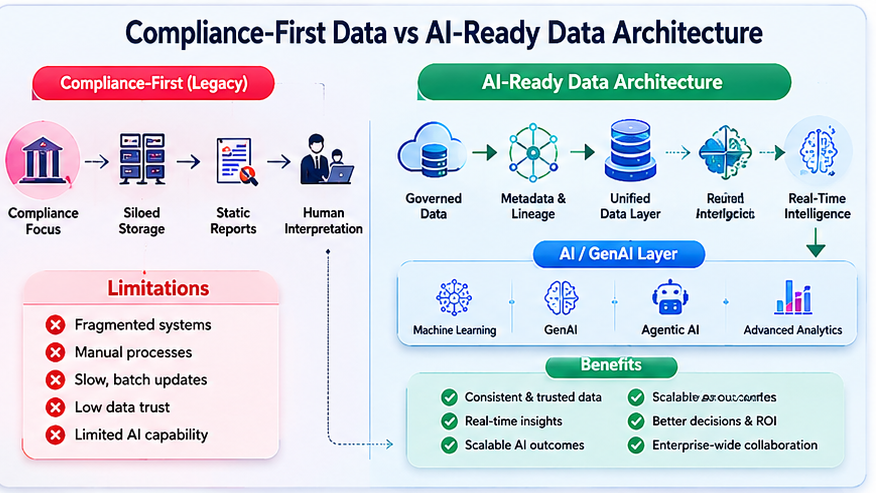
Historically, enterprise systems were designed for transaction processing, compliance, and static reporting. Data warehouses served retrospective analysis. Business intelligence supported dashboards. Governance focused on minimizing operational risk.
AI changes the equation entirely.
Modern AI systems require:
- Context-rich data
- High trust and accuracy
- Interoperability across systems
- Strong metadata foundations
- Real-time accessibility
- Governance at scale
Without these elements, AI systems become unreliable, inconsistent, or even dangerous.
Research from leading advisory firms consistently shows that organizations struggle to scale enterprise AI because their data ecosystems remain fragmented. Many organizations have advanced algorithms but immature operating foundations.
The result?
Enterprise AI often becomes an expensive experimentation exercise instead of a business transformation engine
Why Leaders Struggle with Data Readiness for AI
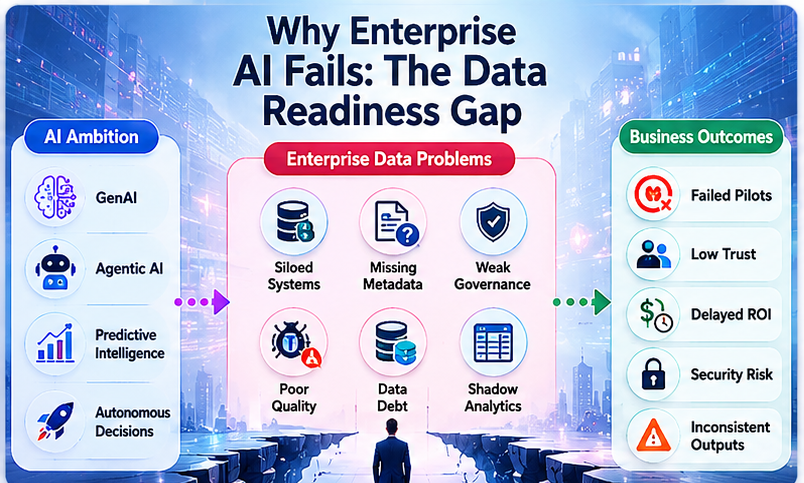
Despite growing investments, most organizations still struggle with data readiness for AI. According to industry research, enterprises frequently overestimate their preparedness, assuming that simply possessing large volumes of data automatically translates into AI readiness. In reality, fragmented systems, weak governance, poor metadata, inconsistent definitions, and unresolved data debt often create invisible barriers that undermine enterprise AI initiatives.
This challenge explains why many organizations report AI pilots without sustained business value. Ambition is accelerating faster than foundational maturity.
The question leaders should ask is not “Are we using AI?” but rather:
“Is our data ready for AI?”
The cost of poor data readiness for AI extends beyond failed proofs of concept.
Why Data Readiness for AI Matters for CIOs and CDOs
Weak foundations can lead to:
- Hallucinated enterprise responses
- Biased outputs
- Regulatory exposure
- Poor executive trust
- Increased operational friction
- Slower AI adoption
For executive teams, the challenge is increasingly strategic rather than technical.
The enterprises winning with AI are not necessarily those with the most advanced models. They are the organizations that invested early in governance, quality, interoperability, and modernization.
For organizations navigating this transition, strengthening data quality for AI initiatives becomes foundational to long-term enterprise value.
Explore a practical enterprise framework for building trusted data foundations through quality, governance, architecture, and modernization — the four pillars required for scalable AI readiness in our How to Build AI-Ready Data Foundations: A Strategic Enterprise Guide.
Enterprise AI Readiness Gap
Sign 1: Your Data Strategy Was Built for Compliance — Not Intelligence
Many enterprises unknowingly operate with data environments designed for yesterday’s priorities.
Traditional data ecosystems evolved to support:
- Regulatory reporting
- Historical compliance
- Financial audits
- Operational recordkeeping
They were not built to support learning systems.
This is one of the biggest blockers to data readiness for AI.
Why Compliance-Centric Data Fails AI
AI systems require machine-readable, contextual, and dynamic information.
Unfortunately, enterprise data environments often suffer from:
Fragmented data silos
Business functions frequently own isolated datasets with inconsistent definitions.
Sales, finance, operations, customer success, and supply chain teams may interpret identical metrics differently.
For humans, this creates inefficiency.
For AI systems, it creates confusion.
Static reporting structures
Legacy reporting systems prioritize retrospective dashboards rather than predictive intelligence.
AI thrives on adaptive, contextual inputs—not static reports frozen in time.
Weak metadata foundations
Many enterprises still lack strong metadata management.
Without metadata, AI cannot effectively understand:
- Context
- Ownership
- Meaning
- Lineage
- Trustworthiness
The result is unreliable outputs.
Executive Insight
Enterprise leaders often mistake data abundance for AI readiness.
Watch the recording of our insightful webinar, “Empowering Small and Medium Enterprises: Mastering Data Strategies for Success.” In this session, we delved into the crucial aspects of building a robust data strategy tailored for success in today’s dynamic business landscape.
But volume does not equal usability.
Organizations that modernize their architectures around intelligence—not compliance alone—typically scale AI faster and more safely.
A modern enterprise data strategy should prioritize:
- Data discoverability
- Contextual metadata
- Real-time interoperability
- Cross-functional visibility
- Machine-readability
For organizations modernizing enterprise analytics, data transformation becomes a strategic enabler rather than an IT project.
Explore the most critical enterprise AI agent adoption challenges, including data readiness, governance complexity, orchestration issues, ROI ambiguity, and organizational resistance
Sign 2: Your Teams Struggle to Trust or Access Enterprise Dat
A practical test for data readiness for AI is simple:
Can teams easily find, trust, and use enterprise data today?
If not, AI will likely magnify existing dysfunction.
AI cannot compensate for poor discoverability.
It simply automates inconsistency faster.
Common Warning Signs
Enterprise leaders often hear statements like:
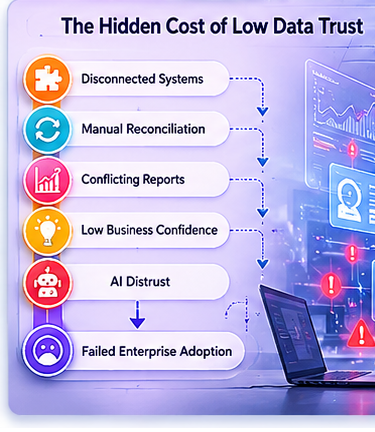
“I’m not sure which dashboard is correct.”
“We had to manually reconcile the data.”
“The numbers don’t match across teams.”
“We exported everything into Excel.”
These are not minor frustrations.
They are major AI readiness warnings.
Why Data Accessibility Matters
AI systems depend on:
- Reliable source systems
- Standardized definitions
- Accessible infrastructure
- Strong governance controls
When employees cannot confidently locate trusted information, enterprise AI systems inherit the same confusion.
This creates:
AI inconsistency
Outputs vary based on conflicting source systems.
Low enterprise trust
Executives stop relying on AI-generated recommendations.
Slower adoption
Employees revert to manual workflows.
Executive Insight
High-performing enterprises treat discoverability as a strategic capability.
This means leaders must know:
- Where data lives
- Who owns it
- Whether it is trustworthy
- How it is consumed
Without visibility, scaling AI becomes nearly impossible.
Modern enterprises increasingly invest in unified governance frameworks to strengthen AI trust.
Further read our blog on Data Quality for AI in 2026: The Ultimate Blueprint for Accuracy, Trust & Scalable Enterprise Adoption
Sign 3: Your Data Governance Isn’t Actually Governing
Many organizations claim to have governance.
Far fewer have governance that actually works.
Governance maturity remains one of the strongest predictors of enterprise data readiness for AI.
What Weak Governance Looks Like
If leaders cannot answer basic questions such as:
- Who owns this dataset?
- Where did this data originate?
- Can we trust this information?
- What permissions exist?
AI risk rises dramatically.
Without governance, AI systems may:
- Access outdated information
- Surface contradictory responses
- Reveal sensitive content
- Generate compliance concerns
This becomes especially risky with generative AI and agentic AI systems that operate autonomously.
Why Governance Becomes an AI Problem
AI magnifies underlying enterprise weaknesses.
Poor governance may have been manageable in traditional reporting environments.
But AI introduces:
Higher speed
Errors spread faster.
Greater scale
Bad decisions replicate quickly.
Larger exposure
Sensitive content becomes vulnerable.
Executive Insight
AI-ready organizations approach governance differently.
They define:
- Clear ownership
- Data lineage
- Standardized terminology
- Access policies
- Metadata structures
Governance stops being a bureaucratic obligation and becomes an operational capability.
Organizations serious about scaling AI increasingly build governance into enterprise modernization roadmaps early rather than retroactively.
Our blog on AI Ready Enterprise Checklist: How to Prepare Your Data for Scalable AI Adoption provides a comprehensive roadmap for leaders seeking to modernize their data estate for scalable AI adoption—grounded in Fabric AI Readiness principles.
Sign 4: Business Intelligence Adoption Is Quietly Declining
One of the most overlooked warning signs in data readiness for AI is poor business intelligence adoption.
At first glance, dashboards appear functional.
Reports still get produced.
Metrics still exist.
Everything looks healthy.
But beneath the surface, users have already stopped trusting enterprise systems.
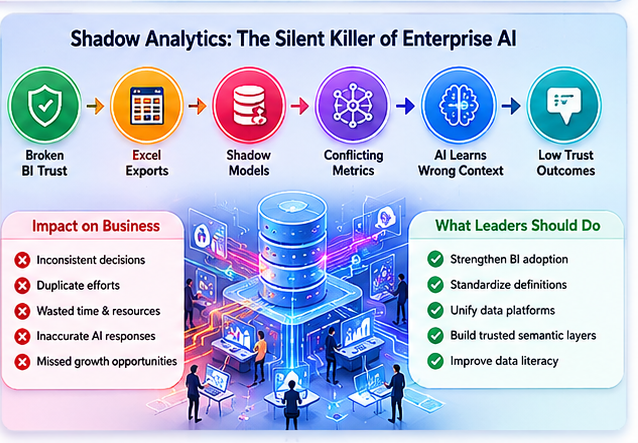
The Rise of Shadow Analytics
When BI tools fail users:
People improvise.
They begin:
- Exporting spreadsheets
- Building unofficial models
- Creating local metrics
- Maintaining hidden databases
This phenomenon is commonly known as shadow analytics.
And it is one of the strongest indicators that enterprise data maturity is weaker than leaders realize.
Why This Matters for AI
AI learns from enterprise truth.
If truth becomes fragmented, AI inherits fragmentation.
The result:
Multiple conflicting outputs
Different teams receive different recommendations.
Loss of semantic consistency
Definitions drift.
Reduced enterprise confidence
Users stop trusting automation.
Executive Insight
Business intelligence acts as the proving ground for enterprise AI.
If employees already distrust dashboards, they are unlikely to trust autonomous AI recommendations.
Before scaling AI, organizations should first evaluate:
Are business users actually using enterprise data platforms?
If not, the issue is rarely the dashboard.
The issue is usually deeper structural fragmentation.
Enterprises investing in long-term AI maturity increasingly prioritize semantic consistency and governed analytics platforms.
Discover more in our partnership page and understand the strategic benefits we bring as a solutions partner.
Shadow Analytics: The Silent Killer of Enterprise AI
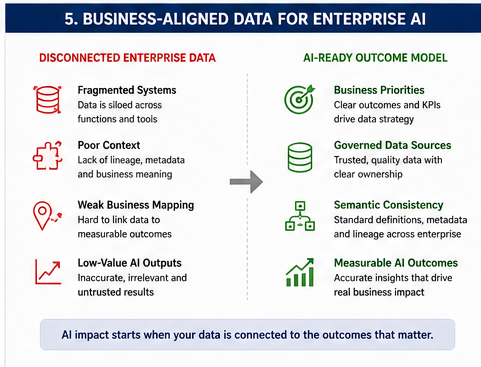
Sign 5: Your Data Doesn’t Clearly Connect to Business Outcomes AI Can Influence
One of the most overlooked barriers to data readiness for AI is a disconnect between enterprise data and measurable business outcomes.
Many organizations accumulate enormous volumes of information yet struggle to answer a deceptively simple question:
“What decisions is this data actually helping improve?”
This challenge becomes especially visible once enterprises begin deploying generative AI or predictive systems.
Initially, excitement is high.
Pilot programs launch quickly.
Teams experiment with copilots, intelligent automation, forecasting, and enterprise search.
But eventually leadership asks:
“Where is the business impact?”
If the answer is unclear, the problem often lies in the data foundation.
Why Outcome Misalignment Happens
Historically, enterprise data was collected for human interpretation.
Business teams relied on institutional knowledge to interpret context, exceptions, and ambiguity.
Humans instinctively understand incomplete information.
AI systems do not.
When enterprise datasets lack clear alignment to measurable business outcomes, AI struggles to generate relevant recommendations.
Common examples include:
Customer service systems with incomplete resolution histories
AI copilots struggle to recommend next-best actions.
Sales data disconnected from conversion outcomes
Forecasting becomes unreliable.
Operational datasets without contextual lineage
AI recommendations lack credibility.
Knowledge repositories filled with outdated information
Generative AI surfaces inaccurate responses.
The result is often inconsistent enterprise AI performance.
Leaders begin seeing outputs that feel:
- Incomplete
- Outdated
- Contradictory
- Detached from business reality
Executive Insight
AI readiness is not about possessing more data.
It is about possessing business-aligned data.
Organizations with strong data readiness for AI connect enterprise datasets directly to measurable value drivers, such as:
- Customer retention
- Revenue optimization
- Supply chain efficiency
- Risk reduction
- Productivity gains
- Decision acceleration
High-performing organizations increasingly prioritize outcome-driven data architecture instead of infrastructure-first thinking.
For enterprises shaping long-term transformation strategies, aligning AI initiatives to business priorities becomes essential.
Explore 7 strategic steps to assess your readiness for Microsoft Fabric Adoption, helping enterprise leaders evaluate technical preparedness, business alignment, governance maturity, and AI readiness before migration begins.
Sign 6: Your Enterprise Is Drowning in Data Debt
Technical debt has long been a challenge for enterprise technology teams.
But in the AI era, data debt may be even more dangerous.
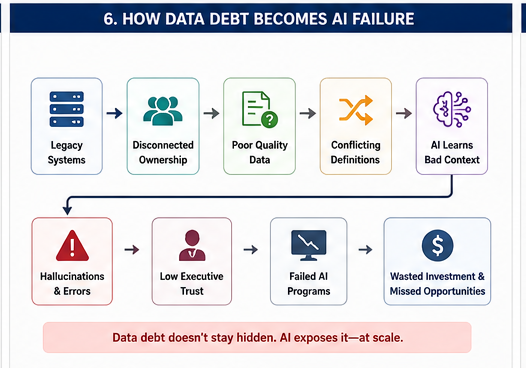
Data debt refers to years of accumulated shortcuts across enterprise systems:
- Inconsistent formats
- Missing values
- Duplicate records
- Conflicting business definitions
- Poor interoperability
- Legacy interfaces
In many organizations, these problems remain hidden until AI arrives.
Then suddenly, they become impossible to ignore.
Why AI Exposes Data Debt Faster
Traditional reporting systems tolerate imperfections.
Humans compensate.
Teams manually reconcile data.
Employees understand organizational nuance.
AI does not.
AI systems treat flawed data as truth.
That means poor-quality information gets amplified at scale.
The Real Cost of Data Debt
When organizations delay remediation, consequences often include:
Unreliable AI outputs
Models generate inaccurate recommendations.
Increased operational friction
Teams spend excessive time validating results.
Reduced trust
Executives stop relying on AI systems.
Slower innovation
Transformation programs stall.
Regulatory exposure
Sensitive data risks increase.
This challenge is particularly difficult because data debt is rarely owned by one team.
IT may manage infrastructure.
Business units own processes.
Analytics teams own reporting.
Governance teams own policy.
But accountability becomes fragmented.
Executive Insight
The biggest AI mistake leaders make is assuming data debt can wait.
In reality, unresolved data debt compounds exponentially as AI adoption expands.
Organizations serious about enterprise AI increasingly prioritize:
Standardization
Establish consistent enterprise definitions.
Observability
Continuously monitor data quality signals.
Automation
Reduce manual remediation work.
Data product thinking
Treat enterprise data as reusable assets.
The enterprises winning with AI are not necessarily eliminating all data debt.
They are reducing enough friction to make trusted AI scalable.
For organizations modernizing trust at scale, structured quality frameworks become foundational.
For deeper insights into AI-powered platforms explore our Microsoft Fabric AI solutions.
Sign 7: Even Basic Insights Are Already Hard to Get
Perhaps the clearest indicator of weak data readiness for AI is this:
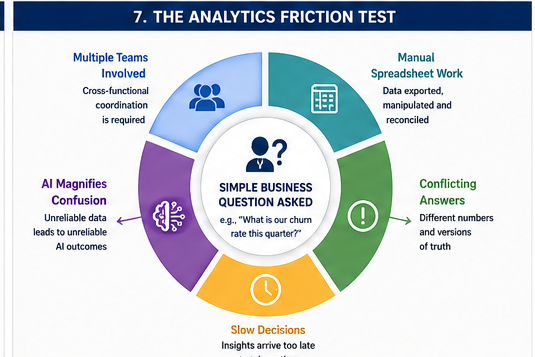
Does your organization already struggle to answer simple business questions?
If obtaining basic operational insight requires:
- Multiple teams
- Spreadsheet reconciliation
- Manual reporting
- Weeks of coordination
Then AI will not fix the problem.
It will amplify it.
The Analytics Friction Problem
Enterprise leaders often underestimate how much effort already exists behind seemingly simple dashboards.
Common symptoms include:
Reporting delays
Teams wait days or weeks for answers.
Multiple versions of truth
Departments disagree on metrics.
Siloed platforms
Data exists across disconnected systems.
Manual effort
Employees spend excessive time gathering information.
These issues are frustrating in analytics environments.
In AI environments, they become blockers.
Why AI Magnifies Existing Weaknesses
AI systems depend on operational consistency.
If foundational analytics already struggle, AI outputs become:
- Less trustworthy
- Less explainable
- Less scalable
Organizations frequently assume AI will solve fragmented operations.
But mature enterprises recognize:
AI is an accelerator—not a replacement for foundational discipline.
Executive Insight
The question leaders should ask is not:
“Can we deploy AI?”
Instead ask:
“Can our organization already trust its own operational insight?”
If the answer is inconsistent, foundational modernization should happen first.
Enterprises advancing faster in AI typically strengthen:
- Data interoperability
- Governance maturity
- Platform modernization
- Enterprise observability
- Semantic consistency
before scaling advanced AI capabilities.
Assess Data Governance and AI Readiness Before Microsoft Fabric Adoption
The Enterprise AI Data Readiness Framework
Most organizations are not entirely unprepared for AI.
They are simply operating at different stages of maturity.
Understanding your maturity level helps leaders prioritize investments.
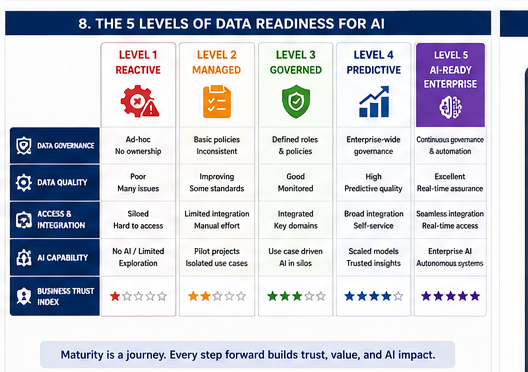
Level 1: Reactive
Characteristics:
- Siloed data
- Weak trust
- Manual reporting
- Poor quality
AI Risk: Extremely high.
Level 2: Managed
Characteristics:
- Basic governance
- Standardized reporting
- Initial quality improvements
AI Risk: Moderate to high.
Level 3: Governed
Characteristics:
- Ownership defined
- Metadata management
- Enterprise policies
AI Risk: Moderate.
Level 4: Predictive
Characteristics:
- Unified analytics
- Cross-functional visibility
- Advanced observability
AI Risk: Lower.
Level 5: AI-Ready Enterprise
Characteristics:
- Trusted, governed data
- Semantic consistency
- Real-time accessibility
- Strong lineage
- AI operating model maturity
AI Outcome Potential: High and scalable.
How Techment Helps Enterprises Build AI-Ready Data Foundations
Enterprise AI success begins long before model deployment.
It starts with trusted, governed, scalable data.
At Techment, we help organizations modernize fragmented data ecosystems and establish the foundation required for responsible, scalable AI adoption.
Our approach focuses on aligning enterprise data modernization with measurable business outcomes.
Data Strategy & AI Readiness Assessment
We help enterprises evaluate:
- Data maturity
- Governance gaps
- Quality risks
- AI operating readiness
This creates a clear roadmap for scalable AI adoption.
Governance & Data Quality Modernization
Techment supports organizations in strengthening:
- Metadata management
- Data lineage
- Governance operating models
- Enterprise-quality frameworks
This ensures AI systems operate on trusted data.
Analytics & Platform Modernization
We help enterprises modernize data ecosystems through:
- Cloud-native architectures
- Unified analytics platforms
- Microsoft Fabric readiness
- Enterprise interoperability
Scalable Enterprise AI Enablement
From advisory through implementation, Techment enables organizations to operationalize:
- Generative AI
- Intelligent automation
- Enterprise copilots
- Predictive analytics
- Responsible AI governance
The goal is simple:
Create enterprise environments where AI becomes measurable, trusted, and scalable.
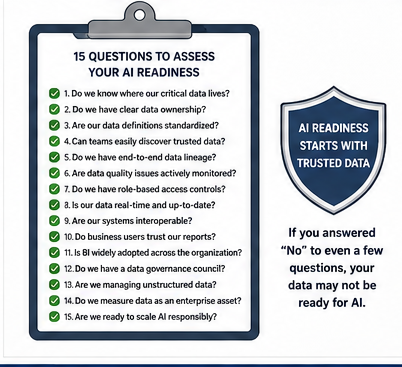
AI-Readiness checklist
Conclusion
Enterprise enthusiasm for AI has never been higher.
Yet for many organizations, the real obstacle is not model sophistication.
It is data readiness for AI.
Weak governance, fragmented systems, declining BI trust, mounting data debt, and disconnected business context all undermine enterprise AI performance.
The organizations that succeed in AI are not necessarily the fastest adopters.
They are the ones that treat data as a strategic business capability.
Before scaling copilots, autonomous workflows, or predictive intelligence, leaders should ask:
“Can our enterprise data actually support trustworthy AI?”
Because in the end, AI readiness is not about experimentation.
It is about foundation.
Enterprises that invest in governance, interoperability, quality, and modernization today will be best positioned to unlock scalable AI outcomes tomorrow.
Techment works with enterprises to transform fragmented data ecosystems into trusted foundations for analytics, automation, and AI at scale.
FAQs
1. What is data readiness for AI?
Data readiness for AI refers to whether enterprise data is accurate, governed, accessible, contextual, and trusted enough to support scalable AI systems.
2. Why do enterprise AI initiatives fail?
Many fail because organizations focus on models before fixing underlying data quality, governance, interoperability, and trust issues.
3. Can generative AI work with poor-quality enterprise data?
It can technically operate, but outputs become unreliable, inconsistent, and difficult to trust.
4. What is the biggest sign data isn’t ready for AI?
A major warning sign is when employees already struggle to trust dashboards or obtain consistent business insights.
5. How long does enterprise AI readiness take?
It varies by maturity level, but organizations often require phased modernization across governance, architecture, and quality foundations.