
Introduction
Enterprise leaders are under increasing pressure to modernize fragmented data ecosystems while enabling advanced analytics, AI, and real-time decision-making. Yet many organizations attempting platform modernization face a common problem: technology adoption often outpaces organizational readiness.
This challenge is particularly relevant when evaluating Microsoft Fabric Adoption.
Microsoft Fabric has emerged as one of the most significant evolutions in enterprise analytics—bringing together data engineering, data science, business intelligence, governance, and AI into a single SaaS-based analytics platform. Instead of maintaining disconnected systems for storage, transformation, reporting, and machine learning, enterprises can consolidate analytics operations under one unified architecture.
However, adopting Microsoft Fabric successfully requires far more than provisioning licenses or migrating workloads.
For CTOs, Chief Data Officers, enterprise architects, and analytics leaders, the more important question is this:
Is your organization truly ready for Microsoft Fabric?
A rushed implementation without evaluating data maturity, governance readiness, integration complexity, and operational alignment can result in rising costs, low user adoption, fragmented reporting, and failed modernization efforts.
According to research from McKinsey, organizations that align technology modernization with operating model transformation are significantly more likely to realize business value from analytics investments.
This is why a structured readiness assessment matters.
In this guide, we explore 7 strategic steps to assess your readiness for Microsoft Fabric Adoption, helping enterprise leaders evaluate technical preparedness, business alignment, governance maturity, and AI readiness before migration begins.
You’ll learn:
- How to assess your current data ecosystem
- What technical and governance gaps commonly derail adoption
- How to prioritize migration workloads
- The organizational capabilities required for long-term success
- A practical enterprise roadmap for Microsoft Fabric readiness
For organizations exploring analytics modernization, understanding how Fabric compares with legacy architectures is equally important. Explore Techment’s perspective on Microsoft Fabric Architecture: CTO’s Guide to Modern Analytics & AI and Microsoft Fabric vs Snowflake vs Traditional Warehousing (2026) | Modern Data Fabric Guide to understand the broader modernization context.
TL;DR
- Microsoft Fabric Adoption succeeds when organizations assess readiness before migration—not after implementation begins.
- Enterprises should evaluate data architecture, governance, business alignment, skills, operating models, and AI readiness before adoption.
- A fragmented data estate often becomes the biggest blocker to Fabric success.
- Governance and change management are just as important as technical migration.
- Organizations that treat Microsoft Fabric as a strategic data modernization platform, rather than another BI tool, achieve significantly higher ROI.
- A phased readiness framework reduces migration risks while accelerating value realization.
Why Microsoft Fabric Adoption Has Become a Strategic Priority
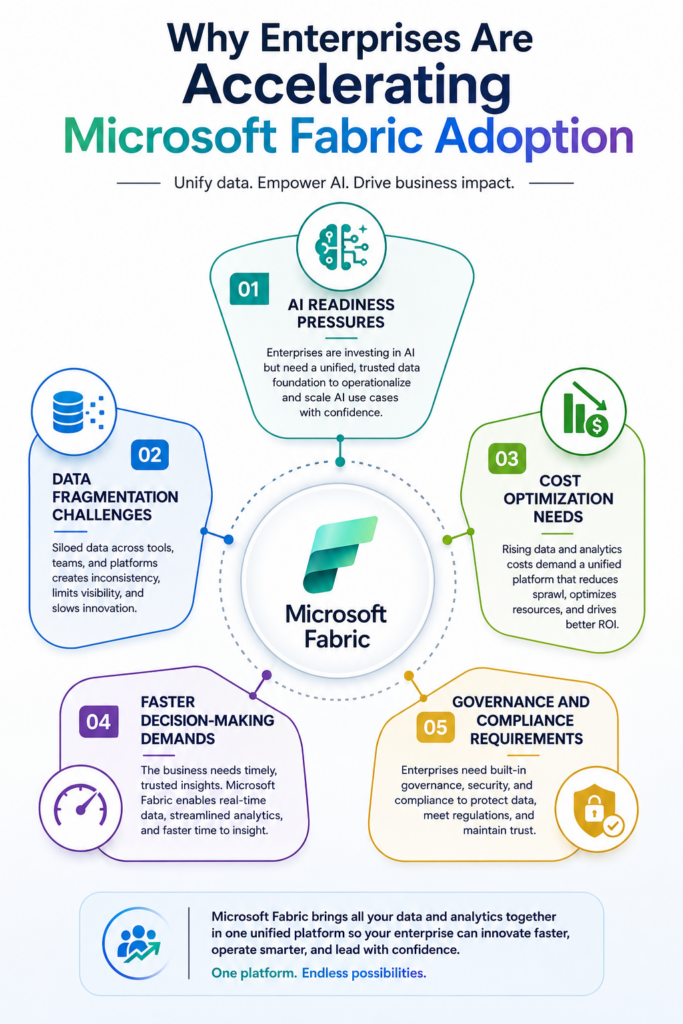
The rapid rise of enterprise AI has fundamentally changed how organizations think about data infrastructure.
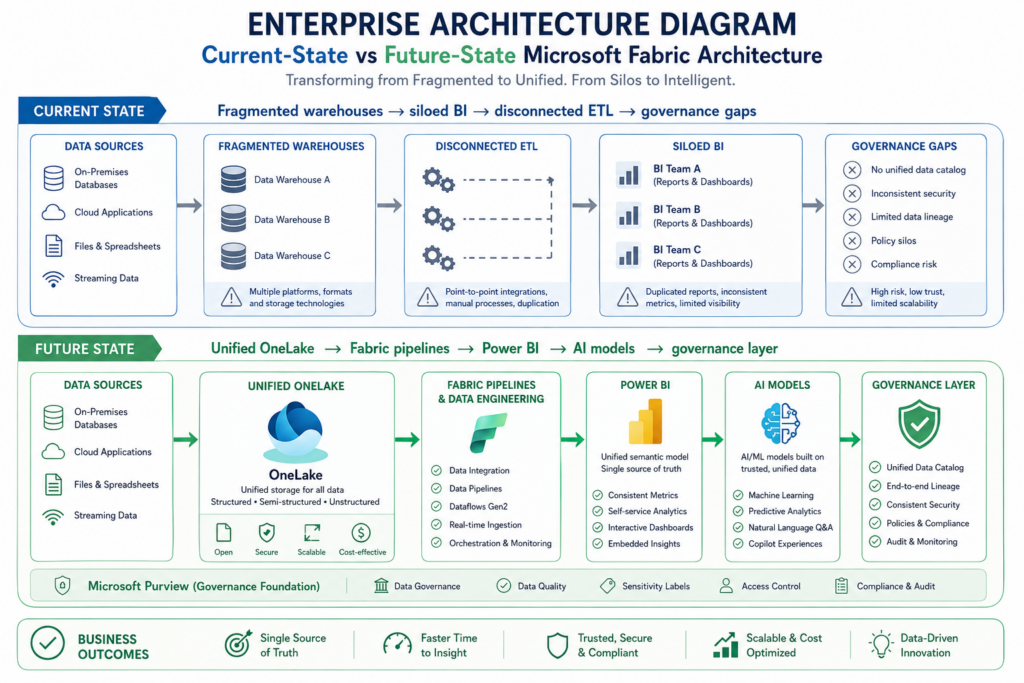
Traditional architectures—built around isolated warehouses, ETL pipelines, reporting systems, and governance silos—are increasingly unable to support the speed and scale required for modern analytics.
This is where Microsoft Fabric Adoption becomes strategically important.
Microsoft Fabric combines previously disconnected capabilities into a single ecosystem:
- Data engineering
- Real-time analytics
- Data science
- Business intelligence
- Data integration
- Governance
- AI-enabled workflows
Rather than managing separate vendors and fragmented pipelines, organizations can create a unified analytics foundation designed for agility.
Why Enterprises Are Prioritizing Microsoft Fabric Adoption
Several market shifts are accelerating interest in Fabric. Microsoft positions Fabric as an end-to-end analytics platform designed to unify data engineering, business intelligence, real-time analytics, and governance under one ecosystem. Organizations evaluating modernization can review Microsoft’s platform capabilities through Microsoft Fabric documentation
Enterprise AI Requires Better Data Foundations
Generative AI and predictive intelligence depend on high-quality, governed, accessible enterprise data.
Many organizations discover that AI ambitions fail because their underlying data ecosystem lacks consistency and trust.
Disconnected systems create:
- Data duplication
- Governance blind spots
- Security risks
- Slow analytics cycles
- Poor interoperability
Microsoft Fabric offers an integrated data foundation that can support both analytics modernization and AI enablement.
Organizations investing in AI readiness should also assess data maturity simultaneously. Techment explores this connection in Fabric AI Readiness: How to Prepare Your Data for Scalable AI Adoption.
Rising Pressure to Simplify Analytics Ecosystems
Most enterprises today operate with overlapping platforms for:
- ETL
- Warehousing
- BI
- Data lakes
- Governance
- Machine learning
This fragmentation drives:
- Higher operational costs
- Vendor sprawl
- Delayed insights
- Integration complexity
Microsoft Fabric’s unified SaaS architecture provides an opportunity to simplify technology stacks while improving analytics speed.
Business Leaders Demand Faster Decisions
Enterprise executives increasingly expect near-real-time reporting and self-service intelligence.
However, legacy analytics environments often struggle with:
- Delayed data refreshes
- Inconsistent KPIs
- Siloed dashboards
- Manual reporting dependencies
Microsoft Fabric enables unified analytics experiences that reduce friction between business users and data teams.
Step 1: Assess Your Existing Data Landscape Before Microsoft Fabric Adoption
The first—and arguably most important—step in preparing for Microsoft Fabric Adoption is understanding your current data ecosystem.
Many organizations underestimate the complexity of their existing environment.
They know where major systems exist, but not necessarily:
- How data flows across systems
- Where bottlenecks emerge
- Which pipelines are business-critical
- Where governance risks exist
- Which workloads are suitable for Fabric migration
Without this visibility, modernization becomes guesswork.
Map Your Enterprise Data Estate
Start by creating a detailed inventory of:
Data Sources
Examples include:
- ERP systems
- CRM platforms
- SaaS applications
- IoT streams
- Legacy databases
- Third-party APIs
Data Storage Environments
Assess:
- Data warehouses
- Data lakes
- Cloud repositories
- On-premises systems
Analytics Workloads
Evaluate:
- Reporting systems
- BI dashboards
- ETL pipelines
- Machine learning models
- Batch processing workloads
The goal is to understand your full data topology before migration planning begins.
Identify Data Silos and Redundancies
Most enterprise environments contain duplicated logic and disconnected reporting systems.
Common issues include:
- Multiple versions of the same KPI
- Inconsistent customer definitions
- Duplicated ETL jobs
- Isolated departmental reporting
These inefficiencies become migration risks.
Microsoft Fabric can simplify architecture—but only if redundancy is addressed beforehand.
Organizations modernizing data ecosystems often benefit from broader transformation initiatives such as Leveraging Data Transformation for Modern Analytics, where architecture modernization and business outcomes remain aligned.
Evaluate Data Quality Before Migration
One of the biggest misconceptions in enterprise modernization is assuming new platforms automatically solve poor data quality.
They do not.
Fabric improves visibility and governance—but unreliable source data will still produce unreliable outcomes.
Assess:
- Completeness
- Accuracy
- Timeliness
- Consistency
- Duplication rates
Poor-quality enterprise data creates downstream issues in:
- AI initiatives
- Forecasting models
- Executive dashboards
- Compliance reporting
Check if your enterprise is mature to adopt AI models with our AI readiness checklist.
Questions Enterprise Leaders Should Ask
Before proceeding, leadership teams should answer:
- Which workloads are creating the most business value?
- What data systems are hardest to maintain?
- Where do reporting bottlenecks exist?
- Which datasets create trust issues?
- What integrations are most business-critical?
These answers shape migration priorities.
Step 2: Define Clear Business Outcomes for Microsoft Fabric Adoption
Technology modernization fails when organizations focus on platform features instead of business outcomes.
Successful Microsoft Fabric Adoption begins with clarity around enterprise objectives.
The question is not:
“What can Fabric do?”
The better question is:
“What business problems are we trying to solve?”
Align Fabric With Strategic Priorities
Different organizations pursue Fabric for different reasons.
Some prioritize:
Analytics Modernization
Goals include:
- Faster dashboards
- Unified reporting
- Reduced latency
- Self-service analytics
Cost Optimization
Objectives may include:
- Consolidating redundant tools
- Lowering infrastructure costs
- Reducing engineering complexity
AI Enablement
Increasingly, organizations adopt Fabric to support:
- Enterprise copilots
- Predictive analytics
- Intelligent automation
- Generative AI systems
For deeper insights into AI-powered platforms: Microsoft Fabric AI solutions
Define Success Metrics Early
Many modernization efforts struggle because success was never clearly defined.
Establish measurable KPIs such as:
- Faster report generation
- Reduced data engineering effort
- Improved governance compliance
- Lower operational costs
- Increased analytics adoption
These benchmarks make ROI measurable.
Avoid the “Lift-and-Shift” Trap
A common mistake is migrating existing inefficiencies directly into Fabric.
Instead of recreating outdated architecture:
Use adoption as an opportunity to:
- Simplify pipelines
- Eliminate duplication
- Standardize governance
- Modernize reporting logic
- Improve data accessibility
Migration should improve the operating model—not preserve technical debt.
Step 3: Evaluate Technical Readiness for Microsoft Fabric Adoption
A successful Microsoft Fabric Adoption strategy depends heavily on technical preparedness.
Many enterprises assume Microsoft Fabric implementation is straightforward because it operates within the Microsoft ecosystem. However, readiness gaps in infrastructure, integration, security, and interoperability often create unexpected complexity.
Before migration begins, organizations must assess whether their existing technology landscape can support Fabric’s unified architecture.
Assess Infrastructure Readiness
One of the first questions enterprise leaders should ask is:
Can our infrastructure support cloud-native analytics modernization?
While Microsoft Fabric simplifies platform management through SaaS delivery, enterprise environments still need to support:
- Hybrid data environments
- Cloud integration patterns
- Identity and access management
- Data movement pipelines
- Security and compliance requirements
Organizations operating heavily on-premises may face additional modernization challenges.
Evaluate:
Cloud Readiness
Assess:
- Existing Azure maturity
- Networking dependencies
- Hybrid integration constraints
- Data residency requirements
Integration Complexity
Review dependencies across:
- ERP platforms
- CRM ecosystems
- Legacy warehouses
- Third-party analytics tools
- Streaming systems
Migration complexity often increases when organizations underestimate downstream system dependencies.
Read our blog that breaks down 10 critical RAG architectures shaping 2026, their trade-offs, and the enterprise use cases they unlock.
Evaluate Existing Data Platform Compatibility
Organizations rarely migrate into Microsoft Fabric from a clean slate.
Most enterprises already operate ecosystems that include:
- Azure Synapse
- Azure Data Factory
- Power BI
- Databricks
- Snowflake
- SQL Server
- SAP data systems
The objective is not immediate replacement.
Instead, readiness planning should determine:
- What should migrate first
- What can coexist temporarily
- Which systems remain strategic
- What technical debt should be retired
A phased coexistence model usually reduces migration risk.
For example:
Low-Risk Starting Workloads
Ideal migration candidates include:
- Departmental reporting
- New analytics use cases
- Non-critical BI modernization
- Experimental AI initiatives
Higher-Complexity Workloads
Migrate later:
- Regulatory reporting
- Core financial pipelines
- Mission-critical operational systems
Assess Security and Compliance Readiness
Security readiness often determines enterprise adoption timelines.
Questions leaders should address include:
- Are data access policies standardized?
- Do governance frameworks exist?
- Is role-based access management mature?
- Are compliance workflows documented?
Without governance maturity, centralized analytics can create new enterprise risks.
This is especially important in regulated industries including:
- Healthcare
- Banking
- Insurance
- Manufacturing
- Public sector
Read our guide on 10 Effective Steps To Building RAG Applications: From Prototype to Production-Grade Enterprise Systems that provides a step-by-step enterprise roadmap for building RAG applications.

Step 4: Assess Data Governance and AI Readiness Before Microsoft Fabric Adoption
One of the biggest reasons enterprise analytics modernization fails is poor governance.
Organizations often focus heavily on migration mechanics while overlooking a foundational reality:
Microsoft Fabric is only as effective as the trustworthiness of enterprise data.
Without governance maturity, unified analytics environments can magnify inconsistency rather than eliminate it.
Why Governance Matters in Microsoft Fabric Adoption
Microsoft Fabric creates unprecedented accessibility to enterprise data.
This is valuable—but it also increases risk.
Without governance, enterprises face:
- Inconsistent KPIs
- Security vulnerabilities
- Duplicate reporting logic
- Shadow analytics
- Compliance failures
Governance should not be treated as an afterthought.
Instead, it must become part of the Microsoft Fabric Adoption readiness process.
Assess Governance Maturity
Evaluate current capabilities across:
Data Ownership
Ask:
- Who owns critical datasets?
- Are stewardship roles defined?
- Is accountability documented?
Metadata and Lineage
Determine:
- Can data lineage be traced?
- Are transformations documented?
- Is metadata centrally managed?
Security Policies
Assess:
- Access controls
- Data classification
- Sensitive information handling
- Regulatory compliance readiness
Microsoft Purview integration makes governance significantly stronger—but organizations still need operational maturity.
Evaluate AI Readiness Simultaneously
One of the strongest reasons enterprises pursue Microsoft Fabric Adoption is AI enablement.
However, most organizations are not AI-ready.
According to industry research, poor data quality remains one of the largest barriers to enterprise AI success.
Evaluate:
Data Reliability
Can business teams trust enterprise data?
Accessibility
Can teams access trusted datasets without delays?
Standardization
Do metrics and definitions remain consistent?
Scalability
Can analytics workloads support AI expansion?
Organizations preparing for AI transformation should treat Fabric readiness and AI readiness as interconnected priorities.
Techment’s How to Assess Data Quality Maturity: Your Enterprise Roadmap explores how enterprises can create a reliable data foundation for intelligent systems.
Common Governance Warning Signs
Your organization may not yet be ready if:
- Business teams disagree on KPIs
- Reports produce conflicting numbers
- Lineage is unclear
- Access policies vary widely
- Manual governance dominates operations
These gaps should be addressed before enterprise-scale migration.
Step 5: Evaluate Organizational and Skills Readiness
Technology readiness alone does not guarantee successful Microsoft Fabric Adoption.
Many analytics transformations fail because organizations underestimate change management.
The reality:
Platforms do not transform enterprises—people and operating models do.
Assess Team Readiness
Evaluate whether your organization has the capabilities needed to support Fabric.
Key roles include:
- Data engineers
- Analytics engineers
- BI developers
- Governance leaders
- Data architects
- Platform administrators
Questions leaders should ask:
- Does the team understand Fabric capabilities?
- Are Power BI skills already mature?
- Do teams have cloud-native engineering experience?
- Are governance capabilities operationalized?
Identify Skill Gaps Early
Common gaps include:
Data Engineering Skills
Teams may lack experience in:
- Lakehouse architectures
- Pipeline modernization
- Real-time analytics
Governance Capabilities
Organizations often struggle with:
- Stewardship models
- Metadata governance
- Compliance automation
Business Adoption Readiness
Fabric success requires:
- Self-service enablement
- Executive sponsorship
- Business alignment
Without user adoption, modernization ROI declines rapidly.
Build an Operating Model
Organizations should establish:
Ownership Structures
Define:
- Platform ownership
- Governance ownership
- Domain accountability
Change Management Frameworks
Support:
- User onboarding
- Training initiatives
- Adoption KPIs
Center of Excellence (CoE)
Many enterprises establish a Fabric Center of Excellence to accelerate adoption.
This improves:
- Best practices
- Governance consistency
- Architecture standards
- Cross-functional alignment
Organizations modernizing analytics often benefit from broader strategic planning. Techment’s What a Microsoft Data and AI Partner Brings to Your Data Strategy provides perspective on navigating enterprise-scale transformation.
Step 6: Build a Phased Migration Strategy for Microsoft Fabric Adoption
One of the biggest mistakes enterprises make is attempting large-scale migration too quickly.
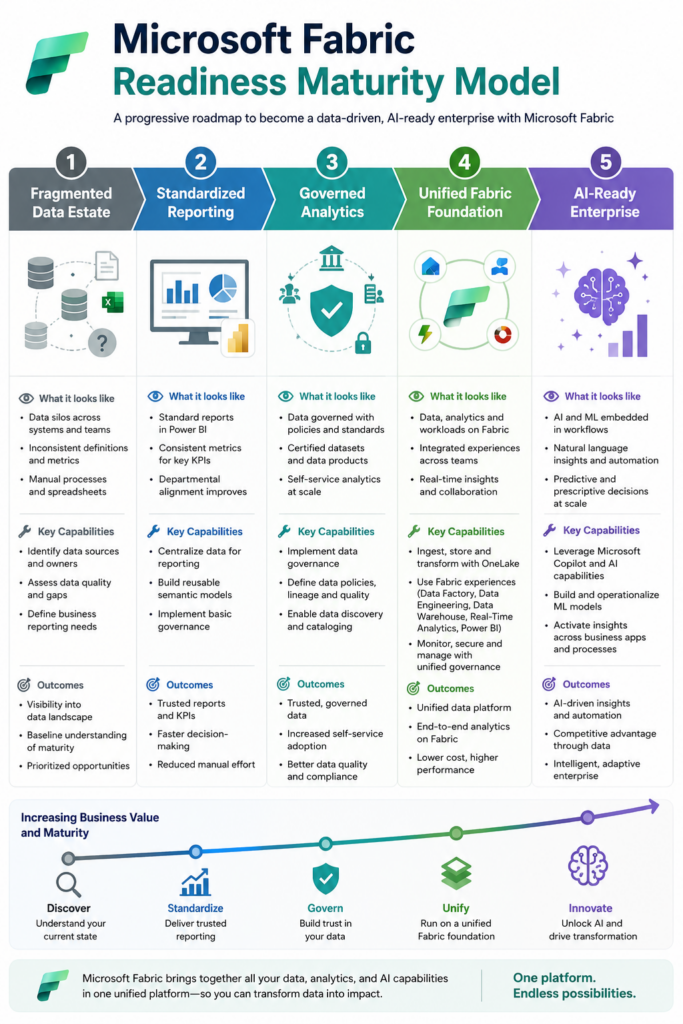
A successful Microsoft Fabric Adoption roadmap prioritizes incremental value delivery.
Prioritize Workloads Strategically
Not all workloads should migrate simultaneously.
Use a prioritization framework based on:
Business Impact
Prioritize workloads that:
- Improve executive visibility
- Enable faster reporting
- Reduce operational friction
Technical Complexity
Start with lower-risk systems.
Examples:
Good Early Candidates
- Power BI modernization
- Reporting workloads
- Sandbox analytics
Later Candidates
- ERP integrations
- Regulatory reporting
- Mission-critical systems
Create Migration Waves
A structured roadmap generally follows:
Wave 1: Quick Wins
Focus:
- Analytics acceleration
- Reporting simplification
- User adoption
Wave 2: Core Data Workloads
Modernize:
- ETL pipelines
- Warehouses
- Governance workflows
Wave 3: AI Enablement
Expand into:
- Predictive analytics
- Generative AI
- Intelligent automation
Mitigate Risk During Migration
Prepare for:
- Downtime risks
- Data inconsistencies
- Integration failures
- Security gaps
Build contingency plans early.
Begin your modernization roadmap and automate governance across all platforms with our data solutions.
Step 7: Create an Ongoing Optimization Framework
Enterprise modernization does not end after implementation.
Successful Microsoft Fabric Adoption requires continuous optimization.
Leading organizations treat Fabric as an evolving capability—not a completed project.
Monitor Platform Performance
Evaluate:
- Query performance
- Pipeline reliability
- Cost optimization
- User adoption trends
Improve Data Quality Continuously
Monitor:
- Data accuracy
- Completeness
- Consistency
Automation increasingly becomes essential.
Organizations still relying on manual checks often struggle to scale analytics quality.
Techment’s Manual Data Quality Checks vs Automation: The Road to Scalable Data Reliability explores scalable approaches to maintaining trusted enterprise data.
Measure Business Impact
Track:
- Faster decisions
- Analytics adoption
- Operational efficiency
- Reduced engineering effort
- AI readiness improvements
Continuous improvement protects long-term ROI.
How Techment Helps Enterprises Accelerate Microsoft Fabric Adoption
Modernizing enterprise analytics requires more than technology implementation.
Successful Microsoft Fabric Adoption depends on aligning architecture, governance, migration strategy, and organizational readiness.
Techment helps enterprises navigate this complexity through an end-to-end modernization approach.
Our capabilities include:
Enterprise Readiness Assessments
We evaluate:
- Data maturity
- Governance readiness
- Architecture gaps
- AI preparedness
- Migration priorities
Microsoft Fabric Architecture & Implementation
Techment helps organizations:
- Design scalable Fabric architectures
- Modernize legacy analytics systems
- Build governed lakehouse environments
- Enable unified reporting ecosystems
Explore Techment’s insights on What is Microsoft Fabric? A Comprehensive Overview on enterprise analytics transformation.
Governance and AI Readiness
We support:
- Microsoft Purview integration
- Data quality modernization
- Responsible AI foundations
- Enterprise governance operating models
End-to-End Transformation Support
From strategy to optimization, Techment helps organizations:
Assess → Prioritize → Modernize → Govern → Optimize
The result is a scalable analytics foundation prepared for long-term AI growth.
Conclusion
The promise of Microsoft Fabric Adoption is compelling.
A unified analytics platform capable of simplifying architecture, accelerating insights, improving governance, and enabling AI-driven innovation presents enormous enterprise value.
But technology alone does not guarantee success.
Organizations that approach Fabric strategically—by evaluating readiness across architecture, governance, skills, migration planning, and operating models—are significantly more likely to realize measurable business outcomes.
The most successful enterprises view Microsoft Fabric not simply as a platform migration, but as an opportunity to modernize how data creates business value.
Before implementation begins, leaders should ask:
Are we truly ready for Microsoft Fabric—or are we only ready to buy it?
Answering that question honestly can determine whether modernization becomes transformational or merely expensive.
As enterprises continue investing in analytics modernization and AI enablement, trusted partners can help reduce complexity, accelerate outcomes, and build sustainable data foundations.
Techment helps organizations turn readiness into execution—with strategic guidance, enterprise architecture expertise, and scalable Microsoft Fabric implementation support.
FAQs
1. How do I assess readiness for Microsoft Fabric Adoption?
Start by evaluating your current data architecture, governance maturity, technical readiness, AI preparedness, and organizational capabilities. A readiness assessment should identify migration priorities and operational gaps.
2. What are the biggest challenges in Microsoft Fabric Adoption?
Common challenges include fragmented data systems, poor governance, skills shortages, migration complexity, and unclear business objectives.
3. Is Microsoft Fabric suitable for enterprises with legacy systems?
Yes. However, most organizations benefit from a phased migration strategy rather than full replacement.
4. How long does Microsoft Fabric Adoption take?
Timelines vary based on complexity. Enterprise migrations often range from several months to multi-phase transformation programs.
5. Does Microsoft Fabric support AI readiness?
Yes. Microsoft Fabric creates a unified data foundation that improves accessibility, governance, and analytics maturity for enterprise AI initiatives.