
P&C insurance data management guide helps insurers build a trusted data foundation by integrating policy, claims, billing, and underwriting data into a unified, governed system, outlined in the P&C Insurance Data Management Guide. This improves data accuracy, regulatory compliance, reporting, and operational decision-making.
Executive Summary
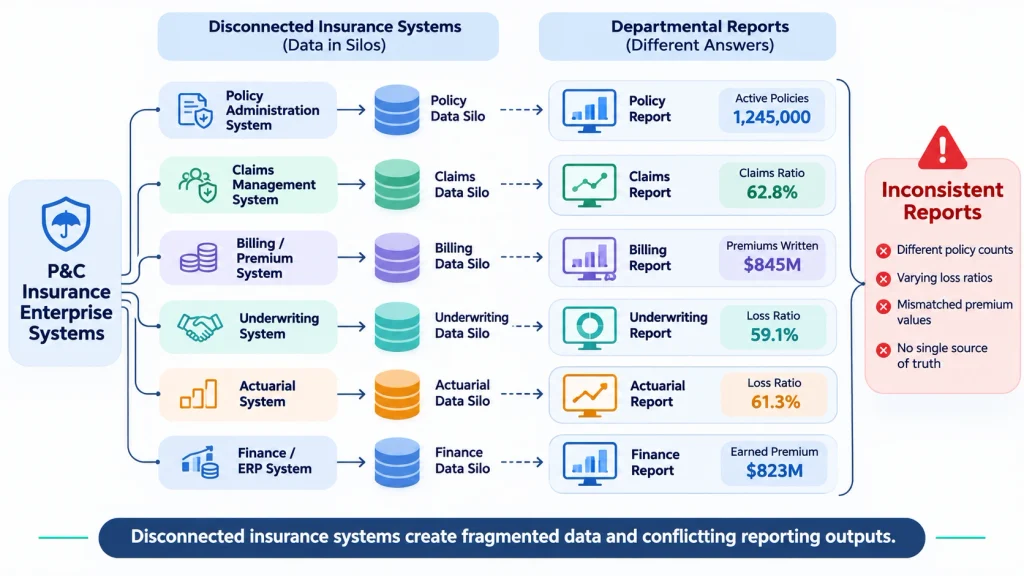
Property and casualty (P&C) insurers depend on accurate, consistent reporting to make decisions across underwriting, claims, actuarial, finance, risk management, and distribution. Yet many insurers face a recurring challenge: different departments produce different answers to what should be the same business question.
Premium reports may not reconcile with finance. Claims dashboards may show different loss figures from actuarial reports. Underwriting teams may use exposure definitions that differ from those used by pricing and portfolio management. Even when teams access the same source systems, differences in extraction logic, transformation rules, reporting periods, and business definitions can create conflicting results.
These inconsistencies are not simply business intelligence problems. They often indicate deeper weaknesses in the enterprise data foundation.
P&C insurers typically operate across multiple policy administration systems, claims platforms, billing applications, actuarial tools, reinsurance systems, spreadsheets, external data providers, and financial applications. Each system may represent the same business event differently. Without common definitions, quality controls, ownership, and traceable transformation logic, consolidating this information does not automatically make it trustworthy.
A trusted data foundation addresses this challenge by connecting fragmented sources, standardizing critical insurance data, establishing enterprise-wide business definitions, implementing data quality controls, and publishing governed datasets for reporting and analytics.
For insurers, the objective is not to force every department into one reporting tool. It is to ensure that every department uses consistent, explainable, and appropriately governed data for its decisions.
This article explains why P&C reports become inconsistent, what those inconsistencies mean for insurance operations, and how insurers can build a reliable data foundation that supports reporting, analytics, AI, and long-term modernization.
Understanding the P&C Insurance Data Management Guide is essential for insurers looking to streamline their processes and enhance data reliability.
TL;DR
P&C insurers struggle with inconsistent reports because policy, claims, billing, actuarial, finance, and external data sources often operate in silos. Different business definitions, transformation rules, reporting periods, and manual reconciliations create conflicting numbers across departments.
A trusted data foundation addresses these problems through:
- Integrated data pipelines connecting core insurance systems.
- Standardized business definitions for premiums, losses, exposures, claims, and policies.
- Data quality rules for completeness, accuracy, consistency, validity, and timeliness.
- Master and reference data management.
- Governed data models and certified reporting datasets.
- Data lineage, ownership, access controls, and auditability.
- Reusable analytics foundations for BI, advanced analytics, and AI.
The outcome is a consistent, traceable, and business-aligned view of insurance performance.
Introduction: Why Do P&C Insurers Get Different Answers From Their Reports?
P&C insurers generate significant volumes of operational and financial data throughout the insurance lifecycle. However, the availability of data does not necessarily mean that the organization has consistent, reliable information.
Consider a common reporting scenario.
The underwriting dashboard shows one written premium figure. The finance report shows another. The actuarial team uses a separate premium dataset for profitability analysis. When leadership asks for the organization’s actual premium position, the teams spend time reconciling figures instead of discussing business performance.
The same issue can occur with:
- Paid, incurred, and outstanding claims.
- Loss ratios and combined ratios.
- Policy counts and renewal rates.
- Exposure and earned premium.
- Claim frequency and severity.
- Acquisition costs and commission.
- Catastrophe losses and geographic exposure.
- Reserve movements and development patterns.
These differences do not always indicate that one report is incorrect. Reports may use different accounting bases, valuation dates, coverage periods, inclusion rules, or business purposes.
The problem arises when those differences are undocumented, inconsistently implemented, or presented as though the reports measure the same thing.
For example, an incurred loss report calculated using a particular valuation date and reserve treatment should not be expected to match a paid-loss report. However, two reports that claim to show the same incurred loss measure, for the same portfolio and valuation date, should reconcile within an agreed tolerance.
This distinction is important. A trusted data foundation does not eliminate legitimate differences between business measures. It makes those differences explicit, controlled, and explainable.
What Is a Trusted Data Foundation in P&C Insurance?
A trusted data foundation is an integrated, governed data environment that connects insurance information from multiple operational systems, standardizes important business definitions, applies measurable data quality controls, and delivers consistent datasets for reporting, analytics, and AI.
For P&C insurers, it provides a reliable way to connect policy, claims, billing, underwriting, actuarial, finance, reinsurance, and external data. It also establishes the ownership, lineage, security, and business rules needed to make information reusable across departments.
A trusted data foundation is not simply a data warehouse, data lake, or reporting platform. It combines several capabilities:
- Data integration: Bringing information together from core and supporting systems.
- Data standardization: Aligning formats, codes, definitions, and business rules.
- Data quality management: Detecting and resolving incomplete, invalid, duplicated, and inconsistent information.
- Data governance: Establishing ownership, stewardship, policies, and accountability.
- Data modeling: Creating reusable business-aligned datasets.
- Data lineage: Making data movement and transformation traceable.
- Data access and security: Ensuring information is available to authorized users under appropriate controls.
- Data consumption: Delivering certified datasets and metrics through reporting, analytics, and AI applications.
The objective is to move from disconnected departmental reporting toward a governed enterprise data capability.
Read more about AI in Insurance: Benefits, Use Cases in 2026
Why P&C Insurers Struggle With Inconsistent Reports
P&C reporting inconsistencies usually emerge from a combination of fragmented systems, inconsistent definitions, weak data quality, and disconnected reporting processes. Fixing only the dashboard or reporting layer does not address these underlying causes.
1. Fragmented Core Insurance Systems
P&C insurers often operate multiple policy administration, claims, billing, underwriting, and financial systems. These platforms may have been introduced at different times, acquired through business expansion, or selected to support specific products and geographies.
As a result, data is distributed across systems that were not necessarily designed to work together.
For example:
- Policy administration systems store policy details and premium transactions.
- Claims management systems capture claim notifications, payments, reserves, and settlements.
- Billing platforms manage invoices, collections, and adjustments.
- Actuarial systems consume historical premium, loss, and exposure information.
- Financial applications maintain accounting and reporting records.
- Reinsurance platforms track ceded premiums, recoverables, and treaty information.
Each system may have its own identifiers, structures, terminology, and update schedules.
A policy number in one platform may not be sufficient to connect all related transactions across the enterprise. Claims may be associated with policy versions, coverage periods, or insured entities using different identifiers.
When reporting teams extract data independently from these systems, they often create separate integration and transformation logic.
Over time, those separate processes become additional sources of inconsistency.
What insurers should do: Establish a governed integration architecture with consistent identifiers, documented source-to-target mappings, and reusable data pipelines. Preserve source information while creating standardized enterprise datasets for reporting and analytics.
2. Different Business Definitions Across Departments
One of the most overlooked causes of inconsistent insurance reporting is the absence of shared business definitions.
Different departments may use the same term but calculate it differently.
Consider written premium. Depending on the reporting purpose, teams may include or exclude endorsements, cancellations, adjustments, reinstatements, or specific transaction types. Different treatment of these events can produce different totals.
The same issue applies to loss ratio, claim frequency, earned premium, exposure, and policy counts.
| Business metric | Possible source of inconsistency | What needs to be standardized |
|---|---|---|
| Written premium | Different treatment of endorsements, cancellations, and adjustments | Premium calculation rules and transaction inclusion criteria |
| Earned premium | Different earning methods and reporting periods | Earning methodology, coverage dates, and valuation date |
| Incurred losses | Different reserve and valuation treatments | Paid losses, case reserves, and other applicable components |
| Loss ratio | Different premium and loss calculation bases | Numerator, denominator, business scope, and reporting period |
| Policy count | Different treatment of renewals, cancellations, and policy versions | Policy counting rules and effective dates |
| Claim frequency | Different claim inclusion and exposure definitions | Claim event rules and exposure denominator |
| Claim severity | Different treatment of reopened or partially settled claims | Severity calculation and claim population |
These definitions should not be treated as technical details buried inside SQL queries or dashboard formulas.
They are business rules that determine how the organization interprets performance.
What insurers should do: Develop an enterprise business glossary and metric catalog. Define each important metric, its formula, reporting basis, source systems, owner, refresh frequency, and approved use cases.
3. Poor Data Quality at the Point of Capture
Reporting inconsistencies often begin before data reaches the analytics environment.
Incomplete policy information, incorrect risk attributes, missing claim details, inconsistent location data, and invalid reference codes can enter through operational workflows.
Examples include:
- Missing property construction details.
- Incomplete insured addresses.
- Incorrect occupancy classifications.
- Missing cause-of-loss codes.
- Inconsistent vehicle or asset identifiers.
- Incorrect policy effective and expiration dates.
- Missing claim closure information.
- Inconsistent broker and intermediary identifiers.
When these errors are not detected early, they move downstream into underwriting reports, actuarial models, claims dashboards, and financial analysis.
The Casualty Actuarial Society’s Monograph No. 9: Data Quality Management in the P&C Insurance Sector examines the importance of data quality across actuarial processes and the wider P&C insurance market.
What insurers should do: Implement data validation at ingestion and, where possible, at the point of data capture. Establish measurable rules for completeness, validity, accuracy, uniqueness, consistency, and timeliness.
4. Manual Data Reconciliation and Spreadsheet Dependency
Spreadsheets remain useful for analysis, but they become a risk when they act as undocumented integration and transformation layers.
In many insurance organizations, reporting teams download information from different systems, combine files, apply manual corrections, and calculate metrics separately.
One team may maintain a spreadsheet containing premium adjustments. Another may apply a separate claims mapping. A third may maintain its own version of a business classification.
This creates several problems:
- Multiple versions of the same dataset.
- Undocumented transformation rules.
- Dependence on individual employees.
- Difficulty reproducing historical reports.
- Increased risk of manual errors.
- Limited visibility into the origin of reported figures.
Manual reconciliation can also consume time that should be spent on analysis and decision-making.
What insurers should do: Identify recurring manual reporting activities and migrate repeatable integration, validation, and calculation logic into governed data pipelines. Retain spreadsheets for appropriate ad hoc analysis, not as the primary enterprise data processing mechanism.
5. Inconsistent Data Across Insurance Lines and Geographies
P&C insurers may operate across personal auto, homeowners, commercial property, general liability, workers’ compensation, specialty, and other business lines.
Each line has different underwriting characteristics, coverage structures, exposure measures, claims processes, and regulatory considerations.
For example, an exposure measure in auto insurance may be based on vehicle or policy characteristics, while property insurance may depend on insured values, locations, construction attributes, and other risk characteristics.
Even when two business units use the same label, the underlying measure may not be comparable.
Geographic expansion and acquisitions add further complexity. Local systems may use different currencies, tax treatments, regulatory classifications, and operational processes.
What insurers should do: Create common enterprise data standards while retaining product-specific and jurisdiction-specific attributes. Standardization should improve comparability without removing information required for specialized underwriting and regulatory reporting.
6. Weak Data Ownership and Governance
Technology teams often own pipelines, databases, and reporting infrastructure. However, the business meaning of insurance data belongs to the functions that create and use it.
When ownership is unclear, important questions remain unresolved:
- Who defines written premium?
- Who approves changes to loss classifications?
- Who is accountable for missing underwriting information?
- Who resolves conflicting policy and claims records?
- Who approves a change to a financial reporting calculation?
- Who determines whether a dataset is ready for enterprise use?
Without clear accountability, data quality becomes an IT cleanup activity rather than a business responsibility.
Deloitte’s analysis of insurance data management highlights how fragmented architectures, incompatible systems, and governance weaknesses can limit data sharing and consistent standards.
What insurers should do: Establish data owners and stewards for critical domains such as policy, claims, premium, exposure, customer, and financial data. Define approval processes, issue escalation paths, and measurable accountability.
7. Different Reporting Refresh Cycles and Data Cut-Offs
Two reports can disagree because they are generated at different times or use different data cut-offs.
For example, a claims dashboard refreshed every hour may include recent claim transactions that are not yet reflected in a finance report refreshed overnight.
Similarly, an actuarial report may use a specific valuation date, while an operational claims dashboard reflects the latest available transactions.
Other causes include:
- Late-arriving transactions.
- Backdated policy endorsements.
- Reopened claims.
- Delayed reserve updates.
- Differences between transaction date and accounting date.
- Batch processing failures.
- Inconsistent time-zone handling.
What insurers should do: Make reporting dates, valuation dates, refresh timestamps, and data completeness status visible. Define service-level expectations for data availability and establish rules for late-arriving records and historical restatements.
Read our blog on Insurance Legacy System Modernization: A Practical Guide
What Inconsistent Reporting Costs P&C Insurers
Inconsistent reporting affects more than the credibility of dashboards. It can reduce decision quality, delay operational processes, increase reconciliation effort, and weaken confidence in analytics.
Underwriting and Pricing Decisions Become Less Reliable
Underwriting and pricing decisions depend on consistent exposure, premium, risk, and claims information. If teams use different definitions or incomplete historical records, portfolio analysis may become distorted.
A trusted data foundation helps underwriting teams access consistent risk attributes, historical performance, and portfolio information.
Claims Performance Becomes Harder to Evaluate
Claims teams need reliable information about claim frequency, severity, settlement times, reserve movements, leakage, and recovery performance.
When claims data is fragmented or inconsistently classified, management may struggle to compare performance across adjusters, regions, products, or claim types.
Actuarial Analysis Requires More Reconciliation
Actuarial teams depend on historical premium, exposure, and loss information for pricing, reserving, forecasting, and portfolio analysis.
Inconsistent data definitions can create additional validation work and make it harder to explain differences between source data and analytical outputs.
Finance and Leadership Lose Confidence in Reports
If finance, underwriting, and claims reports present different numbers without clear explanations, leadership spends time resolving data disputes.
This weakens confidence in business intelligence and delays decisions involving profitability, growth, portfolio performance, and resource allocation.
AI and Advanced Analytics Initiatives Become Harder to Scale
AI applications depend on relevant, reliable, and appropriately governed data.
Fragmented information, inconsistent labels, incomplete records, and undocumented transformations can affect model development, validation, and production monitoring.
A trusted data foundation is therefore an important prerequisite for scaling AI use cases such as claims triage, fraud detection, underwriting assistance, and portfolio analytics.
AI claims automation must be supported by robust enterprise architecture. Techment’s AI-Ready Enterprise Checklist with Microsoft Fabric outlines readiness considerations.
How to Build a Trusted Data Foundation for P&C Insurance
A trusted data foundation requires more than consolidating databases. Insurers need a structured approach that integrates data, standardizes business meaning, measures quality, establishes governance, and delivers certified information to business users.
The following capabilities form a practical foundation.
1. Assess the Existing Insurance Data Landscape
Start by understanding where critical data originates, how it moves, and how it is consumed.
Map the major systems and datasets across:
- Policy administration.
- Claims management.
- Billing and payments.
- Underwriting and rating.
- Actuarial platforms.
- Reinsurance.
- Finance and general ledger.
- Distribution and broker management.
- External risk and enrichment providers.
For each source, document:
- Data owner and technical owner.
- Important entities and attributes.
- Unique identifiers.
- Data formats and structures.
- Update and refresh frequency.
- Known quality issues.
- Downstream reports and models.
- Regulatory and privacy considerations.
The assessment should also identify reports that frequently disagree and trace them back to their source data and calculation logic.
Practical recommendation: Begin with three to five high-impact reporting problems. For example, premium reconciliation, incurred loss reporting, policy counts, or exposure reporting. Use these as diagnostic cases to reveal the underlying issues.
2. Establish Common Business Definitions and Data Standards
A trusted data foundation requires consistent business meaning across systems and teams.
Develop a business glossary for the metrics and entities that matter most to P&C operations.
For example:
| Data element | Standardization requirement |
|---|---|
| Policy | Define policy identity, version, status, and effective period |
| Premium | Define written, earned, collected, and adjusted premium separately |
| Claim | Define claim identity, status, reopening, and coverage relationships |
| Incurred loss | Document the approved components and valuation basis |
| Exposure | Define exposure measures by product and business purpose |
| Insured location | Standardize address, geographic identifiers, and property attributes |
| Coverage | Define coverage identifiers, limits, deductibles, and effective dates |
| Distribution channel | Standardize broker, agent, direct, and intermediary classifications |
Not every metric needs one universal formula. Different business purposes may require different approved measures.
The important requirement is that each measure has a clear definition, owner, calculation method, and documented scope.
Practical recommendation: Maintain a centralized metric catalog and make approved definitions available to data engineers, analysts, actuaries, finance teams, and business users.
3. Integrate Data From Core Insurance Systems
The next step is to establish reliable data movement from operational platforms into an enterprise data environment.
Integration should account for different source technologies, data formats, APIs, database structures, and batch-processing requirements.
A typical integration approach may include:
- API-based integration for systems that expose operational interfaces.
- Change data capture (CDC) for tracking database changes.
- Batch ingestion for scheduled source extracts.
- Event-based integration for selected near-real-time use cases.
- Secure file ingestion for external providers and legacy platforms.
The architecture should preserve source records and metadata while supporting standardized downstream processing.
It should also address:
- Duplicate and late-arriving records.
- Schema changes.
- Failed pipeline recovery.
- Incremental loading.
- Data reconciliation.
- Source-system availability.
- Security and access controls.
Practical recommendation: Avoid building separate, duplicated extraction and transformation logic for every dashboard. Create reusable ingestion pipelines and standardized integration patterns for shared insurance data domains.
4. Implement a Layered Data Architecture
A layered data architecture separates raw ingestion, standardized processing, and business-ready consumption.
One commonly used approach is the medallion architecture, which organizes data into bronze, silver, and gold layers.
| Layer | Purpose | P&C insurance example |
|---|---|---|
| Bronze | Preserve raw source data with minimal transformation | Raw policy transactions, claims records, billing extracts, and broker feeds |
| Silver | Clean, validate, standardize, and integrate data | Conformed policy, claim, premium, customer, and exposure datasets |
| Gold | Publish curated, business-ready data products | Underwriting performance, claims analytics, profitability, and finance reporting models |
The bronze layer preserves source information and supports traceability. The silver layer applies standardization and quality rules. The gold layer provides governed datasets designed around business use cases.
Microsoft documents this approach as a recommended design pattern for Microsoft Fabric lakehouse implementations.
Practical recommendation: Treat the layers as logical responsibilities, not simply three storage locations. Define quality gates and ownership at each stage so downstream teams know which datasets are appropriate for operational reporting, enterprise analysis, or AI.
5. Create a Consistent Insurance Data Model
A standardized data model helps connect information across insurance systems while preserving the relationships required for business analysis.
Core domains commonly include:
- Policy and policy transaction.
- Customer and insured party.
- Coverage and insured asset.
- Risk and exposure.
- Premium and billing transaction.
- Claim and claim transaction.
- Payment and reserve.
- Broker and distribution channel.
- Reinsurance contract and recovery.
- Financial account and reporting period.
The data model should support the relationships between these entities.
For example, a claim should be traceable to the relevant policy, coverage, insured entity, loss event, and financial transactions. A premium transaction should be traceable to its policy, transaction type, effective date, and applicable accounting treatment.
Insurers should also consider historical tracking. Policy endorsements, reserve changes, and corrections may change the current state of a record without removing the need to understand its previous state.
Practical recommendation: Use conformed dimensions, consistent identifiers, effective dates, and historical data patterns where appropriate. Design models around business processes rather than copying the structure of individual source applications.
6. Establish Automated Data Quality Controls
Data quality should be measurable and continuously monitored.
A data quality framework for P&C insurers should address at least six dimensions.
| Quality dimension | What it measures | Insurance example |
|---|---|---|
| Completeness | Whether required information is present | Required policy coverage or claim fields are populated |
| Accuracy | Whether information reflects the correct business fact | Premium amount agrees with the approved transaction source |
| Validity | Whether values follow approved formats and rules | Policy dates and classification codes meet defined constraints |
| Consistency | Whether related systems and datasets agree where they should | Policy identifiers match across policy and claims datasets |
| Uniqueness | Whether duplicate records exist | Duplicate claim or policy transaction records are identified |
| Timeliness | Whether information is available within the expected period | Claims transactions arrive before the reporting cut-off |
Examples of automated checks include:
- Required field validation.
- Duplicate policy and claim detection.
- Referential integrity checks.
- Invalid date and transaction checks.
- Premium reconciliation against source control totals.
- Claim payment and reserve balance checks.
- Valid code and classification checks.
- Pipeline freshness and completeness monitoring.
Quality rules should be prioritized according to business impact. A missing critical coverage attribute may be more consequential than a formatting inconsistency in a nonessential field.
Practical recommendation: Establish thresholds, exception categories, owners, and remediation workflows. Track recurring issues to their source instead of repeatedly correcting the same records in downstream reports.
7. Implement Master Data and Reference Data Management
Master data management helps establish consistent representations of important business entities across systems.
In P&C insurance, relevant entities may include customers, insured organizations, brokers, agents, properties, vehicles, and other insured assets.
Reference data management is equally important. It standardizes shared classifications such as:
- Cause-of-loss codes.
- Coverage categories.
- Claim status.
- Policy status.
- Product classifications.
- Geographic codes.
- Industry classifications.
- Distribution channels.
For example, if different claims systems use different codes for similar loss events, the enterprise needs an approved mapping and governance process.
However, master data management does not mean every source must be replaced by one physical system. Depending on the architecture, insurers may use centralized master records, reference data services, governed mappings, or federated approaches.
Practical recommendation: Prioritize the entities and classifications that influence multiple reports, operational processes, and analytical models.
8. Establish Data Governance, Ownership, and Lineage
Technology can standardize data, but governance makes the standards sustainable.
A governance model should define who owns each critical data domain, who maintains its definitions, who monitors quality, and who approves changes.
| Role | Primary responsibility |
|---|---|
| Business data owner | Accountable for business meaning, quality expectations, and appropriate use |
| Data steward | Maintains definitions, reference data, quality rules, and issue resolution |
| Data engineer | Builds and operates ingestion and transformation pipelines |
| Data architect | Defines integration, modeling, and platform standards |
| BI and analytics team | Develops reports and semantic models using approved datasets |
| Risk and compliance teams | Review applicable regulatory, privacy, retention, and control requirements |
Data lineage should also be available for critical reporting metrics.
For example, a loss ratio should be traceable through:
- The source premium and loss records.
- The ingestion pipelines.
- The transformation and calculation rules.
- The curated reporting dataset.
- The semantic model and dashboard.
- The reporting period and valuation date.
This makes it easier to investigate discrepancies, reproduce reports, and explain how a number was calculated.
Practical recommendation: Start governance with high-value data products and critical metrics. Expand the model as the foundation matures rather than attempting to govern every data element at once.
9. Publish Certified Datasets and Standardized Reporting Models
Once data is integrated, standardized, and validated, insurers need a controlled way to make it available to reporting teams.
A certified reporting dataset should have:
- An approved business definition.
- A named owner.
- Documented source systems.
- Defined calculation rules.
- Quality status and thresholds.
- Refresh frequency.
- Data lineage.
- Security and access policies.
- Version and change history.
A governed semantic model can then provide consistent measures across Power BI reports and other approved consumption tools.
For example, different departments can use the same certified premium and claims measures while applying authorized filters for their business needs.
This is more sustainable than allowing each reporting team to independently recreate calculations.
Practical recommendation: Certify datasets and semantic models based on documented criteria. Certification should mean that a dataset has passed defined controls—not simply that someone has approved its publication.
Reference Architecture: Building a Trusted P&C Insurance Data Foundation
A practical architecture connects operational systems to a governed data platform, applies standardized transformations, and exposes certified data products to business and analytical consumers.
The following logical architecture illustrates the major components.
Layer 1: Source Systems
Data originates from:
- Policy administration systems.
- Claims management systems.
- Billing and payment platforms.
- Underwriting and rating applications.
- Actuarial and reserving platforms.
- Reinsurance systems.
- Finance and ERP platforms.
- Broker and distribution systems.
- External risk, property, geographic, and market data providers.
Layer 2: Data Ingestion and Integration
Data is collected using APIs, CDC, batch pipelines, event streaming, and secure file ingestion, depending on source-system capabilities and business requirements.
Ingestion processes should preserve source metadata, record timestamps, and operational audit information.
Layer 3: Data Processing and Standardization
The data moves through bronze, silver, and gold processing stages.
- Bronze preserves raw source records.
- Silver standardizes entities, validates attributes, resolves duplicates, and applies common business rules.
- Gold publishes curated datasets and business-aligned data products.
Layer 4: Governance and Data Quality
Governance operates across all layers rather than being restricted to the final reporting environment.
Capabilities include:
- Business glossary and metric definitions.
- Data ownership and stewardship.
- Data quality monitoring.
- Master and reference data management.
- Metadata and lineage.
- Role-based access controls.
- Privacy and retention policies.
- Audit and change management.
Layer 5: Reporting, Analytics, and AI Consumption
Approved data products support:
- Executive dashboards.
- Underwriting performance reports.
- Claims analytics.
- Actuarial analysis.
- Financial reporting.
- Portfolio profitability.
- Fraud detection.
- Predictive analytics.
- Generative AI and AI agents.
The same governed foundation can support multiple consumption experiences without requiring every team to rebuild data preparation logic.
Architecture principle: Governance, security, and quality controls must operate throughout the data lifecycle. They should not be treated as final checks performed only after dashboards have been created.
How Microsoft Fabric Can Support a Trusted Insurance Data Foundation
Microsoft Fabric can support a unified analytics environment for P&C insurers by bringing together data ingestion, transformation, lakehouse and warehouse capabilities, governance, and reporting.
Its OneLake storage architecture and medallion design pattern provide a way to organize data into raw, standardized, and curated layers.
A potential implementation may use:
- Data Factory: Ingesting data from core insurance systems, databases, APIs, and external providers.
- OneLake: Providing a unified logical data lake for enterprise data.
- Lakehouse: Supporting large-scale storage, engineering, and transformation.
- Fabric Warehouse: Supporting structured, SQL-oriented analytical workloads.
- Notebooks and pipelines: Implementing transformation, validation, and orchestration.
- Power BI: Delivering governed reporting and semantic models.
- Security and governance capabilities: Managing access, discovery, lineage, and controlled data consumption.
The appropriate architecture depends on existing technology investments, workload characteristics, integration requirements, regulatory constraints, and operational skills.
Fabric is not a substitute for business data governance. A platform can centralize information, but insurers still need to define what premium, loss, exposure, and other metrics mean.
Enterprise Use Cases Enabled by a Trusted Data Foundation
A trusted data foundation creates value when it improves specific business decisions and operational processes. For P&C insurers, the most effective starting points are use cases that depend on multiple data domains and recurring reporting requirements.
1. Underwriting Performance and Portfolio Analytics
Consistent policy, premium, exposure, and claims data enables underwriting leaders to evaluate portfolio performance across products, regions, brokers, and risk segments.
Potential applications include:
- Premium and exposure analysis.
- Renewal and retention reporting.
- Loss ratio monitoring.
- Risk concentration analysis.
- Underwriting performance comparisons.
- Portfolio segmentation.
2. Claims Performance and Operational Analytics
Integrated claims and policy information supports more consistent visibility into claim volumes, severity, settlement patterns, reserve movements, and operational performance.
Potential applications include:
- Claims cycle-time analysis.
- Claim frequency and severity reporting.
- Claims leakage indicators.
- Adjuster workload analysis.
- Settlement trend monitoring.
- Recovery and subrogation analysis.
3. Actuarial and Reserving Analysis
Standardized historical premium, loss, and exposure datasets can reduce repetitive data preparation and improve traceability for actuarial workflows.
Potential applications include:
- Historical loss development analysis.
- Reserve movement reporting.
- Experience studies.
- Pricing data preparation.
- Portfolio loss trend analysis.
Actuarial assumptions, methods, and validation remain the responsibility of qualified professionals. A trusted data foundation supports the work but does not replace actuarial judgment.
4. Finance and Enterprise Performance Reporting
A governed data model can help finance and business teams reconcile operational and financial views of insurance performance.
Potential applications include:
- Premium reconciliation.
- Claims payment reporting.
- Expense and commission analysis.
- Profitability reporting.
- Business unit performance.
- Management reporting.
5. Fraud Detection and Advanced Analytics
Consistent claims, policy, customer, and transaction information can support analytics that identify unusual patterns and potential relationships across records.
Potential applications include:
- Anomaly detection.
- Duplicate claim identification.
- Suspicious claims patterns.
- Network and relationship analysis.
- Fraud investigation prioritization.
Analytical signals should support investigation rather than automatically establish fraud.
6. Generative AI and AI Agents
A trusted data foundation also creates the conditions for more reliable AI-enabled insurance workflows.
For example, an enterprise AI assistant could help authorized users retrieve approved portfolio metrics, summarize claims trends, or explain changes in underwriting performance.
AI agents may support multi-step workflows such as gathering information from approved datasets, checking reporting exceptions, and preparing analysis for human review.
However, these capabilities depend on governed data access, reliable business definitions, permission-aware retrieval, traceability, and appropriate human oversight.
A conversational interface cannot correct poor source data or resolve contradictory business definitions on its own.
Implementation Roadmap: From Fragmented Reporting to Trusted Data
P&C insurers should build a trusted data foundation incrementally. A phased approach reduces delivery risk, demonstrates business value, and allows governance and architecture capabilities to mature alongside implementation.
| Phase | Focus | Key activities | Expected outcome |
|---|---|---|---|
| Phase 1: Assess | Understand the current environment | Map systems, reports, metrics, data flows, and recurring discrepancies | Prioritized data problems and target scope |
| Phase 2: Define | Establish common standards | Create business glossary, metric definitions, ownership, and quality rules | Agreed business meaning and accountability |
| Phase 3: Integrate | Connect critical data sources | Build ingestion pipelines, standard identifiers, and source reconciliation | Reliable data movement |
| Phase 4: Standardize | Build governed data products | Implement transformation layers, data models, validation, and lineage | Reusable, trusted datasets |
| Phase 5: Operationalize | Deliver consistent reporting | Publish certified semantic models and dashboards | Consistent enterprise reporting |
| Phase 6: Scale | Extend analytics and AI | Add new domains, predictive models, AI use cases, and monitoring | Broader business value from governed data |
Recommended Pilot Approach
Rather than starting with a large enterprise-wide transformation, select one reporting problem with visible business impact.
For example, an insurer could begin with premium and claims reconciliation for a specific product line.
The pilot could:
- Identify the reports and source systems involved.
- Agree on the relevant premium and loss definitions.
- Trace the existing transformation logic.
- Identify missing, duplicated, and inconsistent records.
- Build a governed integration and validation pipeline.
- Publish a certified reporting dataset.
- Compare reconciliation effort and reporting quality before and after implementation.
Once the approach is validated, the insurer can extend the foundation to additional product lines and data domains.
How to Measure the Success of a Trusted Data Foundation
A data foundation should be measured through operational, technical, and business outcomes. Simply measuring the volume of data ingested or the number of dashboards created does not demonstrate that reporting has become more trustworthy.
Recommended KPIs include:
| KPI | What it measures | Why it matters |
|---|---|---|
| Report reconciliation rate | Percentage of comparable reports that reconcile within approved tolerances | Indicates consistency across reporting outputs |
| Data quality rule pass rate | Percentage of records meeting defined quality rules | Measures data reliability |
| Critical data completeness | Percentage of required critical fields populated | Shows whether essential information is available |
| Data freshness SLA attainment | Percentage of data deliveries meeting agreed refresh targets | Measures timeliness |
| Manual reconciliation effort | Hours spent resolving recurring reporting differences | Indicates operational efficiency |
| Data lineage coverage | Percentage of critical reports and metrics with documented lineage | Measures traceability |
| Certified dataset adoption | Usage of approved datasets and semantic models | Indicates reuse and governance adoption |
| Data issue resolution time | Average time to resolve critical data quality incidents | Measures governance effectiveness |
| Pipeline reliability | Successful executions against defined operational expectations | Measures integration stability |
Targets should be established from a baseline assessment. For example, insurers can measure current reconciliation time and define a realistic reduction target after the pilot.
The objective is not to eliminate every discrepancy. It is to reduce unexplained differences and make legitimate differences transparent and reproducible.
Common Mistakes P&C Insurers Should Avoid
Building a trusted data foundation requires business alignment as much as technical implementation. The following mistakes can limit the value of modernization efforts.
Treating Data Consolidation as Data Standardization
Moving information into one platform does not automatically create consistent definitions or reliable records.
Better approach: Standardize data meaning, quality rules, and ownership alongside integration.
Fixing Reports Instead of Fixing Upstream Data
Changing dashboard formulas may temporarily resolve visible discrepancies while leaving the source problem untouched.
Better approach: Trace reporting differences to their source systems, transformations, and business rules.
Allowing Each Department to Define Metrics Independently
Department-specific definitions can be appropriate, but undocumented differences create confusion when reports are compared.
Better approach: Maintain an enterprise metric catalog that documents approved variations and their intended use.
Making Data Governance an IT-Only Responsibility
Technology teams cannot independently determine the business meaning of insurance metrics.
Better approach: Assign business owners and data stewards, supported by data engineering and architecture teams.
Building a Complex Enterprise Platform Before Demonstrating Value
Large transformations can become difficult to manage when the scope is not tied to specific business problems.
Better approach: Start with a high-value reporting use case and expand through reusable patterns.
Treating AI as a Solution to Poor Data Quality
AI may identify patterns or help users retrieve information, but it cannot reliably resolve conflicting definitions or missing source records without governed data and business rules.
Better approach: Establish trusted datasets, access controls, and traceability before scaling AI-enabled reporting and decision support.
Ignoring Historical Data and Metric Changes
Insurance data changes over time. Policy endorsements, reserve adjustments, restatements, and changing calculation rules can affect historical comparisons.
Better approach: Preserve appropriate history, document metric versions, and make reporting periods and valuation dates explicit.
Future Trends: Why Trusted Data Foundations Will Matter More
The need for reliable insurance data will grow as insurers adopt more advanced analytics, AI, and automated decision support. The challenge will not simply be collecting more data, but ensuring that the information can be understood, governed, and used consistently.
1. Greater Use of AI in Insurance Operations
AI applications are expanding across underwriting, claims, fraud detection, customer service, and portfolio management.
These applications require consistent data definitions, reliable historical information, and appropriate access controls. Insurers that establish reusable data products will be better positioned to develop and govern AI use cases.
2. More Connected Internal and External Data
P&C insurers increasingly work with external property, geographic, catastrophe, telematics, vehicle, weather, and other risk-related information.
Integrating these sources requires standardized identifiers, metadata, validation, and clear data provenance.
3. Increased Emphasis on Data Lineage and Explainability
As reporting and analytical decisions become more complex, insurers need to understand where information originated and how it was transformed.
Lineage, documentation, and quality evidence can support internal controls, audit processes, model governance, and regulatory responses.
4. Movement Toward Governed Data Products
Instead of creating separate datasets for every reporting request, organizations can publish reusable data products with defined owners, service expectations, quality standards, and approved access.
This approach can improve consistency across business intelligence, analytics, and AI.
5. More Integrated Data and Cloud Architectures
Cloud-based data platforms and unified analytics environments can help insurers connect legacy and modern applications without requiring immediate replacement of every core system.
However, technology modernization must be accompanied by architecture standards, data governance, and operational controls.
Conclusion: Trusted Reporting Starts With Trusted Data
Inconsistent reporting is a visible symptom of a deeper data challenge in many P&C insurance organizations. Fragmented systems, different business definitions, poor data quality, manual reconciliation, and unclear ownership make it difficult to establish a consistent view of insurance performance.
The answer is not simply another dashboard or a centralized reporting tool. Insurers need a trusted data foundation that connects core systems, standardizes business meaning, enforces measurable quality controls, and makes data traceable and reusable.
By adopting a phased approach—starting with high-value reporting problems and expanding through governed data products—P&C insurers can reduce reconciliation effort, improve confidence in business reporting, and create a stronger foundation for underwriting analytics, claims intelligence, actuarial analysis, and AI.
For insurers planning this transformation, the priority should be to align data architecture with business outcomes. Techment’s capabilities across Enterprise Data Engineering, AI Strategy, Microsoft Fabric, Cloud Modernization, and Enterprise Software Engineering can support organizations in designing and implementing data foundations that connect operational systems with trusted enterprise intelligence.
The long-term goal is straightforward: one governed foundation, clearly defined business metrics, traceable data, and consistent information that teams can confidently use to make decisions.
Frequently Asked Questions
1. Why do P&C insurance reports show different numbers?
P&C insurance reports may show different numbers because they use different source systems, business definitions, reporting periods, valuation dates, transformation rules, or data refresh schedules. Some differences are legitimate, but unexplained differences often indicate weaknesses in data integration, governance, or quality controls.
2. What is a trusted data foundation in insurance?
A trusted data foundation is a governed data environment that integrates information from policy, claims, billing, underwriting, actuarial, and financial systems. It standardizes business definitions, applies data quality controls, maintains lineage, and provides reusable datasets for reporting, analytics, and AI.
3. How can insurers improve data quality?
Insurers can improve data quality by implementing validation at the point of capture and ingestion, standardizing reference data, identifying duplicates, monitoring completeness and accuracy, assigning data owners, and establishing issue-resolution workflows. Quality controls should be continuous rather than limited to periodic reporting reviews.
4. What causes data silos in P&C insurance?
Data silos often result from separate policy administration, claims, billing, actuarial, and financial applications, legacy technology, acquisitions, departmental reporting processes, and incompatible data structures. These systems may store related information using different identifiers, formats, and business definitions.
5. How does a trusted data foundation support AI in insurance?
A trusted data foundation provides AI applications with more consistent, documented, and appropriately governed information. It can support use cases such as claims triage, fraud detection, underwriting assistance, and portfolio analytics. AI still requires suitable model validation, access controls, monitoring, and human oversight.
6. How should an insurer start building a trusted data foundation?
Start by identifying a high-impact reporting problem, mapping its source systems and transformations, agreeing on business definitions, and measuring current data quality. Build a small governed data product, validate the results with business stakeholders, and use the lessons to expand into additional insurance domains.
Related Reads
- AI-Ready Enterprise Checklist with Microsoft Fabric
- AI-Powered Risk Assessment in Insurance: Models & Use Cases
- RAG for Insurance: How Retrieval-Augmented AI Speeds Up Claims Processing
- Microsoft Fabric for Insurance Carriers: A Reference Architecture
- AI in Insurance: Benefits, Use Cases in 2026
- From Chatbots to Agents: The AI Maturity in Insurance