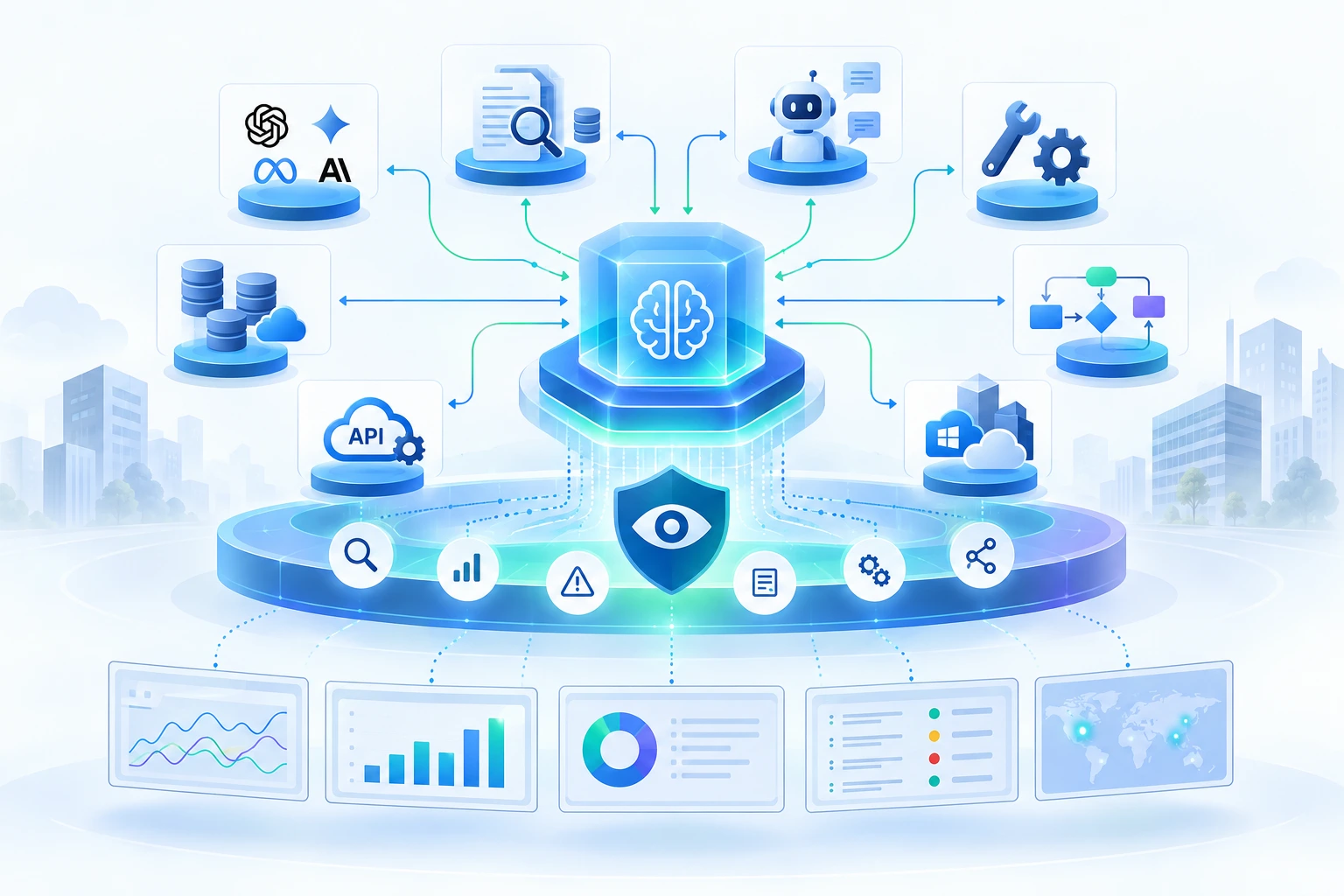
Modern enterprises face a seismic shift: data is no longer support infrastructure — it is the operating system of the entire business. Customer expectations are real-time. Analytics must be automated. AI must be embedded in every workflow. And data ecosystems must scale beyond traditional warehousing, integration tools, and BI stacks.
By 2025, the world will generate 181 zettabytes of data, according to IDC’s Global DataSphere Forecast. Enterprises now grapple with multi-cloud sprawl, unstructured data growth, AI adoption, and governance pressures. Yet most organizations admit they are failing to extract intelligence from the data they already own.
The CTO’s responsibility has transformed:
- From: “maintaining systems”
- To: “building intelligent, automated, AI-driven digital ecosystems”
Traditional data architectures — built around ETL pipelines, staging layers, schema-on-write models, and on-prem warehousing — can no longer keep pace. They lack flexibility, real-time insight delivery, and integration with modern AI workflows.
Microsoft Fabric architecture directly addresses this transformation challenge. It unifies:
- A lakehouse-centric architecture (OneLake)
- Real-time analytics
- Powerful data engineering
- Integrated AI + ML
- Seamless governance and lineage
- Enterprise-ready BI (Power BI Direct Lake)
- A fully SaaS-based operational model
Microsoft Fabric architecture blog is the CTO’s end-to-end roadmap to understanding Microsoft Fabric architecture, evaluating its advantages, comparing it with traditional systems, and charting a modernization strategy fit for the AI-first enterprise.
Read more about our partnership with Microsoft to understand how we help enterprises unify their data.
TL;DR
- Microsoft Fabric architecture unifies data engineering, warehousing, AI, governance, and BI under a single SaaS platform for end-to-end analytics.
- It replaces fragmented, multi-tool data estates with a unified lakehouse (OneLake), real-time pipelines, and AI-driven insights.
- CTOs gain scalability, cost efficiency, and rapid innovation capability with Purview governance and Azure-native AI integrations.
- This guide breaks down Fabric’s architecture, workload experiences, modernization strategies, and competitive advantages.
- Techment (a Microsoft Partner) provides expert-led Fabric strategy, migration, governance, and implementation for enterprise-scale success.
What Is Microsoft Fabric Architecture?
Microsoft Fabric is a fully integrated, SaaS-based data and analytics platform that consolidates every stage of the data lifecycle — ingestion, engineering, warehousing, science, real-time analytics, visualization, and governance — into one unified experience.
Fabric merges capabilities that previously existed across multiple Azure services:
- Power BI
- Azure Data Factory
- Azure Synapse (SQL + Spark)
- Azure Data Explorer
- Azure ML
- Microsoft Purview
- OneLake (unified storage)
It is the first platform where developers, analysts, engineers, and business users operate within the same governed data environment.
Key Principles of Microsoft Fabric
1. SaaS-first Architecture
Fabric eliminates the overhead of provisioning clusters, managing infrastructure, maintaining Spark pools, or manually scaling compute.
2. Lakehouse-Centric: Powered by OneLake
OneLake is Microsoft’s enterprise data lake built into Fabric, providing:
A single tenant-wide storage layer
- Delta/Parquet open formats
- Zero-copy data sharing
- Standardized governance & lineage
3. Unified Governance (Purview)
Data classification, lineage, and policies apply universally across all Fabric workloads.
4. End-to-End AI Integration
Fabric integrates with Azure OpenAI, Azure ML, Copilot, and vectorized data structures.
5. Multi-experience support
Fabric supports:
- Engineering (Spark)
- Warehousing (Synapse SQL)
- BI (Power BI Direct Lake)
- Streaming analytics
- Data science notebooks
- Real-time triggers (Data Activator)
6. Native Security Model
Fabric integrates identity, access controls, compliance, and encryption across all workloads.
For more detailed understand on how Microsoft differs from other platforms, read Microsoft Fabric vs Power BI: A Strategic, Future-Ready Analytics Comparison
Microsoft Fabric Architecture Explained
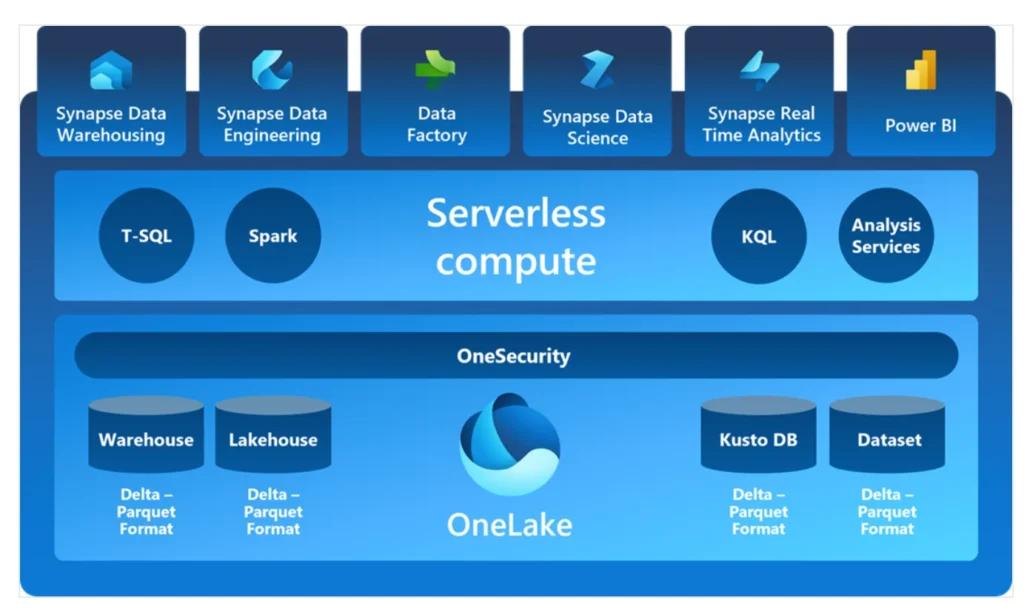
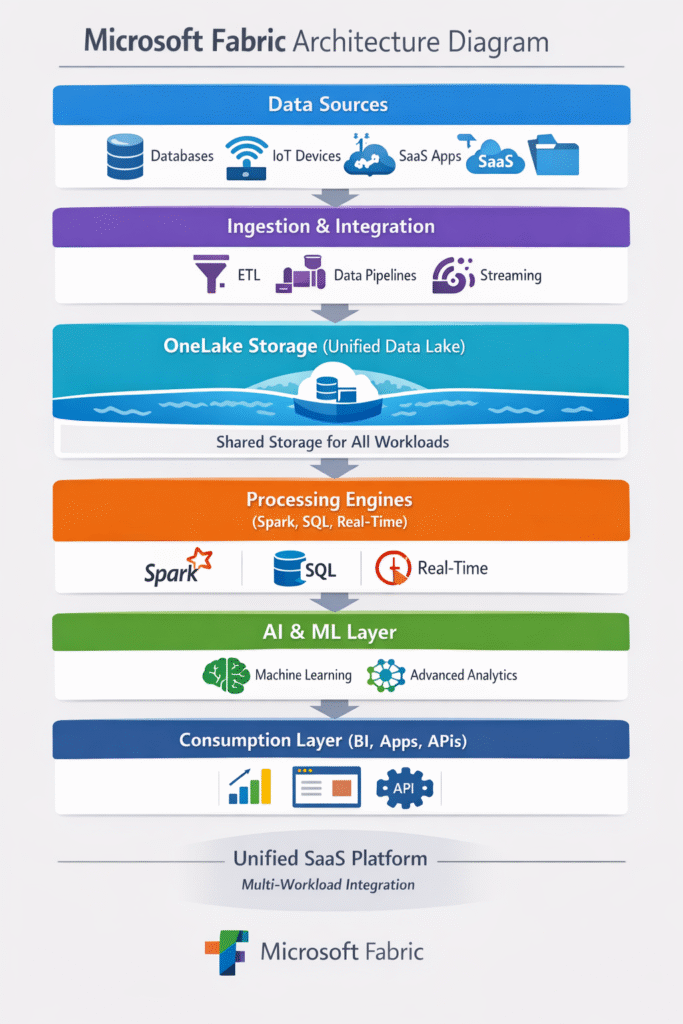
Microsoft Fabric architecture consists of tightly integrated components built around OneLake.
Here is a breakdown.
Core Components of Fabric Architecture
- OneLake architecture
- Data Factory pipelines
- Lakehouse engine
- Warehouse engine
- Real-time analytics engine
- AI & ML layer
- Governance & security layer
Key Benefits Of Microsoft Fabric Architecture
1. One Copy of Data, Many Consumers
No more duplicating datasets for warehouse, BI, ML, or reporting.
2. Open Lakehouse Format
Built on Delta/Parquet, ensuring interoperability and zero vendor lock-in.
3. Workspace + Lakehouse Model
Each department/team gets its own workspace while still sharing global governance.
4. Shortcuts + Mirroring
Shortcuts allow linking data across clouds (AWS S3, ADLS, Google Cloud) without ingestion. Mirroring enables database replication into OneLake in real time.
5. Multi-Cloud, Hybrid Ready
Workloads can operate across federated data environments.
In short: OneLake replaces scattered storage accounts, proprietary formats, and multiple ingestion pipelines with a single, governed, enterprise-wide data layer.
Learn more about implementing unified data framework in Implementing Data Governance Frameworks That Work: A Strategic Playbook for Enterprise Leaders
Fabric Workload Experiences – The 8 Main Pillars
1. Data Engineering (Spark)
- Powered by optimized Apache Spark
- Supports notebooks, pipelines, and lakehouse ETL
- Ideal for large-scale data transformation
2. Data Factory
Enhanced with:
- 150+ connectors
- Low-code dataflows
- Orchestration pipelines
- CI/CD support
3. Data Science
- Python/R notebooks
- Azure ML integration
- Feature store support
- Embedded AI/ML lifecycle
4. Data Warehouse (Synapse SQL)
- Warehouse-native workloads
- Highly elastic SQL compute
- Distributed processing engine
- Direct Lake mode for BI
5. Real-Time Analytics
- Based on Azure Data Explorer
- Ingests telemetry, logs, IoT data
- Supports KQL, time-series analytics
- Ultra-low-latency insights
6. Power BI (BI & Visualization)
- Direct Lake mode
- Governed semantic models
- Row-/column-level security
- Native integration with OneLake
7. Data Activator (Real-Time Triggers)
- Event-driven automation
- Anomaly detection triggers
- Business rule alerts
- Real-time event intelligence
8. Microsoft Purview
- Unified governance
- Metadata scanning
- Lineage
- Policy management
- Compliance controls
Each experience draws data directly from OneLake — giving CTOs a single architecture, not a patchwork of isolated services.
You may also like to read Cloud-Native Data Engineering: The Future of Scalability for the Enterprise
Fabric vs Traditional Data Warehouse Architecture
Understanding how Microsoft Fabric differs from a traditional data warehouse architecture is critical for enterprise decision-makers evaluating modernization strategies.
Below is a structured comparison aligned to architecture, scalability, AI-readiness, governance, and operational complexity.
Architectural Comparison Table
| Dimension | Microsoft Fabric Architecture | Traditional Data Warehouse Architecture |
|---|---|---|
| Deployment Model | Unified SaaS platform (fully managed) | Typically IaaS / PaaS / On-prem |
| Storage Layer | OneLake (single logical data lake across workloads) | Separate data warehouse storage + external data lake |
| Data Movement | Minimal duplication (shared storage) | Heavy ETL/ELT and data replication |
| Workloads | Multi-workload (Data Engineering, Data Science, Real-Time, BI) in one platform | BI + structured analytics primarily |
| Compute Engines | Spark, SQL, Real-Time engines integrated | Mostly SQL engine only |
| AI & ML Integration | Native AI/ML and Copilot capabilities | External ML tools required |
| Governance | Unified governance across workloads | Fragmented governance across tools |
| Scalability | Elastic SaaS scaling | Scaling often requires infrastructure planning |
| Time to Insight | Faster (shared storage + no silos) | Slower due to batch pipelines |
| Cost Model | Capacity-based pricing | Infrastructure + licensing + ETL tooling |
| Real-Time Support | Built-in streaming & event processing | Limited or bolt-on streaming |
| Data Format | Open Delta Lake format | Proprietary warehouse formats |
| Integration with BI | Native integration with Power BI | Often separate BI layer |
| Operational Complexity | Low (single platform experience) | High (multiple tools & integrations) |
Explore our blog on Microsoft Fabric vs Snowflake vs Traditional Warehousing (2026) | Modern Data Fabric Guide.
End-to-End Data Flow in Fabric (Step-by-Step)
A CTO-friendly explanation:
Step 1 — Ingestion
Data ingests through connectors, pipelines, mirroring, real-time streams, or APIs into OneLake.
Step 2 — Transformation & Engineering
Spark jobs shape data using medallion architecture (Bronze → Silver → Gold).
Step 3 — Warehousing
Synapse SQL warehouses structure curated datasets for analytics.
Step 4 — Real-Time Analytics
Event streams feed into Real-Time Analytics for instant querying.
Step 5 — AI/ML Integration
Azure ML + vectorized data enable model training and inferencing.
Step 6 — BI & Decision Intelligence
Power BI Direct Lake eliminates import latency, enabling near-instant dashboards.
Step 7 — Governance & Security
Purview enforces lineage, classification, and permissions across all steps.
Begin your modernization roadmap and automate governance across all platforms with our data solutions.
Microsoft Fabric Architecture for AI & Generative AI Workloads
Pillar 1: Unified Storage with OneLake
OneLake eliminates fragmented storage and enables multi-cloud, zero-copy data sharing.
Pillar 2: Real-Time Decisioning with Data Activator
Proactive intelligence that triggers workflows instantly.
Pillar 3: AI-Ready Workloads
- Azure ML
- OpenAI models
- Natural language interfaces
Pillar 4: End-to-End Experience
All workloads in one platform removes friction.
Pillar 5: Cost Optimization
A consumption-based model ensures budget alignment.
Learn more about our Data Transformation Framework.
When Microsoft Fabric May Not Be Ideal
Microsoft Fabric architecture is powerful, but it is not universally optimal for every enterprise scenario. Understanding its limitations strengthens architectural decision-making and prevents over-investment in the wrong use case.
Below are situations where Fabric may not be the ideal primary platform.
Highly Customized Infrastructure Requirements
Fabric is a fully SaaS-based unified analytics platform. Enterprises that require:
- Deep infrastructure-level control
- Custom Spark cluster tuning
- OS-level configuration
- Specialized GPU workloads with granular control
may find Fabric’s abstraction limiting.
Fabric prioritizes simplicity and managed scalability over low-level customization.
Extreme Low-Latency Sub-Millisecond Trading Systems
While Fabric supports real-time analytics architecture, ultra-low latency financial trading platforms that require:
- Microsecond-level response times
- Bare-metal optimization
- Specialized hardware acceleration
may still prefer purpose-built streaming engines.
Fabric excels in enterprise real-time analytics — not high-frequency trading infrastructure.
Organizations Not Standardized on the Microsoft Ecosystem
Fabric integrates deeply with:
- Azure-native services
- Microsoft 365
- Power BI
- Azure AI
Enterprises heavily invested in alternative ecosystems may face integration complexity and change management overhead.
Architectural alignment matters.
Simple, Single-Use BI Deployments
If an organization:
- Only needs dashboards
- Has small structured datasets
- Does not require AI, streaming, or lakehouse
a full unified analytics platform may be unnecessary.
Fabric shines in complex, multi-workload enterprise environments.
Cost-Sensitive Small Deployments Without Scale Needs
Fabric’s consumption model benefits scale. Very small environments with:
- Minimal data volume
- No AI roadmap
- Limited real-time requirements
may not immediately justify unified architecture adoption.
Enterprise Decision Framework
Before implementing Microsoft Fabric architecture, evaluate:
- Do you require unified lakehouse + real-time + AI?
- Is governance fragmentation slowing decision-making?
- Are you managing multiple disconnected tools today?
- Is AI integration a strategic priority?
If the answer to most is “yes,” Fabric is likely a strong architectural fit.
Know all about Data Lakehouse vs Data Warehouse: Key Differences
Cost Architecture & Performance Optimization in Microsoft Fabric
Understanding cost architecture is essential for CTOs evaluating Microsoft Fabric architecture at scale.
Fabric follows a capacity-based consumption model, separating compute from storage to optimize elasticity and enterprise cost control.
Capacity Units (Compute Model)
Microsoft Fabric uses capacity units to allocate compute resources across workloads.
Key characteristics:
- Shared across data engineering, warehousing, BI, and real-time analytics
- Elastic scaling based on demand
- Consolidated compute pool instead of workload silos
- Supports burst performance without manual provisioning
Optimization Strategy
- Start with right-sized capacity aligned to workload concurrency
- Monitor peak utilization patterns
- Separate dev/test from production capacity
- Avoid over-provisioning idle workloads
Architectural insight:
Fabric eliminates traditional cluster sprawl but requires intelligent workload distribution to maximize ROI.
Storage Separation (OneLake Architecture)
Fabric separates:
- Storage (OneLake)
- Compute (Capacity Units)
This separation provides:
- Independent scaling
- Cost predictability
- Zero-copy data sharing
- Elimination of redundant data duplication
Optimization Strategy
- Implement medallion architecture to reduce unnecessary Gold-layer bloat
- Archive cold data tiers strategically
- Use shortcuts instead of copying external data
- Avoid unnecessary duplication across workspaces
Proper lakehouse zoning significantly reduces long-term storage growth costs.
Compute Scaling & Workload Isolation
Fabric provides elastic scaling, but performance depends on workload management.
Best practices:
- Isolate heavy data engineering jobs from BI-heavy workloads
- Schedule transformation pipelines during low-interaction windows
- Separate real-time analytics workloads when concurrency increases
- Use workload prioritization policies
Enterprise pattern:
Adopt domain-based workspaces with workload-aware capacity distribution.
Query Optimization Tips for Enterprise Performance
Performance optimization directly impacts cost efficiency.
Below are architecture-aligned optimization strategies.
Use Direct Lake Mode for BI
Avoid data imports when possible.
Direct Lake reduces latency and eliminates duplicate storage costs.
Optimize Delta Tables
- Partition by high-cardinality filters
- Use optimized file sizes
- Avoid excessive small file creation
This improves both Spark and SQL performance.
Reduce Data Movement
Fabric architecture is strongest when data stays within OneLake.
Avoid:
- Exporting datasets unnecessarily
- Moving curated data between workspaces
Use shared semantic models instead.
Design Efficient Medallion Layers
- Bronze: Raw only
- Silver: Cleaned & standardized
- Gold: Business-ready aggregates
Avoid bloating Gold with unfiltered datasets.
Monitor Query Concurrency
High enterprise concurrency can impact performance.
Recommendations:
- Monitor peak BI refresh windows
- Use incremental refresh where applicable
- Distribute heavy workloads
Enterprise Cost Architecture Summary
Microsoft Fabric architecture optimizes cost through:
- Unified compute pools
- Storage/compute decoupling
- Zero-copy data sharing
- SaaS-managed infrastructure
- Elastic scaling
However, governance discipline and workload architecture determine real ROI.
Read our blog on Microsoft Fabric vs Azure Data Stack: Enterprise Choice for 2026 to understand the key capabilities and differences.
Future Trends in Microsoft Fabric Architecture (2026–2030)
Microsoft Fabric arhcitecture is not just a convergence of existing tools — it’s a strategic blueprint for the next decade of enterprise analytics and AI. As the platform continues to evolve rapidly, CTOs must anticipate the innovations that will reshape data architectures between now and 2030.
Rise of the Intelligent Lakehouse
The convergence of the data warehouse and data lake continues, but Fabric accelerates this shift with a native, unified engine (OneLake + Direct Lake). Expect:
- Multi-modal storage (tables, files, vectors, streams, graphs)
- AI-native storage layers that support embeddings, generative AI context, and knowledge graphs
- Automatic query optimization via Fabric Copilot
- Intelligent tiering (hot/cold data) managed entirely by Fabric
The lakehouse becomes not just storage — but an adaptive, intelligent analytics engine.
AI-Native Pipelines & Automation Everywhere
Fabric is rapidly embedding AI across the entire data lifecycle. By 2030:
- AI-driven ETL will auto-build and optimize pipelines
- AI-assisted data modeling will auto-generate semantic models
- Copilot for governance will classify, audit, and validate data policies
- Self-healing pipelines will automatically fix broken ETL and ingestion patterns
- Out-of-the-box Generative AI apps will be deployable from Fabric templates
This is the era of Autonomous Data Engineering — where humans supervise, and AI builds.
Real-Time and Event-Driven Architecture Becomes Default
Data Activator and Real-Time Analytics are early signals that Microsoft is betting heavily on:
- Instant event detection
- Real-time anomaly tracking
- Fraud, churn, and risk interceptors powered by streaming ML
- Real-time observability dashboards
- Millisecond-latency analytics
In industries like BFSI, retail, and supply chain — this will become mandatory.
Deep Integration With Copilot & Microsoft 365
As Microsoft extends AI copilots across Teams, Outlook, Excel, Dynamics, and more, Fabric becomes the intelligence layer beneath them.
Expect:
- Natural language analytics inside Teams (“Summarize last week’s sales anomalies from OneLake”)
- Embedded insights inside Outlook (automated briefings based on Fabric datasets)
- Excel auto-ML sourced directly from Fabric semantic models
- Enterprise knowledge graphs built automatically from Fabric metadata
For CTOs, this means AI becomes the new user interface — data is no longer consumed only in dashboards, but embedded into daily workflows.
The Multicloud & Hybrid Future
Fabric’s shortcuts and mirroring capabilities already support federated data. Over time, expect:
- Cross-cloud query federation (Azure + AWS + GCP)
- Multi-cloud governance via Purview
- Native S3/GCS lakehouse virtualization
- Distributed lakehouse architecture
This aligns with the industry shift: Data will be multi-cloud; governance must be unified.
Read our Microsoft Data and AI Partner blog explores the strategic value a Microsoft Data and AI Partner brings to enterprises
Enterprise Deployment Patterns for Microsoft Fabric Architecture
Successful Fabric adoption requires a structured and phased modernization roadmap, balancing technology, people, processes, and governance.
Below is the recommended CTO blueprint for rollout.
Phase 1 — Discovery & Vision Alignment
Objectives:
- Assess current data estate
- Map key business goals
- Identify modernization drivers
- Evaluate AI readiness
- Prioritize domains (finance, supply chain, product, customer)
Typical deliverables:
- Enterprise data maturity assessment
- High-value business cases
- Gap analysis with tech recommendations
- Early governance framework
Start your data integration and MS Fabric journey with Data Management for Enterprises: Roadmap.
Phase 2 — Foundation Architecture Design
Key architectures to define:
OneLake Storage Architecture
- Workspace structures
- Lakehouse zoning (Bronze → Silver → Gold)
- Partitioning & file strategy
- Shortcuts & mirroring setup
Security & Governance Architecture
- RBAC & ABAC
- Data classification
- Sensitivity labels
- Lineage mapping
- Regulatory compliance
BI & Semantic Model Architecture
- Direct Lake models
- Data marts
- Shared datasets
- Cross-domain modeling
Engineering & ML Architecture
- Ingestion pipelines
- Transformation workflows
- Feature stores
- ML ops pipelines
Phase 3 — Migration & Implementation
Activities include:
- Migrating legacy ETL to Fabric Data Factory
- Moving warehouse tables to Fabric SQL
- Replatforming data lakes into OneLake
- Rebuilding semantic models in Power BI
- Implementing Data Activator for event tasks
- Deploying governance via Purview
Migration accelerators reduce time and risk by automating metadata mapping, schema conversion, workload assessment, and validation processes.
Phase 4 — Adoption & Scale-Out
Scale includes:
- Expanding usage across business units
- Rolling out self-service analytics
- Integrating Copilot-based AI apps
- Monetizing data and building predictive use cases
- Continuous cost + performance optimization
Begin your transformation journey and automate governance across all platforms with our data solutions.
AI-Driven Use Cases Microsoft Fabric Architecture Unlocks for Enterprises
Here are high-impact AI and analytics use cases enabled by Fabric:
Customer 360 + Predictive Personalization
Fabric unifies CRM, web behavior, telemetry, transactions, and engagement into a single model.
AI-enabled outcomes:
- Personalized offers
- Churn prediction
- Customer lifetime value modeling
- Micro-segmentation
Supply Chain Digital Twin & Predictive Operations
Fabric’s real-time streaming and Data Activator enable predictive operations:
- Inventory forecasting
- Logistics anomaly detection
- Production optimization
- Predictive maintenance
AI-Powered Finance & Risk
Fabric supports governance-heavy domains with:
- Fraud detection
- Credit risk scoring
- Automated reconciliation
- Cash flow prediction
- Real-time variance alerts
Intelligent Customer Support Automation
Fabric integrates Azure OpenAI + telemetry for:
- AI agents
- Self-service chatbots
- Automated ticket classification
- Knowledge retrieval copilots
Healthcare & Life Sciences AI
Fabric helps build:
- Clinical patient insights
- Risk stratification
- Treatment pathway optimization
- Predictive diagnostics
Read our blog that explores how AI copilots for enterprises are transforming executive leadership in 2026.
Why Techment Is the Ideal Microsoft Fabric Partner for Your Enterprise
Modernizing your data estate with Microsoft Fabric is not merely a platform upgrade — it’s a strategic transformation that reshapes how your organization uses data, AI, automation, and insights. As an official Microsoft Partner, Techment empowers enterprises to build AI-first, future-ready data ecosystems using Fabric, Azure Data Services, and the broader Microsoft Intelligent Data Platform.
Below is a fully refined, strategic narrative.
Techment + Microsoft: Transforming Businesses Into AI-First Enterprises
Techment enables organizations to modernize legacy systems, activate real-time intelligence, and build scalable AI ecosystems — powered by Microsoft Fabric architecture and Azure’s modern data stack.
Our partnership with Microsoft provides:
- Early access to Fabric roadmap updates
- Deep technical alignment with Microsoft product engineering
- Enterprise-scale implementation accelerators
- Certified Fabric, Azure, Power Platform, and AI experts
- Proven frameworks for governance, migration, and modernization
We help enterprises unify, govern, and operationalize their data across hybrid and multi-cloud environments — enabling faster insights, smarter decisions, and scalable innovation.
Begin your journey by learning more about our partnership with Microsoft to help you make the right choice for MS Fabric adoption partner.
Our 4-Pillar Microsoft Fabric Service Portfolio
1. Data & AI on Azure — Building the Intelligent Enterprise
We design secure, governed, scalable data platforms using:
- Azure Synapse
- Azure SQL
- Azure Data Factory
- Azure ML
- Azure Data Lake Storage
Outcomes we deliver:
- Unified and governed data estate
- Accelerated analytics workflows
- Reliable, scalable pipelines
- High-quality, AI-ready data
2. Azure AI Services — Turning Data Into Document Intelligence
Using Azure ML, Azure Cognitive Services, and Azure OpenAI, Techment delivers:
- Faster model development & deployment
- Smart document processing
- Intelligent automation
- Secure, enterprise-grade AI
3. Microsoft Fabric — Unifying the Data & AI Experience
Techment helps you operationalize Fabric’s full ecosystem:
We implement:
- OneLake architecture
- Data Factory pipelines
- Power BI Direct Lake reporting
- Real-Time Analytics
- Purview governance
- Business-ready AI + ML
Benefits:
- Unified analytics
- Real-time decision intelligence
- Reduced ETL/ELT complexity
- Streamlined governance
4. Modern Work & Power Platform
We enhance collaboration, productivity, and automation with:
- Power Apps
- Power Automate
- Power BI
Your Transformation Journey with Techment
Step 1 — Vision & Discovery
Define goals, assess architecture, determine AI readiness.
Step 2 — Roadmap & Strategy
Prioritize initiatives, design modernization blueprint.
Step 3 — Implementation & Adoption
Deploy Fabric, modernize pipelines, build semantic models, migration execution.
Step 4 — Run, Optimize & Scale
Operational excellence, value tracking, cost optimization, AI expansion.
Why Enterprises Choose Techment for Fabric
- Microsoft Partner with Fabric Expertise
- Accelerators for migration & modernization
- Industry-grade governance frameworks
- Real-time analytics & AI capability development
- Deep expertise across healthcare, retail, BFSI, manufacturing
- End-to-end delivery: strategy → implementation → optimization
Get started today — Schedule a Consultation.
Conclusion: The CTO Roadmap for Modern Analytics Starts Here
Microsoft Fabric is not just another analytics tool — it is a future-ready, AI-powered data operating system. It eliminates silos, automates intelligence, and provides a unified foundation for everything from ETL and warehousing to ML and event-driven automation.
For CTOs, this is a once-in-a-decade opportunity to modernize:
- From fragmented → unified
- From reactive → predictive
- From batch → real time
- From manual → automated
- From BI → AI-native intelligence
Organizations that act now will define the competitive landscape of the next decade.
Those who wait will fall behind.
Start your Microsoft Fabric journey with confidence — Contact Techment for a strategy consultation.
FAQ Section — Microsoft Fabric Architecture for CTOs
1. What is Microsoft Fabric architecture?
A unified analytics platform integrating data engineering, warehousing, real-time analytics, governance, AI, and BI — all built on OneLake.
2. Does Microsoft Fabric replace Azure Synapse?
Fabric evolves Synapse into a fully SaaS-based experience but both can co-exist. Fabric is Microsoft’s long-term strategic direction for analytics.
3. Can Fabric support real-time analytics?
Yes. Fabric’s Real-Time Analytics and Data Activator deliver near-instant anomaly detection, event triggers, and streaming analytics.
4. How is OneLake different from a traditional data lake?
OneLake differs from a traditional data lake by being natively integrated into a unified analytics platform rather than functioning as standalone storage. Traditional data lakes often require separate tools for warehousing, BI, governance, and machine learning. OneLake provides a single logical storage layer across the entire platform, enabling zero-copy data sharing, consistent governance, built-in lineage, and open file formats like Delta and Parquet.
5. Can Microsoft Fabric support enterprise AI workloads?
Yes, Microsoft Fabric supports enterprise AI workloads through integrated data engineering, feature engineering, real-time analytics, and machine learning capabilities within a unified architecture.
6. What is the medallion architecture in Fabric?
The medallion architecture in Fabric is a structured data refinement model that organizes data into three layers: Bronze (raw data), Silver (cleaned and standardized data), and Gold (curated, business-ready datasets).
7. Why do enterprises need a Fabric partner?
To ensure architecture alignment, governance setup, security design, migration accuracy, cost optimization, and scalable ad