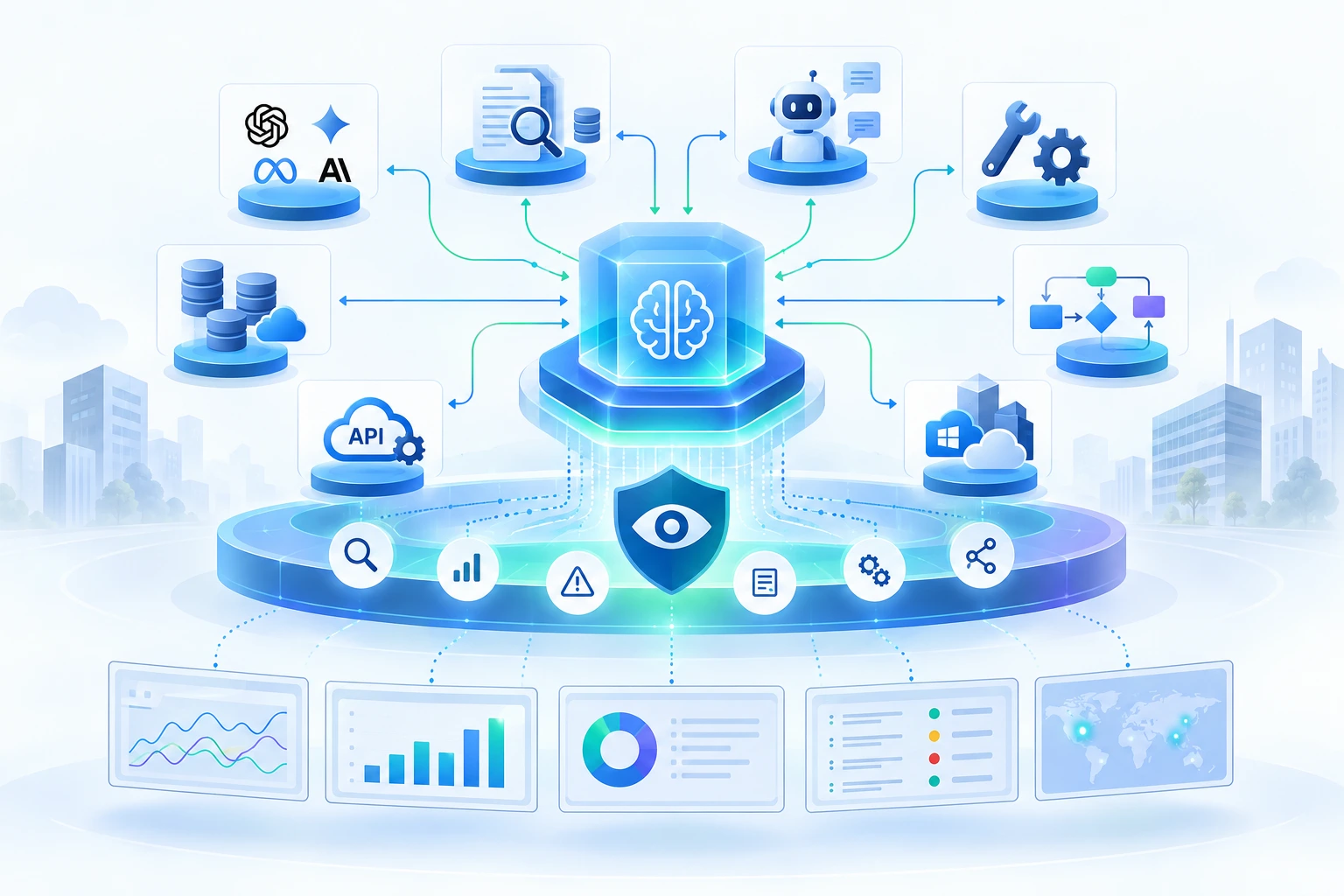

Enterprises have invested heavily in AI experimentation, yet most struggle to turn promising models into repeatable, business-critical capabilities. The gap is not algorithms—it is operationalization. Disconnected data platforms, inconsistent governance, and brittle pipelines prevent AI from scaling across the organization. This is where Microsoft Fabric AI use cases are reshaping enterprise strategy.
Microsoft Fabric represents a shift from fragmented analytics stacks to a unified platform designed for operationalizing AI with Microsoft Fabric across the data lifecycle. For CTOs, CDOs, and AI leaders, Fabric is not just another analytics tool; it is an operating layer for enterprise AI. By integrating data engineering, analytics, and AI workloads into a single SaaS platform, Microsoft Fabric AI use cases guide enables organizations to move from isolated AI pilots to AI at scale with Microsoft Fabric.
Microsoft Fabric AI Use Cases to Operationalize AI at Scale enterprise guide examines how leaders are using Microsoft Fabric to operationalize AI at scale—why it matters, what capabilities enable it, and how enterprises should approach adoption. We focus on strategic implications, architectural considerations, and real-world enterprise AI outcomes.
TL;DR Summary
- Enterprises struggle to move AI from pilots to production due to fragmented data and governance.
- Microsoft Fabric provides a unified analytics and AI platform purpose-built for operationalizing AI at scale.
- Leaders use Fabric to standardize data pipelines, govern AI workflows, and accelerate time-to-value.
- Successful adoption requires architectural alignment, governance, and operating model changes.
What Is Microsoft Fabric and Why It Matters for AI
Microsoft Fabric is a unified analytics platform that brings together data ingestion, engineering, warehousing, real-time analytics, data science, and business intelligence into a single, integrated experience. Unlike traditional analytics platforms that require stitching together multiple services, Fabric is built as an end-to-end SaaS platform optimized for enterprise AI.
Microsoft Fabric AI use cases are fundamentally about unifying how enterprises design, deploy, and scale AI across the data lifecycle. For AI leaders, the significance lies in how Fabric changes the economics and complexity of AI delivery. Traditional architectures often rely on separate data lakes, ETL tools, ML platforms, and BI layers. This fragmentation increases operational overhead and introduces governance gaps. Microsoft Fabric enterprise AI addresses this by standardizing how data flows from source systems to AI models and business insights.
Fabric differs from platforms like Databricks, Snowflake, or AWS-native stacks in its opinionated integration. While alternatives offer powerful individual services, they require significant engineering effort to operationalize AI consistently. Fabric prioritizes cohesion over customization, enabling faster Microsoft AI Fabric adoption for enterprises already invested in the Microsoft ecosystem.
From an AI perspective, Fabric’s OneLake architecture, shared security model, and native integration with Power BI and Azure AI services reduce friction across teams. This makes Microsoft Fabric AI use cases particularly compelling for organizations seeking governed, repeatable AI at scale rather than bespoke experimentation.
Related Insight: Read our blog on what Microsoft Fabric is, how it works, why organizations are rapidly adopting it, and what leaders must know to leverage it effectively.
Why Operationalizing AI Is Critical for Modern Businesses
Microsoft Fabric AI use cases highlight a critical reality: AI only creates value when it is embedded into day-to-day operations. Operationalizing AI means embedding models into core business processes with reliability, governance, and measurable impact. For most enterprises, the challenge is not model accuracy but operational scalability. Without standardized pipelines and controls, AI initiatives remain trapped in innovation labs.
Modern businesses face increasing pressure to deliver real-time insights, automate decisions, and personalize experiences. Achieving this requires scalable machine learning pipelines and analytics workflows that can evolve with the business. AI that cannot be monitored, governed, or updated quickly becomes a liability rather than an asset.
Common barriers to AI operationalization include inconsistent data quality, lack of lineage, unclear ownership, and manual deployment processes. These issues are amplified in regulated industries where compliance and auditability are non-negotiable. As AI adoption accelerates, governance becomes as important as performance.
Operationalizing AI with Microsoft Fabric directly addresses these challenges by unifying data engineering, analytics, and AI operations. Fabric provides a consistent foundation for building, deploying, and monitoring AI workloads while enforcing enterprise data governance. This enables leaders to shift AI from experimental projects to scalable operational capabilities aligned with business outcomes.
Related Insight: Our Microsoft Data and AI Partner blog explores the strategic value a Microsoft Data and AI Partner brings to enterprises — and why the organizations leading the AI revolution are doing it with the right partner beside them.
Core Capabilities of Microsoft Fabric for AI Workloads
At the core of Microsoft Fabric AI use cases is the ability to support diverse AI workloads—predictive, generative, and real-time—on a single platform without fragmenting data or governance models. Its capabilities are particularly relevant for enterprises seeking Microsoft Fabric for scalable AI workflows.
Unified Data Platform for AI
At the core of Fabric is OneLake, a single logical data lake shared across workloads. This eliminates data duplication and enables consistent access for data engineering, analytics, and AI teams. Data ingestion, transformation, and feature engineering occur within the same governed environment.
Compared to traditional data lakes, Fabric enforces standardized metadata, security, and lineage by default. This reduces the risk of shadow datasets and inconsistent features—common issues that undermine AI reliability. For AI leaders, this unified platform simplifies collaboration and accelerates experimentation without sacrificing control.
End-to-End AI Pipeline Support
Fabric supports end-to-end AI pipelines, including data preparation, model training, and deployment orchestration. Integration with Azure Machine Learning and native notebooks allows data scientists to work directly on governed enterprise data.
From an operational standpoint, this tight integration reduces handoffs between teams. Data engineers, data scientists, and analysts operate within a shared platform, enabling cross-platform AI collaboration. This is a key differentiator in Microsoft Fabric architecture for AI, where operational efficiency is prioritized over tool diversity.
Real-Time Analytics and Monitoring
AI value increasingly depends on timeliness. Fabric’s real-time analytics capabilities allow organizations to ingest streaming data and generate insights with minimal latency. This is critical for use cases such as fraud detection, supply chain optimization, and customer behavior analysis.
By combining real-time analytics with historical context, leaders gain continuous visibility into AI-driven processes. Monitoring model performance alongside business KPIs enables proactive optimization and faster decision-making.
Related Insight: Begin your data transformation by choosing the right partner and our partnership page can help you understand the strategic benefits we bring as a solutions partner.
How Top Organizations Are Operationalizing AI Using Fabric
Across industries, Microsoft Fabric AI use cases are emerging as repeatable blueprints rather than one-off projects. Leading organizations define standardized AI use cases—forecasting, personalization, risk scoring, and optimization—and deploy them consistently using Fabric as the enterprise AI backbone. Enterprises across industries are leveraging Microsoft Fabric AI use cases to move AI into production at scale. While implementations vary, common patterns emerge.
In financial services, organizations use Fabric to unify transactional data, customer behavior, and risk models. This enables near real-time fraud detection and credit scoring with full auditability. Fabric’s governance features support regulatory compliance while maintaining agility.
Retail enterprises apply Microsoft Fabric data analytics for AI to demand forecasting and inventory optimization. By integrating sales data, supply chain signals, and external factors, AI models continuously adapt to changing conditions. Fabric’s unified platform reduces the latency between insight generation and operational action.
Healthcare providers leverage Fabric for predictive analytics and operational efficiency. By combining clinical, operational, and IoT data, AI models support capacity planning and patient flow optimization. Fabric’s security and data governance in AI workflows are critical in handling sensitive health data.
Across these examples, the common denominator is not model sophistication but operational maturity. Microsoft Fabric enterprise AI enables organizations to standardize how AI is built, governed, and scaled across the enterprise.
Related Insight: Explore how unified analytics enhances decisions and why Microsoft solutions partner can accelerate your market growth in our latest blog on Microsoft Data Fabric vs Traditional Data Warehousing: What Leaders Need to Know
Best Practices to Operationalize AI with Microsoft Fabric
Best-in-class Microsoft Fabric AI use cases are designed with scale in mind from day one. Enterprises that succeed treat AI use cases as long-lived operational assets rather than isolated experiments. Successfully operationalizing AI with Microsoft Fabric requires more than technology adoption. Leaders must align architecture, governance, and operating models.
A foundational best practice is establishing clear data governance standards. This includes defining data ownership, quality thresholds, and lineage requirements. Fabric’s native governance capabilities support these practices, but leadership alignment is essential.
Scaling model training and versioning is another critical consideration. Enterprises should standardize how models are trained, validated, and deployed within Fabric. This reduces operational risk and accelerates iteration cycles.
Cross-team collaboration patterns must also evolve. Fabric enables low-code AI integration and shared workspaces, but organizations must encourage collaboration between data engineering, analytics, and business teams. Security and compliance should be embedded into workflows rather than treated as afterthoughts.
Related Insight: Our blog on Best Practices for Generative AI Implementation in Business provides an enterprise-ready blueprint for responsible, high-impact GenAI execution — tailored for real business outcomes.
Comparing Microsoft Fabric to Other AI Platforms
When evaluating Microsoft Fabric AI use cases against alternative platforms, the key question is not feature parity but how easily AI use cases can be operationalized, governed, and scaled across the enterprise. Leaders evaluating Microsoft Fabric often compare it against Databricks, Snowflake, and cloud-native AI stacks on AWS or GCP. The differences are less about raw capability and more about operational philosophy.
Microsoft Fabric is opinionated by design. It prioritizes an integrated, end-to-end experience across data engineering, analytics, and AI. Competing platforms often excel in specific domains—advanced data science, high-performance warehousing, or open-source flexibility—but require significant integration effort to operationalize AI consistently.
From an AI pipeline perspective, Fabric reduces architectural sprawl. Data ingestion, transformation, feature engineering, analytics, and AI consumption occur within a single governed environment. In contrast, alternative platforms typically rely on multiple services stitched together through custom orchestration. This increases operational complexity and long-term maintenance costs.
Governance is another key differentiator. Microsoft Fabric embeds security, lineage, and access controls across workloads by default. While competitors offer governance capabilities, they are often layered on top rather than natively enforced. For regulated enterprises, this distinction materially impacts risk and compliance posture.
Ultimately, Microsoft Fabric vs alternative AI platforms is a trade-off between flexibility and operational efficiency. Organizations prioritizing rapid Microsoft AI Fabric adoption, standardized workflows, and enterprise governance often find Fabric better aligned with AI at scale objectives.
Related Insight: See how Microsoft Data Fabric compares against traditional data warehousing across scalability, governance, AI readiness, cost, and decision intelligence.
ROI and Business Outcomes from Fabric-Driven AI
The financial impact of Microsoft Fabric AI use cases becomes clear when AI initiatives transition from isolated pilots to standardized, repeatable operational capabilities embedded across business functions. The business case for Microsoft Fabric enterprise AI is grounded in operational efficiency and accelerated value realization. Enterprises adopting Fabric consistently report improvements across cost, speed, and productivity dimensions.
Cost savings emerge from platform consolidation. By replacing fragmented analytics and AI tooling with a unified platform, organizations reduce infrastructure duplication, licensing overhead, and engineering effort. Fabric’s SaaS model further lowers operational burden by abstracting platform management.
Time-to-insight is another critical outcome. Unified data pipelines and integrated analytics enable faster experimentation and deployment. AI models move from development to production more quickly, allowing business teams to act on insights in near real time. This is particularly valuable in scenarios requiring continuous decision-making, such as dynamic pricing or risk monitoring.
Productivity gains extend beyond technical teams. Business users benefit from consistent, trusted data and embedded AI insights through Power BI and downstream applications. This democratization of AI-driven insights amplifies organizational impact without requiring deep technical expertise.
Collectively, these outcomes strengthen enterprise AI adoption by aligning AI initiatives with measurable business value rather than isolated innovation metrics.
Related Insight: Read our insights on Microsoft Azure for Enterprises: Cloud & AI Modernization to know more about how Azure services extend capabilities for advanced scenarios.
How to Get Started with Fabric for AI
A practical way to accelerate Microsoft Fabric AI use cases is to map priority business outcomes directly to a small number of high-impact AI use cases and design Fabric architectures explicitly around them. Getting started with Microsoft Fabric for AI leaders requires a structured, phased approach. Successful enterprises treat adoption as an operating model transformation rather than a platform rollout.
The first step is assessing AI readiness. Organizations should evaluate data quality, governance maturity, and existing analytics workflows. Establishing a clear baseline helps prioritize use cases that can deliver early value while minimizing risk.
Next, leaders should define a reference architecture aligned with Microsoft Fabric architecture for AI. This includes standardizing data ingestion patterns, workspace design, security boundaries, and integration with Azure AI services. Early architectural discipline prevents fragmentation as adoption scales.
Pilot use cases should focus on high-impact, low-complexity scenarios such as operational reporting augmentation or predictive analytics with well-understood data sources. These pilots validate platform assumptions and build organizational confidence.
Common pitfalls include underestimating change management and over-customizing early implementations. Enterprises should leverage Fabric’s native capabilities and low-code AI integration before introducing bespoke solutions.
Related Insight: Explore our blog on Leveraging Data Transformation for Modern Analyticsto understand the evolution of data transformation, modern frameworks, architectures, patterns, tools, and enterprise best practices.
How Techment Helps Enterprises Operationalize AI with Microsoft Fabric
Operationalizing AI at scale requires more than platform expertise—it demands strategic alignment, governance rigor, and execution discipline. Techment partners with enterprises to turn Microsoft Fabric into a foundation for sustainable, enterprise-grade AI.
Techment supports organizations across the full AI lifecycle, from data modernization and Fabric architecture design to AI readiness and operationalization. This includes establishing unified analytics strategies, designing scalable data pipelines, and embedding governance and compliance into AI workflows.
For enterprises adopting Microsoft Fabric, Techment helps define operating models that align data engineering, analytics, and AI teams. This ensures cross-functional collaboration while maintaining clear ownership and accountability. Techment’s experience across industries enables pragmatic trade-off decisions grounded in real-world constraints.
Beyond implementation, Techment focuses on optimization and value realization. By continuously aligning AI initiatives with business outcomes, Techment enables organizations to move beyond experimentation toward repeatable, measurable impact.
Related Insight: Read our blog on Microsoft Fabric AI Solutions for Enterprise Intelligence to understand how it fundamentally transforms how enterprises unify data, automate intelligence, and deploy AI at scale.
Conclusion — The Future of AI Operationalization with Microsoft Fabric
As AI moves from experimentation to enterprise necessity, operationalization becomes the defining challenge. Microsoft Fabric AI use cases demonstrate how a unified analytics platform can transform fragmented initiatives into scalable, governed capabilities.
For enterprise leaders, the strategic value of Microsoft Fabric lies in its ability to align data, analytics, and AI under a single operating model. This reduces complexity, accelerates value delivery, and strengthens governance as AI adoption expands.
The future of AI at scale will favor platforms that balance innovation with operational rigor. Microsoft Fabric positions organizations to meet this future with confidence. With the right strategy, governance, and execution partner, enterprises can turn AI from isolated projects into a core driver of competitive advantage.
Begin your transformation journey and automate governance across all platforms with our data solutions.
FAQs — Microsoft Fabric and AI at Scale
Can Microsoft Fabric replace existing machine learning pipelines?
Fabric can consolidate and simplify many enterprise ML workflows, particularly where governance and integration are priorities. Some specialized pipelines may continue to coexist, but Fabric often becomes the primary operational layer.
Is Microsoft Fabric suitable for small or emerging AI teams?
Yes. Fabric’s SaaS model and low-code capabilities make it accessible for smaller teams while remaining scalable for enterprise growth.
Does Microsoft Fabric support real-time AI analytics?
Fabric includes native real-time analytics capabilities, enabling streaming data ingestion and near real-time insight generation.
How does Fabric address AI governance and compliance?
Governance is embedded across Fabric workloads, providing lineage, access control, and auditability critical for regulated industries.
Related Reads