
Microsoft Fabric IQ is a set of capabilities that connects enterprise data, Power BI semantic models, and business ontologies to provide shared business context for analytics and AI agents. It helps agents interpret entities, relationships, metrics, and rules consistently, supporting more grounded enterprise AI experiences across analytical and operational workflows.
Enterprise AI agents need more than access to company data. They need to understand what that data means, how business entities relate, which metrics the organization trusts, and what actions business rules permit. Microsoft Fabric IQ addresses this challenge by connecting enterprise data, Power BI semantic models, and business ontologies into a shared context layer for analytics and AI agents. For organizations building AI on Microsoft Fabric, it offers a way to make agent interactions more consistent, business-aware, and grounded in enterprise information.
Executive Summary
Microsoft Fabric IQ is a set of capabilities within Microsoft’s broader IQ ecosystem that helps people and AI agents understand enterprise data in business terms. Built on OneLake and connected to Power BI semantic models, Fabric IQ introduces ontology-based business context that defines entities, properties, relationships, rules, and metrics.
Unlike a conventional semantic model focused primarily on analytical reporting, an ontology can represent how business concepts connect across operational and analytical domains. This context can help AI agents answer questions involving multiple systems, interpret business metrics consistently, and support governed operational decisions.
For enterprise leaders, Fabric IQ is worth evaluating when building data agents, operational AI, and cross-domain enterprise intelligence. However, organizations should validate preview limitations, supported integrations, access controls, and production readiness before adopting it for critical workloads.
TL;DR
- What is Fabric IQ? A Microsoft Fabric capability set that gives enterprise data shared business meaning for analytics, applications, and AI agents.
- How does it work? It combines OneLake, Power BI semantic models, and ontologies to connect data with business definitions, relationships, metrics, and rules.
- Why does it matter? It can reduce ambiguity when AI agents interpret enterprise data and answer business questions.
- Who should evaluate it? CIOs, CTOs, data architects, Microsoft Fabric teams, and enterprise AI leaders.
- What is the key distinction? Power BI semantic models provide trusted analytical definitions, while ontologies extend business context across entities, relationships, and operational logic.
- What should organizations watch? Feature maturity, integration constraints, permissions, data quality, performance, and governance.
What Is Microsoft Fabric IQ?
Microsoft Fabric IQ is a business-context layer within Microsoft IQ that connects enterprise data to the concepts, relationships, and rules that define how an organization operates. It helps people and AI agents reason about business entities rather than interpreting disconnected tables, columns, and records independently.
Microsoft describes Fabric IQ through three layers: unified data, business intelligence, and operational intelligence. These layers bring together OneLake, Power BI semantic models, and ontologies to create reusable business context across Fabric experiences.
Source: Microsoft Learn — What is Fabric IQ?
Why did Microsoft introduce Fabric IQ?
Enterprise data platforms have become better at storing, transforming, and analyzing information. Yet an AI agent can still misunderstand that information if business definitions are scattered across dashboards, databases, applications, and documentation.
Consider a simple question: “Which customer accounts are at risk, and what should we do next?”
Answering it may require the agent to understand:
- Customer identity across CRM, billing, and support systems.
- The organization’s definition of an at-risk account.
- Revenue, renewal, and customer health metrics.
- Relationships between accounts, contracts, products, and support incidents.
- Business policies governing the next action.
Providing access to the underlying data is only part of the solution. The agent also needs consistent definitions and relationships.
Fabric IQ aims to supply that shared context so business users, analytics applications, and AI agents can interpret enterprise information using common concepts.
Is Fabric IQ just another semantic layer?
No. Fabric IQ includes traditional analytical semantics through Power BI semantic models, but its ontology capabilities extend the model toward cross-domain business understanding and operational use.
A semantic model can define measures such as revenue, relationships between analytical tables, and dimensions such as customer or product. An ontology can describe business entities, their properties, how they relate, and the rules that govern their meaning.
The distinction matters when AI agents need to do more than answer a dashboard question—for example, tracing how a delayed shipment affects a customer commitment or identifying which business process should respond to an operational exception.
Read our blog on Microsoft Fabric Semantic Models Explained: The Enterprise Guide to Building Trusted, AI-Ready Business Intelligence
How Does Fabric IQ Work?
Fabric IQ connects enterprise data with reusable business definitions, relationships, and metrics. OneLake provides the data foundation, Power BI semantic models supply curated analytical meaning, and ontologies represent the business concepts and rules that agents can use. Together, these capabilities can support more consistent reasoning across analytical and operational workflows.
1. OneLake provides the unified data foundation
OneLake is the common data foundation for Microsoft Fabric. It brings data from Fabric workloads and supported external sources into a shared environment, using capabilities such as shortcuts and mirroring to connect data without requiring every source to be copied into a separate repository.
For Fabric IQ, this foundation matters because business context is only useful when it can be connected to relevant enterprise information.
For example, a retailer might have:
- Sales and inventory data in a lakehouse.
- Transactional records in a warehouse.
- Streaming events in an eventhouse.
- Business metrics in a Power BI semantic model.
Fabric IQ can use supported data bindings to associate business concepts with these sources. The exact architecture depends on the data sources, their availability, and the capabilities supported by the relevant Fabric feature.
Know more on OneLake – Techment
2. Power BI semantic models define trusted analytics
Power BI semantic models provide business-friendly terminology, relationships, dimensions, hierarchies, and measures for analytical workloads.
An organization might define:
- Net revenue using an approved calculation.
- Customer retention using a consistent reporting definition.
- Inventory turnover using an agreed business metric.
- Sales performance by region, product, or customer segment.
These definitions help prevent different reports and consumers from calculating the same KPI differently.
Fabric IQ can build on existing semantic-model investments. Microsoft documents the ability to generate ontologies from Power BI semantic models, reusing relevant tables, relationships, calculated columns, and source-owned DAX measures.
This creates a practical starting point for organizations that already have well-maintained Power BI models.
3. Ontologies represent business meaning
An ontology is a machine-understandable representation of business concepts and how they connect. In Fabric IQ, an ontology can define entity types, properties, relationships, rules, metrics, and mappings to enterprise data sources.
Consider a manufacturing organization with the following entities:
- Machine: Asset identifier, operating status, and maintenance history.
- Production Order: Order identifier, quantity, and delivery commitment.
- Supplier: Supplier identity, lead time, and quality performance.
- Maintenance Event: Event type, timestamp, and resolution status.
The ontology can describe relationships such as a production order requiring materials from a supplier or a machine being responsible for a production process.
These relationships give agents more context than isolated table names. The ontology describes the business concepts; bindings connect those concepts to underlying data.
Microsoft also documents ontology integration with graph capabilities for relationship-oriented analysis. The ontology defines what connects and why, while graph functionality supports traversing connections and examining patterns.
Source: Microsoft Learn — What is ontology in Fabric IQ?
4. Agents use the shared business context
Once an ontology and its data bindings are configured, supported Fabric data-agent experiences can use that context to answer natural-language questions.
For example, an operations team could ask:
“What production orders are at risk because of supplier delays?”
Answering this reliably requires more than retrieving a matching paragraph. The system must interpret production orders, supplier relationships, delivery commitments, and the business definition of risk, then query the relevant data.
The ontology helps establish that shared meaning. The agent still needs appropriate query capabilities, permissions, instructions, and access to the required sources.
Important implementation note: Microsoft documents Fabric data-agent integration with ontologies as a preview capability. The current documentation also identifies a known issue affecting data agents when an ontology uses semantic models for binding. Validate the supported configuration in your tenant before designing a production dependency.
Source: Microsoft Learn — Create a data agent to use with ontology
Fabric IQ Architecture: From Enterprise Data to AI Action
A useful way to understand Fabric IQ is to separate the data foundation, semantic context, agent interaction, and execution of business actions. This architecture shows how these components fit together conceptually; it is not a claim that every integration or automated action is available in every preview configuration.
The architecture at a glance
Layer 1: Enterprise data
- Lakehouses and warehouses
- Power BI semantic models
- Eventhouses and supported operational data
- Connected external data sources
Layer 2: Business context
- Business entities and properties
- Relationships across domains
- Approved metrics and business rules
- Ontology-to-data bindings
Layer 3: AI and analytics experiences
- Fabric data agents
- Natural-language business queries
- Relationship and impact analysis
- Analytical and operational intelligence experiences
Layer 4: Governed decisions and actions
- Identify business exceptions.
- Evaluate relevant conditions and rules.
- Recommend or initiate supported actions.
- Apply authorization, approval, and audit controls.
The architectural principle is straightforward: keep enterprise data connected to trusted business definitions, then make that context available to the experiences that need it.
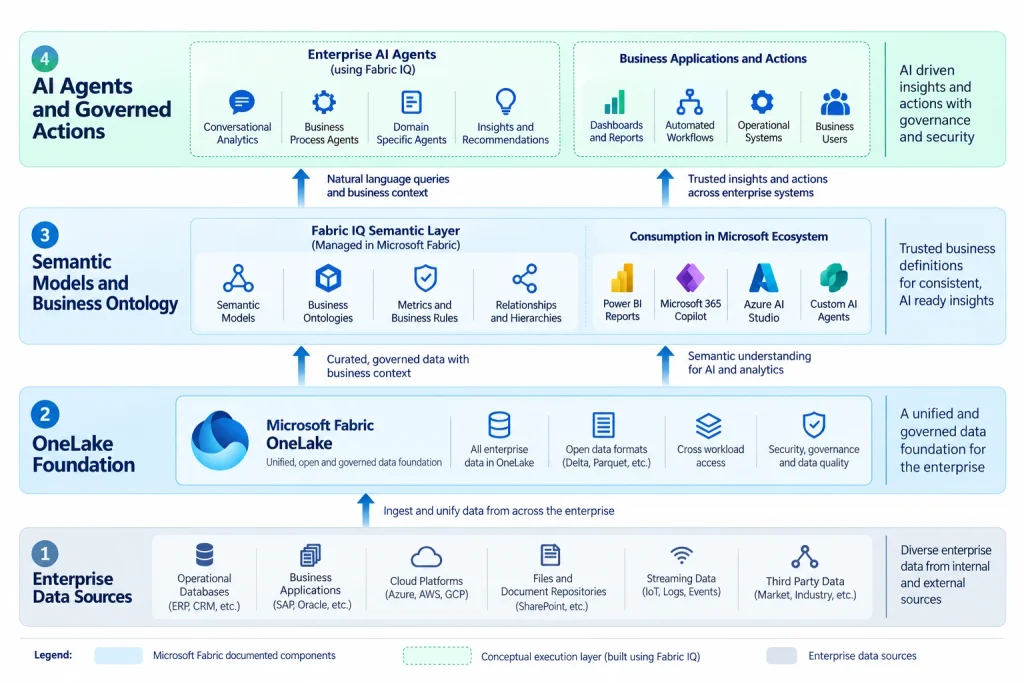
An agent should not independently invent the meaning of “active customer,” “late shipment,” or “critical asset” each time a question is asked. Those concepts should be defined, maintained, and governed as part of the enterprise data and business model.
Fabric IQ vs. Power BI Semantic Models vs. Knowledge Graphs vs. RAG
Fabric IQ, Power BI semantic models, knowledge graphs, and retrieval-augmented generation (RAG) address different but complementary problems. Fabric IQ brings together analytical semantics and ontology-based business context within Microsoft Fabric. Semantic models focus on trusted analytics, graphs represent connected entities, and RAG retrieves relevant information to ground language-model responses.
| Capability | Primary purpose | Best suited for |
|---|---|---|
| Power BI semantic model | Define analytical relationships, measures, and dimensions | Reporting, dashboards, trusted KPIs |
| Fabric IQ ontology | Represent shared business concepts, relationships, rules, and metrics | Cross-domain business context for analytics and agents |
| Knowledge graph | Represent and traverse connected entities and relationships | Dependency analysis, relationship discovery, path-based queries |
| RAG architecture | Retrieve relevant documents or other content to ground model responses | Policies, contracts, manuals, unstructured knowledge |
| AI agent framework | Coordinate model reasoning, tools, workflows, and actions | Executing multi-step tasks and orchestrating systems |
These technologies should not automatically be treated as alternatives. An enterprise architecture may use Fabric IQ for structured business context, RAG for document retrieval, a graph for relationship traversal, and an agent framework for workflow orchestration.
Fabric IQ vs. Power BI semantic models
A Power BI semantic model is a key component of Fabric IQ, not a competing product. It provides curated analytical meaning, while an ontology can extend that meaning into a reusable representation of business entities and relationships.
If the requirement is to create reliable dashboards and standardize KPI calculations, a semantic model may be sufficient. If agents must reason about relationships across business domains and use shared business rules, ontology capabilities may provide additional value.
Fabric IQ vs. knowledge graphs
A knowledge graph represents entities and their connections. Fabric IQ ontologies define business concepts and relationships, and Microsoft Fabric’s graph capabilities can support analysis of those connections.
The difference is primarily one of role: an ontology describes the business vocabulary and its meaning; graph capabilities provide a way to represent and traverse connected data.
Fabric IQ vs. RAG
RAG retrieves relevant content to ground a model’s response. It is especially useful when answers depend on unstructured sources such as contracts, policy documents, technical manuals, and internal knowledge articles.
Fabric IQ focuses on business entities, structured data, analytical definitions, and relationships. A robust enterprise agent may use both: Fabric IQ to understand a customer’s revenue and account status, and RAG to retrieve the contract clauses governing a renewal.
Fabric IQ vs. building a custom semantic layer
A custom semantic layer may be appropriate when an organization requires cross-cloud portability, domain-specific semantics, or integration patterns outside the supported Fabric ecosystem. Fabric IQ is worth evaluating when Microsoft Fabric already provides the main data foundation and the organization wants to reuse its semantic investments.
The decision should account for integration requirements, model portability, feature maturity, governance, and total cost of ownership—not simply the number of capabilities offered.
Key Benefits of Fabric IQ for Enterprise AI
Fabric IQ can help organizations standardize business meaning, reuse trusted analytical definitions, and provide AI agents with more structured enterprise context. Its greatest potential value appears where multiple teams or systems use different definitions for the same business concepts and where agents need to interpret relationships rather than retrieve isolated facts.
1. More consistent AI answers
When agents rely on inconsistent definitions, they may return different answers to the same business question.
A shared ontology can establish what a customer, shipment, asset, or business exception means. When connected to trusted metrics and data sources, this context can reduce ambiguity in how agents interpret business questions.
It does not guarantee correct answers. Data quality, source freshness, query generation, and model behavior still require testing.
2. Reuse of existing data investments
Organizations that have already built Power BI semantic models may be able to use them as a starting point for ontology creation.
This can reduce duplicated modeling effort and help maintain consistency between business intelligence and agent experiences. Teams should still review generated ontologies to confirm that the inherited definitions represent the intended business concepts.
3. Cross-domain business reasoning
Business questions often cross organizational boundaries.
A supply-chain question may involve suppliers, purchase orders, inventory, customer commitments, and transportation events. An ontology can make these relationships explicit so agents can interpret the business context more coherently.
Whether a particular question can be answered depends on the underlying data bindings, query support, and relationships defined in the model.
4. A foundation for operational intelligence
Fabric IQ’s broader capabilities include operational scenarios in which live data, business context, and governed responses work together.
For example, a business could identify an abnormal inventory condition, assess the affected orders, and recommend a replenishment action. Automated execution should only be introduced after validation of permissions, business rules, approval requirements, and failure handling.
5. Shared meaning across analytics and AI
A common business vocabulary can help align reporting, data applications, and AI agents. Instead of maintaining unrelated definitions for every consumer, organizations can progressively establish reusable concepts and metrics.
This is particularly useful for enterprises building multiple agents across finance, operations, sales, customer service, and supply chain.
Enterprise Use Cases for Fabric IQ
Fabric IQ is most relevant when a business problem requires agents to combine structured enterprise data with shared definitions and relationships. Potential applications include supply-chain risk, customer intelligence, asset maintenance, financial analysis, and operational monitoring. Each use case requires suitable data bindings, validated business logic, and access controls.
1. Supply-chain risk management
A supply-chain agent may need to identify which customer orders could be affected by a delayed supplier shipment.
An ontology can model relationships among suppliers, materials, purchase orders, production orders, and customer commitments. The agent can use those definitions to query relevant data and explain which dependencies contribute to the risk.
Potential value: Faster impact analysis, more consistent risk definitions, and better-informed exception handling.
2. Customer 360 and revenue intelligence
Customer data is often spread across CRM, sales, billing, support, and product usage systems.
Fabric IQ can help define a shared Customer entity and connect it to revenue, contract, renewal, and support concepts. An agent could then answer questions such as which renewal accounts have declining usage and unresolved high-priority incidents.
Potential value: More coherent account analysis and less manual reconciliation between systems.
3. Predictive maintenance and asset operations
Manufacturing and infrastructure organizations need to relate machine telemetry to maintenance records, production dependencies, and asset criticality.
A shared ontology can represent assets, operating events, maintenance activities, and dependent production orders. Combined with suitable real-time data and analytical capabilities, this context can support investigations into emerging operational risks.
Potential value: Better incident prioritization and clearer analysis of downstream business impact.
4. Financial planning and performance management
Finance teams need consistent definitions for revenue, margin, cost centers, forecasts, and plan-versus-actual performance.
Power BI semantic models can provide trusted measures, while ontology-based context can help connect financial metrics with business entities such as products, customers, suppliers, and regions.
Potential value: More consistent financial analysis and better contextual explanations of performance changes.
5. Customer service and service-level monitoring
An enterprise service agent may need to understand the relationship between a customer, their contract, an open support case, affected products, and the service-level commitment.
A shared business model can help the agent interpret those relationships consistently. Where policies and contract terms live in documents, a complementary RAG system can retrieve the relevant clauses.
Potential value: More contextual responses and faster investigation of service exceptions.
These are architectural use cases, not guaranteed out-of-the-box outcomes. Each requires validation against supported Fabric capabilities and the organization’s specific data estate.
How to Implement Fabric IQ: A Practical Enterprise Roadmap
A successful Fabric IQ implementation should begin with a business question and a bounded data domain, not an attempt to model the entire enterprise. Start with trusted data and metrics, define a small set of meaningful entities and relationships, validate agent behavior, and expand only when accuracy, permissions, and operational value have been demonstrated.
Step 1: Choose a high-value business scenario
Select one use case with a measurable business outcome, such as identifying at-risk orders or answering customer renewal questions.
Define:
- The users and decisions involved.
- The business question the agent must answer.
- The data sources required.
- The expected response and evidence.
- The acceptable error rate and escalation process.
Avoid beginning with a broad goal such as “make all enterprise data available to AI.”
Step 2: Assess the existing data foundation
Inventory the relevant Fabric lakehouses, warehouses, eventhouses, semantic models, and connected sources.
Check whether the data is reliable, current, accessible, and sufficiently documented. Identify duplicated entity identifiers, conflicting KPI definitions, missing relationships, and unclear ownership.
If the underlying data is inconsistent, creating an ontology will not automatically resolve those inconsistencies.
Step 3: Define the ontology around business concepts
Begin with a small domain model.
For a supply-chain pilot, this might include Supplier, Material, Purchase Order, Shipment, and Customer Order. Define their key properties, relationships, relevant rules, and trusted metrics.
Agree on definitions with business owners and data stewards. Record which source system owns each important attribute and how conflicting records should be resolved.
Step 4: Reuse existing semantic models where appropriate
If trusted Power BI semantic models already exist, evaluate whether generating an ontology from them is suitable.
Review inherited tables, relationships, calculated columns, and measures. Confirm that the resulting ontology captures the business concepts required for the use case rather than simply reproducing the existing reporting structure.
Step 5: Connect the agent and validate its behavior
Use a supported Fabric agent integration to query the ontology and relevant data.
Test representative questions, ambiguous phrasing, missing data, conflicting source values, and questions that should be rejected. Compare agent responses with verified business answers and inspect whether the system uses the intended metrics and relationships.
Microsoft’s current documentation includes a guided ontology tutorial and instructions for creating a data agent grounded in an ontology.
Step 6: Establish governance and expand gradually
Before production use, establish data ownership, change management, access controls, evaluation procedures, and monitoring.
Track metrics such as:
- Answer correctness against a reviewed test set.
- KPI consistency with approved calculations.
- Unsupported or unanswerable question handling.
- Query latency and operating cost.
- Permission-related failures.
- Human escalation and correction rates.
- Business outcomes, such as investigation time or order-risk resolution time.
Expand to additional domains only when the pilot demonstrates measurable value and a maintainable operating model.
Fabric IQ Governance, Security, and Production Readiness
Fabric IQ does not eliminate the need for enterprise governance. The organization must still control access to underlying data, maintain business definitions, review ontology changes, and validate agent behavior. Preview features also introduce potential compatibility and operational constraints, so production readiness must be assessed against the exact configuration being deployed.
Data access and permissions
Review access at the workspace, item, and underlying data-source levels. Microsoft documents identity-based access behavior for the ontology agent, meaning its ability to read or modify resources depends on the permissions of the user interacting with it.
Apply least privilege: give users and agents only the permissions required for their tasks. Do not assume that a shared business model makes every connected data source available to every agent.
Reference: Microsoft Learn — Use the ontology agent
Business logic and model governance
Treat ontology definitions as managed business assets.
Establish ownership for key entities, metrics, relationships, and rules. Review changes when source systems or business processes change. Where the platform supports versioning and lifecycle controls, use them as part of the change-management process.
An incorrect definition of customer risk or revenue can produce consistently incorrect answers even when the underlying agent is technically functioning as designed.
Preview limitations and compatibility
Fabric IQ and ontology capabilities are documented as preview features. Availability, supported integrations, behavior, and limitations can change.
Before committing to a critical workload, verify:
- Feature availability in the target tenant and region.
- Required tenant settings and capacity.
- Supported data sources and bindings.
- Integration constraints and known issues.
- Permission behavior and audit requirements.
- Performance, reliability, and recovery expectations.
- The support and release commitments applicable to the deployment.
Preview status should be treated as an architectural consideration, not a footnote.
Agent evaluation and human oversight
Evaluate agents using representative, business-approved questions. Test not only whether an answer sounds plausible, but whether its numbers, relationships, source data, and reasoning are correct.
For high-impact actions, separate analysis from execution. Require explicit approval for sensitive changes where appropriate, and implement audit trails, exception handling, and rollback procedures.
Common Mistakes to Avoid When Adopting Fabric IQ
The most common implementation risks are treating ontology as a substitute for data quality, assuming that a semantic model automatically solves every agent reasoning problem, and moving preview functionality into critical production workflows without validation. Organizations should treat business context, data engineering, agent evaluation, and governance as one connected engineering discipline.
Mistake 1: Modeling every enterprise domain at once
A large ontology created before business requirements are clear can become difficult to validate and maintain.
Better approach: Start with one domain and expand around proven business questions.
Mistake 2: Treating ontology as a replacement for data engineering
An ontology can clarify business meaning, but it cannot automatically repair missing records, inconsistent identifiers, stale data, or broken pipelines.
Better approach: Establish data quality and source ownership before expanding agent access.
Mistake 3: Assuming natural-language answers are automatically correct
A well-phrased answer can still use the wrong metric or misinterpret a relationship.
Better approach: Test against verified answers, inspect calculations, and define explicit fallback behavior.
Mistake 4: Ignoring unstructured enterprise knowledge
Structured data alone may not answer questions that depend on contracts, policies, manuals, or procedures.
Better approach: Combine structured business context with RAG or other appropriate document-retrieval capabilities when the use case requires them.
Mistake 5: Overlooking permissions and preview constraints
A successful demonstration does not prove that an agent can safely operate across production sources and user roles.
Better approach: Validate permissions, integrations, capacity, known issues, and failure modes before production rollout.
Read more about Microsoft Fabric OneLake Best Practices: A Practical Enterprise Guide
The Future of Enterprise AI with Fabric IQ
Fabric IQ points toward a model in which enterprise agents use shared business definitions rather than relying only on prompts, raw database schemas, or retrieved documents. As these capabilities mature, their practical value will depend on how well organizations connect semantic models, operational data, business rules, and governed agent workflows.
Several developments are worth watching:
- More reusable business context: Shared entities and metrics could reduce duplicated definitions across analytics and AI applications.
- Closer integration between data and action: Operational intelligence could connect live signals with business rules and supported responses.
- Broader agent architectures: Enterprise systems may combine structured ontology context, document retrieval, graph traversal, and specialized agents.
- Stronger governance requirements: Organizations will need reliable ownership, testing, permission management, and change control as more decisions depend on AI-generated analysis.
- Greater emphasis on evaluation: Demonstrable accuracy, traceability, and measurable business outcomes will matter more than the number of agents deployed.
These are directions to monitor, not guarantees about future releases. Enterprises should use Microsoft’s current documentation and release information to distinguish available functionality from roadmap expectations.
How Techment Can Help with Fabric IQ and Enterprise AI
Fabric IQ is a business-context capability, but realizing its value requires more than configuring a new workload. Organizations need reliable data pipelines, trusted semantic models, well-defined business concepts, secure agent integrations, and evaluation processes that connect technical performance to business outcomes.
Techment helps enterprises build and modernize these foundations through Microsoft Fabric implementation, data engineering, enterprise AI strategy, AI agent development, RAG architectures, cloud modernization, and enterprise software engineering.
For organizations exploring Fabric IQ, a focused readiness assessment can identify suitable pilot scenarios, evaluate the existing data and semantic-model foundation, and establish a practical roadmap for governed enterprise AI.
The next step is to choose a business problem where shared data meaning can improve a real decision—and prove that improvement before scaling.
Frequently Asked Questions
1. What is Microsoft Fabric IQ in simple terms?
Microsoft Fabric IQ helps people and AI agents understand enterprise data in business terms. It combines a unified data foundation, Power BI semantic models, and ontology-based context to represent business entities, relationships, rules, and metrics.
2. Is Fabric IQ a semantic layer?
Yes, in a broader sense. Fabric IQ includes Power BI semantic models and ontology capabilities that extend shared business meaning across data domains and agent experiences. It is more than a traditional reporting semantic model.
3. How is Fabric IQ different from Power BI?
Power BI semantic models define analytical relationships, dimensions, and measures for trusted reporting and analysis. Fabric IQ builds on this foundation with ontology-based business context that can connect entities, relationships, rules, and metrics for wider analytical and agent scenarios.
4. How does Fabric IQ help AI agents?
Fabric IQ can provide agents with structured definitions of enterprise entities, relationships, and business metrics. This helps agents interpret questions in business context and query relevant data more consistently, provided the required integrations and data bindings are supported.
5. What is an ontology in Microsoft Fabric?
An ontology is a machine-understandable model of business concepts. It defines entity types, properties, relationships, rules, and metrics, and connects these definitions to enterprise data sources so downstream applications and agents can use a shared vocabulary.
6. Is Fabric IQ the same as a knowledge graph?
No. An ontology defines business concepts and their meaning, while graph capabilities support representing and traversing connected entities. Microsoft Fabric integrates these capabilities, but they serve distinct purposes.
7. Does Fabric IQ replace RAG?
No. Fabric IQ focuses on structured enterprise data and business semantics. RAG retrieves relevant information, often from unstructured sources such as contracts, policies, and technical documents. The two can complement each other in an enterprise AI architecture.
8. Can Fabric IQ use existing Power BI semantic models?
Yes. Microsoft documents generating ontologies from Power BI semantic models to reuse relevant tables, relationships, calculated columns, and source-owned DAX measures. Teams should review the generated model and verify that their intended agent integration is supported.
Related Reads
- What Is Microsoft Fabric? A Comprehensive Overview for Enterprise Leaders
- Microsoft Fabric Semantic Models Explained: The Enterprise Guide to Building Trusted, AI-Ready Business Intelligence
- Microsoft Fabric Architecture Explained: Complete Enterprise Guide (2026)
- Microsoft Fabric vs Snowflake: A Data Management Showdown
- AI-Ready Enterprise Checklist with Microsoft Fabric
- RAG in 2026: How Retrieval-Augmented Generation Works for Enterprise AI
- RAG architectures
- Agentic AI Use Cases: 7 Enterprise Examples Driving Autonomous Operations
- Enterprise AI Strategy in 2026: A Practical Guide for CIOs and Data Leaders
- Is Your Enterprise AI-Ready? Explore our A Fabric-Focused Readiness Checklist
- RAG vs Knowledge Graphs: Which Performs Better for Enterprise AI?