
Introduction
Modern enterprises are no longer struggling with data scarcity—they are overwhelmed by data fragmentation, governance complexity, and AI readiness challenges. As organizations scale across hybrid cloud ecosystems, APIs, SaaS platforms, and real-time data pipelines, traditional architectures are failing to keep pace.
This is where Data Fabric vs Data Mesh becomes a critical strategic discussion for CTOs, CDOs, and data leaders in 2026.
Rather than being competing paradigms, data fabric and data mesh represent two complementary approaches to solving enterprise-scale data challenges—one focused on technology and automation, the other on people, ownership, and operating models.
In this blog, we will break down:
- What data fabric and data mesh truly mean in enterprise contexts
- Their architectural and governance differences
- When to use each—and when to combine them
- Real-world enterprise implications for AI, analytics, and decision-making
- A practical roadmap for implementation
This is not a theoretical comparison. It is a strategic blueprint for building AI-ready, scalable, and governed data ecosystems.
TL;DR Summary
- Data Fabric vs Data Mesh is not a competition—it’s a strategic combination
- Data fabric enables automation, metadata intelligence, and governance
- Data mesh drives domain ownership and data-as-a-product thinking
- Enterprises in 2026 are adopting hybrid architectures
- Success depends on data governance, cataloging, lineage, and operating models
- AI-ready enterprises require both technology and organizational alignment
Why Data Fabric vs Data Mesh Matters for Enterprise Strategy
The Shift from Data Management to Data Strategy
Enterprise data is no longer just an operational asset—it is a strategic enabler of AI, automation, and competitive advantage.
According to Gartner, organizations that fail to modernize their data architecture will struggle to scale AI initiatives beyond pilots. The challenge is not just collecting data—but making it trusted, discoverable, and usable at scale.
Traditional architectures suffer from:
- Centralized bottlenecks
- Poor data quality and trust
- Limited scalability across domains
- Lack of ownership and accountability
- Fragmented governance models
This is where the Data Fabric vs Data Mesh conversation becomes essential.
The Enterprise Inflection Point in 2026
Enterprises today are dealing with:
- Multi-cloud ecosystems (Azure, AWS, Snowflake, Databricks)
- Real-time analytics and streaming pipelines
- AI/ML and generative AI workloads
- Increasing regulatory and compliance pressure
These demands require both centralized intelligence and decentralized execution.
- Data fabric provides unified intelligence and automation
- Data mesh enables scalable ownership and agility
Strategic Insight
Organizations that treat this as an either/or decision are making a fundamental mistake.
The real question is:
How do you combine data fabric and data mesh to create an AI-ready enterprise architecture?
To understand how enterprises are aligning AI with business outcomes, refer to Techment’s perspective on 7 Proven Strategies to Build Secure, Scalable AI with Microsoft Azure
What is Data Fabric? A Technology-Centric Foundation
Defining Data Fabric in Enterprise Context
A data fabric is a metadata-driven architectural pattern that integrates, automates, and governs data across distributed environments.
It is not a single tool—but a composable architecture powered by active metadata, AI, and automation.
At its core, data fabric creates a unified intelligence layer across:
- Hybrid cloud environments
- On-prem systems
- APIs and streaming platforms
- SaaS applications
How Data Fabric Works
Data fabric operates through continuous metadata collection and activation.
Key Components
- Active metadata ingestion
- Automated data discovery
- Intelligent data integration
- Policy-driven governance
- AI-powered recommendations

Business Value of Data Fabric
1. Unified Data Visibility
Breaks silos across multi-cloud and hybrid environments
2. Automated Governance
Enforces policies without manual intervention
3. Improved Data Quality
Uses AI to detect anomalies and inconsistencies
4. Faster Data Access
Enables self-service discovery and reuse
5. AI Readiness
Provides context-rich metadata required for AI systems
Enterprise Perspective
Data fabric is fundamentally about scaling data operations through automation.
It answers the question:
How do we manage and govern data efficiently across a complex ecosystem?
For a deeper dive into modern data architectures, refer to: Designing Scalable Data Architectures for Enterprise Data Platforms
What is Data Mesh? A People-Centric Operating Model
Defining Data Mesh
A data mesh is a decentralized data architecture and operating model that shifts ownership from centralized teams to domain-specific teams.
Unlike data fabric, it is not technology-first—it is organization-first.
Core Principles of Data Mesh
1. Domain-Oriented Ownership
Business domains own their data
2. Data as a Product
Data is treated like a product with SLAs and consumers
3. Self-Serve Data Infrastructure
Platform teams provide reusable capabilities
4. Federated Governance
Balance between autonomy and standardization
Why Enterprises Adopt Data Mesh
Centralized data teams often become bottlenecks due to:
- Lack of domain knowledge
- Slow delivery cycles
- Misaligned priorities
Data mesh solves this by:
- Empowering domain experts
- Improving data quality at the source
- Increasing agility and scalability
Operating Model Transformation
Data mesh introduces a data product mindset:
- Each dataset has an owner
- Defined SLAs (quality, freshness, availability)
- Clear documentation and lineage
- Measurable business value
Table: Data Mesh Operating Model
| Component | Description |
|---|---|
| Ownership | Domain teams |
| Governance | Federated |
| Infrastructure | Self-serve platform |
| Output | Data products |
| Success Metric | Business value |
Strategic Insight
Data mesh answers a fundamentally different question:
Who should own and manage data to maximize business value?
For governance alignment, explore: :Microsoft Fabric Architecture: CTO’s Guide to Modern Analytics & AI
Data Fabric vs Data Mesh: Key Differences That Matter
Not Just Architecture—A Philosophical Shift
The Data Fabric vs Data Mesh debate is often misunderstood as a technology comparison.
In reality, it is a comparison between:
- Technology architecture (fabric)
- Organizational model (mesh)
Core Differences Explained
Ownership
- Data Fabric → Centralized or shared
- Data Mesh → Domain-driven
Governance
- Data Fabric → Automated, policy-driven
- Data Mesh → Federated governance
Focus
- Data Fabric → Integration and automation
- Data Mesh → Ownership and accountability
Implementation Driver
- Data Fabric → Metadata and AI
- Data Mesh → Organizational change
Comprehensive Comparison Table
| Dimension | Data Fabric | Data Mesh |
|---|---|---|
| Focus | Automation & integration | Ownership & scalability |
| Orientation | Technology-driven | Organizational model |
| Governance | Centralized, automated | Federated |
| Ownership | Central/shared | Domain-based |
| Architecture | Metadata-driven layer | Distributed domains |
| Key Enabler | Active metadata | Data product model |
| AI Readiness | High (automation) | High (context) |
Executive Insight
The biggest mistake enterprises make is trying to implement data mesh without data fabric.
Without automation and metadata intelligence:
- Governance breaks down
- Data discovery becomes chaotic
- AI initiatives fail due to lack of context
Similarly, implementing only data fabric leads to:
- Centralized bottlenecks
- Poor domain alignment
- Limited scalability
Strategic Takeaway
Data Fabric vs Data Mesh is not a choice—it is a design decision about balance.
For enterprise implementation patterns, explore: Best Practices for Generative AI Implementation in Business
Why Data Fabric is Critical for AI-Ready Enterprises
The Metadata Explosion Problem
Modern enterprises generate massive volumes of metadata across:
- ETL pipelines
- BI tools
- Cloud platforms
- APIs and microservices
Humans cannot manage this scale.
Role of Data Fabric in AI
Data fabric enables:
- Context-aware data for AI models
- Explainable AI through lineage
- Policy-compliant data access
- Automated feature discovery
Key Enterprise Benefits
1. Multi-Cloud Unification
Seamless governance across Azure, AWS, Snowflake
2. Reduced Operational Complexity
Automation replaces manual processes
3. Accelerated Time-to-Insight
Faster discovery and reuse of data
4. Enhanced Data Trust
Continuous monitoring and validation
Real-World Impact
Organizations using data fabric report:
- Reduced data integration effort
- Improved compliance and auditability
- Faster AI deployment cycles
Strategic Insight
Data fabric is the foundation for AI scalability.
Without it:
- AI models lack reliable input
- Governance risks increase
- Data pipelines become fragile
For AI readiness strategies, refer to: Data Quality for AI in 2026: The Ultimate Blueprint
Why Data Mesh is Essential for Scalable Data Ownership
The Bottleneck Problem in Centralized Architectures
Even with advanced tooling, centralized data teams often struggle to scale. As enterprises expand across business units, geographies, and digital channels, the demand for data grows exponentially.
The result?
- Long backlogs for data requests
- Misaligned data definitions
- Poor data quality due to lack of context
- Friction between business and engineering teams
This is precisely where Data Fabric vs Data Mesh becomes strategically relevant—because data mesh solves the scaling problem that technology alone cannot.
How Data Mesh Transforms Enterprise Data Delivery
Data mesh introduces a domain-driven operating model, where ownership shifts to those closest to the data.
Key Transformations
From Centralized Teams → Domain Ownership
Each business unit owns its data lifecycle
From Data Pipelines → Data Products
Structured, reusable, SLA-driven outputs
From Gatekeeping → Self-Service
Teams consume and publish data independently
Business Impact of Data Mesh
1. Faster Time-to-Insight
Domain teams can deliver data without waiting for centralized approval
2. Improved Data Quality
Context-aware ownership ensures better accuracy and relevance
3. Stronger Accountability
Clear ownership drives responsibility for SLAs and governance
4. Scalable Data Ecosystem
Parallel development across domains accelerates innovation
Enterprise Insight
Data mesh is not easy to implement—it requires:
- Cultural transformation
- Governance redesign
- New operating models
But when done right, it enables:
A scalable, domain-aligned data ecosystem that supports real-time decision-making and AI innovation
For more on enterprise data ownership and governance, explore: Leveraging Data Transformation for Modern Analytics
Can Data Fabric and Data Mesh Work Together? The Hybrid Model
The Rise of the “Meshy Fabric” Architecture
By 2026, leading enterprises are no longer choosing between fabric and mesh—they are combining both into a hybrid architecture.
This approach integrates:
- Data Fabric → Automation, metadata intelligence, governance
- Data Mesh → Ownership, scalability, domain alignment
How the Hybrid Model Works
Layer 1: Data Fabric (Technology Layer)
- Active metadata graph
- Automated governance
- Unified data access
- AI-driven recommendations
Layer 2: Data Mesh (Operating Model Layer)
- Domain-owned data products
- Federated governance
- SLA-driven delivery
- Business-aligned ownership
Connected through APIs and shared governance standards
Enterprise Benefits of Hybrid Approach
1. Balance Between Control and Agility
Centralized intelligence + decentralized execution
2. Scalable AI Enablement
Context-rich, domain-owned data with unified governance
3. Reduced Complexity
Automation simplifies cross-domain integration
4. Stronger Governance
Federated model ensures compliance without rigidity
Strategic Insight
Gartner predicts that organizations adopting one approach will integrate the other within 2–3 years.
The hybrid model answers the ultimate enterprise question:
How do we scale data across domains without losing control?
For hybrid architecture strategies, refer to: Hybrid Cloud Architecture – Techment
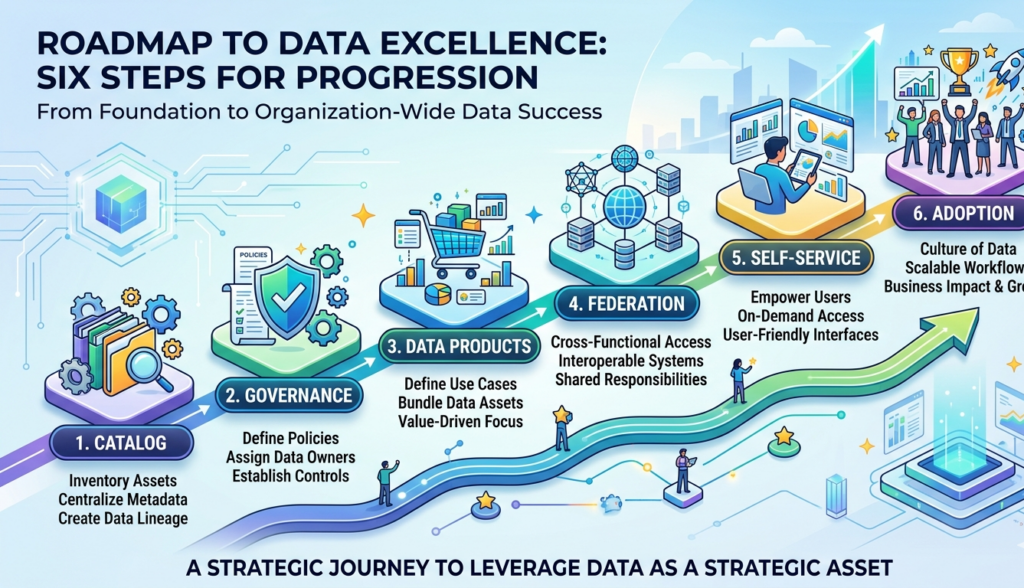
Implementation Roadmap: Building a Data Fabric + Data Mesh Strategy
Step 1: Establish a Data Catalog Foundation
A data catalog is the backbone of both fabric and mesh.
It enables:
- Data discovery
- Metadata management
- Business glossary standardization
- Lineage visibility
Without it, neither architecture can scale effectively.
Step 2: Implement Data Lineage and Governance
Enterprises must ensure:
- End-to-end lineage (column to system level)
- Policy-based access controls
- Auditability for compliance
- Automated governance enforcement
Step 3: Define Data Product Standards
A successful data mesh requires:
- Clear definition of data products
- Metadata standards
- SLAs (quality, freshness, availability)
- Ownership and accountability
Step 4: Build Federated Governance Model
Balance is critical:
- Central team defines policies
- Domains implement and adapt
- Automation ensures enforcement
Step 5: Enable Self-Service Infrastructure
Provide:
- Reusable pipelines
- APIs and connectors
- Scalable cloud platforms
- Developer-friendly tooling
Step 6: Measure Adoption and Trust
Track:
- Data usage metrics
- Time-to-insight
- Data quality scores
- Policy compliance rates
Step-by-Step Implementation Framework
| Step | Capability | Tools/Approach | Outcome |
|---|---|---|---|
| 1 | Data Catalog | Metadata platforms | Visibility |
| 2 | Lineage | Automated tracking | Trust |
| 3 | Data Products | SLA definition | Usability |
| 4 | Governance | Federated model | Compliance |
| 5 | Self-Service | APIs, pipelines | Agility |
| 6 | Measurement | KPIs & metrics | Adoption |
Strategic Insight
Implementation is not a technology rollout—it is an enterprise transformation program.
For deeper implementation insights, explore: Microsoft Fabric AI Solutions for Enterprise Intelligence
Real-World Enterprise Use Cases
Retail: Domain-Driven Customer Intelligence
Retail organizations use:
- Data mesh for domain ownership (marketing, supply chain)
- Data fabric for unified customer insights
Result:
- Personalized experiences
- Real-time inventory optimization
Financial Services: Governance at Scale
Banks adopt:
- Data fabric for compliance and lineage
- Data mesh for product-based data delivery
Result:
- Faster regulatory reporting
- Improved fraud detection
Healthcare: Data Trust and Interoperability
Healthcare systems leverage:
- Data fabric for interoperability across systems
- Data mesh for domain-specific data ownership
Result:
- Better patient outcomes
- AI-driven diagnostics
Enterprise Insight
Across industries, the pattern is consistent:
Fabric ensures trust. Mesh ensures scale.
For enterprise AI transformation examples, refer to: Microsoft Data Fabric vs Traditional Data Warehousing.
Benefits, Risks, and Trade-offs
Benefits of Data Fabric
- Automation at scale
- Unified governance
- Faster integration
- AI readiness
Benefits of Data Mesh
- Scalability through decentralization
- Improved data quality
- Business alignment
- Faster delivery
Risks of Data Fabric
- Over-centralization
- High initial complexity
- Tooling dependency
Risks of Data Mesh
- Governance fragmentation
- Skill gaps in domains
- Organizational resistance
Trade-off Analysis
Enterprises must balance:
- Control vs autonomy
- Standardization vs flexibility
- Speed vs governance
Strategic Insight
The goal is not perfection—but alignment with business priorities and maturity level.
For governance strategies, explore: Designing Scalable Data Architectures for Enterprise Data Platforms
Future Trends: Data Architecture Beyond 2026
1. Rise of Agentic Data Intelligence
AI agents will increasingly:
- Discover data autonomously
- Enforce governance policies
- Generate insights without human intervention
2. Metadata as a Strategic Asset
Metadata will evolve from:
- Passive documentation → Active intelligence layer
3. Data Products as Core Business Assets
Organizations will measure:
- Revenue impact of data products
- Adoption and usage metrics
4. Convergence of Fabric and Mesh
The distinction between Data Fabric vs Data Mesh will blur as:
- Platforms embed both capabilities
- Enterprises adopt unified architectures
Strategic Insight
Future-ready enterprises will not ask:
Fabric or Mesh?
They will ask:
How do we orchestrate both to maximize AI-driven value?
For future-ready strategies, explore: Enterprise AI Strategy in 2026.
How Techment Helps Enterprises
Techment enables enterprises to operationalize Data Fabric vs Data Mesh strategies through a holistic, execution-focused approach.
Strategic Capabilities
Data Modernization
Design and implement scalable architectures across hybrid and multi-cloud environments
AI Readiness
Prepare data ecosystems for AI, ML, and generative AI workloads
Data Governance & Compliance
Implement federated governance models with automated enforcement
Unified Data Platforms
Leverage platforms like Microsoft Fabric to unify analytics and data management
Data Product Operating Model
Define, implement, and scale domain-driven data products
End-to-End Execution
- Strategy and roadmap
- Architecture design
- Implementation and integration
- Optimization and scaling
Techment’s Differentiator
Techment combines:
- Deep technical expertise
- Enterprise strategy alignment
- Proven implementation frameworks
To help organizations: Transform data into a scalable, trusted, and AI-ready strategic asset
Conclusion
The Data Fabric vs Data Mesh conversation is no longer about choosing one over the other—it is about architecting a balanced, future-ready data ecosystem.
Data fabric provides the intelligence, automation, and governance backbone required for modern enterprises. Data mesh delivers the ownership, scalability, and business alignment needed to unlock value from data.
Together, they form the foundation for:
- AI-ready data platforms
- Scalable analytics ecosystems
- Trusted, governed data environments
As enterprises move deeper into AI-driven transformation, the ability to combine these paradigms effectively will define competitive advantage.
Organizations that succeed will not just manage data better—they will operationalize data as a strategic asset.
Techment stands ready to help you navigate this transformation—from strategy to execution to scale.
FAQ Section
1. What is the main difference in Data Fabric vs Data Mesh?
Data fabric is a technology architecture, while data mesh is an organizational and operating model.
2. Can enterprises implement both together?
Yes. Most enterprises adopt a hybrid approach combining automation with domain ownership.
3. Which is better for AI initiatives?
Both are essential—fabric ensures data quality and governance, while mesh ensures context and scalability.
4. How long does implementation take?
Typically 12–24 months, depending on enterprise maturity and scope.
5. What skills are required for data mesh?
Domain expertise, data product thinking, governance knowledge, and platform engineering capabilities.
Related Reads
Unleashing the Power of Data: Building a Winning Data Strategy
Data Quality for AI in 2026: The Ultimate Blueprint
Microsoft Fabric Architecture: CTO’s Guide