

Introduction
Retail has entered an era where customer experience determines competitive survival. Consumers now expect instant responses, personalized interactions, frictionless shopping journeys, and consistent engagement across every channel. Traditional ecommerce systems and rule-based chatbots can no longer meet these rising expectations at enterprise scale.
This is where conversational AI in retail is fundamentally changing the industry.
Modern conversational AI platforms are no longer limited to answering FAQs or routing tickets. Powered by agentic AI, large language models, enterprise data systems, and omnichannel orchestration, conversational AI can now resolve customer issues end-to-end, automate transactional workflows, personalize buying journeys, and generate measurable revenue impact.
According to enterprise CX benchmarks, retailers implementing advanced AI-driven support models are reporting substantial improvements in customer satisfaction, support efficiency, and operational scalability. More importantly, enterprises are discovering that conversational AI is not simply a support technology. It is rapidly becoming a strategic revenue engine.
In this enterprise guide, we explore how conversational AI in retail is transforming customer engagement, sales, support operations, and AI-driven commerce. We also examine architecture considerations, governance requirements, implementation challenges, future trends, and how enterprises can operationalize conversational AI successfully at scale.
TL;DR Summary
- Conversational AI in retail is evolving from chatbot automation into autonomous customer resolution systems.
- Agentic AI enables retailers to automate returns, refunds, order updates, and personalized recommendations.
- Enterprises implementing conversational AI report lower support costs, higher CSAT, and improved customer retention.
- Omnichannel AI experiences across chat, voice, email, and mobile apps are becoming strategic differentiators.
- Data governance, AI readiness, and integration architecture determine long-term AI success.
- Retail leaders adopting enterperises
How Conversational AI in Retail Is Transforming Enterprise Commerce
The retail industry has always evolved alongside customer expectations. The difference today is the speed of that evolution. Digital-native consumers expect real-time interactions across mobile apps, websites, marketplaces, social platforms, and voice channels simultaneously.
Traditional customer service models struggle under this pressure because they rely heavily on manual workflows, fragmented systems, and reactive engagement. Conversational AI changes this operating model entirely.
Unlike legacy chatbots that only retrieve predefined answers, modern conversational AI systems can understand intent, maintain contextual memory, connect to enterprise systems, and execute tasks autonomously. This shift from informational AI to action-oriented AI represents one of the biggest transformations in enterprise retail operations.
From Chatbots to Agentic AI Systems
First-generation retail chatbots focused primarily on FAQ automation. Their capabilities were limited to scripted workflows and static responses. While they reduced some support volume, they often frustrated customers because they lacked contextual understanding and execution capabilities.
Agentic AI introduces a new paradigm.
These systems can:
- Process refunds
- Update shipping addresses
- Recommend products dynamically
- Apply promotions automatically
- Escalate intelligently
- Coordinate workflows across backend systems
The strategic importance of this evolution cannot be overstated. Retail enterprises are increasingly recognizing that AI systems capable of resolving customer issues directly create stronger business outcomes than AI systems that merely provide information.
For organizations building AI-ready digital ecosystems, enterprise data foundations become critical. Techment’s insights on Driving Reliable Enterprise Data and Fabric AI Readiness: How to Prepare Your Data for Scalable AI Adoption provide important guidance for enabling scalable conversational AI architectures.
Why Retail Enterprises Are Accelerating AI Investments
Several macroeconomic and operational factors are accelerating conversational AI adoption:
- Rising customer acquisition costs
- Increasing support volumes
- Omnichannel complexity
- Workforce scalability challenges
- Demand for 24/7 engagement
- Margin pressure in ecommerce
According to industry research from Gartner and McKinsey, enterprises prioritizing AI-driven customer engagement are outperforming competitors in customer retention and operational efficiency.
Conversational AI enables enterprises to simultaneously optimize:
- Customer satisfaction
- Cost efficiency
- Revenue growth
- Agent productivity
- Customer lifetime value
This dual impact on operational efficiency and revenue generation is why conversational AI is increasingly viewed as a board-level transformation initiative rather than a departmental technology upgrade.
Why Agentic AI Matters More Than Traditional Retail Automation
Many retail organizations mistakenly assume all AI systems deliver similar outcomes. In reality, the architectural distinction between reactive automation and agentic AI determines whether AI initiatives produce measurable enterprise value.
The Difference Between Informational AI and Action-Oriented AI
Traditional AI systems respond.
Agentic AI resolves.
This distinction becomes critical in retail environments where friction directly impacts conversion rates and customer loyalty.
For example:
- A traditional chatbot may explain return policies.
- Agentic AI initiates and completes the return automatically.
Similarly:
- Basic AI may provide shipping information.
- Agentic AI updates the order delivery preferences directly.
The enterprise implication is significant. Every additional customer step introduces abandonment risk. AI systems capable of eliminating friction materially improve customer experience and revenue realization.
Conversational AI as a Revenue Engine
Retail leaders increasingly measure conversational AI not by ticket deflection alone, but by its ability to influence revenue outcomes.
Key monetization areas include:
- Personalized upselling
- Cart recovery
- Real-time recommendations
- Dynamic promotions
- Guided product discovery
- Cross-sell optimization
Conversational AI systems now operate as digital sales advisors across the customer lifecycle.
For instance, AI-powered shopping assistants can:
- Recommend complementary products
- Detect buying intent
- Personalize discounts
- Reduce purchase hesitation
- Simplify checkout experiences
This creates measurable improvements in:
- Average order value (AOV)
- Conversion rates
- Repeat purchases
- Retention metrics
Retailers implementing advanced AI engagement models are increasingly integrating conversational AI into broader data modernization initiatives.
For enterprises scaling multiple stores or regions, this unified view becomes critical. As discussed in Techment’s perspective on What a Microsoft Data and AI Partner Brings to Your Data Strategy, strategic data partnerships enable organizations to convert raw information into structured enterprise intelligence.
Traditional Chatbots vs Agentic AI in Retail
Core Differences (Side-by-Side Comparison)
| Capability | Traditional Chatbots | Agentic AI |
|---|---|---|
| Intelligence | Script-based | Context-aware & reasoning-driven |
| Interaction Style | Linear conversations | Dynamic, multi-turn conversations |
| Decision Making | None | Autonomous decision-making |
| Personalization | Basic | Deep personalization |
| Learning Ability | Limited / manual updates | Continuous learning & improvement |
| Use Cases | FAQs, order status | End-to-end customer journeys |
Retail Use Cases
Traditional Chatbots
- Answer product FAQs
- Track orders
- Provide store timings
- Basic customer support
Agentic AI
- Personalized product recommendations
- End-to-end shopping assistance
- Inventory-aware suggestions
- Automated returns & exchanges
- Upselling & cross-selling
- Customer journey orchestration
Personalized Shopping Experiences Powered by Conversational AI
Personalization is no longer a competitive advantage in retail. It is an operational expectation.
Customers increasingly expect:
- Relevant recommendations
- Personalized promotions
- Intelligent product discovery
- Context-aware interactions
- Consistent omnichannel experiences
Conversational AI enables retailers to operationalize personalization at enterprise scale.
AI-Driven Personalization at Scale
Retail enterprises possess massive volumes of customer data:
- Purchase histories
- Browsing behavior
- Loyalty interactions
- Mobile activity
- Customer support conversations
- Product preferences
Conversational AI systems leverage this data to create individualized engagement journeys in real time.
Examples include:
- Personalized product recommendations
- Dynamic pricing offers
- Context-aware promotions
- Behavioral segmentation
- Intent-based marketing
Unlike static personalization engines, conversational AI continuously adapts based on ongoing customer interactions.
This creates more relevant customer journeys while increasing conversion probability.
Omnichannel Personalization Across Customer Touchpoints
Modern retail experiences span:
- Ecommerce websites
- Mobile applications
- Social commerce
- Voice assistants
- Physical stores
- Messaging platforms
Customers expect continuity across all these environments.
Conversational AI enables retailers to maintain contextual consistency across channels, ensuring:
- Persistent customer memory
- Unified interaction history
- Seamless engagement transitions
- Consistent recommendations
For enterprises modernizing customer engagement infrastructure, unified data architecture becomes essential.
Techment’s expertise around Microsoft Fabric Architecture: CTO’s Guide to Modern Analytics & AI and Microsoft Azure for Enterprises: Cloud AI Modernization supports organizations building enterprise-scale conversational AI ecosystems.
Enterprise Benefits of AI-Driven Retail Personalization
| Capability | Business Impact |
|---|---|
| Personalized Recommendations | Higher Conversion Rates |
| Dynamic Promotions | Increased Average Order Value |
| Contextual Engagement | Improved Customer Retention |
| Omnichannel Continuity | Better Customer Experience |
| AI Shopping Assistance | Reduced Cart Abandonment |
Conversational AI in Customer Support and Service Automation
Customer support remains one of the most mature and impactful applications of conversational AI in retail.
Retail enterprises face enormous support complexity driven by:
- Seasonal demand spikes
- Order inquiries
- Refund processing
- Delivery disruptions
- Product availability questions
- Omnichannel interactions
Conversational AI enables enterprises to manage this scale efficiently while improving service quality.
24/7 Intelligent Customer Resolution
Modern consumers expect support availability around the clock.
Conversational AI platforms provide:
- Real-time responses
- Automated ticket handling
- Self-service resolution
- Multilingual support
- Instant escalation when needed
The operational advantage is significant:
- Faster response times
- Lower support costs
- Improved SLA performance
- Increased customer satisfaction
However, the real differentiator lies in autonomous resolution capabilities.
Agentic AI systems can:
- Cancel orders
- Update shipping preferences
- Initiate refunds
- Process exchanges
- Resolve account issues
This removes friction while dramatically reducing human agent workload.
AI-Augmented Human Agents
Contrary to common misconceptions, enterprise conversational AI is not solely about replacing human agents.
Leading enterprises are deploying AI copilots that enhance agent productivity by:
- Summarizing conversations
- Suggesting resolutions
- Surfacing knowledge instantly
- Automating repetitive workflows
- Predicting escalation risks
This hybrid operating model improves:
- First-contact resolution
- Agent efficiency
- Employee satisfaction
- Customer experience consistency
For retailers pursuing digital transformation, integrating Retail Business Intelligence into broader modernization initiatives — similar to strategies outlined in Techment’s blog that explores how AI copilots for enterprises are transforming executive leadership in 2026.
Customer Feedback Intelligence and Sentiment Analytics
Retail enterprises generate enormous volumes of unstructured customer feedback daily.
This includes:
- Reviews
- Survey responses
- Support conversations
- Social media comments
- Chat transcripts
- Voice interactions
Traditionally, analyzing this data at scale was operationally impossible.
Conversational AI fundamentally changes this capability.
Turning Customer Conversations Into Business Intelligence
Modern conversational AI systems analyze:
- Customer sentiment
- Escalation triggers
- Product complaints
- Service friction
- Buying patterns
- Customer intent
This enables enterprises to identify:
- Emerging market trends
- Operational inefficiencies
- Product quality issues
- Experience gaps
- Retention risks
The strategic value extends beyond customer service into:
- Product development
- Inventory planning
- Marketing optimization
- Supply chain forecasting
Real-Time CX Optimization
Advanced conversational AI systems continuously learn from interactions and outcomes.
They can identify:
- Which resolutions work best
- Which workflows create friction
- Which products trigger complaints
- Which experiences improve loyalty
This creates a feedback loop for continuous customer experience optimization.
Enterprises implementing AI-driven customer intelligence initiatives increasingly require strong governance and data quality frameworks.
Retail Business Intelligence is also increasingly embedded within AI initiatives. As outlined in enterprise AI modernization discussions, data quality and architectural maturity directly determine AI success. Retail BI provides that structured foundation.
Building an Enterprise Conversational AI Architecture for Retail
The success of conversational AI in retail depends heavily on the underlying enterprise architecture. Many organizations fail to realize measurable ROI because they deploy isolated chatbot solutions without addressing integration, governance, scalability, and data readiness.
Enterprise conversational AI requires a connected digital ecosystem.
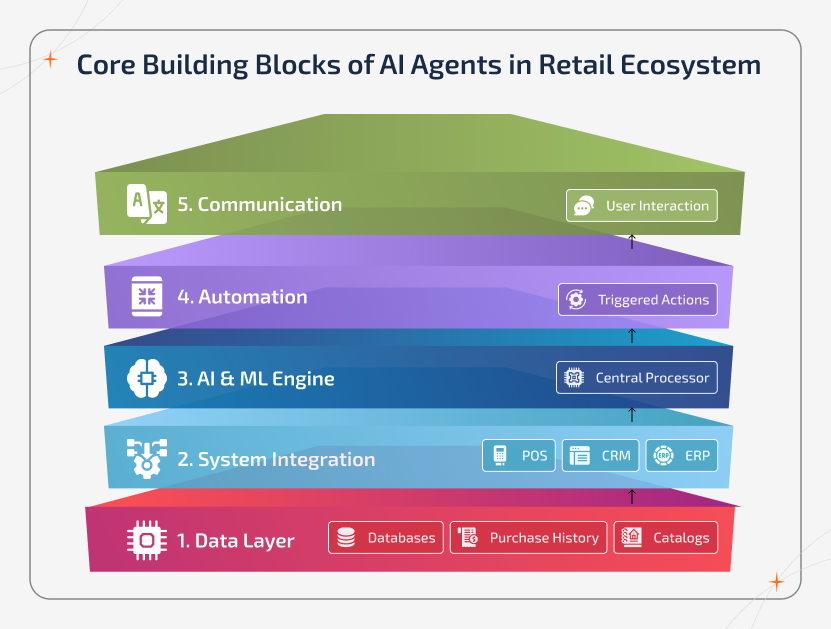
Core Components of a Retail Conversational AI Stack
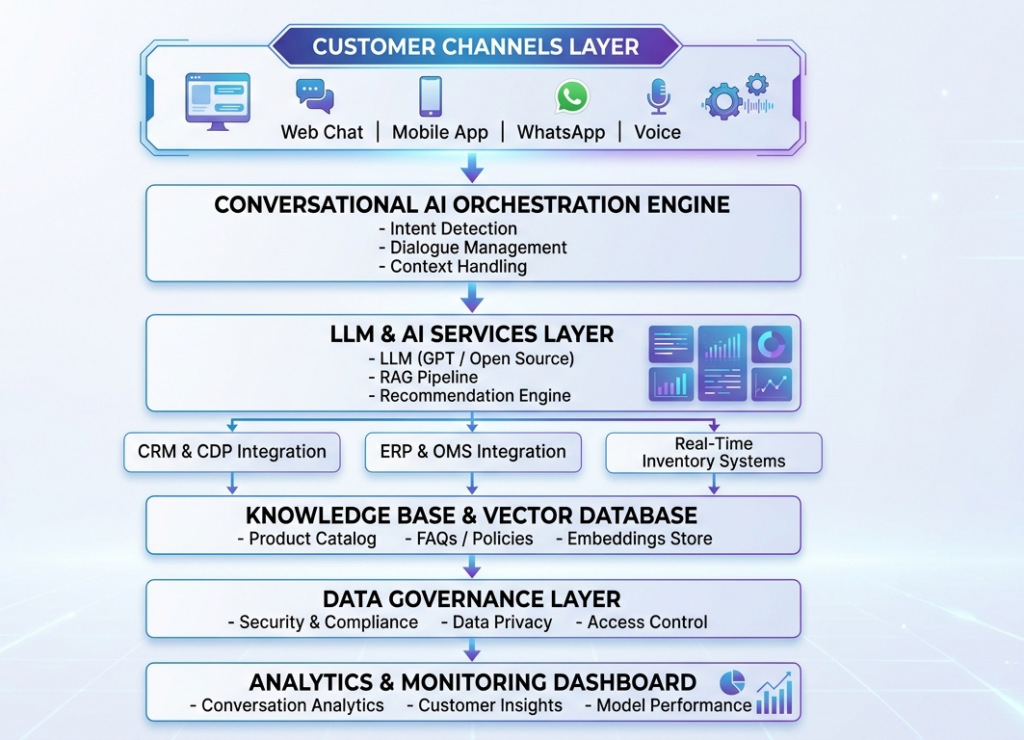
A scalable enterprise conversational AI architecture typically includes:
- Large Language Models (LLMs)
- Customer Data Platforms (CDPs)
- CRM integrations
- Order Management Systems (OMS)
- Inventory systems
- Knowledge repositories
- Real-time analytics engines
- Omnichannel communication layers
- Security and governance controls
The objective is not simply automation. It is intelligent orchestration across customer touchpoints.
Modern conversational AI systems must operate across:
- Chat
- Voice
- SMS
- Mobile apps
- Ecommerce platforms
- Social messaging platforms
This level of orchestration requires unified enterprise data foundations.
Organizations adopting AI-ready architectures are increasingly modernizing their ecosystems using platforms like Microsoft Fabric, Azure AI, and enterprise data fabrics.
Our guide on Retail Business Intelligence: The Comprehensive Enterprise Guide to Strategy, Architecture & Scalable Growth will provide a strategic blueprint for leveraging Retail Business Intelligence as a competitive differentiator.
Why Data Quality Determines AI Success
Conversational AI performance is directly tied to data quality.
Poor-quality enterprise data leads to:
- Inaccurate recommendations
- Faulty resolutions
- Hallucinated AI responses
- Customer frustration
- Compliance risks
This becomes especially problematic in retail environments where:
- Inventory changes rapidly
- Pricing updates continuously
- Customer context evolves dynamically
High-performing AI systems require:
- Real-time synchronization
- Trusted master data
- Governed knowledge repositories
- Structured metadata
- Consistent data pipelines
Retail enterprises investing in conversational AI without modern data governance frameworks often encounter scalability challenges within the first deployment phase.
Learn how Techment build enterprise-grade RAG systems and AI Agents that retrieve, reason, and act on your proprietary knowledge — with governance, observability, and real-time intelligence.
Risks, Governance, and Security Challenges in Conversational AI
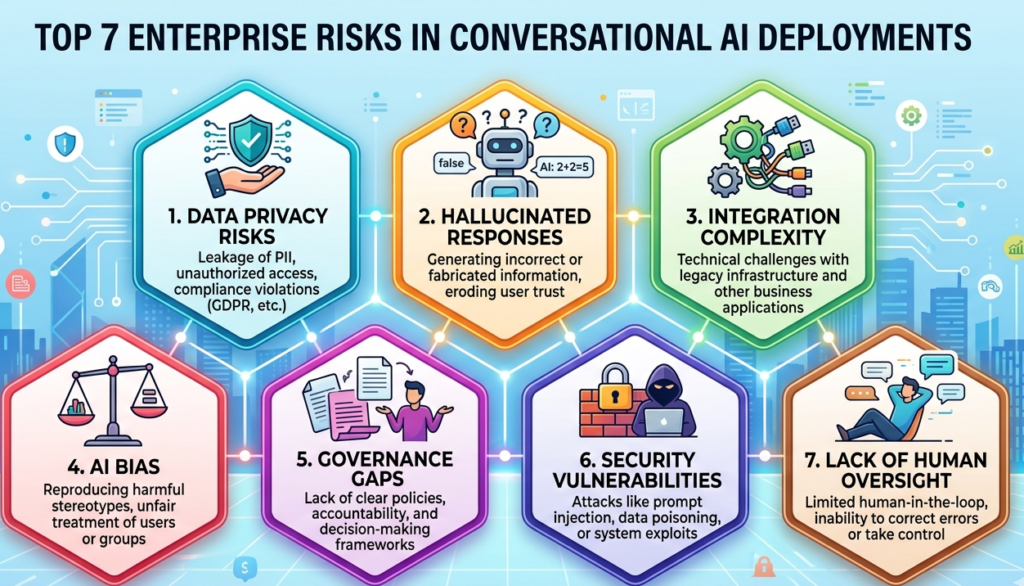
While conversational AI presents enormous opportunities, enterprise adoption also introduces significant operational and governance challenges.
Retail executives increasingly recognize that unmanaged AI deployments can create:
- Brand risk
- Compliance exposure
- Security vulnerabilities
- Data leakage
- Biased recommendations
- Customer trust issues
As conversational AI systems gain autonomous capabilities, governance becomes a strategic priority.
AI Governance in Enterprise Retail
Retail enterprises operate in highly sensitive customer environments involving:
- Payment information
- Purchase history
- Customer identities
- Behavioral data
- Loyalty systems
Conversational AI platforms accessing this data must align with:
- GDPR
- CCPA
- PCI DSS
- Industry-specific compliance standards
Governance frameworks should address:
- Access controls
- AI explainability
- Human oversight
- Audit logging
- Consent management
- Responsible AI policies
Hallucination and Trust Challenges
One of the most discussed enterprise AI risks is hallucination.
In retail environments, hallucinated responses may result in:
- Incorrect promotions
- False inventory availability
- Inaccurate refund information
- Pricing discrepancies
This can directly impact customer trust and operational integrity.
Leading enterprises mitigate these risks through:
- Retrieval-Augmented Generation (RAG)
- Grounded enterprise knowledge systems
- AI guardrails
- Human-in-the-loop escalation
- Continuous monitoring
Techment’s insights around RAG Models – 2026 Enterprise Guide provide practical frameworks for secure AI implementation and governance readiness.
Security and Integration Considerations
Because conversational AI systems integrate deeply into enterprise ecosystems, security architecture becomes critical.
Enterprises must secure:
- APIs
- Customer identity systems
- Transactional workflows
- Third-party integrations
- Data pipelines
- AI inference endpoints
Retail leaders increasingly prefer enterprise-grade AI platforms capable of:
- Role-based governance
- Secure orchestration
- Data residency controls
- Enterprise authentication integration
- Continuous compliance monitoring
Measuring ROI and Business Impact of Conversational AI in Retail
One of the biggest shifts in enterprise AI strategy is the movement away from vanity metrics toward measurable business outcomes.
Retail executives no longer evaluate conversational AI solely by chatbot containment rates.
Instead, they focus on:
- Revenue influence
- Customer lifetime value
- Operational efficiency
- Customer retention
- Cost optimization
- Experience differentiation
Key Metrics Enterprises Should Track
Effective conversational AI programs require multidimensional KPI frameworks.
Critical enterprise metrics include:
Customer Experience Metrics
- CSAT
- NPS
- First Contact Resolution
- Average Resolution Time
Operational Metrics
- Ticket Deflection Rate
- Cost Per Resolution
- Agent Productivity
- Escalation Reduction
Revenue Metrics
- Conversion Rate Improvement
- Cart Recovery
- Upsell Revenue
- Customer Retention
AI Performance Metrics
- Resolution Accuracy
- Intent Recognition Accuracy
- AI Confidence Scores
- Automation Completion Rates
Retail enterprises implementing agentic AI are increasingly reporting:
- Lower service costs
- Faster issue resolution
- Higher customer satisfaction
- Increased purchase conversion
Conversational AI as a Competitive Differentiator
The competitive advantage of conversational AI extends beyond efficiency gains.
Retailers leveraging AI effectively can:
- Deliver hyper-personalized engagement
- Scale customer interactions globally
- Operate continuously
- Reduce operational friction
- Improve customer loyalty
As customer expectations continue evolving, conversational AI is becoming a strategic requirement rather than a digital innovation initiative.
Enterprises that delay adoption risk:
- Higher churn
- Lower digital engagement
- Reduced operational agility
- Competitive displacement
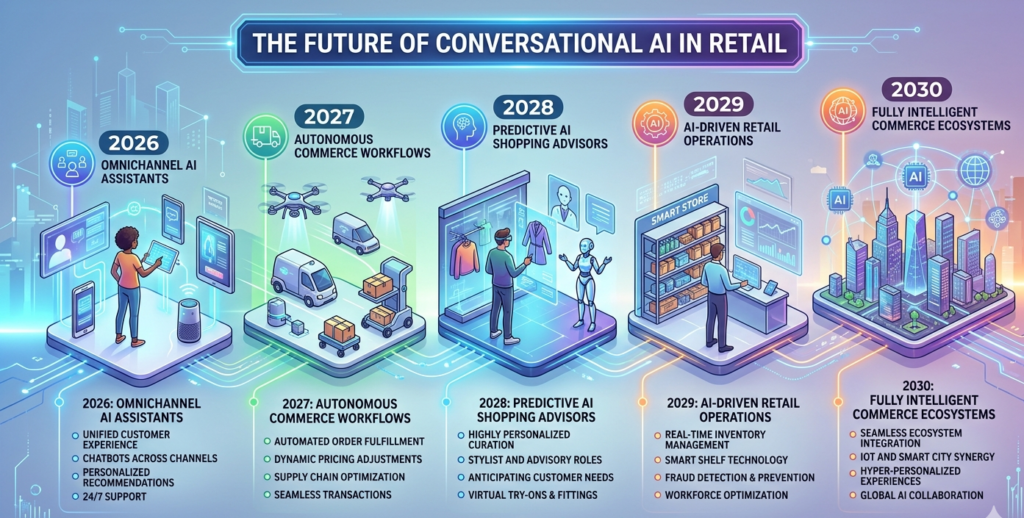
Future Trends Shaping Conversational AI in Retail
Conversational AI is evolving rapidly beyond traditional support automation.
Over the next several years, enterprise retail AI will become:
- More autonomous
- More predictive
- More multimodal
- More context-aware
- More integrated into commerce ecosystems
Multimodal AI Experiences
Future conversational AI systems will combine:
- Text
- Voice
- Images
- Video
- AR/VR interactions
For example:
- Customers may upload images for product recommendations.
- AI assistants may guide visual shopping journeys.
- Voice commerce may integrate seamlessly with ecommerce platforms.
This evolution will reshape customer engagement models entirely.
Autonomous Commerce and AI Agents
Agentic AI will increasingly manage:
- Inventory replenishment
- Dynamic pricing
- Personalized promotions
- Subscription management
- Supply chain coordination
Retail enterprises are moving toward ecosystems where AI systems collaborate autonomously across departments and workflows.
This introduces the concept of:
- AI-powered commerce orchestration
- Autonomous customer journeys
- Self-optimizing retail ecosystems
AI + Data + Cloud Convergence
Conversational AI success increasingly depends on convergence across:
- Cloud modernization
- Real-time analytics
- Enterprise data fabrics
- AI governance
- Intelligent automation
Retailers modernizing these foundations now will be significantly better positioned for future AI adoption.
How Techment Helps Enterprises Build Scalable Conversational AI Solutions
Enterprise conversational AI initiatives require more than AI models. Success depends on architecture, governance, integration, data readiness, and operational alignment.
Techment helps organizations modernize their AI ecosystems through a comprehensive enterprise approach that combines:
- Data modernization
- AI readiness
- Cloud transformation
- Governance frameworks
- Enterprise analytics
- Intelligent automation
Enterprise Conversational AI Enablement
Techment supports enterprises across the entire conversational AI lifecycle, including:
- AI strategy and roadmap development
- Conversational AI architecture design
- Azure AI and Microsoft Fabric implementation
- Data governance and quality modernization
- Omnichannel customer engagement integration
- AI monitoring and optimization
- Responsible AI governance
AI-Ready Data Foundations
Scalable conversational AI depends on trusted enterprise data.
Techment helps organizations:
- Modernize fragmented data environments
- Build AI-ready analytics platforms
- Improve data quality and governance
- Implement enterprise knowledge architectures
- Enable secure AI orchestration
This foundation enables enterprises to operationalize:
- Personalized customer engagement
- AI-powered support automation
- Intelligent analytics
- Predictive retail experiences
Strategic Enterprise Outcomes
Techment’s enterprise-focused approach helps organizations achieve:
- Faster AI adoption
- Reduced operational complexity
- Improved customer satisfaction
- Lower support costs
- Better AI governance
- Scalable intelligencce
Conclusion
Conversational AI in retail is no longer limited to customer support automation. It is becoming a foundational enterprise capability that influences customer experience, operational efficiency, revenue generation, and long-term competitiveness.
The shift from reactive chatbots to agentic AI systems marks a major evolution in retail technology strategy. Enterprises that successfully operationalize conversational AI can create intelligent, scalable, and highly personalized customer experiences across every touchpoint.
However, achieving sustainable success requires more than deploying AI interfaces. Organizations must invest in:
- AI-ready data foundations
- Modern cloud architectures
- Governance frameworks
- Omnichannel integration
- Responsible AI operations
As AI capabilities continue advancing, conversational AI will increasingly power autonomous commerce ecosystems where intelligent systems optimize customer engagement, support operations, and business workflows in real time.
Enterprises that begin building these capabilities now will be better positioned to lead the next generation of intelligent retail transformation.
Techment helps organizations navigate this transformation through enterprise AI strategy, data modernization, Microsoft ecosystem expertise, governance frameworks, and scalable conversational AI implementation services.
FAQ Section
1. What is conversational AI in retail?
Conversational AI in retail refers to AI-powered systems that engage customers through natural language interactions across chat, voice, email, and digital channels to automate support, personalize shopping, and improve customer experience.
2. How is agentic AI different from traditional retail chatbots?
Traditional chatbots primarily provide information. Agentic AI can take action autonomously, including processing refunds, updating orders, applying discounts, and resolving customer issues directly.
3. What are the biggest benefits of conversational AI in retail?
Key benefits include:
Improved customer satisfaction
Reduced support costs
Faster issue resolution
Personalized shopping experiences
Higher customer retention
Increased operational scalability
4. What challenges do enterprises face when implementing conversational AI?
Common challenges include:
Data quality issues
Integration complexity
Governance and compliance risks
AI hallucinations
Security concerns
Change management
5. Why is data governance important for conversational AI?
Conversational AI systems rely heavily on enterprise data. Poor governance can lead to inaccurate responses, security vulnerabilities, compliance violations, and degraded customer experiences.
6. Can conversational AI improve retail revenue?
Yes. Conversational AI improves revenue through:
Personalized recommendations
Cart recovery
Upselling
Faster customer support
Reduced purchase friction
Improved customer loyalty