
LLMOps vs MLOps vs AIOps is one of the most important comparisons enterprise technology leaders must understand as AI adoption expands beyond traditional machine learning into generative AI and intelligent IT operations. While these frameworks share common principles around automation, monitoring, and governance, each addresses a different stage of the enterprise AI lifecycle and serves distinct business objectives.
Introduction
AI initiatives today span far beyond predictive analytics. Enterprises are deploying recommendation engines, AI copilots, intelligent document processing, and self-healing IT systems—all within the same technology landscape. However, building AI solutions is only one part of the journey. The real challenge lies in operationalizing them at scale while ensuring reliability, governance, security, and continuous improvement.
Different AI workloads require different operational approaches. A fraud detection model has different lifecycle requirements than a generative AI chatbot, and both differ significantly from an AI-powered IT monitoring platform. Applying the same operational model across all AI initiatives can lead to inefficiencies, governance gaps, and increased operational risk.
Understanding the roles of LLMOps, MLOps, and AIOps enables enterprises to choose the right framework for each use case, accelerate AI adoption, and establish a scalable foundation for long-term innovation.
TL;DR
- MLOps streamlines the lifecycle of traditional machine learning models, from development to monitoring.
- LLMOps extends MLOps to manage large language models (LLMs), prompt engineering, Retrieval-Augmented Generation (RAG), and AI governance.
- AIOps applies AI to automate IT operations, improving incident detection, root cause analysis, and infrastructure reliability.
- Enterprises rarely need to choose just one. Most organizations benefit from combining these frameworks based on their AI maturity and business goals.
- Selecting the right approach depends on whether you’re building predictive AI, generative AI applications, or intelligent IT operations.
What Are LLMOps, MLOps, and AIOps?
As enterprises operationalize AI at scale, governance and lifecycle management have become as important as model development. According to the National Institute of Standards and Technology, organizations should establish governance, monitoring, and risk management practices throughout the AI lifecycle. This is where operational frameworks such as MLOps, LLMOps, and AIOps become essential. Although they share common principles such as automation, monitoring, and governance, each framework addresses a different stage of enterprise AI operations.
| Framework | Primary Purpose | Best For |
|---|---|---|
| MLOps | Managing the lifecycle of machine learning models | Predictive analytics, forecasting, fraud detection |
| LLMOps | Managing large language models and generative AI applications | AI copilots, chatbots, RAG, enterprise search |
| AIOps | Applying AI to automate IT operations | Infrastructure monitoring, incident management, root cause analysis |
What Is MLOps?
Machine Learning Operations (MLOps) is a set of practices that combines machine learning, software engineering, and DevOps principles to automate the end-to-end lifecycle of machine learning models.
It standardizes activities such as data preparation, model training, deployment, monitoring, and retraining, ensuring that predictive models remain accurate and reliable in production.
Common Enterprise Use Cases
- Demand forecasting
- Customer churn prediction
- Fraud detection
- Predictive maintenance
- Recommendation engines
- Credit risk analysis
MLOps is the foundation for enterprises operationalizing predictive machine learning models.
Read to know more about data engineering from our blog on AI Data Engineering: Building Autonomous Enterprise Data Pipelines for the AI Era
What Is LLMOps?
Large Language Model Operations (LLMOps) extends MLOps principles to support the unique requirements of large language models and generative AI applications.
Unlike traditional ML models, LLMs rely on prompts, external knowledge sources, vector databases, and continuous evaluation of generated responses. LLMOps introduces capabilities such as prompt versioning, Retrieval-Augmented Generation (RAG), guardrails, hallucination detection, and token cost optimization.
Common Enterprise Use Cases
- Enterprise AI assistants
- Customer support chatbots
- Knowledge management
- Intelligent document search
- Contract analysis
- Code generation assistants
LLMOps provides the operational foundation for secure, scalable, and governed generative AI deployments.
What Is AIOps?
Artificial Intelligence for IT Operations (AIOps) applies machine learning and analytics to IT operations, enabling organizations to automate infrastructure monitoring, detect anomalies, correlate events, and accelerate incident resolution.
Rather than managing AI models, AIOps improves the performance and reliability of the systems that run enterprise applications.
Common Enterprise Use Cases
- Infrastructure monitoring
- Application performance management
- Network operations
- Incident management
- Capacity planning
- Automated root cause analysis
AIOps helps IT teams improve operational efficiency and reduce downtime through intelligent automation.
Read insights in our blog on How AI Workflow Automation Is Transforming Enterprises in 2026
LLMOps vs MLOps vs AIOps: Key Differences
While all three frameworks aim to improve operational efficiency, they focus on different workloads, stakeholders, and business outcomes.
| Criteria | MLOps | LLMOps | AIOps |
|---|---|---|---|
| Primary Goal | Operationalize ML models | Operationalize LLMs & Generative AI | Automate IT operations |
| AI Workloads | Predictive models | Foundation models, GenAI | IT infrastructure |
| Primary Users | Data Scientists, ML Engineers | AI Engineers, Platform Teams | IT Operations, SRE, DevOps |
| Data Type | Structured & Semi-structured | Text, documents, knowledge bases | Logs, metrics, events |
| Core Components | Training pipelines, feature stores, model registry | Prompt management, RAG, vector databases, guardrails | Event correlation, anomaly detection, automation |
| Monitoring Focus | Model performance & drift | Response quality, hallucinations, token usage | Infrastructure health & incidents |
| Governance | Model lifecycle governance | Responsible AI, compliance, prompt governance | IT service governance |
| Business Outcome | Better predictions | Smarter AI experiences | Higher operational resilience |
When Should Enterprises Choose MLOps?
If your organization builds predictive machine learning models using structured data, MLOps provides the operational framework to automate model training, deployment, monitoring, and retraining. It enables scalable, governed ML workflows while improving collaboration between data science and engineering teams. However, MLOps is not designed to manage generative AI workloads such as prompt engineering, RAG pipelines, or LLM evaluation.
| Aspect | MLOps |
|---|---|
| Choose When | Building and operating predictive ML models at scale |
| Ideal Use Cases | Demand forecasting, fraud detection, predictive maintenance, customer churn prediction, recommendation engines, risk & credit scoring |
| Business Benefits | Faster deployment, automated retraining, continuous monitoring, improved collaboration, stronger governance |
| Limitations | Doesn’t support prompt management, RAG, hallucination detection, or token optimization |
| Key Takeaway | Best choice for traditional machine learning and predictive analytics initiatives. |
When Should Enterprises Choose LLMOps?
Choose LLMOps when your enterprise is deploying generative AI applications powered by large language models. Unlike traditional ML, LLM-based applications require prompt management, Retrieval-Augmented Generation (RAG), vector databases, AI guardrails, response evaluation, and token cost optimization. LLMOps provides the governance, observability, and operational controls needed to run GenAI applications reliably in production.
| Aspect | LLMOps |
|---|---|
| Choose When | Deploying enterprise generative AI and LLM applications |
| Ideal Use Cases | AI copilots, customer support assistants, knowledge search, document processing, contract analysis, code assistants, conversational AI |
| Business Benefits | Faster GenAI deployment, higher response accuracy, reduced hallucinations, governance, lower inference costs, continuous optimization |
| Best Practices | Use RAG with enterprise data, monitor response quality, implement AI guardrails, optimize token usage |
| Key Takeaway | Essential for operationalizing enterprise GenAI applications safely, efficiently, and at scale. |
When Should Enterprises Choose AIOps?
Choose AIOps when your goal is to optimize IT operations using AI, rather than manage AI models. AIOps analyzes logs, metrics, and events to detect anomalies, identify root causes, automate incident response, and improve infrastructure reliability across complex IT environments.
| Aspect | AIOps |
|---|---|
| Choose When | Modernizing IT operations through AI-driven automation |
| Ideal Use Cases | Infrastructure monitoring, application performance management, network operations, incident management, capacity planning, SRE, hybrid & multi-cloud environments |
| Business Benefits | Reduced MTTR, fewer false alerts, faster root cause analysis, higher availability, lower operational costs, improved user experience |
| Best Practices | Consolidate telemetry, integrate with ITSM, continuously refine anomaly detection models |
| Key Takeaway | Ideal for proactive IT operations, infrastructure monitoring, and automated incident management. |
Can Enterprises Use All Three Together?
Yes. In fact, most large enterprises benefit from using MLOps, LLMOps, and AIOps together as part of a unified AI operating model.
Each framework addresses a different layer of enterprise AI:
| Framework | Enterprise Role |
|---|---|
| MLOps | Operationalizes predictive machine learning models |
| LLMOps | Manages generative AI applications and foundation models |
| AIOps | Optimizes IT infrastructure and operations using AI |
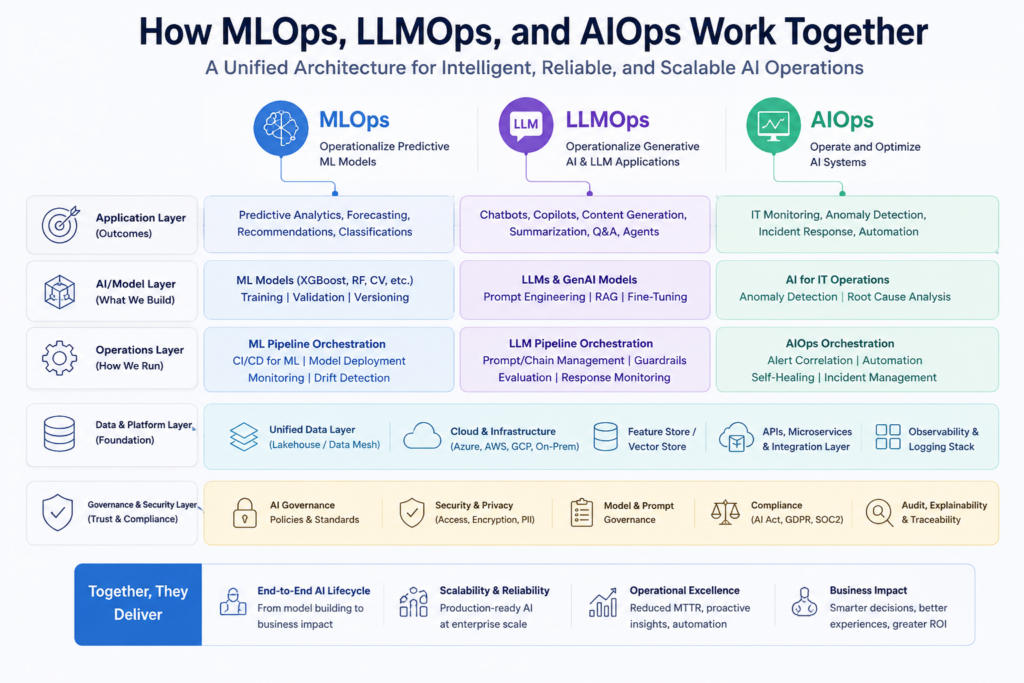
For example:
- A retailer uses MLOps to forecast inventory demand.
- The same organization deploys an AI shopping assistant using LLMOps.
- Its IT operations team relies on AIOps to monitor cloud infrastructure and automate incident response.
Together, these frameworks create a scalable and resilient AI ecosystem.
Explore in our webinar on AI Copilots & The Decision Intelligence Gap where experts discuss on how more data often leads to slower decisions.
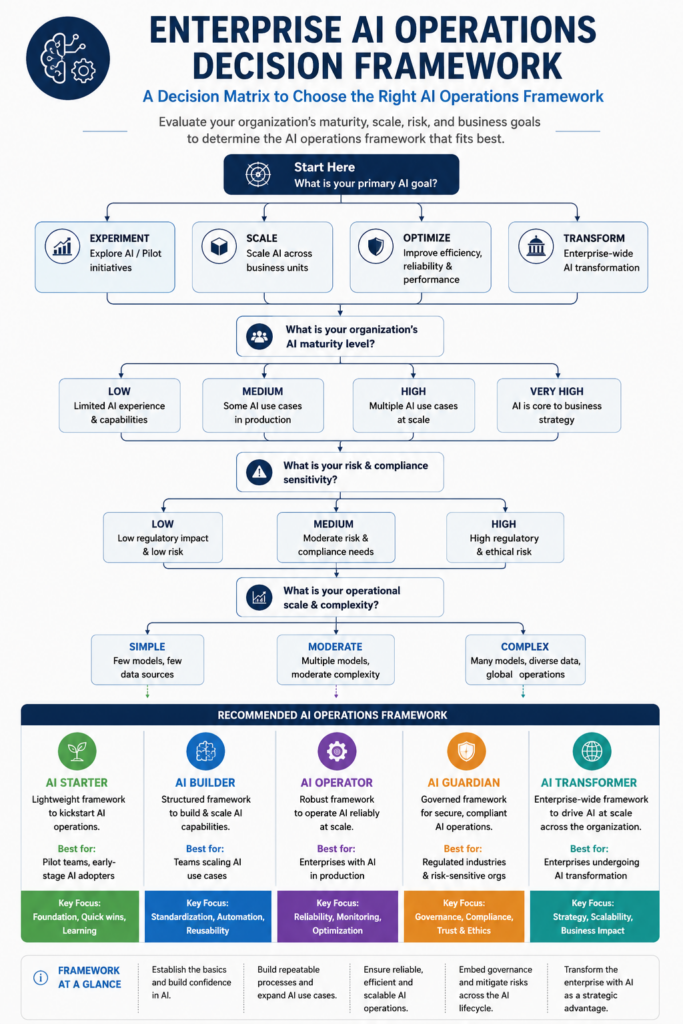
Enterprise Decision Framework
Selecting the right framework depends on the business problem you’re solving rather than the technology itself.
| Business Objective | Recommended Framework | Why |
|---|---|---|
| Forecast demand | MLOps | Manages predictive models efficiently |
| Detect fraud | MLOps | Supports continuous model monitoring and retraining |
| Build an AI copilot | LLMOps | Handles prompts, RAG, and LLM governance |
| Enterprise knowledge search | LLMOps | Optimizes retrieval and response quality |
| Reduce IT downtime | AIOps | Automates monitoring and incident resolution |
| Improve infrastructure reliability | AIOps | Uses AI for anomaly detection and root cause analysis |
| Enterprise-wide AI transformation | MLOps + LLMOps + AIOps | Supports predictive AI, generative AI, and intelligent operations |
Best Practices for Enterprise AI Operations
Regardless of the framework you adopt, these practices are critical for long-term success:
- Establish governance and compliance from the outset.
- Automate deployment, monitoring, and lifecycle management.
- Measure both technical performance and business impact.
- Implement continuous monitoring to detect model or system degradation early.
- Prioritize data quality and observability across AI workflows.
- Optimize operational costs through efficient resource utilization.
- Embed security and responsible AI principles into every stage of the lifecycle.
- Design architectures that can scale with evolving business needs.
Successful AI operations are built on automation, governance, observability, and continuous improvement—not on a single framework alone.
Conclusion
As enterprise AI ecosystems become more sophisticated, choosing the right operational framework is no longer about selecting a single solution—it’s about aligning AI operations with business outcomes.
- Choose MLOps to operationalize predictive machine learning models and automate their lifecycle.
- Choose LLMOps to deploy, monitor, and govern generative AI applications built on large language models.
- Choose AIOps to enhance IT operations through AI-driven monitoring, incident management, and automation.
For many organizations, the future lies in combining all three. By integrating predictive AI, generative AI, and intelligent IT operations under a unified governance model, enterprises can accelerate innovation, improve operational resilience, and maximize the value of their AI investments.
Frequently Asked Questions
1. Is LLMOps replacing MLOps?
No. LLMOps complements rather than replaces MLOps. MLOps manages the lifecycle of traditional machine learning models, while LLMOps addresses the unique operational requirements of large language models, including prompt management, Retrieval-Augmented Generation (RAG), model evaluation, and AI safety. Enterprises deploying both predictive and generative AI typically implement both frameworks.
2. Can MLOps manage large language models?
MLOps provides foundational capabilities such as CI/CD, model versioning, and monitoring, but it does not natively support prompt engineering, vector databases, token optimization, or hallucination detection. These capabilities are central to LLMOps.
3. What is the difference between LLMOps and AIOps?
LLMOps focuses on operating generative AI applications powered by large language models. AIOps applies AI to IT operations by analyzing logs, metrics, and events to automate incident detection, root cause analysis, and infrastructure management. One manages AI applications; the other improves IT operation
4. Do enterprises need both MLOps and LLMOps?
Yes, if they use both predictive AI and generative AI. For example, a financial institution may use MLOps for fraud detection models while leveraging LLMOps to power customer service assistants and internal knowledge copilots.
5. Where does Retrieval-Augmented Generation (RAG) fit?
RAG is a core capability of LLMOps. It enhances large language models by retrieving relevant enterprise knowledge at runtime, improving response accuracy, reducing hallucinations, and enabling access to up-to-date information.
6. Which framework delivers the fastest ROI?
The answer depends on your business objectives:
MLOps: Delivers value through automation and operational efficiency for predictive AI.
LLMOps: Accelerates productivity with enterprise copilots, intelligent search, and customer service automation.
AIOps: Improves IT reliability by reducing downtime and automating operational workflows.
Organizations often realize the greatest long-term ROI by integrating these frameworks into a unified AI operating model.
7. What are the key challenges of implementing LLMOps?
Common challenges include:
Managing prompt versions and experiments
Evaluating response quality
Controlling inference costs
Preventing hallucinations
Implementing AI guardrails
Governing enterprise knowledge used in RAG pipelines
A structured LLMOps strategy helps address these challenges through standardized processes and observability.
8. How should enterprises get started?
Start with the framework that aligns with your immediate business priorities:
Predictive analytics: Adopt MLOps.
Generative AI applications: Implement LLMOps.
IT modernization: Invest in AIOps.
As AI adoption matures, unify governance, monitoring, and automation across all AI initiatives.