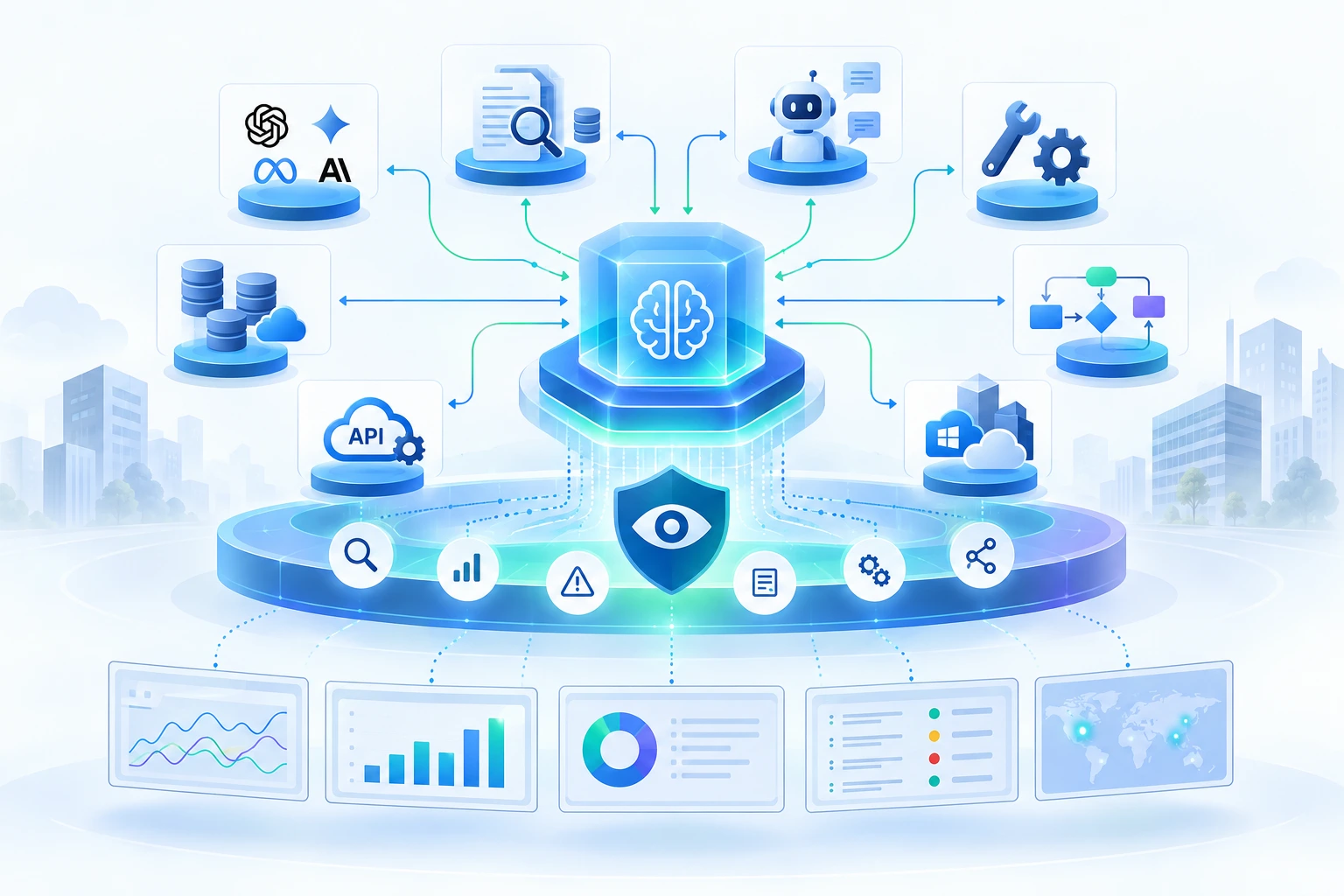

Introduction
Insurance leaders are facing a fundamental shift. Rising customer expectations, volatile risk environments, and increasing regulatory complexity are forcing insurers to rethink how they operate. In this context, insurance data analytics has emerged as a critical lever for competitive differentiation.
Forward-looking insurers are no longer relying on static actuarial models or fragmented reporting systems. Instead, they are building real-time, intelligence-driven ecosystems where data informs every decision—from underwriting and claims to pricing and customer engagement.
According to McKinsey, insurers leveraging advanced analytics have achieved up to a 25% improvement in profitability, highlighting the tangible business impact of this transformation.
But unlocking this value requires more than deploying tools. It demands a strategic data foundation, modern architecture, governance discipline, and organizational alignment.
This blog provides a comprehensive, enterprise-focused blueprint for insurance data analytics in 2026, covering infrastructure, use cases, implementation strategies, and future trends that every CTO, CDO, and data leader must understand.
TL;DR Summary
- Insurance data analytics is now a core strategic capability, not a support function
- Advanced analytics improves profitability by up to 25% (McKinsey)
- Key use cases include underwriting, fraud detection, pricing, and customer retention
- Modern infrastructure requires unified data platforms, governance, and AI integration
- Legacy systems and data silos remain the biggest barriers to transformation
- Enterprises must shift from reporting to real-time, decision-centric analytics ecosystems
Why Insurance Data Analytics Is a Strategic Imperative in 2026
In 2026, insurance data analytics is no longer optional—it is foundational to survival and growth.
From Historical Reporting to Real-Time Intelligence
Traditional insurance systems were built for backward-looking analysis. Reports summarized what happened—but offered limited insight into what will happen next.
Modern insurance analytics shifts this paradigm:
- Descriptive → Predictive → Prescriptive analytics
- Real-time decision-making across operations
- Continuous risk assessment instead of static evaluation
Get a clear, enterprise-grade comparison of agentic vs copilot AI, grounded in process maturity, risk tolerance, and operational readiness.
Market Forces Driving Adoption
Several structural shifts are accelerating adoption:
- Customer expectations: Personalized, digital-first experiences
- Risk complexity: Climate events, cyber threats, and behavioral risks
- Regulatory pressure: Data transparency and compliance mandates
- Competitive intensity: InsurTechs redefining agility and innovation
According to Deloitte, insurers increasingly view analytics and data management as critical to maintaining competitiveness, with industry research showing widespread recognition that advanced analytics drive differentiation, innovation, and growth.
For enterprise leaders, the implication is clear:
Insurance data analytics is not a technology initiative—it is a business transformation strategy.
Organizations that treat analytics as a standalone function will struggle. Those that embed it into core operations will redefine market leadership.
For insurers exploring broader modernization, aligning AI agents with an enterprise data strategy is critical — as discussed in Enterprise AI strartegy 2026.
Understanding Insurance Data Analytics Infrastructure
A high-performing insurance analytics capability is built on a robust, scalable, and governed data infrastructure.
What Defines Insurance Data Analytics?
Insurance data analytics refers to the systematic use of data to:
- Assess and price risk
- Detect fraud and anomalies
- Optimize claims processing
- Enhance customer engagement
- Improve operational efficiency
It integrates structured and unstructured data sources, including:
- Policy and claims data
- Telematics and IoT signals
- Third-party datasets
- Customer interaction data
For enterprise leaders, understanding what is Agentic AI is no longer optional. Read our enterprise guide on Agentic AI and its comprehensive overview.
The Shift Toward Unified Data Platforms
Legacy architectures often create fragmented data environments. Claims, underwriting, and customer systems operate in silos—limiting insight generation.
These platforms enable:
- Centralized data access
- Real-time analytics processing
- Seamless integration across functions
- AI-ready data environments
Key Architectural Characteristics
A modern insurance analytics infrastructure must deliver:
- Scalability – Handle exponential growth in data volumes from IoT, digital channels, and external sources
- Interoperability – Integrate across legacy systems, cloud platforms, and third-party ecosystems
- Real-Time Processing – Support streaming data and instant decision-making
- Governance & Security – Ensure compliance with regulations like GDPR and industry standards
Without a strong infrastructure foundation, even the most advanced analytics models will fail to deliver value.
Read further on how to transform your data migration into a catalyst for AI-driven growth with our data migration services.
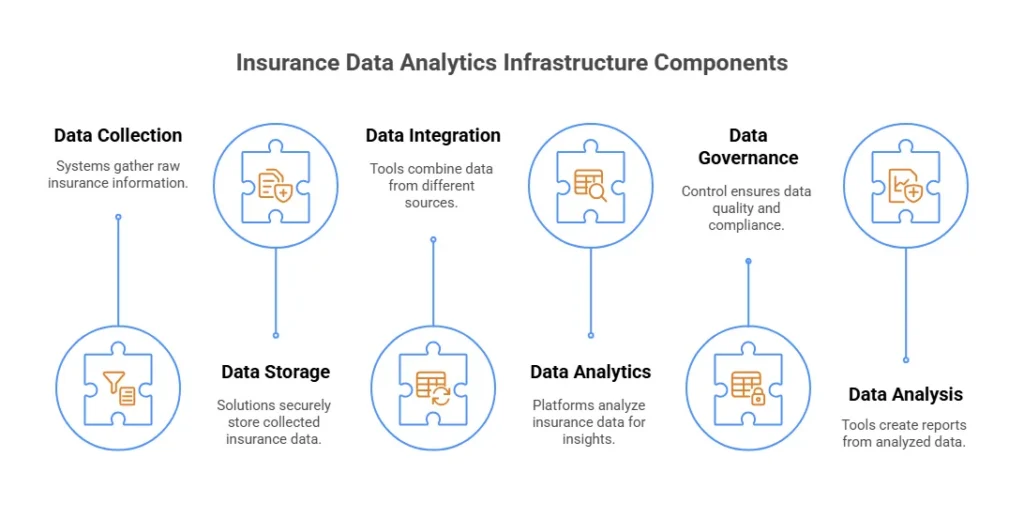
Core Components of Insurance Data Analytics Infrastructure
Building a scalable insurance data analytics ecosystem requires multiple interconnected layers.
Data Collection and Ingestion Systems
Insurance organizations rely on diverse data sources:
- Customer applications and interactions
- Claims records and documentation
- IoT devices (vehicles, homes, wearables)
- External datasets (credit scores, weather data)
Modern ingestion pipelines must support:
- Batch and real-time ingestion
- API-driven integrations
- Event streaming architectures
Data Storage and Processing Layers
The storage strategy defines scalability and performance.
Cloud-based storage enables:
- Elastic scalability
- Cost efficiency
- Faster deployment
Hybrid architectures are often used where compliance demands on-premise controls.
Leading enterprises are transitioning from data warehouses to lakehouse architectures, enabling unified storage and analytics.
This evolution is detailed in Techment’s comparison of data fabric vs traditional data warehousing .
Explore how AI agents in insurance workflows transform enterprise operations — architecturally, operationally, and strategically.
Data Integration and Transformation
Insurance data is inherently fragmented. Integration tools are essential for:
- Data cleansing and normalization
- Eliminating inconsistencies
- Creating a unified data model
ETL/ELT pipelines and data transformation frameworks play a critical role in ensuring analytics-ready datasets.
Analytics and AI Platforms
This is where value is generated.
Key capabilities include:
- Predictive modeling
- Machine learning algorithms
- AI-driven automation
- Natural language processing
These technologies enable:
- Risk prediction
- Fraud detection
- Customer segmentation
- Automated decision-making
Business Intelligence and Visualization
Analytics must be accessible to business users.
Modern BI tools provide:
- Interactive dashboards
- Real-time insights
- Self-service analytics
This aligns with enterprise trends in data democratization, enabling decision-making across functions.
Data Governance and Quality Frameworks
No analytics initiative succeeds without trust in data.
Strong governance ensures:
- Data accuracy and consistency
- Regulatory compliance
- Security and access control
To understand how governance frameworks reduce enterprise risk, explore our article on building an enterprise data governance operating model- Data Governance For Data Quality
High-Impact Use Cases of Insurance Data Analytics
Insurance data analytics delivers value across the entire value chain.
Underwriting and Risk Assessment Transformation
Traditional underwriting relied heavily on historical data and manual judgment.
Modern analytics enables:
- Real-time risk scoring
- Multi-variable risk modeling
- Continuous risk monitoring
Machine learning models can process thousands of variables simultaneously, improving prediction accuracy by up to 20%.
This shift transforms underwriting into a data-driven, automated decision engine.
Claims Management and Fraud Detection
Fraud remains a major cost driver in insurance.
Advanced analytics enables:
- Real-time anomaly detection
- Pattern recognition across claims
- Network analysis for fraud rings
Natural language processing extracts insights from unstructured data such as:
- Claims documents
- Adjuster notes
- Customer communications
The result:
- Faster claims processing
- Reduced fraud losses
- Improved customer satisfaction
Customer Acquisition and Retention
Customer expectations are evolving rapidly.
Insurance data analytics enables:
- Hyper-personalized offerings
- Predictive churn modeling
- Customer lifetime value analysis
Insurers can identify at-risk customers 60–90 days before churn, enabling proactive retention strategies.
Pricing Optimization
Pricing is a critical lever for profitability.
Analytics enables:
- Dynamic pricing models
- Microsegmentation
- Price elasticity analysis
This allows insurers to balance:
- Competitiveness
- Profitability
- Risk exposure
These use cases demonstrate a fundamental shift:
Insurance analytics is moving from supporting decisions to automating decisions.
Why a Strong Insurance Analytics Infrastructure Drives Competitive Advantage
The value of insurance data analytics is not theoretical—it delivers measurable business outcomes.
Operational Efficiency at Scale
Automation reduces:
- Manual processing
- Errors
- Processing time
This leads to:
- Faster claims resolution
- Reduced operational costs
- Improved productivity
Enhanced Customer Experience
Personalization is no longer optional.
Analytics enables:
- Tailored policies
- Proactive engagement
- Seamless digital experiences
Advanced Risk Management
Better data leads to better risk models.
Insurers can:
- Predict risks more accurately
- Adjust pricing dynamically
- Mitigate losses proactively
Competitive Differentiation
Leading insurers like Progressive have demonstrated how analytics can redefine:
- Pricing strategies
- Claims processing
- Customer engagement
Executive Takeaway
Insurance data analytics is not just about efficiency—it is about strategic differentiation in a data-driven market.
Step-by-Step Framework to Build a Scalable Insurance Data Analytics Platform
Modernizing insurance data analytics is not a one-time implementation—it is a structured transformation journey.
Step 1: Assess the Current Data Ecosystem
Most insurers operate in fragmented environments:
- Policy systems disconnected from claims platforms
- Legacy underwriting tools
- Siloed customer data
A comprehensive assessment should evaluate:
- Data sources and ownership
- Data quality and consistency
- Integration gaps
- Analytics maturity
Step 2: Design a Future-Ready Data Architecture
The next step is defining a modern architecture that supports scalability and AI readiness.
Key architectural layers include:
- Data ingestion (batch + real-time)
- Unified storage (lakehouse/data fabric)
- Transformation pipelines
- Analytics and AI layer
- Governance and security
Enterprise Insight:
Organizations adopting unified platforms such as Microsoft Fabric significantly reduce data latency and integration complexity.
Step 3: Implement Data Governance and Quality Controls
Data is only as valuable as it is trustworthy.
Key governance priorities:
- Data ownership and stewardship
- Metadata management
- Data lineage tracking
- Compliance enforcement
Techment highlights this in data governance for enterprise data quality , where governance is positioned as a business enabler—not just compliance overhead.
Step 4: Deploy Advanced Analytics and AI Models
Once the data foundation is established, organizations can deploy:
- Predictive models for risk scoring
- AI models for fraud detection
- NLP for document processing
- Recommendation engines for personalization
The shift here is critical:
From dashboards → to decision automation systems
Step 5: Enable Business Adoption and Data Culture
Technology alone does not deliver transformation.
Organizations must:
- Train business teams on analytics usage
- Embed analytics into workflows
- Align incentives with data-driven decisions
This aligns with Techment’s insights on AI adoption challenges in enterprises , where cultural barriers are often the biggest bottleneck.
Key Challenges in Insurance Data Analytics Transformation
Despite its potential, implementing insurance data analytics comes with significant challenges.
1. Data Quality and Fragmentation
Insurance data is:
- Inconsistent
- Incomplete
- Distributed across systems
Poor data quality leads to:
- Inaccurate models
- Faulty decisions
- Loss of trust
2. Legacy Systems and Technical Debt
Many insurers still rely on decades-old systems.
These systems:
- Cannot handle large-scale data
- Lack integration capabilities
- Increase operational complexity
Modernization is essential but complex.
3. Talent and Skill Gaps
Advanced analytics requires:
- Data engineers
- Data scientists
- AI specialists
- Domain experts
The shortage of these skills slows adoption.
4. Data Security and Compliance Risks
Insurance data includes highly sensitive information.
Organizations must ensure:
- Encryption and access control
- Regulatory compliance (GDPR, HIPAA)
- Auditability
5. Organizational Resistance
Change management remains a critical barrier.
Common issues include:
- Resistance to automation
- Lack of trust in AI
- Siloed decision-making

Traditional vs Modern Insurance Analytics
| Capability | Traditional Insurance Analytics | Modern Insurance Data Analytics |
| Data Processing | Batch-based | Real-time + streaming |
| Data Sources | Limited internal data | Multi-source + IoT + external |
| Decision Making | Manual, delayed | Automated, real-time |
| Risk Assessment | Static models | Dynamic, AI-driven |
| Fraud Detection | Reactive | Predictive and proactive |
| Customer Insights | Generic segmentation | Hyper-personalized |
| Infrastructure | Siloed systems | Unified data platforms |
The shift is not incremental—it is a complete operating model transformation.
Emerging Trends Shaping Insurance Data Analytics in 2026
The next wave of innovation is redefining how insurers leverage data.
1. Real-Time Analytics and Event-Driven Architecture
Insurers are moving toward:
- Instant claims processing
- Real-time risk scoring
- Event-based decision triggers
2. AI-Powered Underwriting
AI models now:
- Analyze behavioral data
- Integrate external datasets
- Continuously update risk profiles
3. Embedded Insurance Ecosystems
Insurance is becoming integrated into:
- Mobility platforms
- E-commerce ecosystems
- Financial services
Analytics enables seamless integration and pricing.
4. Data Fabric and Unified Platforms
Organizations are adopting data fabric architectures to:
- Eliminate silos
- Enable cross-domain analytics
- Improve governance
This is explored in Techment’s insights on modern data platforms and analytics ecosystems .
5. Ethical AI and Explainability
Regulators are increasingly focusing on:
- Model transparency
- Bias detection
- Ethical AI usage
Insurers must ensure explainable models.
Insurance Data Analytics Use Case Impact
| Use Case | Business Impact | KPI Improvement |
| Underwriting | Better risk selection | +20% accuracy |
| Fraud Detection | Reduced fraud losses | +80% detection improvement |
| Claims Processing | Faster settlements | -50% processing time |
| Customer Retention | Reduced churn | +25% retention |
| Pricing Optimization | Increased profitability | +2–3% premium optimization |
How Techment Helps Enterprises Transform Insurance Data Analytics
Techment partners with enterprises to build end-to-end insurance data analytics ecosystems that deliver measurable business outcomes.
Strategic Capabilities
1. Data Modernization & Platform Engineering
Techment enables insurers to transition from legacy systems to modern architectures using platforms like Microsoft Fabric.
2. AI-Driven Analytics Implementation
From predictive modeling to intelligent automation, Techment helps embed analytics into business workflows.
3. Data Governance and Quality Frameworks
Ensuring data reliability through quality frameworks
4. Unified Analytics and BI Solutions
Empowering decision-makers with real-time insights using modern BI tools.
5. End-to-End Transformation Approach
Techment supports:
- Strategy and roadmap
- Architecture design
- Implementation
- Optimization
This aligns with its broader expertise in enterprise AI and analytics transformation .
Conclusion
Insurance is undergoing a structural transformation—and insurance data analytics is at the center of it.
Organizations that successfully build modern analytics ecosystems will:
- Improve operational efficiency
- Enhance customer experience
- Optimize risk and pricing
- Gain sustainable competitive advantage
However, success requires more than tools. It demands:
- A strong data foundation
- Scalable architecture
- Governance discipline
- Organizational alignment
As insurers navigate this transformation, partnering with experienced data and AI leaders like Techment can accelerate outcomes and reduce risk.
The future of insurance belongs to organizations that can turn data into real-time, intelligent decisions at scale.
FAQ Section
1. What is insurance data analytics?
Insurance data analytics involves using data to improve risk assessment, pricing, claims processing, and customer engagement.
2. Why is insurance data analytics important in 2026?
It enables real-time decision-making, improves profitability, and enhances customer experience in a highly competitive market.
3. What are the biggest challenges in implementation?
Data quality issues, legacy systems, skill gaps, and organizational resistance.
4. How does AI impact insurance analytics?
AI enables predictive modeling, automation, fraud detection, and personalized customer experiences.
5. What is the future of insurance analytics?
The future lies in real-time analytics, unified data platforms, and AI-driven decision automation.
Related Reads
- Microsoft Fabric Architecture: A CTO’s Guide to Modern Analytics & AI
- Fabric AI Readiness: How to Prepare Your Data for Scalable AI Adoption
- Data Quality for AI in 2026: The Ultimate Enterprise Guide
- Enterprise AI Strategy in 2026: What Leaders Must Get Right
- How to Assess Data Quality Maturity: Your Enterprise Roadmap
- Data Migration
- Data Transformation
- Data Pipeline Engineering
- Data Cleansing & Cataloging
- Data Governance & Quality
- Visualization and Analytics