RAG vs Fine-Tuning vs AI Agents is a critical decision for enterprises building AI systems that need reliable knowledge, specialized behavior, or autonomous workflow execution. While RAG connects large language models to current enterprise information, fine-tuning improves task-specific model behavior, and AI agents enable multi-step actions across business systems.
The right approach depends on what your AI system needs to know, how it needs to behave, and what it needs to do. For most enterprises, the decision should be driven by knowledge freshness, task complexity, data governance, workflow requirements, accuracy, security, and total cost of ownership—not by the complexity of the technology itself..
TL;DR: RAG vs Fine-Tuning vs AI Agents
If you need a quick decision, use this framework:
- Choose RAG when your AI needs access to current, private, or frequently changing information.
- Choose fine-tuning when you need consistent model behavior, specialized task performance, terminology, tone, or structured outputs.
- Choose AI agents when the system must perform multi-step reasoning, call tools or APIs, make decisions, and execute actions.
- Choose RAG + fine-tuning when you need both current enterprise knowledge and consistent specialized behavior.
- Add AI agents when the workflow requires the system to act across enterprise applications rather than simply provide an answer.
The simplest rule
RAG solves a knowledge problem. Fine-tuning solves a behavior problem. AI agents solve an action problem.
Which AI architecture should you choose?
Need current enterprise knowledge? → RAG
Need consistent behavior or output format? → Fine-tuning
Need multi-step workflow execution? → AI agents
Need current knowledge plus specialized behavior? → RAG + fine-tuning
Need knowledge, specialized behavior, and workflow execution? → RAG + fine-tuning + agents
RAG vs Fine-Tuning vs AI Agents: What Is the Difference?
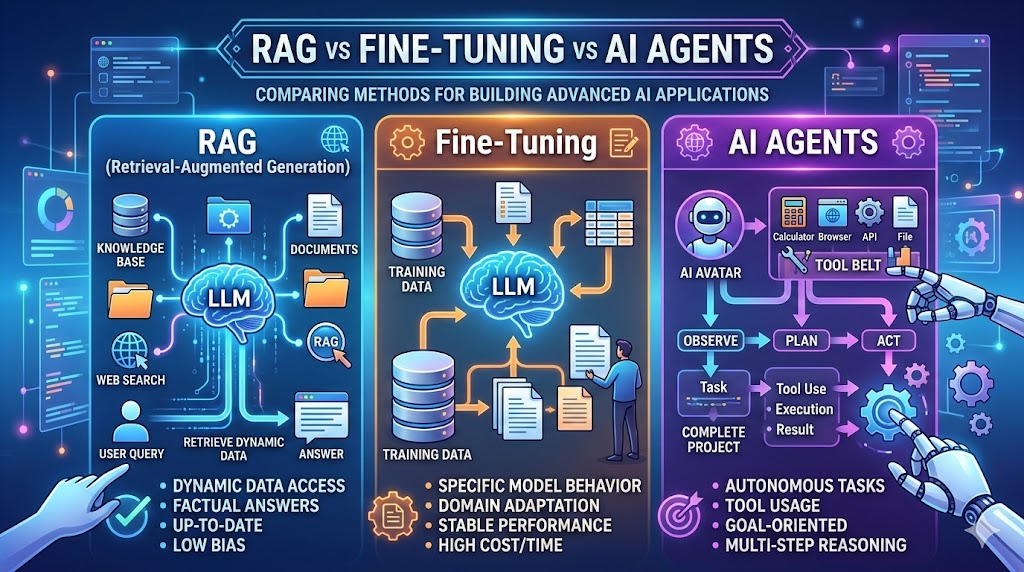
RAG, fine-tuning, and AI agents solve different enterprise AI problems. RAG provides access to current or private knowledge, fine-tuning improves consistent model behavior and specialized task performance, while AI agents enable planning, tool use, and multi-step workflow execution. In simple terms, RAG handles knowledge, fine-tuning handles behavior, and agents handle action.
RAG, fine-tuning, and AI agents operate at different layers of an enterprise AI architecture.
Retrieval-Augmented Generation (RAG) connects a foundation model to external knowledge sources and retrieves relevant information at inference time.
Fine-tuning trains a model on curated examples to improve specific behaviors, formats, styles, classifications, or task performance.
AI agents extend models with tools, workflows, memory, planning, and the ability to take actions across systems.
The distinction can be summarized as:
| Architecture | Primary purpose | Best suited for | Main consideration |
|---|---|---|---|
| RAG | Access external knowledge | Enterprise search, knowledge assistants, current documentation, compliance research | Retrieval quality and data governance |
| Fine-tuning | Change model behavior | Specialized tasks, consistent formats, terminology, tone and classification | Training data and ongoing evaluation |
| AI agents | Execute workflows | Multi-step automation, tool use, decision-making and orchestration | Reliability, permissions and governance |
| Hybrid | Combine capabilities | Complex enterprise workflows requiring knowledge, specialization and action | Higher system complexity |
This distinction is important because these approaches are not direct substitutes.
An enterprise knowledge assistant may need RAG but not an agent.
A document-classification system may benefit from fine-tuning without RAG.
A claims-processing workflow may use RAG to retrieve policy information and an agent to execute actions across enterprise systems.
The architecture should therefore follow the business requirement rather than the popularity of a technology.
When Should Enterprises Use RAG?
Enterprises should use RAG when an AI system needs access to current, private, or frequently changing information. RAG retrieves relevant information from approved enterprise sources at runtime, making it suitable for enterprise search, knowledge assistants, customer support, documentation, compliance research, and other knowledge-intensive applications.
Use RAG when an AI system needs current, private, or frequently changing enterprise information.
RAG allows a large language model to retrieve relevant information from external sources at inference time instead of relying only on information encoded in model parameters.
This makes RAG particularly useful when enterprise knowledge changes regularly or must remain traceable to an approved source.
How RAG works
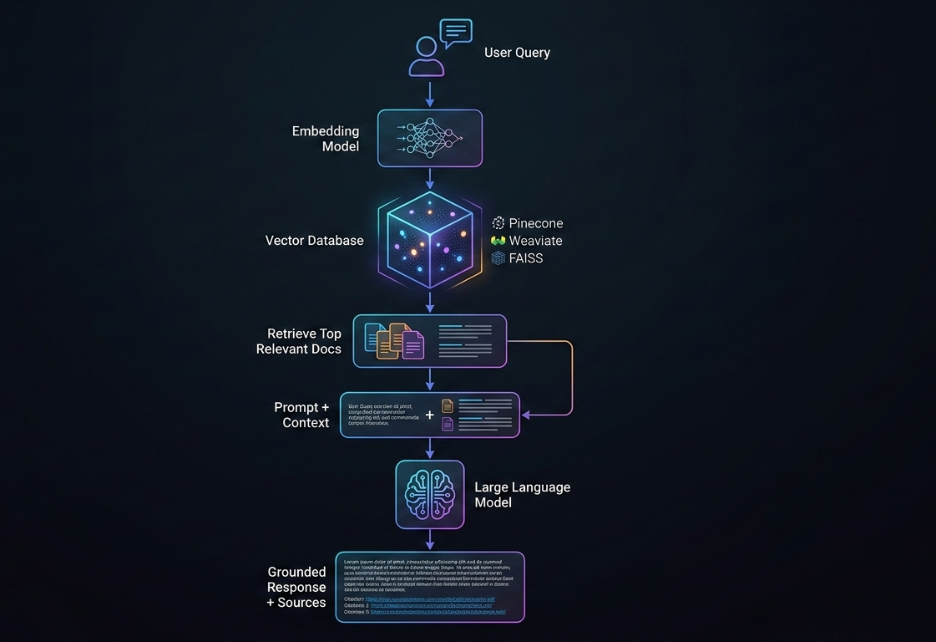
A typical enterprise RAG architecture includes four stages:
- Ingest enterprise information from documents, databases, knowledge bases, applications, or other approved sources.
- Index the information using embeddings, search infrastructure, or other retrieval mechanisms.
- Retrieve relevant context when a user submits a query.
- Generate a grounded response using the retrieved information.
The model itself does not need to be retrained every time a source document changes.
When RAG is the right choice
RAG is particularly suitable when:
- Enterprise knowledge changes frequently.
- Responses need to reference internal or proprietary information.
- Users need answers grounded in approved sources.
- The organization needs better traceability and auditability.
- The AI system is primarily answering questions rather than executing workflows.
- Knowledge resides across documents, policies, product information, wikis, databases, or enterprise applications.
Common enterprise use cases include:
- Enterprise knowledge search
- Customer support assistants
- Internal policy assistants
- Regulatory and compliance research
- Product documentation assistants
- Technical support
- Employee knowledge management
- Research and analysis
How Does RAG Work?
RAG works by retrieving relevant information from an external knowledge source and providing that information to a language model as context before it generates an answer. A typical RAG system ingests enterprise data, indexes the content, retrieves relevant information for a user query, and generates a response grounded in the retrieved context.
RAG separates knowledge from model behavior.
When a policy changes, the enterprise can update the underlying knowledge source rather than retraining the model simply to reflect that change.
That makes RAG particularly valuable for organizations working with information that changes faster than model-training cycles.
However, RAG is not automatically reliable.
Poor retrieval produces poor generation.
If the knowledge base contains outdated, duplicated, incomplete, or poorly structured information, the model can still produce an incorrect answer.
For that reason, enterprise RAG requires more than a vector database. It requires:
- Data quality
- Access controls
- Metadata
- Retrieval evaluation
- Source governance
- Monitoring
- Content lifecycle management
- Security controls
How RAG works in four steps:
Generate a response using that context.
Ingest enterprise data.
Index the information for retrieval.
Retrieve relevant context for a query.
When not to use RAG
RAG is not the best answer when:
- The task does not require external knowledge.
- The main problem is consistent model behavior.
- The required output format can be solved through prompting or structured generation.
- There is no reliable knowledge source to retrieve from.
Verdict:
Choose RAG when the model needs reliable access to external knowledge, particularly when that knowledge is private, current, or frequently changing.
When Should Enterprises Use Fine-Tuning?
Enterprises should use fine-tuning when the primary requirement is consistent model behavior rather than access to changing information. Fine-tuning can improve specialized task performance, classification, terminology, tone, structured output, and repeatable response patterns when prompting alone does not provide sufficient consistency.
Use fine-tuning when the primary problem is model behavior rather than information access.
Fine-tuning involves training an existing model on curated examples so that it performs better on a specific task or follows a desired behavioral pattern more consistently.
Fine-tuning can be useful for:
- Specialized classification
- Consistent output formats
- Domain-specific terminology
- Brand or communication style
- Repetitive task patterns
- Structured generation
- Narrow task optimization
- Specialized instruction following
What fine-tuning changes
RAG primarily changes what information the model can access.
Fine-tuning changes how the model responds to a task.
For example, consider an enterprise that processes thousands of documents using a fixed classification taxonomy.
If the primary requirement is:
“Classify every document according to this specialized schema.”
fine-tuning may be appropriate.
If the requirement is:
“Answer questions using the latest internal policy documents.”
RAG is usually the more direct architectural solution.
When fine-tuning is the right choice
Fine-tuning is best used for improving how a model performs a specific, relatively stable task. It is particularly useful when an organization needs consistent terminology, formatting, classification, tone, or task-specific behavior that cannot be achieved reliably through prompting alone.
Consider fine-tuning when:
- The behavior you want is stable.
- The task is narrow and well-defined.
- Prompting alone does not produce sufficient consistency.
- You have high-quality training examples.
- The model must repeatedly follow a specialized format.
- A smaller specialized model could provide the required performance or latency.
Fine-tuning and enterprise knowledge
Fine-tuning should not automatically be treated as a replacement for enterprise knowledge retrieval.
If the underlying information changes frequently, encoding that information into model behavior creates a maintenance problem.
For example, product pricing, internal policies, regulatory requirements, inventory data, and operational metrics can change regularly.
Those are usually better candidates for retrieval or live system integration.
Fine-tuning becomes more valuable when the requirement is stable behavior around that information.
When not to use fine-tuning
Avoid fine-tuning when:
- The primary problem is access to current enterprise knowledge.
- The information changes frequently.
- Prompting already achieves the required behavior.
- You do not have sufficient high-quality training examples.
- The expected performance improvement does not justify the additional training and evaluation lifecycle.
Verdict:
Choose fine-tuning when you need consistent behavior or specialized task performance that prompting and standard model capabilities cannot reliably provide.
What Is the Difference Between RAG and Fine-Tuning?
RAG provides a model with external information at runtime, while fine-tuning changes the model’s behavior through additional training. RAG is generally better for current or frequently changing enterprise knowledge, whereas fine-tuning is better for stable specialized tasks, consistent formats, terminology, and behavioral patterns.
Quick comparison
| RAG | Fine-tuning |
|---|---|
| Changes accessible knowledge | Changes model behavior |
| Runtime retrieval | Additional training |
| Good for changing information | Good for stable tasks |
| External knowledge source | Curated training examples |
| Easier knowledge updates | Requires retraining for major changes |
When Should Enterprises Use AI Agents?
Enterprises should use AI agents when an AI system needs to perform multi-step tasks, make decisions, use tools or APIs, and execute actions across business systems. Unlike a conventional AI assistant that primarily generates responses, an agent can plan a workflow, interact with enterprise tools, evaluate results, and continue until the task is completed or requires human intervention.
Use AI agents when the system must do more than answer a question.
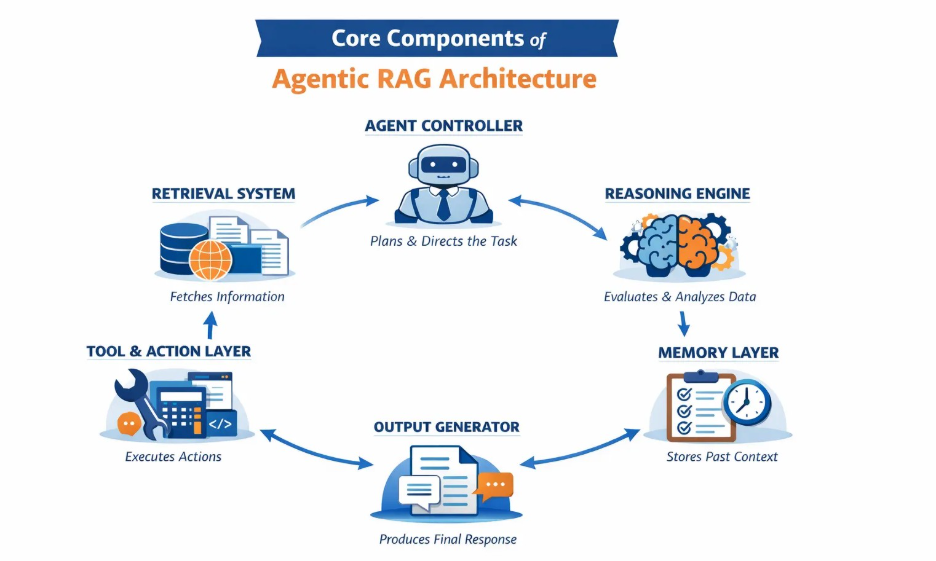
An AI agent can combine a foundation model with tools, APIs, memory, planning, workflow logic, and enterprise systems to complete multi-step tasks.
The difference is simple:
RAG retrieves. Fine-tuning specializes. Agents execute.
What Are AI Agents?
AI agents are AI systems that combine a language model with tools, instructions, workflows, memory, and enterprise system integrations to perform tasks. Instead of only generating an answer, an agent can interpret an objective, plan steps, use approved tools, evaluate results, and execute actions within defined boundaries.
What makes an AI agent different?
A conventional AI assistant may:
- Receive a question.
- Retrieve information.
- Generate an answer.
An agentic system may:
- Interpret the objective.
- Break the objective into steps.
- Retrieve relevant information.
- Decide which tool to use.
- Call an enterprise API.
- Evaluate the result.
- Continue to the next step.
- Complete the workflow or escalate to a human.
When AI agents make sense
Agents are useful when workflows involve:
- Multiple dependent steps
- Decisions based on changing information
- Tool or API calls
- Enterprise system integrations
- Repetitive operational processes
- Human approval checkpoints
- Workflow orchestration
Potential use cases include:
- IT incident management
- Customer service operations
- Claims processing
- Sales operations
- Finance workflows
- Procurement
- Employee service management
- Research workflows
- Enterprise operations
For example, an insurance claims workflow could use:
RAG → retrieve policy information
Agent → evaluate workflow conditions
Enterprise API → retrieve customer/claim information
Agent → initiate an approved action
Human → approve high-risk decision
This is fundamentally different from a simple knowledge assistant.
The governance challenge
The more capability an agent has, the more important permissions, monitoring, evaluation, and governance become.
Gartner has warned that many agentic AI initiatives face challenges involving cost, unclear business value, and inadequate risk controls.
More recently, Gartner has highlighted the importance of matching governance controls to an agent’s autonomy and scope rather than applying identical controls to every agent.
For enterprise deployments, this means agent architecture should define:
- What the agent can access
- What tools it can call
- What actions it can perform
- What requires human approval
- What actions must be logged
- What happens when confidence is low
- How failures are detected and contained
NIST’s Generative AI Profile similarly emphasizes managing risks across the AI lifecycle, including governance, evaluation, and deployment.
When not to use AI agents
Do not introduce an agent simply because the technology is available.
Agents may be unnecessary when:
- The system only needs to answer questions.
- There are no external actions to perform.
- The workflow is too unpredictable to automate safely.
- A deterministic workflow would work better.
- The expected business value does not justify the additional complexity.
Verdict:
Choose AI agents when the business problem requires multi-step decisions, tool use, orchestration, and action across enterprise systems.
What Is the Difference Between RAG and AI Agents?
RAG is primarily a knowledge-retrieval architecture, while AI agents are execution systems that can use tools and perform multi-step workflows. A RAG application may retrieve information and generate an answer, whereas an agent can retrieve information, decide what to do next, call enterprise tools, and execute actions. An agent can also use RAG as its knowledge layer.
What Is the Difference Between Fine-Tuning and AI Agents?
Fine-tuning improves how a model behaves on specialized tasks, while AI agents extend a model with tools, planning, integrations, and workflow execution. Fine-tuning is primarily a model-specialization technique; agentic architecture is primarily a system-level approach for performing multi-step work
As explored in internal AI strategy and road-mapping, improving retrieval precision directly improves generation reliability.
RAG vs Fine-Tuning vs AI Agents: Comparison Table
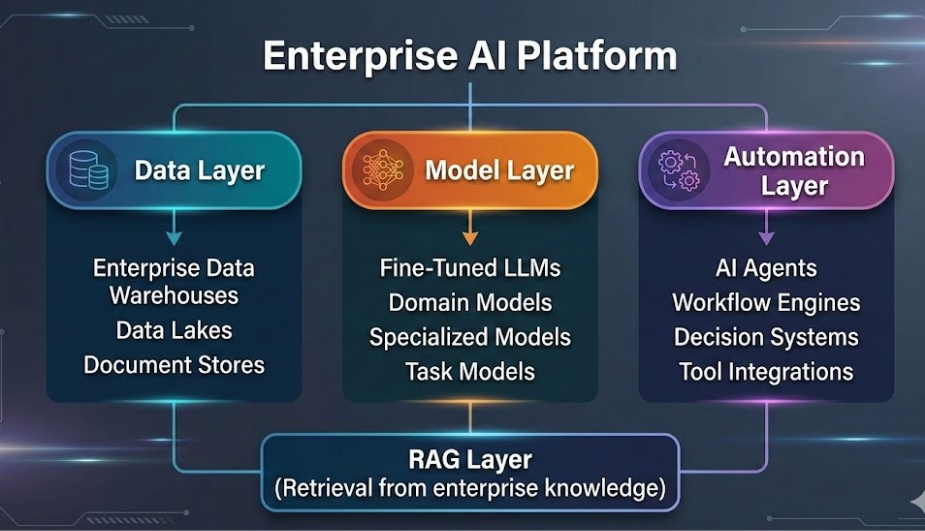
RAG is primarily used to provide an AI model with current external knowledge, fine-tuning is used to improve specialized or consistent behavior, and AI agents are used to execute multi-step tasks. RAG is the knowledge layer, fine-tuning is the behavior layer, and agents are the execution layer. Enterprises can combine these layers when a use case requires all three capabilities.
The fastest way to compare the three architectures is to evaluate what your business actually needs.
| Decision factor | RAG | Fine-tuning | AI agents |
| Primary purpose | Access knowledge | Change behavior | Execute workflows |
| Knowledge freshness | High | Low unless retrained | High when connected to live sources |
| Behavior customization | Moderate | High | Depends on underlying model and design |
| External data access | Yes | Not inherently | Yes, through tools/integrations |
| Tool use | Not inherent | Not inherent | Core capability |
| Best for | Knowledge-heavy applications | Stable specialized tasks | Multi-step automation |
| Source traceability | Strong when retrieval is designed for it | Limited by itself | Depends on architecture |
| System complexity | Moderate | High | High |
| Main risk | Poor retrieval or poor data | Training-data limitations and drift | Reliability, permissions and governance |
| Typical enterprise role | Knowledge layer | Specialization layer | Execution layer |
The three architectural layers
A useful way to think about enterprise AI is:
RAG → Knowledge layer
Fine-tuning → Behavior layer
AI agents → Execution layer
These layers can operate independently or together.
The important question is not:
“Which technology is best?”
It is:
“Which capabilities does this use case actually require?”
For organizations building AI roadmaps, see: Enterprise AI Strategy in 2026
How to Choose Between RAG, Fine-Tuning and AI Agents
Choose RAG when the AI needs current or private knowledge, fine-tuning when it needs consistent specialized behavior, and AI agents when it needs to perform multi-step actions across systems. Start with the simplest architecture that meets the use case, then add fine-tuning, retrieval, or agentic capabilities only when a measurable business requirement justifies the additional complexity.
A practical enterprise decision should begin with the business requirement rather than the technology.
Evaluate the use case across six dimensions:
1. Knowledge freshness
Ask:
Does the AI need information that changes frequently?
If yes, RAG or live enterprise integrations become important.
Examples include:
- Policies
- Pricing
- Product documentation
- Regulations
- Inventory
- Customer information
- Operational data
2. Behavioral consistency
Ask:
Does the model need to follow a specific behavior or format repeatedly?
If yes, evaluate prompting first and then fine-tuning if the behavior cannot be reliably achieved otherwise.
Examples include:
- Classification
- Structured outputs
- Specialized terminology
- Consistent document generation
- Narrow domain tasks
3. Workflow complexity
Ask:
Does the system need to take actions across multiple systems?
If yes, an agent or workflow orchestration layer may be appropriate.
4. Data sensitivity
Ask:
What information can the system access, and under what conditions?
Enterprise AI architecture should define:
- Data boundaries
- Identity and access controls
- Permissions
- Data retention
- Logging
- Source provenance
5. Governance requirements
Ask:
What happens if the AI is wrong?
High-impact workflows may require:
- Human approval
- Audit trails
- Evaluation
- Monitoring
- Policy enforcement
- Escalation paths
NIST’s AI Risk Management Framework provides a structured foundation for organizations managing AI risks across design, development, deployment, and use.
6. Cost and operational complexity
Ask:
What is the simplest architecture that can meet the business requirement?
A more sophisticated architecture is not automatically a better architecture.
Every additional layer introduces:
- More infrastructure
- More monitoring
- More failure modes
- More governance requirements
- More engineering effort
- More operational dependencies
closely with modern data platform architectures such as data fabrics and unified analytics platforms, which consolidate enterprise data for AI and analytics workloads.
Read our guide on 10 Effective Steps To Building RAG Applications: From Prototype to Production-Grade Enterprise Systems that provides a step-by-step enterprise roadmap for building RAG applications.
RAG vs Fine-Tuning vs AI Agents: Decision Tree
Use RAG when the AI needs current or private knowledge. Use fine-tuning when the model needs consistent specialized behavior. Use AI agents when the system needs to plan, use tools, and execute multi-step workflows. If a use case requires current knowledge and specialized behavior, combine RAG with fine-tuning; if it also requires workflow execution, add an agent layer. Use this decision framework when evaluating an enterprise use case.
Does the AI need current or private enterprise information?
Yes → Start with RAG.
Does it also need highly consistent behavior, terminology or output format?
Yes → Consider fine-tuning alongside RAG.
Does the system need to perform actions across enterprise applications?
Yes → Add an agent or workflow execution layer.
Does the system only need to answer questions?
Do not add agents unnecessarily.
Does prompting already solve the behavior problem?
Do not fine-tune unnecessarily.
Is the knowledge stable and small enough to provide directly in context?
A simpler approach may be sufficient.
The objective is not to maximize architectural complexity.
The objective is to maximize business value while controlling risk and operational overhead.
Get a comprehensive view about how RAG in 2026 in Enterprise AI scenario has shifted from experimentation to a production-critical architecture to ensure accuracy, compliance, and real-time intelligence.
RAG vs Fine-Tuning vs AI Agents: Common Architecture Mistakes
Choosing the wrong architecture can create unnecessary engineering and maintenance costs.
1. Fine-tuning a knowledge problem
If the primary requirement is access to changing enterprise information, fine-tuning may create unnecessary retraining requirements.
Better approach: use RAG or an appropriate live data integration.
2. Building agents before the workflow is ready
An agent cannot compensate for a poorly defined business process.
Better approach: standardize and measure the workflow first, then automate the parts that benefit from agentic execution.
3. Adding RAG without fixing data quality
A sophisticated retrieval system cannot compensate for outdated or poorly governed source data.
Better approach: establish data quality, metadata, access control, and content governance before scaling retrieval.
4. Adding a hybrid architecture too early
Combining RAG, fine-tuning and agents may sound like the most advanced approach.
But if RAG alone solves the business requirement, additional layers create unnecessary complexity.
Better approach: start with the minimum viable architecture and add layers when evidence justifies them.
5. Measuring only model accuracy
Enterprise AI success is broader than model output quality.
Measure:
- Business outcomes
- Task completion
- Retrieval quality
- Hallucination/error rates
- Latency
- Cost per task
- Human escalation
- Adoption
- Security incidents
- Governance compliance
McKinsey’s 2025 State of AI research highlights a similar enterprise challenge: AI adoption is widespread, but many organizations remain in experimentation or pilot stages rather than achieving scaled enterprise impact. The organizations seeing greater value are also more likely to redesign workflows around AI.
Read our blog that breaks down 10 critical RAG architectures shaping 2026, their trade-offs, and the enterprise use cases they unlock.
RAG vs Fine-Tuning vs AI Agents: Cost and Complexity
RAG, fine-tuning, and AI agents have different cost and complexity profiles. RAG typically requires retrieval and knowledge infrastructure, fine-tuning requires curated training data and model evaluation, while AI agents add orchestration, tools, integrations, monitoring, and governance. The right choice should therefore be based on total cost of ownership and business value rather than implementation cost alone.
Cost should not be evaluated as a single development number.
Each architecture creates a different cost profile.
RAG
RAG typically introduces costs associated with:
- Data ingestion
- Embedding generation
- Search or vector infrastructure
- Retrieval
- Model inference
- Monitoring
- Data maintenance
Its main advantage is that enterprise knowledge can generally be updated without retraining the underlying model.
Fine-tuning
Fine-tuning introduces costs associated with:
- Dataset preparation
- Data labeling or curation
- Training
- Evaluation
- Model hosting
- Retraining
- Model monitoring
The business case is strongest when a measurable improvement in specialized behavior justifies those additional costs.
AI agents
Agentic systems can introduce costs across:
- Model inference
- Tool calls
- API integrations
- Orchestration
- Workflow infrastructure
- Monitoring
- Evaluation
- Security
- Human review
The more steps an agent takes, the more important it becomes to monitor cost and reliability at the workflow level, not only at the model level.
The better cost question
Instead of asking:
“Which architecture is cheapest?”
ask:
“Which architecture delivers the required business outcome at an acceptable total cost of ownership?”
A more expensive architecture can be justified when it replaces significant manual work.
A cheaper architecture can still be wasteful if it does not solve the underlying business problem.
For enterprises exploring early-stage AI assistants, this approach is often aligned with modernization efforts such as those described in Techment’s Best Practices for Generative AI Implementation in Business.
When Should You Combine RAG, Fine-Tuning and AI Agents?
Combine RAG and fine-tuning when an enterprise AI system needs both current external knowledge and consistent specialized behavior. RAG can provide changing enterprise information at runtime, while fine-tuning can improve task-specific behavior, terminology, formatting, or response consistency.
Hybrid architectures make sense when a single architectural layer cannot meet the requirements.
RAG + Fine-Tuning
Use this combination when the system needs:
- Current enterprise knowledge
- Specialized behavior
- Consistent output
- Domain-specific task performance
For example, a specialized enterprise assistant may use fine-tuning to improve task behavior while RAG supplies current internal documentation.
RAG + AI Agents
Use this combination when the system needs:
- Current enterprise information
- Multi-step reasoning
- Tool use
- Workflow execution
For example, an enterprise service agent could retrieve internal policies using RAG and then use approved tools to execute a service workflow.
RAG + Fine-Tuning + AI Agents
Use the full combination only when the business requirement genuinely needs:
- Current knowledge
- Specialized behavior
- Multi-step execution
This can be appropriate for mature, high-value workflows where the additional complexity can be governed and justified.
Hybrid does not mean better by default
A hybrid architecture introduces additional engineering and governance requirements.
Therefore:
Add architectural layers because the business requires them, not because the technology makes them possible.
Enterprise AI Architecture Implementation Roadmap
A practical implementation roadmap should evolve with the maturity of the use case.
Phase 1: Define the business problem
Start with:
- Business objective
- Users
- Workflow
- Data sources
- Required outputs
- Risk level
- Success metrics
Do not start by selecting a model or framework.
Phase 2: Establish the data foundation
Before scaling AI, assess:
- Data quality
- Data ownership
- Metadata
- Access controls
- Data freshness
- Governance
- Source reliability
For RAG especially, retrieval quality depends heavily on the quality and structure of the underlying knowledge.
Techment’s resources on data quality for AI, enterprise data governance, and enterprise AI strategy can support this stage.
Phase 3: Establish a baseline
Start with the simplest viable architecture.
For many knowledge-intensive use cases, this may mean:
Foundation model + prompt engineering + RAG
Measure the baseline before adding additional components.
Phase 4: Add specialization only when needed
If prompting and retrieval cannot achieve the required task performance, evaluate fine-tuning.
Use measurable evaluation criteria such as:
- Accuracy
- Format adherence
- Classification performance
- Consistency
- Latency
Phase 5: Add workflow execution
If the use case requires actions across systems, introduce agents or deterministic workflow orchestration.
Define:
- Tool permissions
- Action boundaries
- Human approval
- Escalation
- Monitoring
- Logging
Phase 6: Scale and govern
Production AI requires ongoing:
- Evaluation
- Monitoring
- Security
- Governance
- Cost optimization
- Data maintenance
- Model evaluation
- Workflow optimization
The objective is to create an AI system that remains reliable after deployment, not simply one that performs well in a demonstration.
How Techment Helps Enterprises Build the Right AI Architecture
Selecting the right architecture is only the first step.
Enterprise AI systems also require the data, cloud, governance, integration, engineering, and operational foundations necessary to move from experimentation to production.
Techment helps enterprises design and implement AI solutions across:
Enterprise AI Strategy
Define high-value AI use cases, architecture priorities, implementation roadmaps, and measurable business outcomes.
RAG and Enterprise Knowledge Systems
Design retrieval architectures that connect AI systems to governed enterprise knowledge and data sources.
AI-Ready Data Foundations
Improve data quality, governance, pipelines, and architecture so AI systems can work with reliable enterprise information.
LLM Architecture
Design architectures that combine foundation models, retrieval, specialized models, APIs, orchestration, and enterprise applications where appropriate.
Agentic AI
Build bounded AI agents capable of using enterprise tools and executing workflows with appropriate guardrails and human oversight.
Governance and Responsible AI
Establish controls around data access, model behavior, evaluation, monitoring, security, and responsible AI deployment.
The goal is not to build the most complex AI stack.
It is to build the right architecture for the business problem and create the foundations required to operate it reliably at enterprise scale.
Key Takeaway: Choose Architecture by Use Case
RAG, fine-tuning, and AI agents should not be viewed as competing technologies.
They solve different enterprise AI problems.
Use RAG for knowledge.
Use fine-tuning for stable specialized behavior.
Use AI agents for multi-step action.
Combine them only when the use case requires multiple capabilities.
The strongest enterprise architecture is therefore not the one with the most components.
It is the one that provides the required:
- Accuracy
- Knowledge freshness
- Behavioral consistency
- Workflow capability
- Security
- Governance
- Latency
- Cost efficiency
- Business value
As enterprises move from AI pilots toward production systems, architecture decisions will increasingly determine whether AI becomes a reliable business capability or another isolated technology experiment.
The organizations that succeed will be the ones that connect AI architecture with data foundations, workflow design, governance, and measurable business outcomes
ms.
See how insights become decisions in Enterprise Data Quality Framework: Best Practices for Reliable Analytics and AI
Lay the groundwork for AI readiness, identify ROI-positive use cases, and build a prioritized execution roadmap designed for value, feasibility, and governance with our AI services.
Conclusion
The discussion around RAG vs Fine-Tuning vs AI Agents reflects a broader shift in enterprise AI strategy.
Organizations are moving beyond standalone AI models toward integrated AI platforms capable of reasoning, accessing enterprise knowledge, and executing workflows.
Each architectural approach plays a unique role:
- RAG enables AI systems to access trusted enterprise data in real time.
- Fine-tuning embeds domain expertise and specialized reasoning patterns.
- AI agents transform AI systems into autonomous operators capable of executing business processes.
The most successful enterprises do not treat these approaches as mutually exclusive. Instead, they design hybrid architectures that combine retrieval, specialized models, and agent orchestration.
As enterprise AI adoption accelerates, the ability to design and implement the right LLM architecture will become a critical competitive advantage.
Organizations that invest in scalable AI foundations today will be best positioned to unlock the full potential of intelligent automation and data-driven decision-making in the years ahead.
See how your enterprise can develop self-service capabilities and integrate augmented analytics/AI modules in our solution offerings.
Frequently Asked Questions
1. What is the difference between RAG and fine-tuning?
RAG retrieves relevant data from external knowledge sources during inference, allowing models to generate responses based on current information. Fine-tuning modifies the model itself by training it on specialized datasets, embedding domain expertise directly into model parameters.
2. When should enterprises use AI agents instead of RAG?
AI agents should be used when the goal is to automate multi-step workflows rather than simply retrieve information. Agents can analyze data, make decisions, and execute actions across enterprise systems.
3. Can RAG and fine-tuning be used together?
Yes. Many enterprises combine fine-tuned models with RAG architectures to balance domain expertise and real-time knowledge access.
4. How long does it take to implement enterprise LLM systems?
Typical implementation timelines vary by architecture:
RAG systems: 4–8 weeks
Fine-tuned models: 8–16 weeks
AI agent systems: 12–24 weeks
5. Which approach offers the best ROI?
ROI depends on the business objective. RAG often delivers the fastest ROI through improved knowledge access, while AI agents typically deliver the highest long-term ROI through workflow automation.