Why Agentic AI Is Transforming Enterprise Operations
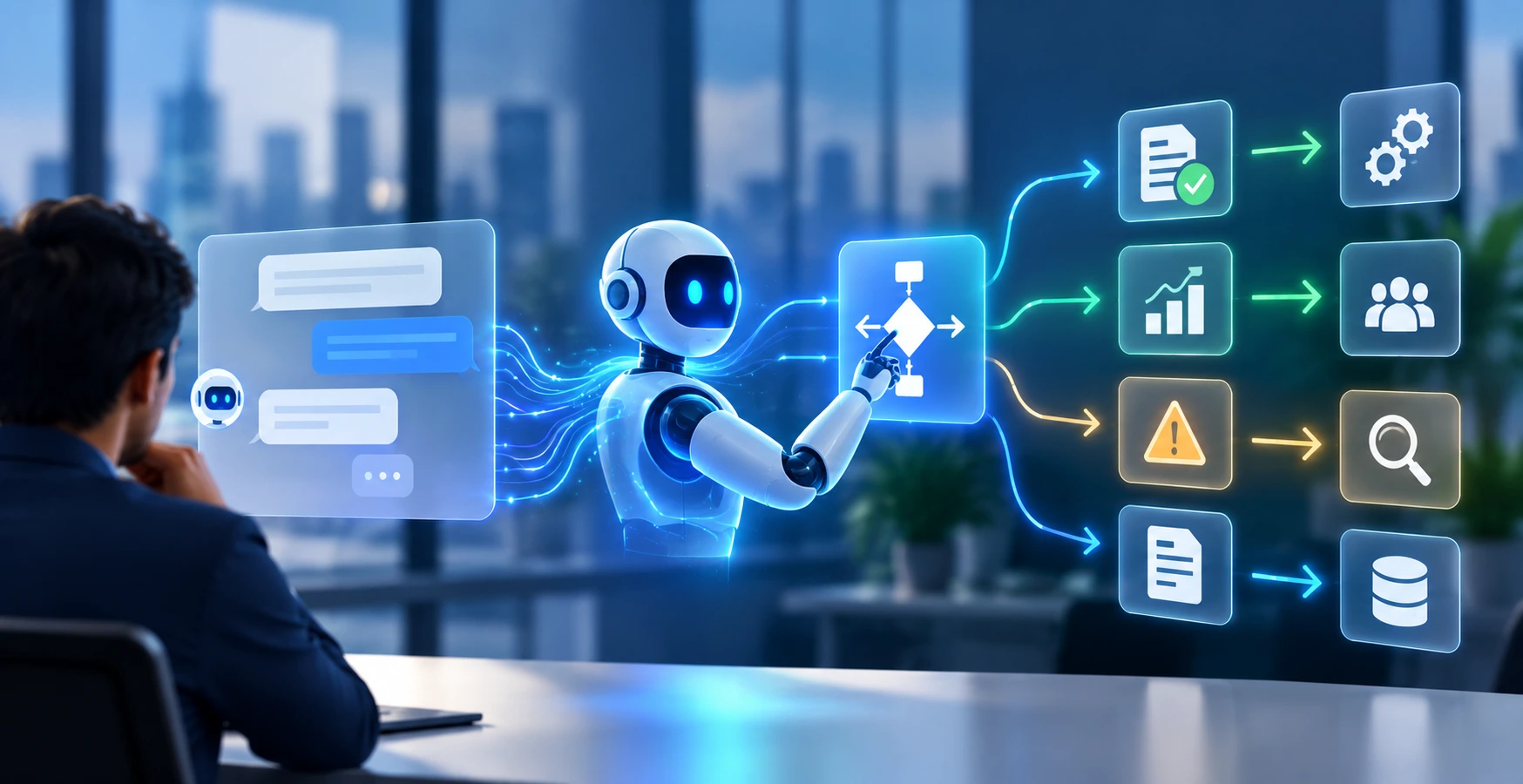
Agentic AI is changing how enterprises automate work. Unlike traditional automation or generative AI, agentic AI systems can understand business goals, plan multi-step workflows, interact with enterprise applications, and execute tasks with minimal human intervention. Industry analysts, including Gartner, identify agentic AI as one of the technologies expected to reshape enterprise software by enabling AI systems to move beyond assistance toward autonomous task execution.
Instead of automating isolated activities, agentic AI coordinates complete business processes across systems such as ERP, CRM, HRIS, ITSM, and cloud platforms. This enables organizations to reduce manual coordination, accelerate service delivery, improve compliance, and operate more efficiently.
In this guide, you’ll discover seven high-impact agentic AI use cases across IT, HR, finance, cybersecurity, customer service, workplace productivity, and business process optimization. You’ll also learn how agentic AI differs from traditional automation, the architectural components required for enterprise deployment, governance best practices, and how organizations measure business value from autonomous AI systems.
TL;DR Summary
- Agentic AI enables autonomous execution of enterprise workflows—not just task automation.
- AI agents can reason, plan, execute, and adapt across multiple business systems.Enterprises are applying agentic AI across IT, HR, finance, cybersecurity, customer service, and business operations.
- Governance, security, and observability are essential for safe enterprise deployment.
- Organizations that combine autonomous execution with strong governance are best positioned to scale enterprise AI successfully.
High-Impact Real-World Applications of Agentic AI
1. Agentic AI Use Cases in IT Operations
Modern IT teams manage thousands of service requests, infrastructure alerts, software deployments, and access requests every day. While IT service management platforms automate portions of these processes, engineers often spend significant time coordinating work across monitoring tools, identity platforms, cloud environments, and ticketing systems.
Agentic AI enables IT teams to move beyond ticket automation by autonomously coordinating and executing multi-step operational workflows.
High-Impact IT Use Cases
Autonomous Incident Resolution
Agentic AI continuously monitors infrastructure, correlates alerts across multiple monitoring platforms, identifies probable root causes, and initiates remediation actions such as restarting services, scaling resources, or rolling back failed deployments. Human teams intervene only when predefined risk thresholds are exceeded.
Intelligent Access Provisioning
When employees join, change roles, or leave the organization, AI agents can automatically provision or revoke access across identity providers, SaaS applications, cloud platforms, and enterprise systems while enforcing least-privilege policies.
Self-Service IT Support
Instead of only answering employee questions, agentic AI can resolve common issues by resetting passwords, diagnosing VPN connectivity problems, validating device compliance, or initiating software installation workflows.
Change Monitoring and Automated Rollback
Following infrastructure changes or application releases, AI agents continuously monitor system health. If anomalies are detected, they can trigger rollback procedures, notify stakeholders, and document corrective actions automatically.
Business Benefits
- Faster incident resolution
- Reduced ticket volumes
- Lower operational costs
- Improved service reliability
- More time for strategic IT initiatives
Related Insight: For a deeper dive into scalable automation foundations, reference Techment’s perspective on Manual Data Quality Checks vs Automation.
2. Agentic AI Use Cases in Human Resources
HR teams coordinate onboarding, employee services, policy management, payroll interactions, compliance requirements, and workforce support across multiple business systems. Although many HR processes are standardized, they still require extensive manual coordination between HR, IT, finance, and facilities.
Agentic AI helps HR teams automate end-to-end employee workflows while delivering more consistent employee experiences.
High-Impact HR Use Cases
End-to-End Employee Onboarding
Rather than assigning onboarding tasks individually, agentic AI coordinates identity creation, device provisioning, payroll enrollment, learning assignments, benefits registration, and facilities access across enterprise platforms.
Autonomous Employee Self-Service
Employees can request information about leave policies, benefits, reimbursements, or internal procedures. AI agents retrieve contextual information based on role, geography, and employment status while completing approved transactions when appropriate.
Policy Interpretation and Compliance
Agentic AI evaluates employee requests against organizational policies, labor regulations, and internal approval workflows to ensure consistent and compliant decisions.
Workforce Case Management
HR agents automatically classify employee requests, prioritize urgent cases, collect supporting information, and route complex issues to the appropriate specialists with complete context.
Business Benefits
- Better HR operational efficiency
- Faster onboarding experiences
- Reduced administrative workload
- Consistent policy enforcement
- Improved employee satisfaction
3. Agentic AI Use Cases in Finance
Finance organizations depend on accuracy, auditability, and regulatory compliance. However, many financial processes still involve manual reviews, fragmented approvals, and repetitive reconciliation activities that delay decision-making.
Agentic AI enables finance teams to automate complex operational workflows while maintaining governance and financial controls.
High-Impact Finance Use Cases
Intelligent Invoice Processing
AI agents capture invoice data, validate purchase orders, compare contract terms, identify discrepancies, route approvals, and initiate payments while maintaining complete audit trails.
Automated Expense Management
Agentic AI reviews submitted expenses, verifies receipts, checks policy compliance, categorizes transactions, and escalates exceptions that require human approval.
Financial Close Acceleration
AI agents monitor close activities, identify missing entries, reconcile data across ERP systems, and notify finance teams about outstanding tasks before reporting deadlines.
Executive Financial Intelligence
Business leaders can ask natural-language questions about budgets, operating expenses, cash flow, or business performance. Agentic AI retrieves information from enterprise finance systems, performs analysis, and delivers actionable insights in real time.
Business Benefits
- Faster financial close cycles
- Reduced manual reconciliation
- Improved compliance and audit readiness
- Better financial visibility
- Higher operational efficiency
4. Agentic AI Use Cases in Security Operations
Security operations teams face an overwhelming volume of alerts across endpoints, identities, cloud environments, networks, and SaaS applications. While Security Orchestration, Automation, and Response (SOAR) platforms automate predefined workflows, they often require human intervention when incidents become complex or ambiguous.
Agentic AI enhances security operations by reasoning across multiple signals, assessing context, and autonomously executing approved response actions while remaining within enterprise governance policies.
High-Impact Security Use Cases
Intelligent Threat Detection
Agentic AI continuously analyzes user behavior, network traffic, endpoint activity, and cloud workloads to identify anomalies that may indicate compromised accounts, insider threats, or malicious activity. Unlike rule-based systems, agents evaluate behavioral context before escalating incidents.
Autonomous Alert Triage
Instead of overwhelming analysts with thousands of alerts, agentic AI correlates signals from SIEM, EDR, IAM, cloud security, and threat intelligence platforms to prioritize high-confidence incidents and suppress false positives.
Cross-System Incident Response
Once a threat is confirmed, AI agents can isolate compromised endpoints, disable user accounts, rotate credentials, block malicious IP addresses, and notify stakeholders while maintaining detailed audit logs for compliance.
Adaptive Policy Enforcement
Security agents continuously evaluate risk posture and dynamically enforce access policies based on factors such as user behavior, device health, geographic location, and application sensitivity.
Business Benefits
- Stronger security governance
- Reduced Mean Time to Detect (MTTD)
- Faster incident response
- Lower analyst workload
- Improved threat prioritization
Related Insights: Read our blog that explores how AI copilots for enterprises are transforming executive leadership in 2026.
5. Agentic AI Use Cases in Customer Service
Many organizations have implemented AI chatbots, but these systems often stop at answering questions or routing customer requests. Human agents still complete the actual work of updating accounts, processing refunds, resolving disputes, or coordinating across business systems.
Agentic AI moves beyond conversational support by autonomously resolving customer requests across enterprise applications while maintaining complete visibility into every action.
High-Impact Customer Service Use Cases
Autonomous Case Resolution
AI agents classify customer requests, gather account information, validate business policies, and complete approved actions such as processing refunds, updating customer profiles, modifying subscriptions, or replacing products without requiring manual intervention.
Customer Context Aggregation
Before responding to customers, agentic AI automatically assembles information from CRM platforms, billing systems, support tickets, order history, and communication channels, giving both AI and human agents complete business context.
Proactive Customer Support
Instead of waiting for customers to report issues, AI agents monitor usage patterns, product telemetry, and sentiment signals to identify potential problems early and proactively recommend solutions.
Omnichannel Experience Management
Whether customers engage through email, chat, voice, or self-service portals, agentic AI maintains conversation context and workflow continuity across every interaction.
Business Benefits
- More personalized customer experiences
- Faster case resolution
- Higher first-contact resolution rates
- Lower service costs
- Improved customer satisfaction
6. Agentic AI Use Cases for Workplace Productivity
Employees spend a significant portion of their workday coordinating meetings, searching for information, requesting approvals, switching between applications, and completing administrative tasks. While AI assistants improve productivity by generating content or answering questions, they rarely execute work on behalf of employees.
Agentic AI acts as a digital coworker that can coordinate workflows, retrieve enterprise knowledge, and complete multi-step operational tasks across business systems.
High-Impact Workplace Productivity Use Cases
Intelligent Meeting Coordination
Agentic AI schedules meetings, resolves calendar conflicts, identifies suitable participants, books meeting rooms, distributes agendas, and updates schedules automatically when priorities change.
Enterprise Meeting Intelligence
Agents prepare agendas, retrieve supporting documents, capture meeting notes, summarize decisions, assign action items, and monitor follow-up activities without manual effort.
Enterprise Knowledge Retrieval
Employees can ask natural language questions and receive contextual answers sourced from enterprise documentation, CRM platforms, project management tools, collaboration applications, and internal knowledge bases.
AI-Powered Employee Assistance
Agentic AI helps employees complete HR requests, submit procurement approvals, generate reports, retrieve operational data, and automate repetitive administrative work through conversational interactions.
Business Benefits
- Improved operational efficiency
- Increased employee productivity
- Reduced administrative workload
- Faster knowledge discovery
- Better collaboration
Related Insights: Enterprise AI Strategy in 2026: A Practical Guide for CIOs and Data Leaders
7. Agentic AI Use Cases for Business Process Optimization
Many enterprise processes span multiple departments, systems, and approval workflows. Traditional automation handles predefined tasks well but struggles when business conditions change or exceptions occur. Agentic AI introduces a more adaptive approach by continuously monitoring workflows, coordinating across systems, and responding intelligently to changing conditions.
High-Impact Business Process Optimization Use Cases
Autonomous DevOps Pipeline Management
Agentic AI reviews code changes, initiates testing, validates deployment readiness, monitors production health, and automatically rolls back releases when failures are detected. Engineering teams receive complete diagnostics and recommended corrective actions.
Intelligent Supply Chain Coordination
AI agents monitor inventory, supplier performance, logistics networks, and demand forecasts in real time. When disruptions occur, they can recommend alternative suppliers, rebalance inventory, adjust procurement schedules, or reroute shipments based on business priorities.
Automated Compliance Monitoring
Rather than relying on periodic audits, agentic AI continuously evaluates enterprise systems against internal policies and regulatory requirements. It identifies compliance gaps, generates audit-ready documentation, and recommends remediation actions before issues escalate.
Autonomous Quality Assurance
In manufacturing and production environments, AI agents analyze sensor data, detect anomalies, recommend process adjustments, trigger quality inspections, and coordinate corrective workflows to reduce defects and operational waste.
Business Benefits
- Lower operational costs
- More resilient business operations
- Reduced operational risk
- Faster decision-making
- Improved compliance
What Is Agentic AI?
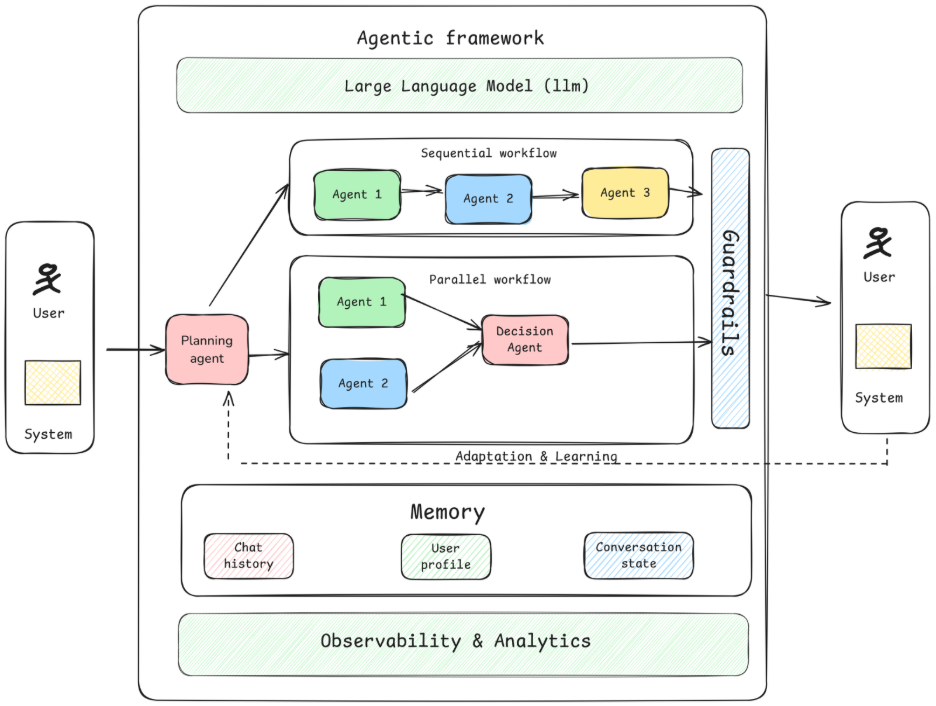
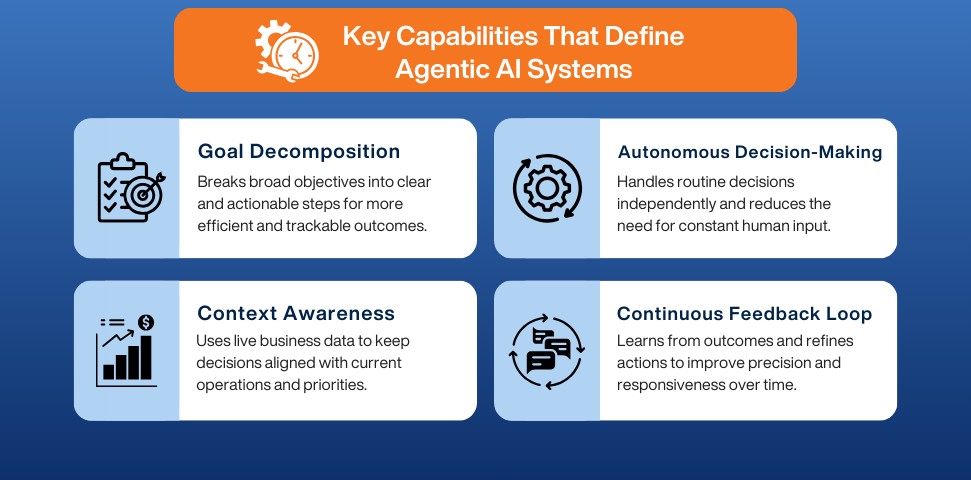
Agentic AI refers to AI systems that can autonomously plan, execute, and optimize multi-step workflows to achieve a defined business objective. Unlike traditional automation, which follows predefined rules, or generative AI, which primarily creates content and recommendations, agentic AI can make decisions, interact with enterprise systems, and complete tasks with minimal human intervention.
Rather than responding to individual prompts, agentic AI works toward an outcome. For example, when an employee requests software access, an AI agent can verify identity, evaluate approval policies, provision access across multiple applications, notify stakeholders, update audit logs, and confirm completion—all within predefined governance boundaries.
This ability to reason, orchestrate actions, and adapt to changing conditions makes agentic AI well suited for enterprise workflows that span multiple systems, departments, and business processes.
The most successful agentic AI use cases focus on reducing operational complexity rather than simply automating repetitive tasks. By combining intelligent decision-making with secure execution, organizations can improve service delivery, increase productivity, and enable employees to focus on higher-value work.
Related Insight: Get a clear, enterprise-grade comparison of agentic vs copilot AI, grounded in process maturity, risk tolerance, and operational readiness.
Related Insights: Learn how we enable organizations to operationalize AI through RAG architectures and autonomous AI Agents that are secure, governed, and actionable at scale. eams, agentic AI enables a shift from reactive operations to predictable, outcome-driven execution.
Related Insight: Explore what defines an AI-First Enterprise, how Copilot and intelligent business apps transform workflows, and how Techment helps organizations chart their roadmap from pilot to scale.
Agentic AI vs Traditional Automation vs Generative AI
Although these technologies complement one another, they address different enterprise challenges.
Traditional automation executes predefined workflows. It is highly effective for repetitive, rules-based processes but requires manual intervention when exceptions occur.
Generative AI helps employees create content, summarize information, answer questions, and support decision-making. However, it typically relies on users to carry out business actions.
Agentic AI combines reasoning, planning, and execution. It can understand a business objective, determine the required steps, interact with multiple enterprise applications, adapt to changing conditions, and complete workflows while operating within defined governance policies.
| Capability | Traditional Automation | Generative AI | Agentic AI |
|---|---|---|---|
| Follows predefined workflows | ✓ | Limited | ✓ |
| Generates content and insights | ✗ | ✓ | Limited |
| Plans multi-step workflows | ✗ | Limited | ✓ |
| Coordinates multiple enterprise systems | Limited | ✗ | ✓ |
| Adapts to changing conditions | ✗ | Limited | ✓ |
| Handles operational exceptions | ✗ | ✗ | ✓ |
| Executes end-to-end business processes | ✗ | ✗ | ✓ |
For enterprises, the progression is clear: automation executes tasks, generative AI assists employees, and agentic AI orchestrates complete business outcomes.
Related Insights: For a deeper perspective on aligning AI initiatives with enterprise strategy, see Techment’s guide on Enterprise AI Strategy in 2026.
Enterprise Benefits of Agentic AI
Organizations adopting agentic AI are moving beyond isolated automation projects to autonomous, outcome-driven operations. The greatest value comes from coordinating complex workflows across enterprise systems rather than automating individual tasks.
Key benefits include:
Faster Operations
AI agents execute multi-step workflows without waiting for manual coordination, reducing response times for IT support, customer service, HR requests, and financial processes.
Improved Productivity
Employees spend less time on repetitive administrative work and more time on strategic initiatives that require human expertise.
Lower Operating Costs
By reducing manual effort, minimizing rework, and streamlining workflows, agentic AI helps organizations improve operational efficiency at scale.
Better Accuracy and Compliance
Policy-aware AI agents apply business rules consistently, maintain detailed audit trails, and support regulatory compliance across enterprise processes.
Enhanced Employee and Customer Experiences
Faster issue resolution, intelligent self-service, and proactive support contribute to higher employee satisfaction and improved customer experiences.
Related Insights: Data Quality for AI: The Ultimate 2026 Blueprint for Trustworthy & High-Performing Enterprise AI
How to Identify the Best Agentic AI Use Cases
Not every business process requires agentic AI. The highest-value use cases share common characteristics that make autonomous execution both practical and impactful.
Look for processes that:
- Span multiple enterprise applications or departments
- Require frequent manual coordination between teams
- Follow well-defined business policies or approval rules
- Experience recurring delays due to repetitive administrative work
- Generate high volumes of requests or transactions
- Require consistent execution while allowing human oversight for exceptions
Examples include employee onboarding, IT service management, invoice processing, customer case resolution, procurement approvals, and security incident response.
Organizations should begin with workflows that are high in operational complexity but governed by clear business policies. These processes often deliver the fastest return on investment while minimizing implementation risk.
Implementation Considerations for Agentic AI
Scaling agentic AI successfully requires more than deploying intelligent agents. Organizations need a governance framework that ensures secure, reliable, and transparent execution.
Integrate with Enterprise Systems
AI agents should securely connect with systems such as ERP, CRM, HRIS, ITSM, identity providers, and collaboration platforms through governed APIs and enterprise integration layers.
Establish Governance and Guardrails
Clearly define which actions AI agents can execute independently, which require human approval, and how policies are enforced across different workflows.
Keep Humans in the Loop
High-risk decisions, regulatory approvals, financial transactions, and sensitive customer interactions should include appropriate human oversight.
Ensure Observability and Auditability
Every decision and action taken by an AI agent should be traceable through comprehensive logging, monitoring, and reporting. This supports compliance, improves transparency, and enables continuous optimization.
Organizations that balance autonomy with governance are better positioned to scale agentic AI confidently across the enterprise.
Conclusion
Agentic AI use cases represent the next stage of enterprise automation. Instead of automating isolated tasks, organizations can deploy AI agents that reason, coordinate actions across systems, and execute complete business workflows within defined governance boundaries.
From IT operations and HR to finance, cybersecurity, customer service, and business process optimization, agentic AI is helping enterprises reduce operational complexity, improve service delivery, and increase productivity.
The most successful implementations begin with clearly defined business outcomes, strong governance, and high-value workflows where coordination—not decision-making—is the primary bottleneck.
As enterprises expand their AI strategies, agentic AI is becoming a foundational capability for building more efficient, resilient, and autonomous operations.
Related Insight: Is Your Enterprise AI-Ready? A Fabric-Focused Readiness Checklist
FAQs on Agentic AI Use Cases
1. What are agentic AI use cases?
Agentic AI use cases are business scenarios where AI systems autonomously plan, execute, and manage multi-step workflows. Common enterprise examples include IT incident resolution, employee onboarding, invoice processing, cybersecurity response, and customer service automation.
2. How is agentic AI different from generative AI?
Generative AI creates content, summarizes information, and supports decision-making. Agentic AI goes further by executing business processes, interacting with enterprise systems, and completing workflows with minimal human intervention.
3. Which industries benefit most from agentic AI?
Industries with complex, process-driven operations—including financial services, healthcare, manufacturing, retail, telecommunications, and technology—can benefit from agentic AI to improve efficiency, compliance, and service delivery.
4. How do organizations choose the right agentic AI use cases?
The best candidates are workflows that involve multiple systems, repetitive coordination, policy-driven decisions, and measurable business outcomes. Starting with these processes helps organizations achieve faster value while reducing implementation risk.
5. What should organizations consider before implementing agentic AI?
Successful deployments require secure integration with enterprise systems, clear governance policies, human oversight for high-risk decisions, and comprehensive monitoring to ensure compliance, transparency, and continuous improvement.