

To understand Traditional Search vs Semantic Search, know that traditional search retrieves information using exact keyword matching, while semantic search understands the meaning, context, and intent behind user queries using AI, Natural Language Processing (NLP), and vector embeddings. Semantic search delivers more relevant, personalized, and conversational search experiences, making it the preferred choice for modern enterprise applications, ecommerce platforms, and AI-powered knowledge systems.
TL;DR
- Traditional search is built around keywords.
- Semantic search is built around meaning.
- As enterprise applications become increasingly conversational—with AI assistants, enterprise copilots, RAG applications, and voice interfaces—organizations need search systems that understand intent rather than simply matching words.
- While keyword search remains useful for structured lookups, semantic search dramatically improves relevance, user satisfaction, and knowledge discovery.
Traditional Search vs Semantic Search: Which Is Better?
Search is no longer just a navigation feature—it has become a critical business capability.
Whether customers are shopping online, employees are searching internal knowledge bases, or AI agents are retrieving enterprise information, users expect search engines to understand what they mean instead of simply matching the words they type.
Traditional keyword-based search served organizations well for decades. However, advances in Artificial Intelligence, transformer models, vector databases, and Retrieval-Augmented Generation (RAG) have accelerated the adoption of semantic search.
According to Gartner, by 2028, organizations that redesign search experiences using Generative AI and semantic retrieval are expected to improve employee productivity and digital customer experiences significantly. Likewise, McKinsey reports that organizations effectively adopting AI-powered knowledge retrieval can substantially reduce the time employees spend searching for information.
This article explores how traditional search compares with semantic search, where each approach excels, and how enterprises can successfully modernize their search capabilities.
Read more about RAG in 2026: How Retrieval-Augmented Generation Works for Enterprise AI
What Is Traditional Search?
Quick Answer
Traditional search retrieves results by matching the exact keywords entered by users against indexed documents. Ranking primarily depends on keyword frequency, location, metadata, and predefined scoring algorithms rather than understanding the meaning behind the query.
Traditional search has powered websites and enterprise applications for decades through technologies such as:
- SQL Full-Text Search
- Apache Solr
- Elasticsearch (BM25)
- Lucene
- Relational Database Search
The underlying principle is straightforward:
Find documents containing the same words the user entered.
How Traditional Search Works
- User submits a query
- Query is tokenized into keywords
- Search engine scans an inverted index
- Matching documents are retrieved
- Ranking algorithms score relevance
- Results are displayed
Example
Query:
“Affordable laptops for engineering students”
Traditional search primarily looks for documents containing:
- Affordable
- Laptops
- Engineering
- Students
If a product description instead uses “budget notebook computers,” it may never appear despite being highly relevant.
What Is Semantic Search?
Quick Answer
Semantic search uses Artificial Intelligence, Natural Language Processing (NLP), embeddings, and vector similarity to understand the intent and contextual meaning of user queries instead of relying solely on exact keyword matches.
Rather than searching for words, semantic search searches for concepts.
Modern semantic search leverages technologies including:
- Transformer models
- BERT
- Sentence-BERT
- OpenAI Embeddings
- Cohere Embeddings
- Vector Databases
- Retrieval-Augmented Generation (RAG)
How Semantic Search Works
The semantic retrieval pipeline generally includes:
- Convert documents into vector embeddings
- Convert user query into embedding
- Calculate similarity scores
- Retrieve semantically related content
- Re-rank using contextual signals
- Deliver the most relevant answers
This enables the search engine to understand that:
“cheap smartphones”
and
“budget mobile phones”
express nearly the same intent.
Traditional Search vs Semantic Search: Feature Comparison
Let’s explore how does semantic search differ from keyword search?
| Capability | Traditional Search | Semantic Search |
|---|---|---|
| Search Logic | Keyword Matching | Meaning & Intent |
| NLP Understanding | Minimal | Advanced |
| Synonym Recognition | Limited | Excellent |
| Conversational Queries | Poor | Native Support |
| Misspelling Handling | Rule-based | AI-driven |
| Personalization | Basic | Behavioral & Contextual |
| Multilingual Search | Limited | Strong with Multilingual Models |
| Voice Search | Weak | Excellent |
| Enterprise Knowledge Discovery | Moderate | High |
| AI Assistant Compatibility | Limited | Excellent |
| RAG Support | No | Native |
Why Enterprises Are Moving Toward Semantic Search
Quick Answer
Semantic search improves customer experience, employee productivity, and AI application performance by delivering context-aware, intent-driven search results that reduce search friction and increase information discovery.
Is semantic search necessary for enterprise AI?
Several industry trends are accelerating adoption:
- Explosion of enterprise knowledge
- Growth of AI copilots
- Increasing use of conversational interfaces
- Customer expectations shaped by ChatGPT and Gemini
- Adoption of Retrieval-Augmented Generation (RAG)
According to IDC, the volume of enterprise data continues to grow rapidly, making intelligent retrieval increasingly important for digital transformation initiatives.
Benefits of Semantic Search
1. Higher Search Relevance
Instead of matching isolated words, semantic search identifies related concepts.
This significantly improves search quality.
2. Better Customer Experience
Users increasingly search naturally:
“Show me lightweight laptops under $1000 with long battery life.”
Semantic search interprets the entire request.
3. Improved Product Discovery
Especially valuable for:
- Ecommerce
- Marketplaces
- B2B catalogs
- Healthcare
- Manufacturing
Users discover products they might never find through keyword search alone.
4. Stronger AI Applications
Semantic retrieval powers:
- Enterprise Chatbots
- AI Agents
- Microsoft Copilot Extensions
- RAG Systems
- Customer Support Assistants
Without semantic retrieval, Generative AI often produces incomplete or hallucinated responses.
5. Reduced Search Friction
Users spend less time reformulating queries because the system understands intent from the first interaction.
Challenges of Semantic Search
Despite its advantages, semantic search introduces new technical considerations:
| Challenge | Description |
|---|---|
| Infrastructure Complexity | Requires vector databases and embedding models |
| Computational Cost | Higher indexing and inference requirements |
| Explainability | AI-driven rankings may be less transparent |
| Domain Adaptation | Models often require fine-tuning for specialized industries |
| Governance | Data privacy and access controls become critical |
Traditional Search vs Semantic Search: Enterprise Decision Framework
Choose Traditional Search if you:
- Have a small, structured dataset
- Search primarily by IDs, SKUs, or exact names
- Require simple implementation
- Operate in low-complexity environments
Choose Semantic Search if you:
- Manage large knowledge repositories
- Support conversational search
- Build AI copilots or RAG applications
- Need multilingual capabilities
- Prioritize customer experience and personalization
Semantic Search Architecture
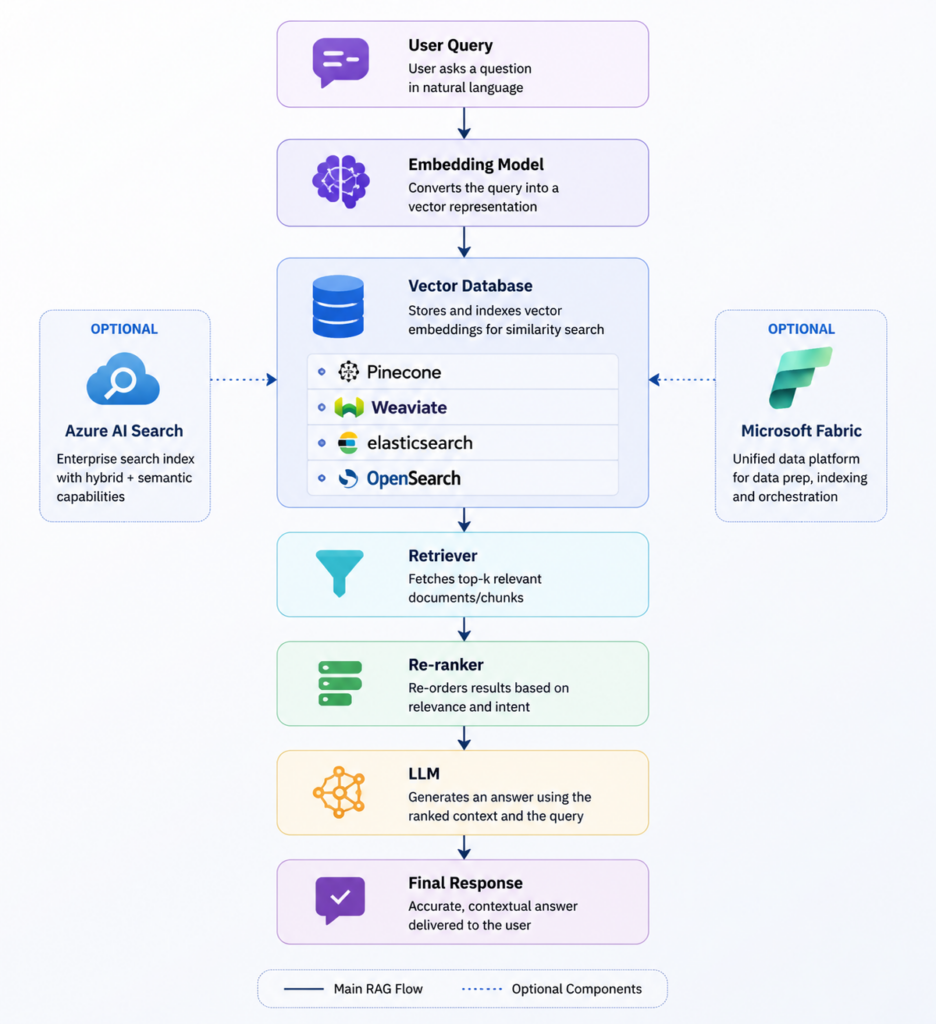
Read more about RAG architectures.
Traditional Search vs Semantic Search in the Era of Generative AI
Generative AI has fundamentally changed search expectations.
Today’s users expect answers rather than lists of links.
This shift has fueled rapid adoption of:
- AI Search
- Conversational Search
- Enterprise Copilots
- Knowledge Assistants
- RAG Platforms
- AI Agents
Semantic search forms the retrieval layer that enables these systems to generate grounded, trustworthy responses.
Read more on How LLMs Power Modern Enterprise Applications.
Enterprise Use Cases – Which industries benefit most from semantic search?
Financial Services
- Regulatory document search
- Policy retrieval
- Customer service copilots
Healthcare
- Clinical knowledge search
- Medical research retrieval
- Patient support assistants
Manufacturing
- Equipment manuals
- Spare parts lookup
- Maintenance knowledge
Retail & Ecommerce
- Product discovery
- Personalized recommendations
- Natural language shopping experiences
Enterprise Knowledge Management
- HR policy search
- IT help desk
- Internal documentation
- SharePoint knowledge retrieval
Read more about Agentic AI Use Cases: 7 Enterprise Examples Driving Autonomous Operations
Best Practices for Implementing Semantic Search
- Combine keyword and semantic retrieval using hybrid search.
- Select embedding models aligned with your domain and language needs.
- Continuously evaluate retrieval quality with user feedback.
- Apply metadata filtering and access controls for secure enterprise search.
- Optimize vector indexes for latency and scalability.
- Integrate semantic search with RAG pipelines to improve AI answer accuracy.
- Monitor retrieval metrics such as precision, recall, and click-through rates.
Know more about RAG vs Knowledge Graphs: Which Delivers Better Performance for Enterprise AI in 2026?
Common Mistakes Organizations Make
❌ Replacing keyword search entirely instead of adopting hybrid search
❌ Ignoring domain-specific vocabulary
❌ Underestimating data governance and security
❌ Deploying without relevance evaluation
❌ Treating semantic search as a one-time implementation rather than an evolving capability
Future Trends
The future of enterprise search is moving toward:
- Agentic AI-powered search
- Multimodal search across text, images, audio, and video
- Context-aware personalization
- Autonomous enterprise knowledge assistants
- Federated search across distributed data sources
- Real-time retrieval integrated with business workflows
Hybrid search—combining keyword precision with semantic understanding—is expected to become the default architecture for enterprise applications.
Explore more in our blog on Enterprise AI Strategy in 2026: A Practical Guide for CIOs and Data Leaders.
How Techment Helps Enterprises Build Intelligent Search
Building an enterprise-grade semantic search platform involves more than integrating an embedding model. Organizations need scalable data pipelines, vector databases, governance frameworks, AI orchestration, and seamless integration with existing business systems.
Techment helps enterprises accelerate this journey by delivering end-to-end capabilities across:
- Enterprise AI Strategy and Consulting
- Retrieval-Augmented Generation (RAG) Solutions
- AI Agents and Enterprise Copilots
- Microsoft Fabric and Azure AI implementations
- Cloud-native Data Engineering
- Intelligent Knowledge Management Platforms
- Search Modernization and AI Integration
Whether modernizing an ecommerce search experience or enabling enterprise-wide knowledge discovery, Techment designs scalable, secure, and business-aligned AI search solutions that drive measurable outcomes.
Is Your Enterprise AI-Ready? Explore our A Fabric-Focused Readiness Checklist
Conclusion
Traditional search continues to serve structured lookup scenarios effectively, but it struggles to meet the expectations of today’s users who interact through natural language and conversational interfaces.
Semantic search addresses these limitations by understanding context, intent, and relationships between concepts. As enterprises increasingly adopt Generative AI, RAG, and AI-powered assistants, semantic retrieval is becoming a foundational capability rather than an optional enhancement.
Organizations evaluating their search strategy should view semantic search not as a replacement for keyword search, but as part of a hybrid architecture that combines precision with contextual intelligence. By investing in modern search capabilities today, businesses can improve customer experiences, enhance employee productivity, and unlock greater value from their enterprise knowledge assets.
Looking to modernize enterprise search with AI? Techment partners with organizations to design and implement scalable semantic search, Retrieval-Augmented Generation (RAG), AI agents, and intelligent knowledge platforms tailored to enterprise needs. Connect with our experts to explore how AI-powered search can accelerate your digital transformation.
Frequently Asked Questions
1. What is the biggest difference between traditional and semantic search?
Traditional search retrieves information based on exact keyword matches, whereas semantic search interprets the meaning and intent behind a user’s query using AI and NLP.
2. Is semantic search replacing keyword search?
Not entirely. Most enterprise platforms now use hybrid search, combining keyword precision with semantic understanding to achieve optimal relevance.
3. What technologies power semantic search?
Common technologies include transformer models (such as BERT), vector embeddings, vector databases (like Pinecone, Weaviate, or Azure AI Search), reranking models, and Retrieval-Augmented Generation (RAG).
4. Does semantic search improve Generative AI applications?
Yes. Semantic search enables LLMs to retrieve accurate, contextually relevant information from enterprise data, reducing hallucinations and improving response quality in AI assistants and copilots.
5. Which industries benefit the most from semantic search?
Industries with large volumes of content—such as retail, healthcare, financial services, manufacturing, legal, and enterprise knowledge management—typically see the greatest improvements in search relevance and user experience.
Related Reads
- RAG in 2026: How Retrieval-Augmented Generation Works for Enterprise AI
- RAG architectures
- Agentic AI Use Cases: 7 Enterprise Examples Driving Autonomous Operations
- Enterprise AI Strategy in 2026: A Practical Guide for CIOs and Data Leaders
- AI-Ready Enterprise Checklist with Microsoft Fabric
- Is Your Enterprise AI-Ready? Explore our A Fabric-Focused Readiness Checklist
- RAG vs Knowledge Graphs: Which Performs Better for Enterprise AI?