Introduction
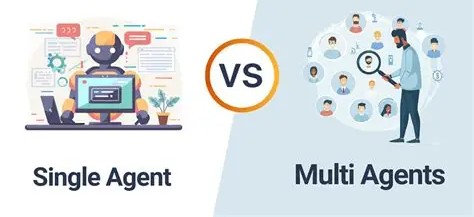
Enterprise AI is no longer about isolated models—it is about orchestrating intelligence across complex, distributed systems. As organizations scale their AI initiatives, the architectural decision between Multi-Agent Systems vs Single-Agent Architectures becomes a defining factor in long-term success.
Traditional single-agent systems—centralized, monolithic AI models—have served well for narrowly scoped use cases. However, as enterprises move toward autonomous workflows, real-time decisioning, and cross-functional intelligence, these architectures begin to show limitations.
Multi-agent systems, by contrast, introduce a paradigm where multiple intelligent agents collaborate, compete, and coordinate to achieve complex outcomes. This shift is not just technical—it is strategic. According to industry perspectives reflected across enterprise AI research and implementation frameworks , organizations are increasingly investing in distributed AI models to improve adaptability, resilience, and decision velocity.
This blog explores the architectural, operational, and strategic differences between Multi-Agent Systems vs Single-Agent Architectures, helping CTOs, CDOs, and enterprise leaders make informed decisions aligned with scalability, governance, and AI maturity.
TL;DR Summary
- Multi-Agent Systems vs Single-Agent Architectures is a critical decision in enterprise AI strategy
- Multi-agent systems enable scalability, resilience, and autonomy but introduce complexity
- Single-agent architectures offer simplicity and control but struggle at enterprise scale
- Governance, orchestration, and data quality become pivotal in multi-agent environments
- Enterprises must align architecture choice with business complexity, scale, and AI maturity
Why Multi-Agent Systems vs Single-Agent Architectures Matters in 2026
The Shift from Models to Systems
Enterprise AI is evolving from isolated models to interconnected systems. The conversation is no longer about “which model performs better,” but about how intelligence is orchestrated across the enterprise.
Single-agent architectures operate as centralized decision-makers. They ingest data, process it, and produce outputs. While effective for contained use cases, they struggle in environments where decisions are distributed across functions, domains, and time horizons.
Multi-agent systems, however, enable multiple specialized agents to collaborate. Each agent can focus on a specific task—data ingestion, reasoning, planning, execution—creating a modular and scalable intelligence layer.
Enterprise Insight:
Organizations adopting distributed AI architectures report improved responsiveness and reduced bottlenecks in decision-making pipelines.
For a deeper perspective on building enterprise-ready AI strategies, explore: Enterprise AI strategy 2026
Market Drivers Accelerating Adoption
Several macro trends are driving the shift toward multi-agent systems:
- Explosion of data complexity across structured and unstructured sources
- Need for real-time decisioning in dynamic environments
- Rise of autonomous workflows in operations and customer engagement
- Integration of GenAI with enterprise systems
Research from firms like Gartner and McKinsey suggests that enterprises leveraging distributed AI architectures achieve significantly higher operational efficiency and adaptability.
Key Implication:
The debate around Multi-Agent Systems vs Single-Agent Architectures is not theoretical—it directly impacts scalability, agility, and competitive advantage.
Where Single-Agent Architectures Still Fit
Despite the rise of multi-agent systems, single-agent architectures are not obsolete. They remain relevant in:
- Narrow, well-defined use cases
- Low-latency decision systems with limited dependencies
- Environments requiring strict centralized control
However, their limitations become evident as complexity grows.
For more insights on foundational AI architectures, refer to: RAG architectures Enterprise Use Cases in 2026.
Understanding Single-Agent Architectures
What is a Single-Agent Architecture?
A single-agent architecture consists of a centralized AI system responsible for decision-making. It processes inputs, applies logic or learned models, and produces outputs independently.
This architecture is often monolithic, meaning all capabilities—data processing, reasoning, and execution—are tightly coupled.
Core Characteristics
Centralized Intelligence:
All decision-making happens within a single entity.
Tight Coupling:
Components are interdependent, making changes more complex.
Deterministic Flow:
Processes follow predefined logic or model-driven pathways.
Benefits of Single-Agent Architectures
Simplicity and Control
Single-agent systems are easier to design, deploy, and manage.
Lower Operational Complexity
Fewer components mean fewer integration challenges.
Predictability
Centralized control ensures consistent behavior.
Limitations at Enterprise Scale
Scalability Constraints
As workloads increase, centralized systems become bottlenecks.
Limited Adaptability
Single-agent systems struggle to adapt to dynamic, multi-domain environments.
Single Point of Failure
Failures in the central agent can disrupt the entire system.
Enterprise Example
Consider a traditional recommendation engine in e-commerce. A single model processes user behavior and generates recommendations. While effective, it lacks the ability to dynamically coordinate across inventory, pricing, and customer engagement systems.
Strategic Takeaway
Single-agent architectures are best suited for controlled, well-scoped environments. However, they are not designed for the complexity of modern enterprise ecosystems.
For more on building scalable data foundations that support AI, explore: Data Quality For AI in 2026 Enterprise Guide
Understanding Multi-Agent Systems
What are Multi-Agent Systems?
Multi-agent systems consist of multiple autonomous agents that interact to achieve shared or individual goals. Each agent operates independently but collaborates through defined protocols.
These systems are inherently distributed, enabling parallel processing, specialization, and dynamic coordination.
Core Characteristics
Decentralized Intelligence
Decision-making is distributed across multiple agents.
Specialization
Each agent performs a specific function.
Collaboration and Coordination
Agents communicate and negotiate to achieve outcomes.
Benefits of Multi-Agent Systems
Scalability
New agents can be added without disrupting existing systems.
Resilience
Failure of one agent does not collapse the entire system.
Adaptability
Agents can dynamically adjust to changing conditions.
Challenges and Trade-offs
Increased Complexity
Designing and managing multiple agents requires sophisticated orchestration.
Governance Challenges
Ensuring compliance and consistency across agents is non-trivial.
Communication Overhead
Coordination between agents introduces latency and complexity.
Operational Trade-offs in Multi-Agent Systems
While multi-agent systems provide scalability and adaptability, they introduce significant operational overhead:
- Protocol Design Complexity: Each agent interaction requires well-defined communication protocols
- State Synchronization Challenges: Maintaining consistent context across agents is non-trivial
- Monitoring Overhead: Each agent requires independent observability and debugging
- Security Expansion: More agents increase attack surfaces and credential management complexity
- Cost Amplification: Redundant context processing increases compute and token usage
- Latency Accumulation: Each agent handoff introduces additional processing delay
Multi-agent systems do not reduce complexity—they redistribute it across coordination layers.
Enterprise Example
In supply chain optimization, multiple agents can handle:
- Demand forecasting
- Inventory management
- Logistics planning
- Supplier coordination
Each agent operates independently but collaborates to optimize the overall system
Strategic Takeaway
Multi-agent systems are ideal for complex, dynamic, and large-scale environments, where centralized systems fail to keep up.
To understand how enterprises are preparing data for such advanced AI systems, refer to:
https://www.techment.com/blogs/ai-ready-enterprise-checklist-microsoft-fabric/
Key Differences: Multi-Agent Systems vs Single-Agent Architectures
Architectural Comparison
Single-Agent: Centralized, monolithic
Multi-Agent: Distributed, modular
Operational Comparison
Single-Agent: Sequential processing
Multi-Agent: Parallel processing
Strategic Comparison
Single-Agent: Best for simplicity
Multi-Agent: Best for scalability and adaptability
Comparative Table
| Dimension | Single-Agent Architecture | Multi-Agent Systems |
|---|---|---|
| Architecture | Centralized | Distributed |
| Scalability | Limited | High |
| Resilience | Low | High |
| Complexity | Low | High |
| Adaptability | Limited | Dynamic |
| Governance | Easier | Comple |
Executive Insight
The choice between Multi-Agent Systems vs Single-Agent Architectures is not binary. Many enterprises adopt hybrid models—combining centralized control with distributed intelligence.
For a deeper understanding of modern data architectures enabling such systems: Microsoft Fabric Architectures 2026
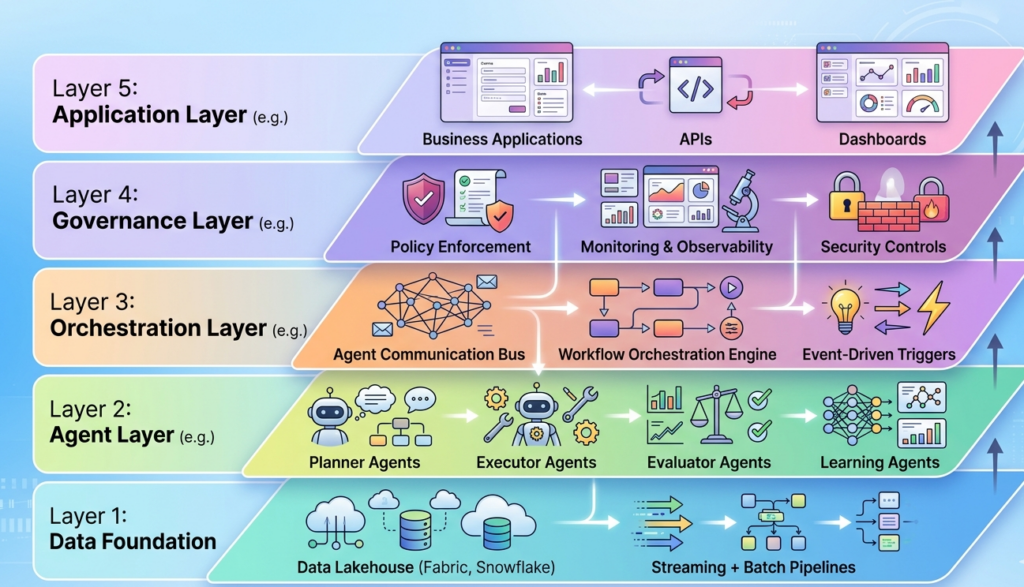
Architecture Deep Dive: How Multi-Agent Systems Work
Agent Roles and Responsibilities
In a multi-agent system, agents are designed with specific roles:
- Planner Agents: Define goals and strategies
- Executor Agents: Perform tasks
- Monitor Agents: Track performance and outcomes
- Coordinator Agents: Manage communication and workflows
Communication Mechanisms
Agents interact through:
- Message passing
- Shared data environments
- Event-driven triggers
Orchestration Layer
The orchestration layer ensures:
- Task coordination
- Conflict resolution
- Workflow optimization
Enterprise Implication
Without proper orchestration, multi-agent systems can become chaotic. Governance frameworks must evolve to manage distributed intelligence effectively.
For insights into governance frameworks, explore: Data Governance For Data Quality
Multi-Agent Orchestration and Workflow Design
Why Workflows Are Critical in Multi-Agent Systems
In the context of Multi-Agent Systems vs Single-Agent Architectures, one of the most overlooked factors is workflow orchestration.
Multi-agent systems are not inherently reliable—they require structured workflows to coordinate interactions between agents. Without orchestration, agent-to-agent communication becomes brittle, unpredictable, and difficult to scale.
Manual chaining of agents often leads to:
- Fragile dependencies
- Uncontrolled execution paths
- Increased failure rates
Workflow-driven orchestration introduces deterministic control over distributed intelligence, ensuring enterprise-grade reliability.
Core Workflow Capabilities in Multi-Agent Systems
| Workflow Capability | Enterprise Purpose |
|---|---|
| Coordination | Controls agent interaction via sequential, parallel, or conditional execution |
| State Management | Maintains shared context across agents to preserve accuracy and continuity |
| Branching Logic | Dynamically routes tasks to specialized agents or escalation paths |
| Transparency | Enables auditability, debugging, and compliance tracking |
Workflows transform multi-agent systems from experimental architectures into enterprise-ready platforms.
Without orchestration, multi-agent systems introduce more risk than value.
Implementation Strategies: Choosing Between Multi-Agent Systems vs Single-Agent Architectures
When to Choose Single-Agent Architectures
Single-agent architectures remain a pragmatic choice when enterprise requirements are constrained and predictable. In many enterprise scenarios, the decision between Multi-Agent Systems vs Single-Agent Architectures is made prematurely—often based on perceived complexity rather than validated requirements.
A more effective strategy is to start with a single-agent prototype, then evolve toward multi-agent systems only when necessary.
When Single-Agent Should Be Your First Step
Clear Role Separation Exists
Distinct roles (planner, executor, reviewer) do not automatically require multiple agents. A single agent can simulate role-based behavior using:
- Persona-based prompting
- Context-aware policies
- Tool-based execution control
Rapid Time-to-Market is Critical– Single-agent systems enable faster prototyping, iteration, and validation.
Cost Optimization is a Priority– Single agents minimize token usage and infrastructure overhead.
Data Volume is High but Manageable– Many scalability issues stem from poor retrieval design—not architecture.
High Throughput Requirements Exist– Test whether a single agent can meet performance needs before introducing orchestration complexity.
Multi-Modality is Required– Modern models can handle text, images, and structured data within a single agent.
When to Choose Multi-Agent Systems
Multi-agent systems are the preferred choice when enterprises operate in complex, dynamic, and distributed environments.
Ideal Use Cases:
- Autonomous supply chain optimization
- Real-time financial decision systems
- Intelligent customer engagement platforms
- AI-driven enterprise operations
Key Strategic Drivers:
- Need for parallel decision-making
- Cross-domain orchestration
- Continuous learning and adaptation
According to enterprise AI implementation patterns outlined in modern strategy frameworks , organizations leveraging distributed agent-based systems achieve significantly higher scalability and resilience. These systems excel in environments where:
- Decision logic is linear and well-defined
- Data sources are limited and structured
- Latency requirements are strict and coordination overhead must be minimal
Enterprise Scenarios:
- Fraud detection models with deterministic rules
- Static recommendation engines
- Internal analytics tools with limited scope
From a strategic standpoint, single-agent architectures reduce time-to-market and simplify governance. However, they should be viewed as foundational, not future-proof, particularly as enterprises move toward composable AI ecosystems.
Hybrid Architectures: The Emerging Standard
Most enterprises are not choosing between Multi-Agent Systems vs Single-Agent Architectures—they are combining both.
Hybrid Model Approach:
- Centralized governance layer (single-agent control)
- Distributed execution layer (multi-agent collaboration)
This allows organizations to balance control with scalability, ensuring that innovation does not compromise governance.
For deeper insights into enterprise AI implementation strategies: Microsoft Fabric Ai solutions Enterprise Intelligence
Enterprise Architecture Decision Framework: Multi-Agent vs Single-Agent
A Strategic Decision Model for CTOs
Choosing between Multi-Agent Systems vs Single-Agent Architectures should not be a technical decision alone—it must align with enterprise operating models, data maturity, and AI ambitions.
Below is a structured decision framework used by enterprise architecture teams:
Decision Matrix Table
| Decision Factor | Single-Agent Architecture | Multi-Agent Systems |
|---|---|---|
| Business Complexity | Low | High |
| Data Volume & Variety | Limited | Massive & diverse |
| Real-Time Requirements | Moderate | High |
| Cross-System Integration | Minimal | Extensive |
| AI Maturity Level | Early-stage | Advanced |
| Governance Complexity | Low | High |
| Innovation Velocity | Slower | Faster |
Executive Insight
- If your enterprise operates in predictable workflows, single agent suffice.
Governance, Risk, and Compliance in Multi-Agent Systems
Why Governance Becomes Complex
In single-agent systems, governance is straightforward—one system, one decision pathway. In multi-agent systems, governance becomes exponentially more complex due to:
- Distributed decision-making
- Autonomous agent behavior
- Dynamic interactions between agents
Key Governance Challenges
Consistency:
Ensuring all agents adhere to enterprise policies
Auditability:
Tracking decisions across multiple agents
Data Integrity:
Maintaining consistent and reliable data across distributed systems
Security Risks:
Preventing unauthorized agent actions or data acces
Governance Framework for Multi-Agent Systems
Policy Layer:
Defines rules and constraints for all agents
Monitoring Layer:
Tracks agent behavior and performance
Control Layer:
Intervenes when agents deviate from expected behaviorStrategic Insight
Governance is not optional—it is foundational. Enterprises that fail to establish robust governance frameworks risk losing control over their AI systems.
Explore how AI data discovery is reshaping enterprise analytics, what architectures enable it, and how organizations can operationalize it to accelerate insight generation and decision-making.
Performance, Scalability, and Cost Trade-offs
Performance Considerations
Single-Agent Systems:
- Faster for simple tasks
- Lower latency due to centralized processing
Multi-Agent Systems:
- Faster for complex, parallel tasks
- Potential latency due to communication overhead
Scalability Analysis
Single-Agent:
Scaling requires increasing system capacity, which becomes expensive and inefficient
Multi-Agent:
Scaling is achieved by adding more agents, enabling horizontal scalability
Cost Implications
Single-Agent:
- Lower initial cost
- Higher long-term scaling cost
Multi-Agent:
Executive Takeaway
Enterprises must evaluate not just immediate costs but long-term scalability economics when choosing between Multi-Agent Systems vs Single-Agent Architectures.
Explores how enterprises can systematically approach preventing data leakage in GenAI and Copilot implementations, covering architecture, governance, risks, and practical strategies aligned with modern enterprise environments.
Real-World Enterprise Applications
Financial Services
Multi-agent systems enable:
- Fraud detection agents
- Risk assessment agents
- Compliance monitoring agents
These agents collaborate to provide real-time financial insights.
Healthcare
Applications include:
- Diagnostic agents
- Treatment recommendation agents
- Patient monitoring agents
Retail and E-commerce
Multi-agent systems support:
- Personalized recommendations
- Inventory optimization
- Dynamic pricing
Manufacturing
Use cases include:
- Predictive maintenance
- Supply chain coordination
- Production optimization
Strategic Insight
Industries with high complexity and interdependencies benefit most from multi-agent systems.
For more on enterprise AI applications: Microsoft Azure For Cloud AI Modernization.
Future Trends: The Rise of Autonomous Enterprise Systems
From Automation to Autonomy
Enterprises are moving from rule-based automation to fully autonomous systems powered by multi-agent architectures.
Integration with Generative AI
Multi-agent systems are increasingly integrated with GenAI to enable:
- Context-aware decision-making
- Natural language interaction
- Adaptive workflows
AI-Native Enterprises
The future belongs to organizations that are AI-native, where intelligence is embedded across all processes.
Strategic Prediction
Within the next 3–5 years, multi-agent systems will become the default architecture for enterprise AI.
Supporting Insight
Enterprise AI readiness frameworks emphasize the importance of scalable, distributed architectures for future growth .
Explore how to prepare for AI-native transformation
How Techment Helps Enterprises
Building Enterprise-Grade AI Architectures
Techment enables organizations to navigate the complexity of Multi-Agent Systems vs Single-Agent Architectures through:
- AI strategy consulting aligned with business goals
- Data modernization for scalable AI systems
- Platform implementation using Microsoft Fabric and Azure
Enabling Multi-Agent Ecosystems
Techment supports:
- Agent orchestration frameworks
- Distributed data architectures
- Real-time analytics integration
Governance and Compliance
Techment helps enterprises implement:
- Data governance frameworks
- AI compliance models
- Monitoring and observability systems
End-to-End Transformation
From strategy to execution, Techment delivers:
- Roadmap design
- Architecture implementation
- Continuous optimization
Strategic Positioning
Techment acts as a trusted advisor, helping enterprises balance innovation with control in their AI journey.
For more insights: What does a Microsoft Data And AI partner brings to your data strategy
Conclusion
The debate around Multi-Agent Systems vs Single-Agent Architectures is fundamentally about how enterprises design intelligence at scale.
Single-agent architectures offer simplicity and control, making them suitable for well-defined use cases. However, they fall short in addressing the complexity, scale, and dynamism of modern enterprise environments.
Multi-agent systems, while more complex, provide the scalability, resilience, and adaptability required for the future of enterprise AI. They enable organizations to move beyond isolated intelligence toward orchestrated, autonomous ecosystems.
The path forward is not about choosing one over the other—it is about strategically combining both to align with business goals, operational complexity, and AI maturity.
As enterprises evolve toward AI-native models, the ability to design and govern distributed intelligence will become a critical differentiator.
Techment stands ready to guide organizations through this transformation—helping them build scalable, governed, and future-ready AI architectures.
FAQ Section
1. What is the main difference between multi-agent systems and single-agent architectures?
Multi-agent systems involve multiple autonomous agents collaborating, while single-agent architectures rely on a centralized system for decision-making.
2. Are multi-agent systems always better than single-agent architectures?
No. Multi-agent systems are better for complex, scalable environments, while single-agent architectures are suitable for simpler, controlled use cases.
3. What are the biggest challenges in multi-agent systems?
Governance, coordination, communication overhead, and system complexity are the primary challenges.
4. How do enterprises transition from single-agent to multi-agent systems?
Through phased adoption, starting with hybrid architectures and gradually introducing distributed agents.
5. What skills are required to implement multi-agent systems?
Expertise in distributed systems, AI/ML, data engineering, and governance frameworks is essential.