

AI application development challenges are among the biggest obstacles organizations face when building intelligent, scalable, and production-ready AI solutions. While Artificial Intelligence (AI) can automate processes, improve decision-making, and unlock new business opportunities, developing successful AI applications requires more than choosing the right model. Organizations must overcome challenges related to data quality, business alignment, enterprise integration, responsible AI, and production scalability to realize measurable business value.
AI application development faces five major challenges: poor data quality, unclear business objectives, system integration, responsible AI and explainability, and scaling AI into production. Organizations can overcome these challenges by implementing strong data governance, defining measurable business goals, adopting API-first architectures, embedding AI governance, and leveraging MLOps for continuous monitoring and optimization.
Introduction
AI application development involves designing, building, deploying, and maintaining intelligent software that learns from data to solve business problems. While AI offers significant competitive advantages, successful implementation requires more than advanced algorithms—it demands high-quality data, clear business goals, scalable architecture, governance, and continuous optimization.
Artificial Intelligence (AI) is transforming how businesses automate processes, improve customer experiences, and make data-driven decisions. However, building successful AI applications is far more complex than training a machine learning model. Organizations often struggle with poor data quality, unclear business objectives, legacy system integration, responsible AI concerns, and scaling AI from proof of concept to production.
This article explores the top five AI application development challenges and practical strategies to overcome them. Whether you’re a CIO, CTO, product leader, or engineering team, these insights will help you build AI solutions that are accurate, scalable, secure, and aligned with business goals.
Related Reading: AI-Accelerated Legacy Modernization for Enterprise & SaaS Platforms
TL;DR
- AI success starts with clean, well-governed data.
- Define measurable business outcomes before building AI models.
- Design AI to integrate seamlessly with enterprise systems.
- Prioritize explainability, governance, and security from day one.
- Adopt MLOps and continuous monitoring to scale AI applications successfully.
Top 5 Challenges in AI Application Development
Understanding AI application development challenges before starting an AI initiative helps organizations reduce risks, improve deployment success, and accelerate business value. Artificial Intelligence is no longer a futuristic concept—it has become a strategic business capability. From intelligent automation and predictive analytics to generative AI assistants, organizations are investing heavily in AI to improve efficiency, reduce costs, and create better customer experiences.
However, despite growing investments, many AI initiatives struggle to move beyond the pilot stage. The challenge is rarely the algorithm itself. Instead, organizations often face issues related to data readiness, integration, governance, scalability, and business alignment.
Understanding these challenges before development begins enables organizations to build AI applications that deliver measurable business value rather than isolated technical successes.
1. Poor Data Quality and Availability
Poor data quality is one of the biggest obstacles to successful AI application development. AI models rely on accurate, complete, and consistent data to generate reliable predictions. Organizations that invest in data governance, cleaning, and integration create stronger AI models with better business outcomes and reduced operational risks.
AI models are only as good as the data used to train them. Incomplete, inconsistent, biased, or siloed data results in inaccurate predictions, unreliable insights, and poor business outcomes.
Data remains the foundation of every successful AI application. Yet many organizations store information across disconnected systems such as CRM platforms, ERP applications, spreadsheets, and legacy databases. Inconsistent formats, duplicate records, and missing values make it difficult for AI models to identify meaningful patterns.
Generative AI applications introduce additional complexity because they rely on high-quality enterprise knowledge bases for Retrieval-Augmented Generation (RAG). Poor documentation or outdated knowledge repositories often lead to hallucinations or inaccurate responses.
Addressing these AI application development challenges starts with building a strong data foundation.
How to Solve It
- Establish enterprise-wide data governance.
- Standardize data collection processes.
- Remove duplicates and inconsistencies.
- Create a unified data platform.
- Continuously monitor data quality.
Enterprise Insight: Organizations that invest in data quality before model development typically achieve faster AI adoption and better business outcomes than those focusing solely on algorithm selection.
2. Unclear Business Objectives
AI projects often fail when organizations prioritize technology over business outcomes. Clearly defining business objectives, measurable KPIs, and expected ROI ensures AI initiatives remain focused, deliver tangible value, and align with long-term organizational goals instead of becoming isolated technology experiments.
Many AI projects fail because organizations begin with technology instead of business problems. Without defined objectives, even technically successful AI models struggle to demonstrate business value.
A common mistake is starting with the question, “Where can we use AI?” Instead, organizations should ask:
- Which business process needs improvement?
- What measurable outcome are we trying to achieve?
- How will success be measured?
Whether the objective is reducing customer support response times, detecting fraud, forecasting demand, or automating document processing, every AI initiative should align with strategic business priorities.
How to Solve It
Define clear KPIs before development begins.
Examples include:
- Reduce support costs by 30%
- Increase forecasting accuracy
- Improve document processing speed
- Decrease manual effort
- Improve customer satisfaction
A focused Proof of Concept (PoC) should validate business value before scaling into production.
3. Integrating AI with Existing Enterprise System
AI applications deliver the greatest value when they integrate seamlessly with existing enterprise systems such as ERP, CRM, cloud platforms, and business workflows. API-first architectures and modular integration strategies improve scalability, reduce deployment challenges, and accelerate enterprise AI adoption.
Even high-performing AI models deliver little value if they cannot integrate with existing enterprise applications, workflows, and business processes.
Most organizations operate complex technology ecosystems involving ERP, CRM, HR systems, cloud platforms, APIs, and legacy applications. AI applications must seamlessly exchange data with these systems to become part of everyday operations.
Poor integration often leads to duplicate work, inconsistent data, and low user adoption. System integration remains one of the most overlooked AI application development challenges, especially in enterprises with legacy infrastructure.
How to Solve It
Successful AI applications are designed using an API-first and modular architecture.
Best practices include:
- Use REST APIs and event-driven integration.
- Design cloud-native architectures.
- Leverage enterprise integration platforms.
- Plan deployment during solution design—not after model development.
- Ensure interoperability across business applications.
Integration should be viewed as a core component of AI architecture rather than a post-development activity.
4. Building Trust Through Explainable and Responsible AI
Responsible AI focuses on developing transparent, explainable, fair, and secure AI systems that users can trust. Organizations that implement governance frameworks, bias detection, explainable AI techniques, and human oversight improve compliance, reduce operational risks, and encourage wider AI adoption.
AI adoption depends on trust. Users are unlikely to rely on AI recommendations if they cannot understand how decisions are made or whether those decisions are fair and compliant. Organizations should align AI governance practices with recognized frameworks such as the NIST AI Risk Management Framework (AI RMF 1.0) to identify, assess, and mitigate AI-related risks while improving transparency, accountability, fairness, and regulatory compliance throughout the AI lifecycle.
Industries such as healthcare, banking, insurance, and public services require transparency, accountability, and governance. Black-box models without explainability create regulatory, ethical, and operational risks.
Responsible AI also includes addressing bias, protecting privacy, and ensuring human oversight for critical decisions.
Related Reading: Enterprise AI Governance Framework: Complete 2026 Guide for Responsible AI
How to Solve It
Organizations should embed Responsible AI principles throughout the development lifecycle.
Key practices include:
- Explain model outputs clearly.
- Detect and mitigate bias.
- Implement human-in-the-loop validation.
- Maintain audit trails.
- Establish AI governance policies.
- Regularly evaluate model performance.
Building trustworthy AI improves user adoption and reduces long-term operational risk.
5. Scaling AI from Pilot to Production
Many AI initiatives succeed as prototypes but struggle in production due to model drift, operational complexity, and changing business requirements. MLOps, continuous monitoring, automated deployment, and regular model retraining help organizations scale AI applications reliably and maintain long-term performance.
Many AI initiatives succeed during experimentation but fail when deployed across the enterprise. Scaling AI requires operational processes, governance, and continuous monitoring—not just accurate models.
As business environments evolve, AI models experience data drift, concept drift, and changing user behavior. Without monitoring, model performance gradually declines.
This is where MLOps and LLMOps become essential. Scaling models into production is one of today’s most significant AI application development challenges because it requires governance, monitoring, and continuous optimization.
How to Solve It
Organizations should establish repeatable AI operational practices.
These include:
- Automated model deployment
- Version control
- Continuous evaluation
- Performance monitoring
- Drift detection
- Feedback loops
- Security monitoring
Treat AI as a continuously improving product rather than a one-time software project.
AI Development Challenges Comparison Table
The most effective way to address AI development challenges is by aligning each challenge with a proven solution. Data governance improves model accuracy, business-first planning increases ROI, API-first architectures simplify integration, Responsible AI builds trust, and MLOps enables scalable, production-ready AI systems.
| Challenge | Why It Happens | Business Impact | Best Solution |
|---|---|---|---|
| Poor Data Quality | Siloed, inconsistent, incomplete data | Low prediction accuracy | Data governance, data engineering, unified data platform |
| Unclear Objectives | No defined business KPIs | Poor ROI and failed projects | Business-first AI strategy with measurable outcomes |
| Legacy System Integration | Disconnected enterprise applications | Slow deployment and low adoption | API-first architecture and cloud-native integration |
| Explainability & Responsible AI | Black-box models and regulatory requirements | Compliance risks and low trust | Explainable AI (XAI), governance, human oversight |
| Scaling AI | No monitoring or operational processes | Model drift and inconsistent performance | MLOps, LLMOps, continuous evaluation and monitoring |
Enterprise Best Practices for Successful AI Development
Successful enterprise AI initiatives combine strong data governance, clear business objectives, scalable architectures, Responsible AI principles, and continuous monitoring. Organizations that treat AI as an ongoing business capability rather than a one-time project consistently achieve higher adoption and measurable business outcomes.
Organizations that consistently deliver successful AI initiatives typically follow these best practices:
- Start with clearly defined business outcomes.
- Prioritize data quality over model complexity.
- Build AI using scalable, cloud-native architectures.
- Incorporate Responsible AI and governance from day one.
- Continuously monitor models after deployment.
- Foster collaboration between business, data, and engineering teams.
- Measure AI success using business KPIs—not just model accuracy.
Related Reading: AI Product Development Cost in 2026: Enterprise Pricing Guide to Building Scalable AI Solutions
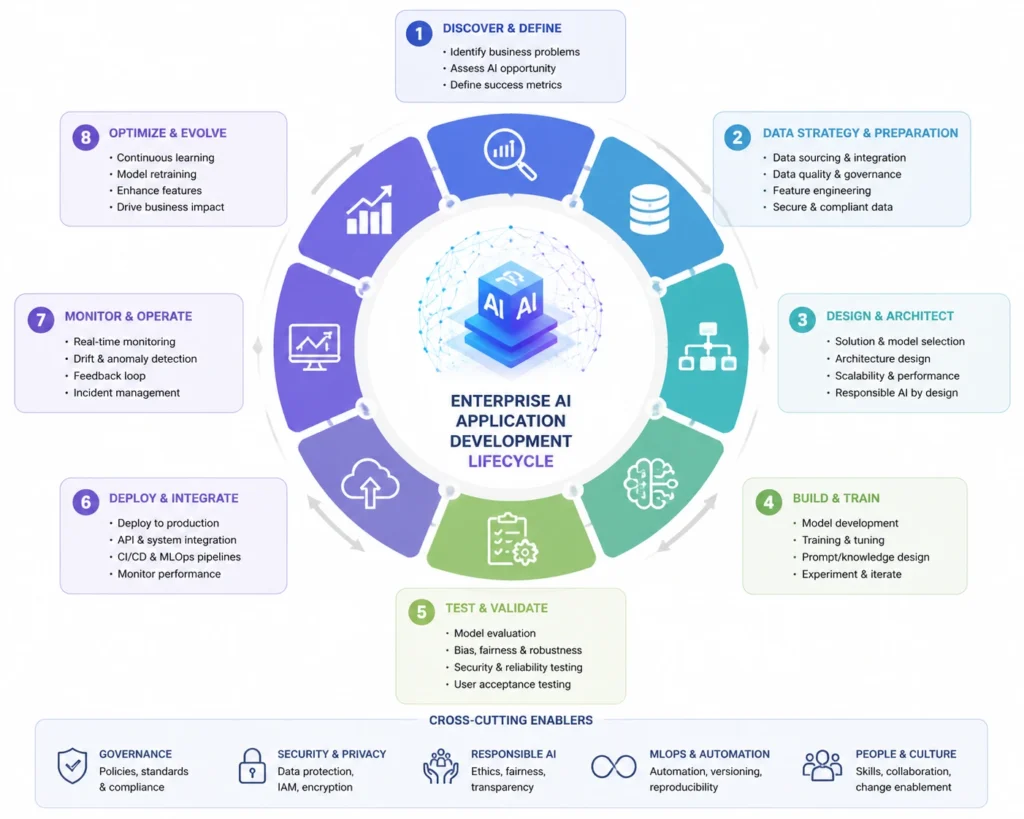
AI Application Development Roadmap
A structured AI development roadmap helps organizations reduce implementation risks and accelerate deployment. Starting with business discovery, followed by data preparation, model development, pilot testing, production deployment, and continuous optimization, ensures AI applications remain scalable, secure, and aligned with evolving business needs.
- Identify the business problem.
- Assess data readiness.
- Build and validate a Proof of Concept.
- Pilot with business users.
- Deploy using scalable MLOps practices.
- Continuously monitor, optimize, and improve.
Related Reading: Data Governance for Data Quality: Building Trusted, AI-Ready Enterprise Data
Common Mistakes to Avoid
Many AI projects fail because organizations overlook foundational requirements such as data quality, business alignment, governance, and operational monitoring. Avoiding these common mistakes improves deployment success, reduces project risks, and maximizes long-term business value from AI investments.
- Starting with technology instead of business goals.
- Ignoring data quality issues.
- Underestimating integration complexity.
- Treating AI as a one-time implementation.
- Overlooking governance, security, and compliance requirements.
Future Trends in AI Application Development
AI application development is rapidly evolving with advancements in agentic AI, Retrieval-Augmented Generation (RAG), multimodal AI, domain-specific language models, and AI governance. Organizations that invest in scalable architectures today will be better prepared to adopt these innovations and maintain a competitive advantage.
The next generation of AI applications will increasingly focus on:
- Agentic AI capable of autonomous task execution.
- Retrieval-Augmented Generation (RAG) for enterprise knowledge retrieval.
- Smaller, domain-specific language models for improved efficiency.
- Multimodal AI combining text, images, audio, and video.
- AI governance platforms to support regulatory compliance and responsible AI practices.
Organizations that invest in scalable architectures and governance today will be better positioned to adopt these emerging capabilities.
AI Readiness Checklist
Is Your Organization Ready for AI?
Before starting AI application development, ask these questions:
✔ Is the business problem clearly defined?
✔ Do you have sufficient, high-quality data?
✔ Have you identified measurable success metrics?
✔ Can your existing systems integrate with AI?
✔ Do you have governance and security policies in place?
✔ Have you planned for monitoring and model retraining?
If the answer to most of these questions is “No,” addressing these foundational areas first can significantly improve the likelihood of a successful AI initiative.
From Idea to Production: AI Development Lifecycle
| Stage | Objective | Success Metric |
|---|---|---|
| Business Discovery | Identify high-value use cases | Clearly defined KPIs |
| Data Preparation | Clean and organize enterprise data | High-quality datasets |
| Model Development | Build and validate AI models | Accuracy and precision |
| Pilot Deployment | Test with real users | Business validation |
| Production Deployment | Integrate into enterprise workflows | User adoption |
| Continuous Optimization | Monitor, retrain, and improve | Sustained model performance |
Conclusion
Successful AI application development requires more than selecting the right technology. Organizations that prioritize high-quality data, business alignment, responsible AI, seamless integration, and scalable operations are better positioned to build trustworthy AI solutions that deliver sustainable business value and long-term competitive advantage.
Developing successful AI applications involves much more than selecting the right algorithms. High-quality data, clearly defined business objectives, seamless system integration, responsible AI practices, and scalable operational processes are essential for long-term success.
Organizations that proactively address these AI application development challenges are better positioned to build scalable, trustworthy, and business-ready AI solutions.
At Techment, we help enterprises design, build, and scale production-ready AI solutions by combining expertise in Enterprise AI, Data Engineering, AI Strategy, Generative AI, RAG, AI Agents, Microsoft Fabric, Cloud, and modern software engineering. Whether you’re exploring your first AI initiative or scaling enterprise-wide adoption, the right strategy and technology foundation can accelerate your journey from proof of concept to measurable business value.
Key Takeaways
- AI projects succeed when business goals drive technology decisions.
- High-quality, governed data is the foundation of reliable AI.
- Enterprise AI requires seamless integration with existing systems.
- Responsible AI improves trust, compliance, and user adoption.
- MLOps enables scalable, production-ready AI applications.
- Continuous monitoring ensures AI models remain accurate over time.
FAQ Section On Enterprise AI Development Challenges
1. What are the AI application development challenges?
The biggest challenges include poor data quality, unclear business objectives, legacy system integration, responsible AI concerns, and scaling AI applications from pilot to production.
2. Why do AI application development projects fail?
Most projects fail due to inadequate data, undefined business goals, poor stakeholder alignment, integration challenges, and lack of operational monitoring after deployment.
3. How can businesses improve AI implementation success?
Businesses can improve success by defining measurable KPIs, investing in data governance, integrating AI with existing systems, implementing Responsible AI practices, and adopting MLOps.
4. What is the role of MLOps in AI application development?
MLOps automates model deployment, monitoring, versioning, and retraining, enabling organizations to maintain AI performance and scale applications efficiently.
5. Why is data quality critical for AI applications?
AI models learn from data. High-quality, accurate, and consistent data improves prediction accuracy, reduces bias, and enhances overall model performance.
6. How does Responsible AI improve enterprise adoption?
Responsible AI promotes transparency, fairness, security, and explainability, helping organizations meet compliance requirements while building user trust.
7. How long does it take to develop an AI application?
Development timelines vary by complexity. A focused proof of concept may take 6–12 weeks, while enterprise-scale AI applications typically require 3–9 months, depending on data readiness, integration needs, governance, and deployment scope.
Related Reads
- Enterprise AI Governance Framework: Complete 2026 Guide for Responsible AI
- How to Build Enterprise AI Copilots: A Complete Guide for Business Leaders (2026)
- AI Agent Evaluation Frameworks Compared: Choosing the Right Platform for Enterprise AI in 2026
- Agentic vs copilot AI
- AI Product Development Cost in 2026: Enterprise Pricing Guide to Building Scalable AI Solutions
- AI-Accelerated Legacy Modernization for Enterprise & SaaS Platforms