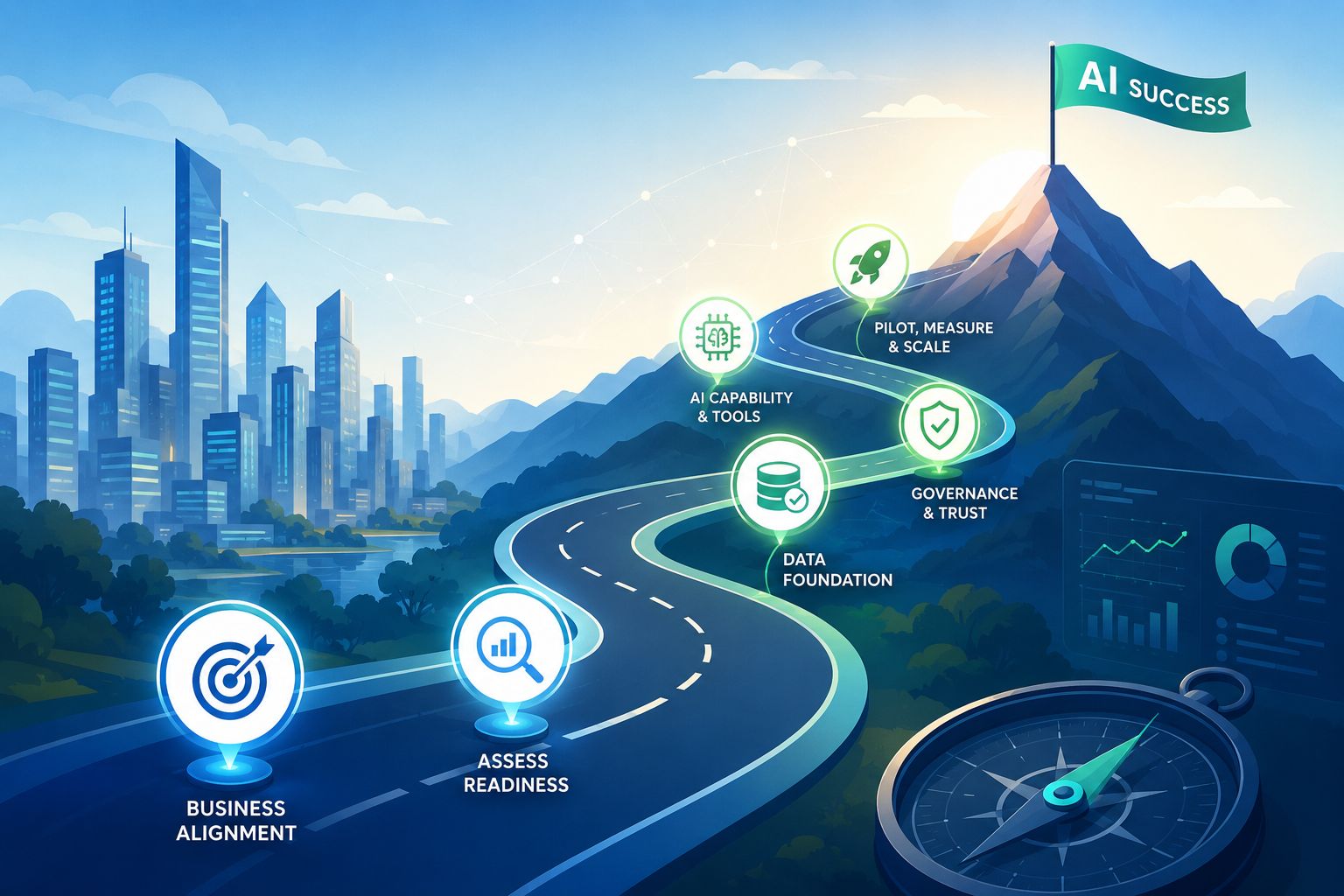
Introduction
Artificial intelligence is entering a defining phase across the financial services industry—and few sectors are poised for as profound a transformation as insurance. The future of AI in insurance extends far beyond automation. It represents a fundamental shift in how insurers understand risk, interact with customers, and operate their enterprises.
Historically, insurance has relied on actuarial science, statistical models, and manual processes to price risk and process claims. But today, AI systems can analyze billions of data points in seconds, detect patterns invisible to traditional analytics, and generate real-time insights that reshape decision-making.
The result is a rapidly evolving insurance landscape. Customers expect personalized policies, faster claims processing, and seamless digital experiences. Meanwhile, insurers face mounting pressure to improve operational efficiency, detect fraud, and adapt to emerging risks such as climate volatility and cyber threats.
This is where AI becomes transformational.
Advanced technologies—including generative AI, predictive analytics, and multi-agent AI systems—are enabling insurers to reimagine their entire value chain. From automated underwriting to AI-assisted claims processing and conversational customer service, AI is becoming the central nervous system of the modern insurance enterprise.
However, unlocking the future of AI in insurance requires more than deploying isolated tools. It demands enterprise-wide transformation—rewiring operating models, modernizing data platforms, and embedding AI into every workflow.
This article explores how AI is reshaping insurance across underwriting, claims, risk modeling, customer engagement, and enterprise operations—and what insurers must do to stay competitive in an AI-driven future.
TL;DR (Executive Summary)
- The future of AI in insurance is reshaping underwriting, claims, distribution, and customer engagement.
- Generative AI and agentic AI systems enable automation, personalization, and real-time risk intelligence.
- AI leaders in insurance generate 6× higher shareholder returns than laggards by embedding AI enterprise-wide.
- The biggest transformation opportunities lie in AI-driven underwriting, automated claims, and hyper-personalized insurance products.
- Insurers must modernize data platforms, governance frameworks, and operating models to scale AI successfully.
The Future of AI in Insurance: Why the Industry Is at a Turning Point
The insurance industry is approaching a pivotal transformation moment. For decades, insurers have gradually digitized their operations—but artificial intelligence is accelerating this shift dramatically.
Industry research suggests that AI-driven insurers are significantly outperforming their competitors. According to analysis by leading consulting firms, AI leaders in insurance have generated more than six times the total shareholder returns of AI laggards over the past five years. The gap continues to widen as AI adoption scales across the industry.
According to a recent report by McKinsey & Company on the future of AI in insurance, insurers that lead in AI adoption have generated over six times the total shareholder returns compared with AI laggards over the past five years. The report highlights that generative AI, predictive analytics, and agentic automation are enabling insurers to transform underwriting, claims management, and customer engagement at scale. These findings reinforce the growing consensus that the future of AI in insurance will be defined not by isolated pilots but by enterprise-wide transformation strategies.
Several forces are driving the urgency around the future of AI in insurance.
First, customer expectations have fundamentally changed. Digital-first consumers now expect real-time policy quotes, instant claims processing, and personalized coverage recommendations. AI enables insurers to deliver these capabilities at scale.
Second, the complexity of risk is increasing. Climate change, cyber threats, and emerging technologies are introducing new variables into risk modeling. Traditional actuarial approaches alone are no longer sufficient to analyze these multidimensional risks.
Third, operational efficiency has become a strategic imperative. Insurance organizations process enormous volumes of documents, claims, and customer interactions daily. AI automation can dramatically reduce costs while improving accuracy.
Finally, the rise of generative AI is unlocking new possibilities. Unlike traditional analytics models, generative AI can understand unstructured data such as medical reports, accident photos, legal documents, and customer conversations. This capability dramatically expands the scope of AI applications in insurance.
For insurers pursuing AI-driven transformation, data becomes the critical foundation. Organizations must ensure their data ecosystems are reliable, governed, and scalable before AI can deliver meaningful business value.
Enterprises exploring this transformation often begin by building a strong data strategy aligned with long-term analytics goals. Techment explores this approach in detail in Enterprise AI Strategy 2026, which highlights how data-driven organizations unlock competitive advantage through modern analytics platforms.
As insurers continue their digital transformation journeys, AI is becoming the catalyst that connects strategy, data, and operational execution.
Key AI Technologies Transforming the Insurance Industry
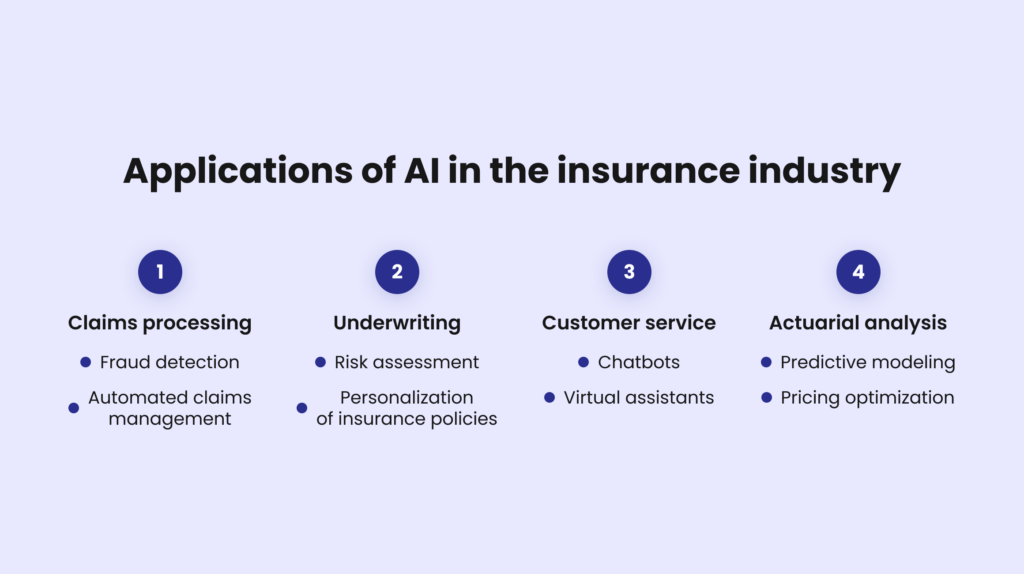
The future of AI in insurance is shaped by several rapidly advancing technologies that extend far beyond traditional machine learning models. Together, these technologies create a powerful ecosystem that enables insurers to automate workflows, enhance decision-making, and deliver personalized experiences.
Understanding these technologies is critical for executives designing AI strategies within insurance enterprises.
Generative AI for Insurance Intelligence
Generative AI represents one of the most disruptive innovations currently transforming the insurance sector.
Unlike conventional AI models that focus on prediction, generative AI systems can create content, synthesize insights, and interact with users conversationally. This capability enables insurers to automate complex workflows involving text, documents, and communication.
For example, generative AI systems can:
- Generate personalized policy explanations for customers
- Summarize complex claim documents
- Draft regulatory reports
- Assist underwriters by analyzing historical risk patterns
These capabilities significantly enhance productivity across underwriting, claims, and compliance functions.
Agentic AI Systems
A major breakthrough shaping the future of AI in insurance is the emergence of agentic AI.
Agentic systems consist of multiple AI agents that collaborate autonomously to perform complex tasks. Instead of a single AI model performing one function, a network of specialized agents can coordinate workflows across multiple systems.
In insurance, agentic AI can automate entire processes such as customer onboarding.
For example:
- An intake agent gathers policyholder information
- A risk analysis agent evaluates risk exposure
- A pricing agent generates policy quotes
- A compliance agent ensures regulatory adherence
Together, these agents create an automated decision engine capable of handling complex insurance processes with minimal human intervention.
Predictive Analytics and Risk Modeling
Predictive analytics remains foundational to AI-driven insurance.
Advanced machine learning models can analyze historical claims data, geographic patterns, customer behavior, and external datasets to predict potential risks. These models help insurers improve underwriting accuracy while reducing loss ratios.
AI-powered predictive analytics can also identify emerging risks that traditional actuarial models might miss.
Conversational AI and Voice Agents
Customer engagement is another domain where AI is delivering major impact.
Conversational AI platforms enable insurers to deploy intelligent chatbots and voice assistants that handle customer interactions across digital channels. These systems can answer policy questions, guide customers through claims processes, and provide personalized product recommendations.
Enterprises adopting conversational AI often rely on scalable cloud platforms and enterprise AI frameworks to ensure reliability and security. As Techment discusses in Data Quality for AI in 2026: The Ultimate Blueprint, scalable AI depends on trusted data foundations.
Together, these technologies form the foundation of the AI-powered insurance enterprise.
AI-Powered Underwriting: Transforming Risk Assessment
Underwriting sits at the heart of the insurance business. It determines how insurers evaluate risk, price policies, and maintain profitability.
Traditionally, underwriting has relied heavily on historical data, actuarial models, and manual analysis by experienced professionals. While effective, these processes can be time-consuming and limited in scope.
The future of AI in insurance underwriting introduces a dramatically more sophisticated approach.
Real-Time Risk Intelligence
AI models can analyze vast volumes of structured and unstructured data in real time, enabling insurers to build more comprehensive risk profiles.
These models can incorporate:
- Satellite imagery
- Climate data
- IoT sensor data
- Social and behavioral indicators
- Historical claims patterns
By integrating these diverse datasets, AI-driven underwriting systems generate more accurate risk predictions.
For example, property insurers can analyze satellite images and climate trends to estimate future natural disaster exposure. Similarly, health insurers can leverage medical records and lifestyle data to improve risk scoring.
AI-Augmented Underwriters
Importantly, AI is not replacing human underwriters. Instead, it is augmenting their capabilities.
AI-powered underwriting assistants can analyze complex documents, extract relevant insights, and present recommendations to human experts. This collaboration significantly improves decision speed and consistency.
In many cases, underwriting tasks that previously required days can now be completed within minutes.
Dynamic Pricing and Product Personalization
Another major advantage of AI-driven underwriting is the ability to personalize insurance products.
AI models can dynamically adjust policy pricing based on individual risk profiles, behavioral data, and contextual factors.
For example:
- Auto insurers can price policies based on real-time driving data.
- Health insurers can adjust premiums based on wellness metrics.
- Property insurers can assess risk using geospatial analytics.
This level of personalization represents a major shift in the future of AI in insurance, enabling insurers to move from standardized policies to customized coverage models.
To support these advanced analytics capabilities, insurers must invest in modern data platforms that unify structured and unstructured datasets across the enterprise. Techment explores this architecture in Microsoft Fabric Architecture: A CTO’s Guide to Modern Analytics and AI.
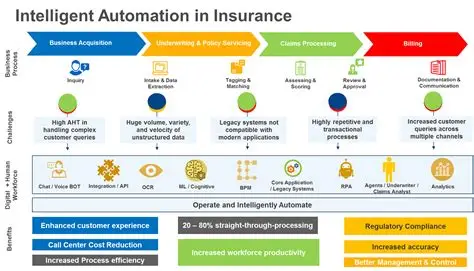
AI in Claims Processing: From Manual Workflows to Intelligent Automation
Claims processing is one of the most operationally intensive functions in insurance.
Handling claims typically involves document verification, fraud detection, damage assessment, and customer communication—often requiring extensive manual effort.
AI is transforming this domain by enabling intelligent automation across the entire claims lifecycle.
Automated Claims Assessment
AI-powered systems can analyze images, documents, and structured data to assess claims automatically.
For example:
- Computer vision models can evaluate vehicle damage from accident photos.
- Natural language processing models can extract insights from adjuster reports.
- AI systems can compare claims data with historical patterns to detect anomalies.
These capabilities significantly accelerate claims processing while reducing operational costs.
Some insurers have already deployed dozens of AI models within their claims domains, improving routing accuracy and reducing processing times dramatically.
Fraud Detection and Prevention
Fraud remains a major challenge for insurance companies, costing the industry billions annually.
AI-driven fraud detection models analyze complex patterns across claims data to identify suspicious behavior.
These systems can detect:
- Duplicate claims
- Unusual claim patterns
- Inconsistent documentation
- Organized fraud networks
By identifying these anomalies early, insurers can prevent fraudulent payouts and protect profitability.
Improving Customer Experience
Beyond efficiency, AI also improves the customer experience during claims events.
Claims often occur during stressful situations such as accidents, property damage, or medical emergencies. AI-powered communication systems can generate empathetic responses and guide customers through claims processes step by step.
This capability is becoming increasingly important as customers expect faster, more transparent claims experiences.
As insurers scale AI across claims operations, data quality becomes a critical success factor. Without reliable data, AI models cannot deliver accurate predictions or automation.
Techment explores this challenge in Data Quality for AI in 2026: The Ultimate Blueprint for Accuracy, Trust & Scalable Enterprise Adoption, which outlines how organizations can ensure data reliability across AI systems.
AI-Driven Customer Experience and Hyper-Personalization
Customer expectations in financial services have evolved dramatically over the past decade. Digital-native consumers expect seamless, personalized interactions similar to those offered by leading technology platforms. The future of AI in insurance is therefore closely tied to the ability of insurers to deliver intelligent, real-time customer experiences.
Artificial intelligence enables insurers to move beyond traditional transactional relationships and build proactive, personalized engagement models. Instead of reacting to customer requests, AI systems can anticipate needs, recommend coverage options, and guide policyholders through complex decisions.
Conversational AI and Intelligent Service
Conversational AI has become one of the most visible applications shaping the future of AI in insurance. Advanced chatbots and voice assistants powered by generative AI can now engage customers in natural, human-like conversations.
These systems support multiple high-value use cases:
- Policy inquiries and coverage explanations
- Claims status updates
- Policy renewals and upgrades
- Product recommendations
Modern conversational AI platforms integrate with CRM systems, policy databases, and analytics platforms to provide contextual responses. For example, a customer contacting an insurer about a claim may receive real-time updates and tailored advice based on policy details and claim history.
Organizations implementing conversational AI often rely on scalable cloud architectures to support enterprise-grade deployments.
Our Enterprise data platform modernization frameworks provide a structured, risk-managed blueprint for transforming legacy ecosystems into resilient, scalable, AI-ready architectures.
Hyper-Personalized Insurance Products
Another transformative aspect of the future of AI in insurance is hyper-personalization.
AI systems analyze behavioral data, demographic information, financial patterns, and risk indicators to tailor insurance products to individual customers. Instead of offering standardized policies, insurers can dynamically generate coverage options aligned with a customer’s lifestyle and risk profile.
Examples include:
- Usage-based auto insurance based on driving behavior
- Personalized health insurance plans using wellness data
- Property insurance policies informed by geospatial risk models
Hyper-personalization also improves cross-selling and upselling opportunities. AI recommendation engines can identify coverage gaps and suggest additional policies that align with customer needs.
Omnichannel Customer Engagement
Customers increasingly interact with insurers across multiple channels—mobile apps, websites, call centers, and messaging platforms. AI-powered engagement systems ensure consistency across these channels.
For example, a customer might begin a policy inquiry on a mobile app and continue the conversation through a call center. AI systems can retain context across channels, allowing the interaction to continue seamlessly.
This capability represents a critical component of the future of AI in insurance, enabling insurers to deliver unified digital experiences while improving operational efficiency.
AI Use Cases Across the Insurance Value Chain
| Insurance Domain | AI Use Case | Business Impact |
|---|---|---|
| Underwriting | Risk prediction models | Improved pricing accuracy |
| Claims | Automated claims assessment | Faster claims resolution |
| Customer Service | Conversational AI agents | Improved customer satisfaction |
| Fraud Detection | Anomaly detection models | Reduced fraud losses |
| Sales | AI-powered recommendation engines | Higher policy conversion rates |
AI Maturity Model For Insurance Enterprises
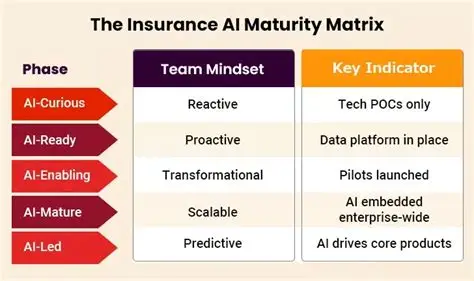
As insurers scale artificial intelligence initiatives, progress typically follows a structured maturity path. The future of AI in insurance will not be defined by isolated pilots but by how quickly organizations move toward AI-native operations. Industry research suggests that most insurers currently operate in the early stages of AI maturity—experimenting with analytics models and limited automation—while only a small group has embedded AI across their value chains.
The AI maturity model for insurance enterprises outlines the journey from experimentation to full-scale AI transformation. In early stages, insurers deploy AI for narrow use cases such as fraud detection or chatbot automation. As maturity increases, AI becomes integrated into underwriting, claims management, and customer engagement. Ultimately, AI-native insurers operate with intelligent systems embedded in every workflow, enabling real-time decision-making, hyper-personalization, and autonomous operations.
Understanding this maturity curve helps insurers prioritize investments and build the capabilities required to compete in the AI-driven insurance economy.
Enterprise AI Architecture for Insurance Transformation
Scaling AI across an insurance organization requires more than deploying isolated models. Enterprises must design robust AI architectures that integrate data platforms, machine learning pipelines, and business applications.
The future of AI in insurance depends on the development of modular, scalable AI ecosystems capable of supporting enterprise-wide transformation.
The Four-Layer AI Architecture for Insurers
Leading insurers are adopting AI architectures built around four key layers.
1. Engagement Layer
The engagement layer includes customer-facing interfaces such as chatbots, digital portals, and agent applications. These interfaces allow customers and employees to interact with AI-powered systems.
2. Intelligence Layer
This layer includes AI models responsible for predictive analytics, risk modeling, and decision support. It processes data and generates insights used across underwriting, claims, and customer service.
3. Data Platform
A modern data platform serves as the backbone of AI-driven insurance systems. It integrates structured data, unstructured documents, and real-time data streams into a unified environment.
Organizations adopting modern analytics architectures often leverage unified data platforms. Techment explores this architecture in Microsoft Fabric AI Solutions for Enterprise Intelligence.
4. Infrastructure Layer
The infrastructure layer includes cloud computing environments, machine learning pipelines, and model deployment platforms. These components ensure scalability, reliability, and security.
Modular AI Components
A key architectural principle shaping the future of AI in insurance is modularity.
Instead of building separate AI systems for each business function, insurers can develop reusable AI components. For example:
- Document processing engines used in underwriting can also support claims analysis.
- Fraud detection models can be applied across multiple insurance products.
- Customer analytics engines can power both marketing and service applications.
This modular approach reduces development costs while accelerating AI adoption across the enterprise.
Operating Models for AI-Native Insurance Companies
Technology alone cannot deliver AI transformation. The future of AI in insurance also requires new operating models that align business strategy, technology capabilities, and organizational structures.
Leading insurers are redesigning their operating models to support AI-driven innovation at scale.
Domain-Based Transformation
One of the most effective strategies involves transforming entire business domains rather than isolated use cases.
For example, insurers may choose to overhaul a specific domain such as:
- Claims management
- Underwriting
- Distribution and sales
- Customer service
Transforming an entire domain allows organizations to redesign workflows, integrate multiple AI capabilities, and achieve measurable performance improvements.
Studies suggest that domain-level AI transformations can deliver significant results, including:
- 10–20% improvement in sales conversion rates
- 10–15% growth in premiums
- 20–40% reduction in customer onboarding costs
- 3–5% improvement in claims accuracy
Agile Product Teams
AI-native insurers often operate using agile product teams responsible for specific digital capabilities.
These teams combine:
- Data scientists
- Software engineers
- product managers
- business domain experts
This structure enables faster innovation while ensuring AI solutions align with business objectives.
AI Control Towers
Many organizations also establish AI governance bodies—sometimes referred to as AI control towers.
These teams oversee:
- AI strategy and investments
- model governance and compliance
- enterprise AI standards
- performance monitoring
Such governance frameworks ensure that AI initiatives deliver measurable value while maintaining regulatory compliance.
Strong data governance practices are essential for these operating models to succeed. Techment explores this topic in Data Governance for Data Quality: Future-Proofing Enterprise Data.
Risks, Governance, and Ethical Considerations in AI-Driven Insurance
While AI offers enormous opportunities, the future of AI in insurance also introduces new risks and governance challenges.
Insurance companies operate in highly regulated environments, making responsible AI implementation essential.
Algorithmic Bias and Fairness
AI systems trained on historical data may inadvertently reflect biases present in that data.
For example:
- Biased risk models could unfairly impact certain demographic groups.
- Pricing algorithms might unintentionally reinforce inequalities.
To address these concerns, insurers must implement fairness testing and ethical AI governance frameworks.
Data Privacy and Security
Insurance companies manage vast amounts of sensitive data, including personal, medical, and financial information.
AI systems must therefore comply with strict data privacy regulations such as:
- GDPR
- HIPAA
- regional financial regulations
Secure data architectures and governance frameworks are critical to protecting customer information.
Regulatory Transparency
Regulators increasingly require transparency in AI-driven decision-making processes.
Insurers must be able to explain how AI models generate predictions and decisions—especially in areas such as underwriting and claims.
Explainable AI (XAI) techniques allow insurers to interpret model outputs and demonstrate compliance with regulatory requirements.
AI Governance Frameworks
A robust governance framework for the future of AI in insurance typically includes:
- AI ethics policies
- model validation procedures
- bias detection mechanisms
- audit trails for automated decisions
Enterprises implementing AI governance frameworks must also ensure strong data quality practices across their AI pipelines.
AI claims automation must be supported by robust enterprise architecture. Techment’s AI-Ready Enterprise Checklist with Microsoft Fabric outlines readiness considerations.
How Techment Helps Enterprises Implement AI in Insurance
AI transformation requires deep expertise in data architecture, cloud platforms, and enterprise analytics. Techment supports insurance organizations in building scalable AI ecosystems that deliver measurable business outcomes.
Techment works with enterprises across the full AI transformation lifecycle—from strategy development to platform implementation and optimization.
Data Strategy and AI Readiness
Successful AI adoption begins with a strong data foundation. Techment helps insurers design enterprise data strategies that ensure high-quality, governed datasets for AI models.
Organizations exploring AI transformation often start with strategic data planning frameworks like those discussed in Enterprise AI Strategy in 2026.
Modern Data Platforms and Analytics
Techment enables insurers to modernize their analytics ecosystems using scalable cloud platforms, unified data fabrics, and advanced analytics tools.
These platforms allow insurers to integrate structured and unstructured data, support machine learning workloads, and enable real-time analytics across the enterprise.
AI and Advanced Analytics Implementation
Techment helps organizations deploy advanced AI solutions across underwriting, claims, customer service, and fraud detection.
These solutions include:
- Generative AI applications
- predictive analytics models
- intelligent automation systems
- conversational AI platforms
Governance, Compliance, and Responsible AI
Techment also supports insurers in implementing governance frameworks that ensure responsible AI usage.
These frameworks include data governance policies, model validation processes, and compliance monitoring systems designed for highly regulated industries.
By combining strategy, technology, and governance expertise, Techment enables insurers to accelerate their journey toward AI-driven transformation.
FAQs: The Future of AI in Insurance
1. How will AI transform the insurance industry?
AI will automate underwriting, claims processing, customer service, and risk modeling. It will enable insurers to deliver personalized policies, improve operational efficiency, and enhance risk prediction accuracy.
2. What role does generative AI play in insurance?
Generative AI enables insurers to process unstructured data such as documents, emails, and conversations. It supports tasks such as automated customer communication, claims documentation analysis, and underwriting assistance.
3. Will AI replace insurance professionals?
AI will augment rather than replace most roles. Underwriters, claims adjusters, and agents will increasingly work alongside AI systems that provide insights and automation.
4. What are the biggest challenges in implementing AI in insurance?
Major challenges include legacy infrastructure, data quality issues, regulatory compliance, and talent shortages. Addressing these challenges requires a comprehensive enterprise AI strategy.
5. How can insurers start their AI transformation journey?
Insurers should begin by identifying high-impact domains such as underwriting or claims and implementing AI solutions that deliver measurable business outcomes.
Conclusion
The future of AI in insurance represents one of the most profound transformations the industry has experienced in decades.
Artificial intelligence is redefining how insurers understand risk, interact with customers, and operate their enterprises. From AI-powered underwriting and automated claims processing to hyper-personalized insurance products, the possibilities are vast.
However, achieving these benefits requires more than deploying isolated AI tools. Insurers must rethink their operating models, modernize data platforms, and embed AI capabilities across the enterprise.
Organizations that successfully scale AI will unlock significant competitive advantages—faster decision-making, improved customer experiences, and stronger risk intelligence.
Those that delay may find themselves struggling to keep pace with AI-native competitors.
For insurers seeking to navigate this transformation, partnering with experienced data and AI specialists can accelerate progress and reduce implementation risks.
With the right strategy, technology foundation, and governance frameworks, insurers can harness the full potential of AI and position themselves for success in an increasingly intelligent and data-driven future.
Related Reads
- Microsoft Fabric Architecture: A CTO’s Guide to Modern Analytics and AI
- 12 Proven RAG Optimization Techniques for Production AI Systems
- Data Quality for AI in 2026: The Ultimate Enterprise Guide
- Ultimate Guide to Optimizing Spark Workloads in Microsoft Fabric for Data Engineers
- AI Agents Driving Productivity: How Enterprises Achieve 10x Efficiency
- Migrating from Azure Data and AI Stack to Microsoft Fabric: A Practical Enterprise Guide
- AI in Insurance: Benefits, Use Cases & Enterprise Strategy for 2026