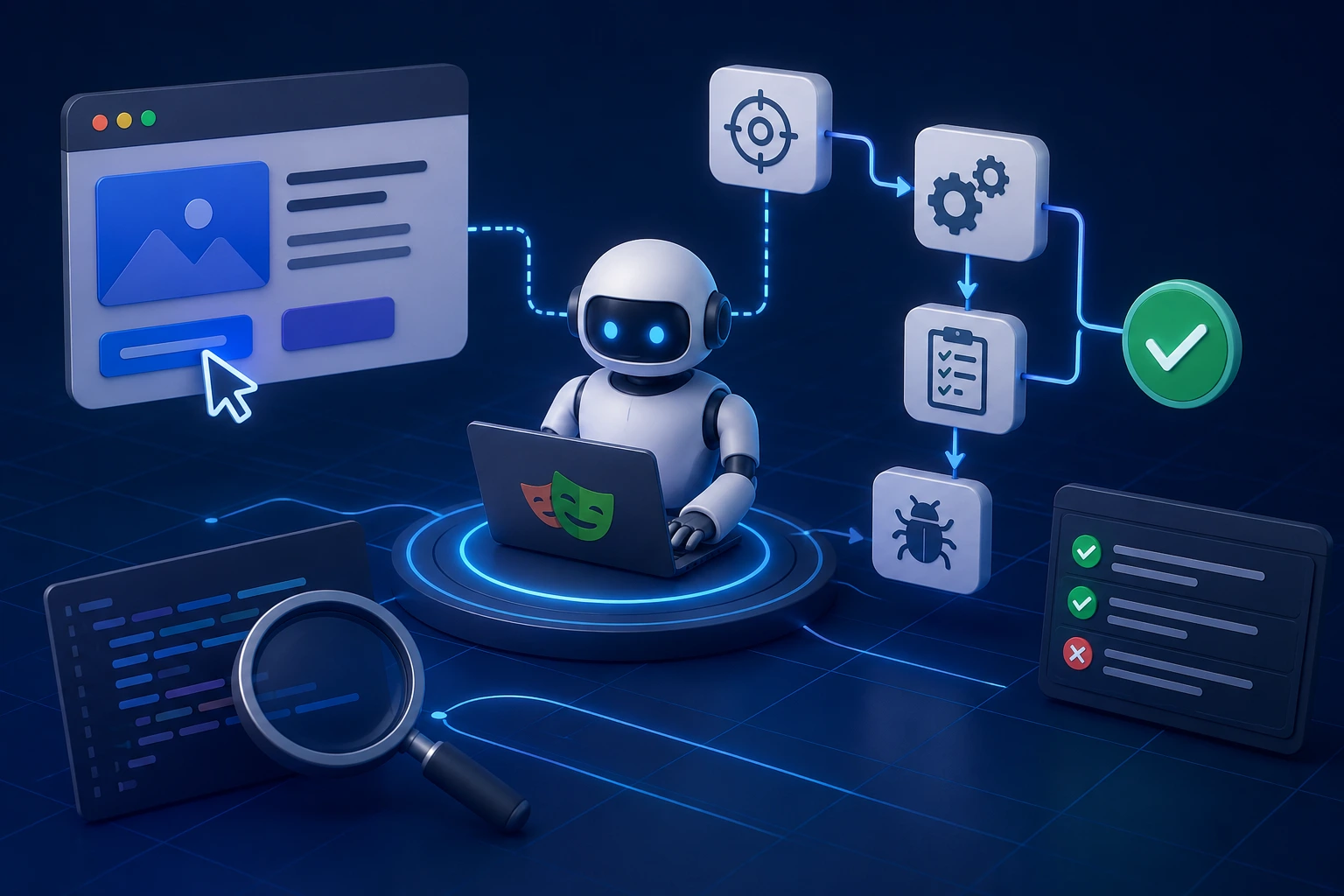
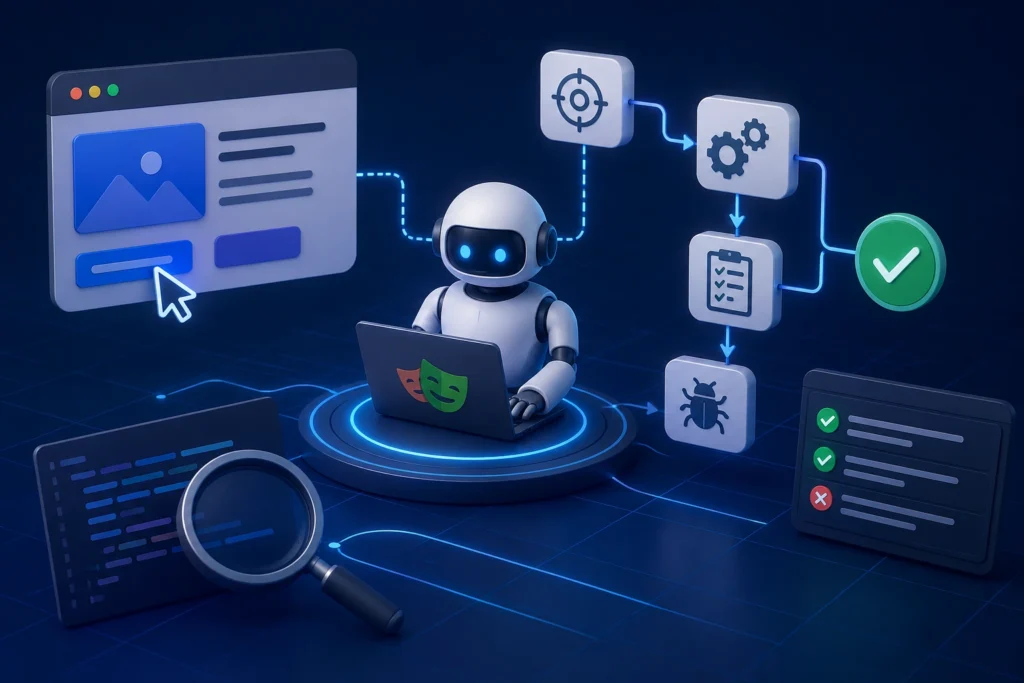
Agentic AI testing with Playwright combines goal-driven AI agents with browser automation to explore applications, adapt test paths, and support broader QA coverage. The key is to keep the responsibilities clear: let AI decide the path, let Playwright drive the browser, and let deterministic assertions decide the truth.
TL;DR: Agentic AI Testing With Playwright
- Agentic AI testing uses AI agents to pursue testing goals, choose actions, observe application behavior, and adapt their test path.
- Playwright acts as the execution layer, controlling the browser while the AI agent handles planning and decision-making.
- Deterministic assertions remain the source of truth—AI confidence should never be the only reason a test passes.
- Agentic testing is especially useful for exploratory testing, UI changes, broader coverage, test generation, and failure triage.
- Do not replace critical scripted tests for payments, authentication, permissions, checkout, or other high-risk business workflows.
- Use goals instead of rigid click paths, but define clear environments, expected outcomes, constraints, and stop conditions.
- Add guardrails such as maximum steps, blocked actions, staging-only execution, budget limits, and restricted credentials.
- Combine agentic testing with the traditional test pyramid: unit and API tests at the foundation, scripted Playwright tests for critical flows, and agents for broader exploration.
- Measure bugs found, false passes, false failures, runtime, cost, coverage expansion, and maintenance savings before scaling.
- Bottom line: Let AI decide the path. Let Playwright drive the browser. Let your assertions decide the truth.
Introduction
Software teams ship faster than ever. Developers use AI to write code. Releases happen every day. But quality still matters.
Traditional UI automation has been effective for years. We wrote scripts like: open login page, type email, type password, click Login, then check the dashboard.
That approach still works, but it can break when the UI changes. Maintenance becomes expensive. Coverage can remain limited because humans must define and maintain every path.
Agentic AI testing is a new approach in which an AI agent receives a testing goal, decides what to do next, uses tools such as Playwright to interact with the application, observes the result, and adapts within defined limits.
The important distinction is that agentic testing does not mean handing quality decisions entirely to an AI model.
The safer model is:
AI plans. Playwright executes. Assertions verify.
This guide explains what agentic AI testing is, how it works with Playwright, where it helps, where it fails, how to structure a practical architecture, and how modern QA teams can adopt it without sacrificing trust.
What Is Agentic AI Testing?
Agentic AI testing is a software testing approach in which an AI agent works toward a defined testing goal by planning actions, interacting with an application, observing results, and adapting its next step. Unlike traditional scripted automation, the agent does not necessarily follow one fixed click path.
An agent can:
- Understand a testing goal.
- Decide what to do next.
- Use browser or API tools.
- Observe the application state.
- Change its approach when necessary.
- Stop, retry, or escalate when conditions require it.
The important point is that goal-driven execution does not eliminate deterministic verification.
Classic automation vs agentic AI testing
| Dimension | Scripted Playwright | Agentic AI Testing |
|---|---|---|
| Test definition | Step-by-step instructions | Goal and constraints |
| Execution path | Predetermined | Agent-selected |
| UI changes | Often require script updates | May adapt within limits |
| Assertions | Deterministic | Should remain deterministic |
| Exploration | Limited to authored paths | Can explore multiple paths |
| Repeatability | High | Lower if the agent decides at runtime |
| Debugging | Usually straightforward | Requires agent traces and reasoning logs |
| Best use | Critical, stable workflows | Exploration, coverage expansion, change-heavy flows |
| Release confidence | High when well maintained | Requires stronger guardrails |
A simple example
Classic Playwright idea:
Click
#checkout-btn, then fill#card-number.
Agentic idea:
Buy the blue T-shirt with a test card and confirm the order success message.
The agent decides how to navigate.
Playwright executes browser actions.
Your hard assertions decide whether the test passed.
Why Teams Feel Pain With Traditional UI Automation
Most UI suites fail for the same reasons:
- Flaky tests that pass locally and fail in CI
- Broken selectors after a small UI change
- Slow maintenance that consumes more time than finding bugs
- Low trust in green builds, causing people to retest by hand
These problems are not new.
The difference is that AI-generated application code and faster release cycles can increase the number of UI changes QA teams need to validate.
Why agentic testing is gaining attention
Agentic testing can help widen coverage without requiring a human to author every possible path.
But it does not magically remove the underlying testing problems.
An agent can choose a different path when a UI changes.
It cannot guarantee that the path is correct.
It can identify a potentially broken workflow.
It cannot determine business truth unless you give it a reliable oracle.
That distinction is fundamental to trustworthy agentic QA.
Read our blog on How to Validate AI Testing Agents for Enterprise Quality Engineering
Agentic AI Testing vs Traditional Test Automation
The most important difference is not simply that one uses AI.
It is where the decision-making happens.
Traditional automation says:
“Perform these steps.”
Agentic testing says:
“Achieve this outcome within these constraints.”
Traditional automation
A scripted Playwright test might define:
Open product page
→ Click Add to cart
→ Open cart
→ Click Checkout
→ Fill email
→ Fill payment details
→ Click Pay
→ Verify confirmation
The execution path is explicit.
Agentic testing
An agent may receive:
Goal:
As a guest user on staging, buy the blue T-shirt
and reach the order confirmation page.

Constraints:
- Use the approved test account or guest flow.
- Use test payment data only.
- Do not delete data.
- Do not leave staging.
- Stop after 25 steps.
The agent can choose the path. The constraints define the boundaries. The assertions define success.
The practical difference
Traditional automation optimizes for repeatability. Agentic testing optimizes for adaptability and exploration.
The two approaches should therefore complement each other rather than compete.
IBM AI Agent Testing is useful for the broader distinction between testing conventional applications and evaluating autonomous agents, particularly around reliability, safety, tools, and multi-step behavior.
Why Playwright Is a Strong Foundation for Agentic Testing
Playwright provides browser automation across Chromium, Firefox, and WebKit, along with auto-waiting, web-first assertions, tracing, screenshots, parallel execution, and API testing capabilities. Playwright also now documents a first-party Test Agents workflow with planner, generator, and healer agents, and provides Playwright MCP for AI agents that need structured browser interaction.
That makes Playwright particularly relevant to agentic QA because it already provides the deterministic execution and evidence layer around which an agent can operate.
Keep the roles clear
The AI is the brain.
It plans and chooses the next action.
Playwright is the hands.
It clicks, types, navigates, captures evidence, and interacts with the browser.
Your assertions are the judge.
They decide pass or fail.
This separation is what keeps the system explainable.

Professional rule
Never let the agent’s confidence be the only pass condition. A green result must come from a check you can explain.
Playwright’s own testing model emphasizes web-first assertions and tracing, which reinforces the value of deterministic checks and evidence rather than relying on an AI-generated statement that something “looks correct.”
How Agentic Testing Works With Playwright
The basic agentic testing loop is:
Goal → Plan → Act → Observe → Decide → Assert
1. Goal
Define the business outcome.
Example:
Complete checkout as a guest user and reach order confirmation.
2. Plan
The agent determines likely next steps.
3. Act
Playwright clicks, types, navigates, and interacts with the browser.
4. Observe
The agent receives information such as:
- Page content
- Accessibility information
- URL
- DOM state
- Screenshots
- Console output
- Test artifacts
5. Decide
The agent determines whether to:
- Continue
- Retry
- Change path
- Stop
- Escalate
6. Assert
Deterministic checks decide whether the expected outcome occurred.
The loop is flexible.
The final verification should not be.
Read our blog on Agentic AI in Testing: From Script Generation to Autonomous Orchestration
Playwright’s Current Agentic Testing Capabilities
Agentic testing with Playwright is no longer only a conceptual pattern.
Playwright’s current documentation includes Playwright Test Agents:
- Planner — explores the application and produces a test plan.
- Generator — converts the plan into Playwright Test files.
- Healer — replays failed tests, inspects the current UI, suggests repairs, and reruns within defined limits.
Playwright also provides Playwright MCP, which allows AI agents to control browsers using structured accessibility snapshots.This creates an important distinction for QA teams.
Agentic testing can happen at different stages
| Stage | AI role | Human/engineering role |
| Test planning | Explore and identify scenarios | Define scope and risk |
| Test generation | Produce Playwright tests | Review generated code |
| Test execution | Select actions or recover from failures | Set guardrails |
| Failure healing | Suggest locator/test repairs | Review whether repair preserves intent |
| Release verification | Provide evidence and findings | Own release decision |
The important principle remains: Agent autonomy should increase only as confidence, observability, and guardrails increase.
A Simple Mental Model: The Test Pyramid Plus an Agent Layer
Do not replace all tests with agents.
Use a layered approach.
The role of each layer
Unit and component tests
Fast and stable. Catch defects close to the code.
API tests
High return with less UI noise.
Scripted Playwright end-to-end tests
Protect critical business paths.
Agentic layer
Expand exploration, discover alternate paths, support UI-change-heavy scenarios, and assist with failure analysis.
Core rule
Agents add breadth. Scripted tests protect money and trust flows.
This is especially important for:
- Payments
- Authentication
- Authorization
- Account deletion
- Financial transactions
- Compliance workflows
- Irreversible business actions
For deeper insights into enterprise data and AI strategy foundations, explore: Enterprise AI strategy in 2026.
Where Agentic AI Testing Helps Most
Agentic testing is most useful where fixed scripts have difficulty providing enough breadth or where test authoring becomes expensive.
1. UI changes often
Buttons move.
Labels change.
CSS classes break.
Agents may recover from some UI changes better than brittle selectors, but the final result still requires verification.
2. Exploratory testing at scale
Humans explore well, but slowly.
Agents can try multiple paths and surface issues that nobody explicitly scripted.
3. Faster first drafts of coverage
When a new feature lands, an agent can help create initial coverage before the team invests in a polished scripted suite.
4. Failure triage support
Agents can help classify a failure as:
- Product bug
- Test issue
- Environment issue
- Data issue
- Infrastructure failure
The classification should still be reviewable.
5. Support for AI-generated product code
More AI-written product code means more changes arriving faster.
Agentic testing can help widen the search for edge cases and regressions.
6. Test maintenance assistance
Modern agentic workflows can also help inspect failed tests, identify equivalent UI elements, suggest locator changes, and regenerate or repair tests. Playwright’s documented healer agent is an example of this workflow.
Best-fit use cases
| Use case | Agentic testing value | Keep scripted? |
| Exploratory UI testing | High | Supporting tests |
| UI change discovery | High | Yes for critical paths |
| New feature smoke coverage | High | Yes after stabilization |
| Failure triage | High | Human review |
| Critical payment flow | Low–Medium | Yes |
| Authentication | Low–Medium | Yes |
| Account deletion | Low | Yes |
| Broad regression exploration | High | Yes for release gates |
Where Agentic AI Testing Can Fail
Agentic testing is powerful, but it is not magic.
Be honest with your team about the risks.
False confidence
The agent says “done,” but a key business rule failed.
Unsafe actions
An agent can potentially click Delete, submit payment, modify settings, or trigger other consequential actions if the environment and tools allow it.
Cost
LLM calls, browser interactions, retries, and long agent loops can increase CI cost.
Non-determinism
The same goal may produce a different path from one run to another.
Hard-to-debug reasoning
You need good logs and artifacts to answer:
“Why did it click that?”
Weak oracles
If checks are soft, green builds mean little.
Environment contamination
An exploratory agent can create data, modify state, or interfere with other tests if isolation is weak.
Security and data exposure
Agentic systems may interact with application data, credentials, APIs, and test environments. Permissions and secrets therefore need explicit boundaries.
The key risk
The biggest mistake is confusing agent success with product correctness.
An agent reaching the end of a workflow does not automatically mean the workflow was correct.
Rule for high-risk workflows
If money, identity, privacy, compliance, or irreversible state is involved, keep deterministic Playwright tests as the source of truth.
Agentic Testing Architecture for Modern QA Teams
A practical architecture separates planning, execution, observation, verification, and control.
| Layer | Responsibility | Example |
| Goal manager | Stores testing intent | “Complete checkout” |
| AI agent | Plans and selects next action | Navigation decision |
| Playwright runner | Executes browser actions | Click, fill, navigate |
| Observation layer | Captures application state | DOM, URL, screenshot |
| Oracle / assertions | Determines PASS/FAIL | URL and business-state check |
| Guardrails | Restricts behavior | Max steps, blocked actions |
| Reporter | Stores evidence | Trace, screenshot, logs |
Guardrail examples
Block actions containing:
- Delete
- Remove account
- Transfer
- Refund
- Change permissions
Allow only the staging base URL.
Stop after 30 steps.
Fail if the cost exceeds the budget.
Require a final assertion list before PASS.
Prevent access to production.
Restrict credentials and sensitive data from model context wherever possible.
Agentic Testing Guardrails: What Should Be Deterministic?
A useful way to design agentic testing is to separate AI decisions from non-negotiable constraints.
| Agent can decide | System should enforce |
| Which button to click | Allowed domain |
| Which navigation path to take | Maximum steps |
| Which equivalent element to use | Blocked actions |
| Whether to retry | Budget limit |
| Which exploratory path to try | Test environment |
| How to recover from a UI change | Credential boundaries |
| Which scenario to explore next | Final assertions |
This division creates a practical safety boundary.
Give the agent freedom inside the test. Keep the boundaries outside the agent.
Step-by-Step: How to Start Agentic Testing
Step 1 — Keep your critical scripted tests
Login, checkout, payments, permissions, and other high-risk flows should not be the first candidates for replacement.
Step 2 — Pick one non-critical journey
Example:
Search for a product and open the details page.
Step 3 — Write a clear goal
Bad:
Test the site.
Good:
Search for blue T-shirt, open the first result, and confirm the product title is visible.
Step 4 — Add hard assertions
Use:
- URL patterns
- Visible text
- Element state
- API status
- Database or application data checks where appropriate
Step 5 — Add safety limits
Start with:
- Maximum steps
- Blocked actions
- Staging-only execution
- Budget limits
- Restricted credentials
Step 6 — Compare results for two weeks
Measure:
- Bugs found
- False passes
- False failures
- Runtime
- Token/model cost
- Maintenance time
- Useful coverage discovered
Step 7 — Scale only what proves value
Promote agentic coverage only after it finds useful issues without creating unacceptable noise.
Writing Better Agent Goals
Agent quality depends on goal quality.
Vague goals produce vague testing.
Weak goal
Test a checkout.
Strong goal
As a guest user on staging, add the blue T-shirt (SKU BT-01) to cart, complete checkout with approved test payment data, and verify the page shows “Order confirmed” and the URL contains
/order-confirmation.
Include these elements in every goal
| Goal component | Example |
| Environment | Staging |
| User type | Guest user |
| Business outcome | Complete checkout |
| Test data | SKU BT-01 |
| Expected result | Order confirmed |
| Location check | /order-confirmation |
| Restrictions | Test payment only |
| Stop conditions | Do not modify unrelated data |
Goal-writing formula
[User] + [environment] + [business action] + [expected outcome] + [constraints]
This makes goals more specific, reproducible, and easier to evaluate.
Assertions: The Trust Layer
Agents can be creative.
Assertions must be strict.
Good assertion types
Text visibility
await expect(page.getByText('Order confirmed')).toBeVisible();URL checks
await expect(page).toHaveURL(/order-confirmation/);Element state
await expect(page.getByRole('button', { name: 'Pay now' }))
  .toBeDisabled();
API response checks
Verify that the expected API request returned an acceptable status.
Data checks
Verify that an order exists with the correct identifier, status, or total where the test architecture allows it.
Avoid
- “Looks fine” as a pass condition
- AI confidence as the only pass condition
- Screenshot-only decisions without explicit rules
- Assertions that simply repeat the agent’s own reasoning
The trust hierarchy
Business rule
     ↓
Deterministic assertion
     ↓
Test result
     ↓
AI explanation / summary
Not:
AI says it passed
     ↓
PASS
CI/CD Advice for Agentic Testing
In CI, start small.
Run agentic tests nightly at first rather than on every commit.
Keep scripted smoke tests on every pull request.
Store:
- Traces
- Screenshots
- Agent step logs
- Test output
- Failure classifications
- Cost metrics
Fail the build on assertion failure, not on agent confidence.
Recommended execution strategy
| Test type | Suggested trigger | Primary purpose |
| Unit / API | Every pull request | Fast feedback |
| Scripted Playwright smoke | Every pull request | Critical regression |
| Full scripted E2E | Main branch / nightly | Regression coverage |
| Agentic exploration | Nightly / pre-release | Coverage discovery |
| Agent-assisted healing | On failure | Maintenance support |
| Broad exploratory runs | Scheduled | New defect discovery |
As the agentic suite becomes more predictable and measurable, selected scenarios can move closer to release gates.
Do not make that transition simply because the agent “usually works.”
Agentic Testing Metrics: What Should QA Teams Measure?
A successful pilot should be measured with more than the number of AI-generated tests.
Recommended metrics
| Metric | What it tells you |
| Bugs found | Whether coverage creates real value |
| Unique bugs | Whether agents discover new issues |
| False-pass rate | Whether results can be trusted |
| False-fail rate | Amount of noise created |
| Runtime | Operational efficiency |
| Cost per run | AI economics |
| Maintenance hours | Productivity impact |
| Coverage expansion | Additional paths explored |
| Escalation rate | How often human review is needed |
| Assertion failure rate | Actual product/test failures |
Most important metric
Useful defects found per unit of cost and maintenance effort.
An agent that executes 10,000 actions but finds nothing useful is not automatically better than a scripted test that finds one serious defect.
Agentic AI Testing Best Practices Checklist
Use this checklist before scaling an agentic testing program.
- Use Playwright as the browser execution engine.
- Keep critical business flows scripted.
- Write specific, measurable goals.
- Define deterministic assertions.
- Separate agent decisions from hard constraints.
- Add action allow and deny lists.
- Restrict execution to approved environments.
- Cap agent steps.
- Cap model/token or financial budget.
- Protect credentials and sensitive test data.
- Log agent decisions and actions.
- Store traces and screenshots.
- Review failed runs with evidence.
- Measure false passes and false failures.
- Measure cost against bugs found.
- Start with low-risk exploratory journeys.
- Expand only after the pilot proves value.
When Should You Use Agentic Testing vs Scripted Playwright?
This is the practical decision most QA teams need to make.
| Scenario | Scripted Playwright | Agentic Testing |
| Stable critical checkout | Best | Supporting |
| Login regression | Best | Supporting |
| Payment validation | Best | Low priority |
| Exploratory testing | Limited | Best |
| UI changes frequently | Maintenance required | Useful |
| New feature with unknown paths | Limited | Useful |
| Broad overnight exploration | Limited | Best |
| Deterministic release gate | Best | Supporting |
| Failure triage | Moderate | Useful |
| Test generation | Moderate | Strong |
| Test healing | Manual/code changes | Strong potential |
The rule
Use scripted Playwright where repeatability and release confidence matter most. Use agentic testing where adaptability, exploration, and coverage breadth matter most.
What Agentic Testing Should Not Replace
Agentic testing should not become an excuse to remove the deterministic foundation of a mature QA strategy.
Keep scripted tests for:
- Authentication
- Authorization
- Payments
- Checkout
- Account deletion
- Financial transactions
- Compliance-critical workflows
- Core business invariants
- Release-blocking smoke tests
The reason is simple.
A critical test should be predictable enough that the team understands exactly what was executed and exactly why it passed.
Agentic exploration is valuable precisely because it can do things that are harder to predict.
Those are complementary strengths.
The Future of Agentic QA With Playwright
The direction of Playwright’s tooling is already moving beyond browser automation alone.
Its first-party Test Agents now support planning, test generation, and healing, while Playwright MCP enables AI agents to interact with browsers through structured tooling.
AI increasingly participates across the test lifecycle, while engineering controls remain responsible for quality decisions.
Final Thoughts
Agentic AI testing with Playwright is one of the most important shifts happening in QA automation.
It can help teams explore more, adapt faster, create initial coverage more quickly, and reduce some maintenance pain.
But agentic testing does not remove the need for good test engineering.
Trust still comes from:
- Clear goals
- Deterministic assertions
- Safe guardrails
- Reliable test data
- Good observability
- Risk-based test design
- A smart CI strategy
The strongest approach is not to replace your Playwright suite with agents.
It is to give agents the work they are good at while keeping deterministic automation responsible for the checks that matter most.
Let AI decide the path. Let Playwright drive the browser. Let your assertions decide the truth.
Frequently Asked Questions
1. Will agentic testing replace Playwright scripts?
No. Agentic testing complements scripted Playwright automation rather than replacing it. Critical journeys such as login, checkout, payments, permissions, and other high-risk workflows should generally retain deterministic tests. Agentic testing is particularly useful for exploration, broader coverage, test generation, maintenance support, and change-heavy scenarios.
2. What is agentic AI testing?
Agentic AI testing uses AI agents to pursue testing goals by planning actions, interacting with applications, observing results, and adapting their next steps. Unlike traditional scripted automation, the agent does not have to follow one fixed path, although deterministic assertions should still decide whether the expected outcome occurred.
3. How does agentic testing work with Playwright?
An AI agent defines or receives a testing goal, plans a path, and uses Playwright to interact with the browser. It observes the application, adapts its next action when necessary, and then relies on deterministic Playwright assertions or other test oracles to determine the final result.
4. Is Playwright suitable for AI agent testing?
Yes. Playwright provides cross-browser automation, auto-waiting, assertions, tracing, screenshots, and browser tooling that can serve as the execution layer for AI agents. Playwright also provides first-party Test Agents for planning, generation, and healing, plus Playwright MCP for agent-driven browser control.
5. Do I need deep AI knowledge to start agentic testing?
No. Start with strong Playwright fundamentals, one well-defined testing goal, deterministic assertions, and basic safety limits. Teams can introduce more sophisticated agentic workflows after they understand the cost, reliability, and failure patterns of a smaller pilot.
6. Can AI agents fix broken Playwright tests?
Yes. Agentic workflows can inspect failed tests, identify changed UI elements or flows, suggest locator or test changes, and rerun the test. Playwright’s documented healer agent follows this general pattern, with guardrails determining when the repair loop stops.
7. What should QA teams measure during an agentic testing pilot?
Measure useful defects found, false passes, false failures, runtime, model cost, maintenance effort, additional coverage, escalation rate, and overall business value. The goal is not to maximize the number of agent actions or generated tests; it is to increase useful coverage without creating unacceptable noise or cost.
Related Reads
- Ultimate Guide to Optimizing Spark Workloads in Microsoft Fabric for Data Engineers
- Microsoft Fabric Architecture: CTO’s Guide to Modern Analytics & AI
- Data Governance for Data Quality: Future-Proofing Enterprise Data
- Data Quality for AI in 2026: Enterprise Guide
- Microsoft Fabric vs Power BI: Understanding the Difference
- Microsoft Fabric vs Snowflake: Data Management Showdown
- AI-Ready Enterprise Checklist for Microsoft Fabric Microsoft Fabric vs Power BI: Understanding the Difference
- Microsoft Fabric vs Snowflake: Data Management Showdown
- AI-Ready Enterprise Checklist for Microsoft Fabric