Introduction
Enterprise AI strategies are increasingly defined not by models—but by how effectively organizations retrieve, structure, and contextualize data. This is where the debate around RAG vs Knowledge Graphs becomes strategically critical.
As generative AI adoption accelerates, leaders are realizing that large language models alone are insufficient. Without reliable data grounding, hallucinations, inconsistency, and governance risks quickly emerge. Retrieval-Augmented Generation (RAG) has emerged as a dominant pattern to mitigate these issues—especially for unstructured data.
At the same time, knowledge graphs are experiencing a resurgence. Their ability to model relationships, enforce semantic consistency, and enable explainable AI is making them indispensable in regulated and complex enterprise environments.
So which performs better?
This blog provides a deep, enterprise-grade comparison of RAG vs Knowledge Graphs, analyzing performance across dimensions like scalability, accuracy, governance, cost, and real-world applicability. We also explore hybrid architectures, implementation trade-offs, and how CTOs can make the right strategic choice.
TL;DR Summary
- The RAG vs Knowledge Graphs debate is evolving into GraphRAG dominance
- RAG excels in speed, flexibility, and unstructured data retrieval
- Knowledge graphs deliver explainability, reasoning, and governance
- GraphRAG combines both—emerging as the enterprise standard
- Architecture choice depends on query complexity, explainability, and cost structure
Why RAG vs Knowledge Graphs Matters for Enterprise AI Strategy
The Shift from Models to Data Architecture
Enterprise AI is no longer about choosing the best model—it’s about choosing the right data retrieval and context layer.
According to industry reports (Gartner, McKinsey), majority of AI project failures stem from data quality and contextual relevance issues, not model limitations. Gartner reports that up to 60–63% of organizations lack AI-ready data practices, and predicts that 60% of AI projects will be abandoned by 2026 due to poor data foundations. McKinsey similarly emphasizes that weak data governance and contextualization are primary drivers of failure, making the choice between Retrieval-Augmented Generation (RAG) and Knowledge Graphs a foundational decision. This makes the RAG vs Knowledge Graphs decision foundational, not optional.
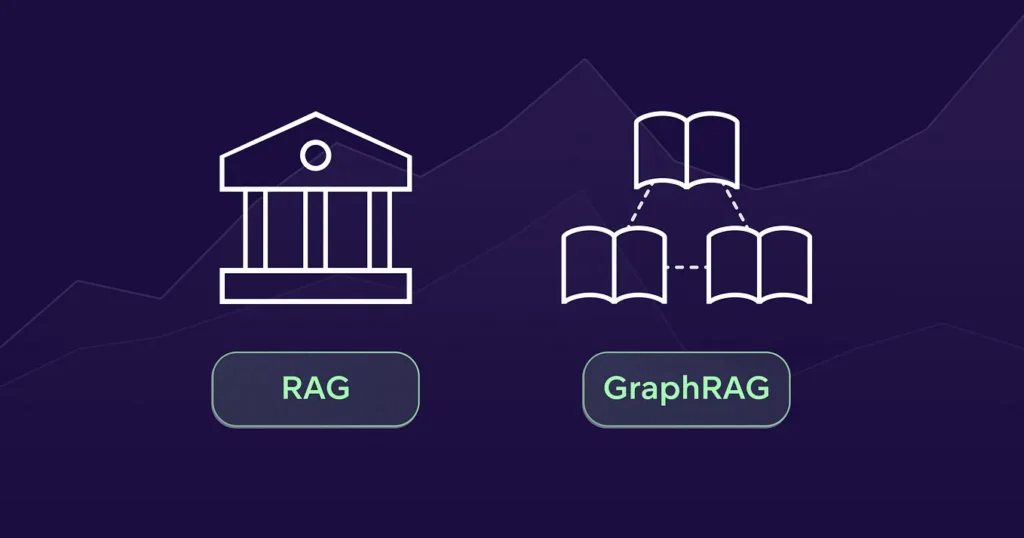
RAG focuses on retrieving relevant documents at runtime and feeding them into LLMs. Knowledge graphs, on the other hand, encode relationships explicitly, enabling structured reasoning.
Key enterprise implication:
- RAG = speed and flexibility
- Knowledge Graph = control and semantic depth
For a deeper understanding of enterprise data foundations, explore: Enterprise AI strategy 2026
The Cost of Getting It Wrong
Choosing the wrong architecture can lead to:
- Hallucinated outputs (RAG without governance)
- Incomplete reasoning (RAG without relationships)
- High complexity and cost (over-engineered graphs)
- Poor scalability (graphs without optimization)
Enterprises must evaluate:
- Data types (structured vs unstructured)
- Use cases (search vs reasoning)
- Compliance requirements
- Latency expectations
Strategic Decision Framework
Executives should evaluate RAG vs Knowledge Graphs across:
- Performance (latency, accuracy)
- Data coverage (structured vs unstructured)
- Governance and explainability
- Scalability and cost
This blog will break down each of these dimensions in depth.
Understanding RAG Architecture in Enterprise AI
What is Retrieval-Augmented Generation (RAG)?
RAG is an architecture that enhances LLM outputs by retrieving relevant external data at query time.
Core components:
- Vector database (embeddings)
- Retriever (semantic search)
- Generator (LLM)
Workflow:
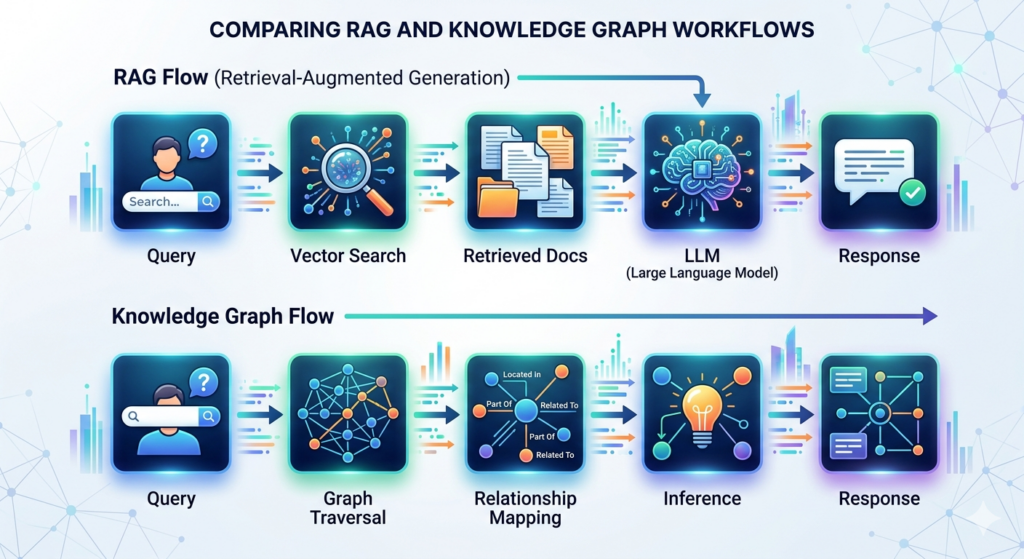
- User query → converted to embedding
- Similar documents retrieved
- Context injected into LLM prompt
- Response generated
Why RAG Became the Default for Generative AI
RAG gained traction because it solves key enterprise challenges:
- Reduces hallucinations
- Enables real-time knowledge updates
- Works well with unstructured data (PDFs, emails, logs)
- Avoids expensive model retraining
According to internal insights from enterprise implementations , RAG is now the baseline architecture for GenAI deployments in 2026.
Strengths of RAG in Enterprise Context
1. Scalability with Unstructured Data– RAG handles massive document corpora efficiently using vector search.
2. Faster Implementation – Compared to knowledge graphs, RAG pipelines can be deployed quickly.
3. Flexibility Across Use Cases– From chatbots to enterprise search, RAG adapts easily.
4. Lower Upfront Modeling Effort– No need to define relationships explicitly.
Limitations of RAG
Despite its advantages, RAG has critical limitations:
Lack of Deep Contextual Reasoning
RAG retrieves documents—but doesn’t inherently understand relationships.
Fragmented Knowledge Representation
Information remains siloed across documents.
Governance Challenges
Difficult to enforce data lineage and trust.
Latency Issues at Scale
Large vector searches can impact performance.
For a deeper dive into RAG models and enterprise patterns: RAG Models enterprise guide
Understanding Knowledge Graphs in Enterprise AI
What are Knowledge Graphs?
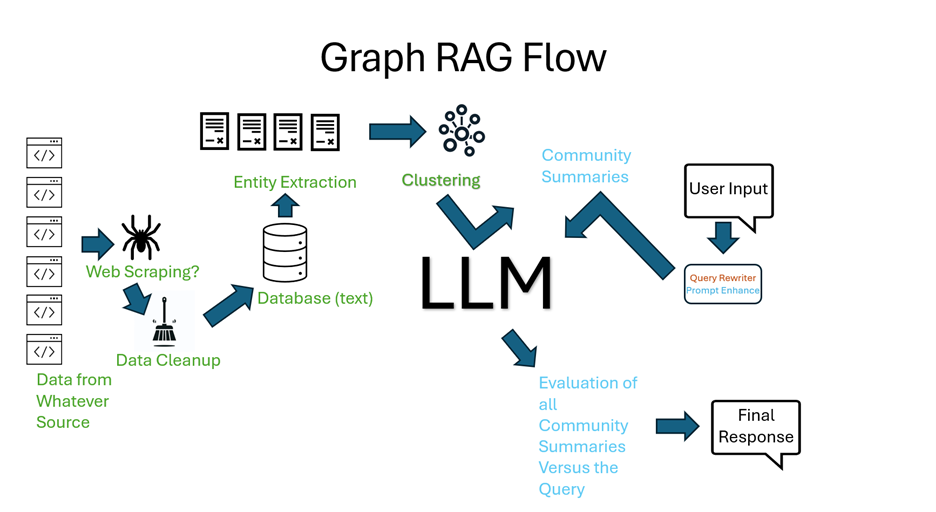
Knowledge graphs represent data as entities and relationships, enabling machines to understand context and connections.
Core elements:
- Nodes (entities)
- Edges (relationships)
- Ontologies (schemas)
Why Knowledge Graphs Are Resurging
Knowledge graphs are gaining traction because enterprises need:
- Explainable AI
- Semantic consistency
- Strong governance
- Cross-domain integration
They are particularly valuable in industries like:
- Healthcare
- Finance
- Supply chain
Strengths of Knowledge Graphs
1. Rich Context and Relationships
Graphs capture meaning—not just data.
2. Explainability and Trust
Every output can be traced back to relationships.
3. Strong Governance
Schema and ontology enforce consistency.
4. Advanced Reasoning Capabilities
Supports inference and multi-hop reasoning.
Limitations of Knowledge Graphs
High Implementation Complexity
Building ontologies requires domain expertise.
Slower Time-to-Value
Compared to RAG, graphs take longer to deploy.
Scalability Challenges
Graph traversal can be resource-intensive.
Maintenance Overhead
Keeping graphs updated is non-trivial.
For more insights on foundational AI architectures, refer to: RAG architectures Enterprise Use Cases in 2026.
RAG vs Knowledge Graphs: Core Architectural Differences
Key Differences in RAG vs Knowledge Graphs That Define Enterprise Performance
Information Structure: Documents vs Relationships
At the core of RAG vs Knowledge Graphs lies a fundamental difference in how knowledge is structured.
RAG:
- Stores knowledge as text chunks
- Uses embeddings in vector space
- Treats information as isolated fragments
Knowledge Graphs:
- Represent knowledge as entities and relationships
- Encode meaning through connections
- Enable structured navigation across data
This distinction directly impacts AI capabilities.
Enterprise Insight:
Knowledge graphs outperform RAG when relationships drive value, while RAG excels when content retrieval is sufficient.
Retrieval Mechanisms: Semantic Search vs Graph Traversal
RAG uses semantic similarity search, retrieving content based on contextual closeness.
Knowledge graphs use deterministic traversal, following explicit relationships.
Implication:
- RAG → probabilistic retrieval
- Knowledge Graph → deterministic reasoning
Research insights indicate knowledge graph augmentation can significantly improve reasoning accuracy by grounding outputs in relationships
Query Capability: Single-Step vs Multi-Hop Reasoning
One of the most critical differences in RAG vs Knowledge Graphs is query complexity handling.
RAG:
- Best for direct, single-step queries
- Example: “What is our leave policy?”
Knowledge Graphs:
- Handles multi-hop queries
- Example: “Which customers bought Product A and later churned after support escalation?”
Explainability: Black Box vs Transparent AI
- RAG provides similarity scores (opaque)
- Knowledge graphs provide traceable reasoning paths
Enterprise implication:
Explainability is non-negotiable in regulated industries → favoring knowledge graphs.
RAG vs Knowledge Graphs is fundamentally a comparison between:
- Retrieval-based intelligence vs
- Relationship-based intelligence
Enterprise Comparison Table
| Dimension | RAG | Knowledge Graph |
|---|---|---|
| Data Type | Unstructured-heavy | Structured + semantic |
| Speed | Fast retrieval | Slower traversal |
| Context | Document-level | Relationship-level |
| Explainability | Low | High |
| Governance | Weak | Strong |
| Implementation | Faster | Complex |
| Scalability | High (vector DBs) | Moderate |
| Reasoning | Limited | Advanced |
Benefits Analysis: RAG vs Knowledge Graphs
What Makes Knowledge Graphs Powerful for Enterprise AI
1. Multi-Hop Reasoning
Knowledge graphs enable AI to connect multiple data points across relationships—critical for decision intelligence.
2. Explainable AI
Every output is backed by a relationship path, improving trust and auditability.
3. Disambiguation and Consistency
Graphs resolve ambiguity (e.g., “Jaguar” as a brand vs animal) using context.
4. Governance-First Architecture
Schema and ontology enforce data consistency across systems.
What Makes RAG Powerful for Enterprise AI
1. Rapid Deployment
RAG systems can be deployed in weeks using existing document repositories.
2. Broad Knowledge Coverage
Excels in retrieving information across large unstructured datasets.
3. Flexibility and Adaptability
No need for upfront data modeling.
4. Lower Barrier to Entry
Minimal infrastructure required compared to knowledge graphs.
Enterprise Reality Check
The choice is not about superiority—but alignment with enterprise needs:
- RAG → speed, breadth, flexibility
- Knowledge Graph → depth, trust, reasoning
Strategic Insight
The real question is not RAG vs Knowledge Graphs—but:
“Where does each architecture deliver maximum enterprise value?”
For more on building scalable data foundations that support AI, explore: Data Quality For AI in 2026 Enterprise Guide
Performance Comparison: Which Performs Better?
Accuracy and Relevance
RAG improves accuracy by grounding responses—but depends on retrieval quality.
Knowledge graphs provide higher precision due to structured relationships.
Verdict:
- RAG = broader recall
- Knowledge Graph = higher precision
Latency and Speed
RAG systems are optimized for fast retrieval.
Knowledge graphs can slow down with complex queries.
Verdict:
- RAG performs better in real-time scenarios
Scalability
RAG scales horizontally using vector databases.
Knowledge graphs struggle with large-scale dynamic data.
Verdict:
- RAG wins in scalability
Governance and Trust
Knowledge graphs dominate here.
They provide:
- Lineage
- Traceability
- Semantic validation
Verdict:
- Knowledge Graphs outperform RAG significantly
Overall Performance Summar
| Metric | Winner |
|---|---|
| Speed | RAG |
| Accuracy | Knowledge Graph |
| Scalability | RAG |
| Governance | Knowledge Graph |
Executive Takeaway
There is no universal winner in RAG vs Knowledge Graphs.
The decision depends on:
- Use case complexity
- Data type
- Regulatory requirements
When Should You Use RAG vs Knowledge Graphs? (Decision Framework)
Choose Knowledge Graphs When
- Relationships are central to insights
- Multi-hop reasoning is required
- Regulatory compliance demands explainability
- Data is structured or semi-structured
Example Use Cases:
- Fraud detection
- Supply chain optimization
- Risk analysis
Choose RAG When
- Knowledge exists in documents
- Queries are straightforward
- Time-to-market is critical
- Budget is constrained
Example Use Cases:
- Enterprise search
- Chatbots
- Document summarization
Use GraphRAG When (Most Enterprises Do)
- Both structured and unstructured data exist
- Queries vary in complexity
- Governance + speed are required
Key takeaway from industry research:
Most enterprises eventually converge toward hybrid architectures combining both approaches
Hybrid Architecture: The Future of RAG vs Knowledge Graphs
Why Enterprises Are Moving Beyond “Either-Or”
The most advanced organizations are no longer debating RAG vs Knowledge Graphs as mutually exclusive options. Instead, they are converging on hybrid architectures that combine the strengths of both.
Why? Because enterprise AI demands:
- The flexibility of RAG for unstructured data
- The semantic depth of knowledge graphs for reasoning
- The governance layer needed for compliance
According to enterprise AI trends outlined in internal strategy frameworks , hybrid architectures are becoming the default for large-scale AI deployments by 2026.
Hybrid Architecture Pattern Explained
A modern hybrid system typically looks like this:
Step 1: Query enters the system
Step 2: Knowledge graph enriches query context (entities, relationships)
Step 3: RAG retrieves relevant documents
Step 4: LLM combines both structured and unstructured context
Step 5: Response generated with higher accuracy and explainability
Key Benefits of Hybrid Approach
1. Contextual Precision + Broad Recall
Graphs provide precision; RAG provides coverage.
2. Improved Explainability
Graph relationships justify LLM outputs.
3. Enhanced Governance
Structured layers enforce compliance.
4. Reduced Hallucination Risk
Multiple grounding layers improve reliability.
When to Use Hybrid
Hybrid is ideal when:
- Enterprises operate across structured + unstructured data
- Regulatory compliance is critical
- AI decisions require explainability
- Use cases involve multi-step reasoning
Explore the architectural, operational, and strategic differences between Multi-Agent Systems vs Single-Agent Architectures, helping you make informed decisions aligned with scalability, governance, and AI maturity.
Real-World Enterprise Use Cases
1. Customer Support AI
RAG Approach:
- Retrieves FAQs, documentation
- Powers conversational agents
Knowledge Graph Enhancement:
- Maps customer journeys
- Links products, issues, resolutions
Outcome:
- Faster responses + contextual accuracy
2. Fraud Detection in Financial Services
Knowledge Graph Dominant Use Case
- Detects relationships between entities (accounts, transactions)
- Identifies suspicious patterns
RAG alone cannot detect relational anomalies effectively.
3. Healthcare Clinical Decision Suppor
Hybrid Approach
- RAG retrieves research papers
- Knowledge graph maps patient history, treatments
Result:
- Evidence-backed recommendations with context
4. Enterprise Search and Knowledge Management
RAG Strength
- Fast retrieval across documents
Graph Enhancement
- Connects concepts, departments, metadata
Executive Insight
Use cases determine architecture:
- Search-heavy → RAG
- Relationship-heavy → Knowledge Graph
- Complex enterprise workflows → Hybrid
To further understand how reliable data drives enterprise outcomes, refer to Designing Scalable Data Architectures for Enterprise Data Platforms
Cost, Maintenance, and Operational Trade-offs
Cost Structure Comparison
| Cost Factor | RAG | Knowledge Graph |
|---|---|---|
| Setup Cost | Low | High |
| Maintenance | Moderate | High |
| Query Cost | High (inference-heavy) | Efficient |
| Scaling Cost | Moderate | Complex |
Maintenance Overhead
RAG:
- Document updates
- Embedding refresh
Knowledge Graph:
- Schema evolution
- Entity resolution
- Relationship updates
Hidden Enterprise Costs
- Poor architecture → rework
- Lack of governance → compliance risks
- Over-engineering → delayed ROI
Executive Insight
- RAG = faster ROI
- Knowledge Graph = long-term strategic value
- GraphRAG = optimized balance
Implementation Strategy: Choosing the Right Approach
Step 1: Assess Data Landscape
Ask:
- Is your data mostly structured or unstructured?
- Do relationships matter?
- Is real-time retrieval required?
Step 2: Define Use Cases Clearl
Avoid generic AI deployments.
Map architecture to:
- Search
- Recommendations
- Decision intelligence
- Automation
Step 3: Evaluate Governance Requirements
If your industry requires:
- Explainability
- Auditability
- Compliance
→ Knowledge graphs or hybrid models are essential.
Step 4: Consider Cost and Complexity
RAG:
- Lower initial cost
- Faster ROI
Knowledge Graph:
- Higher upfront investment
- Long-term strategic value
Step 5: Build Incrementally
Start with RAG → layer knowledge graph → evolve to hybrid.
Explore our guide on enterprise AI implementation best practices.
Risks, Trade-offs, and Hidden Challenges
RAG Risks
- Hallucinations due to poor retrieval
- Lack of explainability
- Dependency on embedding quality
Knowledge Graph Risks
- High complexity
- Data modeling challenges
- Slower iteration cycles
Hybrid Risks
- Increased architectural complexity
- Integration overhead
- Skill gaps
Enterprise Trade-off Matrix
| Factor | RAG Risk | Knowledge Graph Risk |
|---|---|---|
| Complexity | Low | High |
| Governance | Weak | Strong |
| Cost | Moderate | High |
| Speed | Fast | Slower |
Strategic Insight
The biggest risk is not choosing wrong—it’s choosing without clarity on use case and data strategy.
For data quality considerations in AI: Data Quality for AI
Future Trends: Where RAG vs Knowledge Graphs is Heading
1. Convergence into Unified Data Layers
Future architectures will integrate:
- Vector search
- Graph databases
- Semantic layers
2. Rise of Graph-Augmented RAG
Emerging pattern:
- Graph-enhanced retrieval
- Context-aware embeddings
3. AI Governance as a Priority
Regulations will push adoption of:
- Explainable AI
- Traceable data systems
→ Favoring knowledge graphs and hybrids
4. Integration with Platforms like Microsoft Fabric
Unified platforms are enabling:
- Data + AI + governance in one ecosystem
5. Autonomous AI Systems
Future AI agents will require:
- Memory (graphs)
- Retrieval (RAG)
- Reasoning (LLMs)
Executive Outlook
The future is not about RAG vs Knowledge Graphs—it’s about intelligent orchestration of both.
For platform-driven AI transformation, read our blog on Microsoft Fabric AI Solutions for Enterprise Intelligence
How Techment Helps Enterprises
Techment enables organizations to navigate the RAG vs Knowledge Graphs decision with a strategic, outcome-driven approach.
End-to-End AI and Data Modernization
Techment supports:
- Data architecture design (RAG, graphs, hybrid)
- AI readiness assessments
- Enterprise-scale implementation
Unified Data + AI Strategy
From strategy to execution:
- Data discovery and preparation
- Governance frameworks
- AI model integration
Platform Expertise
Deep expertise across:
- Microsoft Fabric
- Azure AI
- Modern analytics ecosystems
Governance and Trust
Techment ensures:
- Data quality
- Compliance
- Explainability
Business Outcome Focus
Not just technology—but:
- ROI-driven AI adoption
- Scalable enterprise solutions
- Long-term data strategy
Read our step-by-step adoption roadmap for enterprises moving from fragmented analytics to unified decision intelligence as documented in Unlocking Data Value with Microsoft Fabric.
Conclusion
The RAG vs Knowledge Graphs debate is not about identifying a universal winner—it’s about aligning architecture with enterprise objectives.
RAG delivers speed, scalability, and flexibility—making it ideal for generative AI and unstructured data use cases. Knowledge graphs, on the other hand, provide the semantic depth, governance, and explainability required for complex, high-stakes decision environments.
For most enterprises, the future lies in hybrid architectures that combine both approaches—leveraging RAG for retrieval and knowledge graphs for reasoning and trust.
As AI adoption matures, the competitive advantage will not come from models alone—but from how effectively organizations orchestrate data, context, and intelligence.
Techment stands as a strategic partner in this journey—helping enterprises design, implement, and scale AI architectures that are not just powerful, but sustainable and trustworthy.
FAQ Section
1. What is the main difference between RAG and knowledge graphs?
RAG retrieves documents using semantic similarity, while knowledge graphs use relationships for structured reasoning.
2. What is GraphRAG?
GraphRAG combines vector search with graph traversal to improve AI accuracy and context.
3. Which performs better for enterprise AI?
It depends on the use case. RAG is better for unstructured data retrieval, while knowledge graphs excel in contextual reasoning and governance.
4. Can RAG replace knowledge graphs?
No. RAG cannot fully replace knowledge graphs, especially where relationships and explainability are critical.
5. Is RAG cheaper to implement?
Yes, RAG typically has lower upfront costs and faster deployment timelines compared to knowledge graphs.