
Introduction: Data Is the New Oil—But Only If Refined
In today’s digital-first economy, data is no longer just a byproduct of business operations—it is the engine of competitive advantage. Every customer interaction, transaction, supply chain movement, and digital touchpoint generates data. Yet, for many small and mid-sized enterprises (SMEs), this data remains underutilized, fragmented, or locked inside disconnected systems.
According to IDC’s Global DataSphere Forecast, global data creation is expected to reach 181 zettabytes by 2025, growing at a compound annual growth rate (CAGR) of 23%. This explosion is fueled by cloud adoption, IoT, AI-driven personalization, digital commerce, and remote operations. However, the challenge is not the availability of data—it is the ability to turn data into decisions.
Large enterprises have long invested in analytics teams and sophisticated platforms. SMEs, on the other hand, often operate with lean teams, limited budgets, and competing priorities. As a result, many rely on intuition, spreadsheets, or disconnected dashboards—approaches that no longer scale in a volatile, data-driven market.
This is where a well-defined data strategy for SMEs becomes a game-changer.
A smart data strategy empowers SMEs to:
- Strengthen competitive advantage with real-time, actionable insights
- Make faster, evidence-based decisions instead of relying on gut instinct
- Break down data silos and create a unified, reliable source of truth
- Improve customer experience through personalized insights and targeting
- Identify new revenue opportunities and market trends early
- Optimize operations by uncovering inefficiencies and cost leakages
- Enhance forecasting accuracy for better planning and risk management
- Enable scalable growth with the right data infrastructure in place
This blog provides a practical, non-technical roadmap for building a winning data strategy—designed specifically for SMEs. You don’t need a data science degree or massive budgets. You need clarity, focus, and the right approach.
Start with a structured foundation—explore Data Management for Enterprises: Roadmap
What Is a Data Strategy?
A data strategy is a structured plan that outlines how your business will collect, manage, store, analyze, and leverage data to meet its objectives. It acts as your digital roadmap, helping you align data initiatives with business goals while adapting to evolving market conditions. Your customer service team will anticipate common problems before customers even call. Your marketing budget will go toward activities that actually bring in customers, not just likes and clicks. You’ll stock the right products at the right times, hire during busy seasons, and notice opportunities your competitors miss entirely.
What a Good Data Strategy Is—and Is Not
A Good Data Strategy Is:
Customizable: Tailored to your business model, industry, and maturity
Scalable: Grows as your business grows
Incremental: Delivers value in stages, not years
Business-led: Driven by outcomes, not tools
A Data Strategy Is NOT:
Buying expensive analytics software without a plan
Building dashboards that no one uses
A one-time IT project
Only for large enterprises
For SMEs, the goal is simple: use data to make better decisions today, while preparing for tomorrow.
Read our blog on How to Build AI-Ready Data Foundations: A Strategic Enterprise Guidethat explores a practical enterprise framework for building trusted data foundations through quality, governance, architecture, and modernization
Why a Data Strategy Is Critical for SMEs
SMEs operate in an environment of constant change—shifting customer expectations, rising competition, supply chain volatility, and economic uncertainty. Decisions based on gut instinct alone are no longer enough.
A Harvard Business Review study found that organizations leading in data and AI significantly outperform peers in:
Customer loyalty (77% vs. 45%)
Retention and personalization
Speed of innovation
Crucially, 84% of these leaders have a clear strategy for extracting value from data.
For SMEs, a well-executed data strategy levels the playing field.
Learn how we help enterprises design and manage data systems that ensure accessibility, quality, and performance driving insights that fuel business growth and innovation through our data engineering services.
Key Benefits Of Having A Data Strategy For SMEs
A Harvard Business Review study found that data and AI leaders outperform peers in customer loyalty and retention (77% vs. 45%), and 84% of these leaders have a clear strategy for extracting value from data, which includes customer understanding. SMEs are increasingly recognizing that decisions based on gut feelings are no longer successful in a data-driven world. A tailored data strategy helps you:
- Streamline operations through better visibility and automation
- Improve decision-making using actionable insights
- Gain a competitive edge by identifying trends and customer behaviors faster than the competition
- Personalize engagement for higher customer retention and loyalty
- Forecast future growth using predictive analytics
In short, a smart data strategy gives SMEs the precision and power typically reserved for larger enterprises.
Convert raw data into enriched, analytics-ready assets with our data transformation services.
Watch the recording of our insightful webinar, “Empowering Small and Medium Enterprises: Mastering Data Strategies for Success Webinar Recap” that delved into the crucial aspects of building a robust data strategy tailored for success in today’s dynamic business landscape.
The Core Components of a Winning Data Strategy for SMEs
Crafting a data strategy isn’t about complexity—it’s about clarity, alignment, and long-term value. For SMEs, a well-structured data strategy is the difference between reactive operations and proactive growth. Here are the essential building blocks tailored for small and mid-sized businesses:
1. Define Business Objectives
Start with SMART (Specific, Measurable, Achievable, Relevant, Time-bound) goals. Whether it’s improving customer retention or boosting operational efficiency, data initiatives must tie back to business outcomes. In fact, companies that align data management and governance strategies are 33% more likely to outperform peers, according to Gartner Data and Analytics report.
2. Assess Your Current Data Landscape
Evaluate what data exists, where it’s stored, and how it’s being used. Identify redundancies and gaps According to a report by Small Enterprise Magazine, 74% of Indian SMEs struggle to derive meaningful value from their data—a clear indication of gaps in their IT infrastructure. From data collection to integrated analytics, these businesses need robust systems tailored to their unique needs.
3. Secure Stakeholder Buy-in
A winning data strategy needs broad participation. Involve business leaders, IT teams, and data users early. Clarify data ownership and accountability. In its report on AI in the workplace, McKinsey highlights that a lack of leadership engagement is one of the most significant barriers to successful AI adoption, reinforcing the critical role of executive sponsorship in driving data and AI initiatives forward.
Additionally, McKinsey’s research on organizational growth mindsets reveals that companies with proactive, growth-oriented leadership consistently outperform their peers, with some achieving up to 50% higher total shareholder returns.
4. Set a Realistic Budget
Data success doesn’t require big spending. Start small—use open-source or pay-as-you-grow tools. Align tech investments with your current scale and future goals. When a data product was scaled to another market, projected costs were about 40% lower compared to building individual solutions—demonstrating the efficiency and ROI benefits of starting with reusable, pilot-ready architectures
5. Implement Scalable Data Collection & Storage
Adopt cloud-based platforms or hybrid solutions that can unify data from multiple touchpoints. Choose systems with APIs and data integration capabilities. This ensures future readiness for AI and automation.
6. Prioritize Data Quality
Decisions are only as good as the data behind them. Focus on the “seven pillars of data quality”: accuracy, completeness, consistency, validity, timeliness, uniqueness, and integrity. Poor data quality costs companies $12.9 million annually .
7. Establish Data Governance
Implement lightweight yet robust governance practices that ensure data privacy, accessibility, and regulatory compliance without introducing operational bottlenecks. According to a McKinsey report, effective data governance is among the top three differentiators between organizations that unlock significant value from their data and those that fall short.
8. Strengthen Data Security
Use role-based access, encryption, and basic compliance checks. As you grow, explore frameworks like ISO 27001 or industry-specific standards.
9. Deploy Easy-to-Use Business Analytics Tools
Leverage tools like Power BI, Looker, or Tableau to democratize data. Empower teams to build their own dashboards and derive insights. Data-literate teams are 23% more productive, as per a report.
Explore next steps with How to Assess Data Quality Maturity: Your Enterprise Roadmap
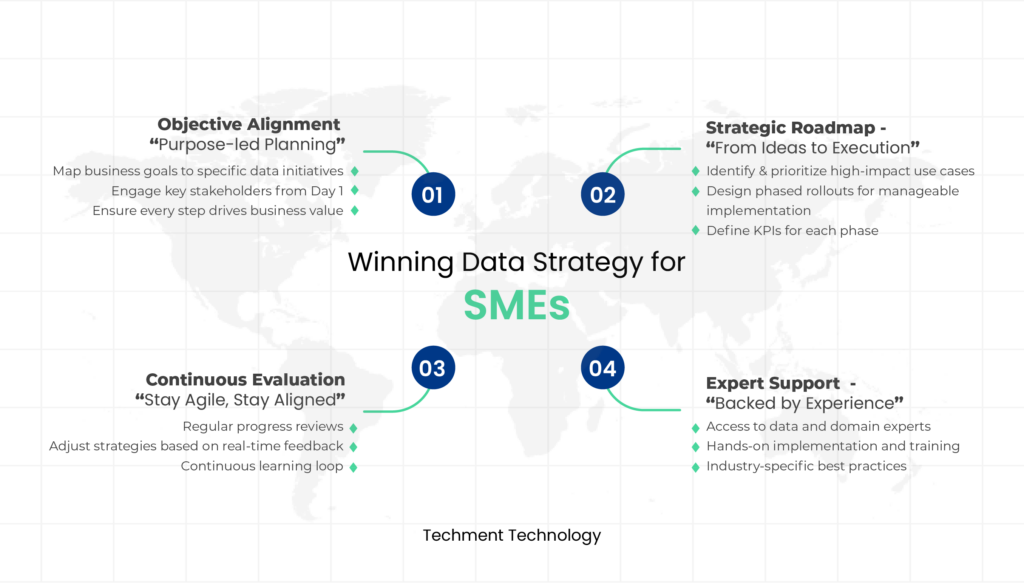
Techment’s Proven Framework for Data Strategy
Techment simplifies the path with a structured, collaborative approach designed specifically for SMEs:
- Objective Alignment: Techment works closely with stakeholders to map business goals to data initiatives—ensuring every step has purpose.
- Strategic Roadmap: Prioritize high-impact use cases and design phased rollouts for measurable ROI.
- Continuous Evaluation: Progress is tracked regularly to recalibrate initiatives and stay on course.
- Expert Support: SMEs benefit from domain-specific insights and hands-on implementation expertise.
Our Comprehensive & Scalable Data Services : Techment provides end-to-end data engineering solutions from architecture design and pipeline development to warehouse optimization. These services centralize and streamline data, making it scalable, secure, and accessible.
AI-Powered Integration & Quality : AI-driven tools eliminate data silos, enabling real-time, cross-functional insights. Automated cleansing and validation ensure consistent, reliable data—vital for decision-making, analytics, and compliance.
Cloud-Native Flexibility: With cloud-native solutions like server less computing and microservices, SMEs gain the agility to scale operations without bloating infrastructure costs.
Leverage AI-First data practices and deep expertise as enlisted in our whitepaper – Unleashing the Power of Data: Building a winning data strategy for Small & Medium Businesses – Techment.
The Bottom Line: Your Data Has Value—Let’s Unlock It, Together
If you’ve made it this far, chances are you already know that your business collects more data than ever before. The real question is—are you using it to its full potential?
Whether you’re trying to streamline operations, understand your customers better, or prepare for what’s next, a strong data strategy can be your most valuable asset. And it doesn’t have to be overwhelming or expensive. You just need a clear roadmap, the right guidance, and a partner who understands the unique realities of running an SME.
At Techment, we work closely with leaders like you—people who are wearing many hats, moving fast, and aiming to make smart, sustainable decisions. Our goal is simple: to make data work for you, not the other way around.
If you’re ready to start turning your data into decisions that drive growth, download our whitepaper: Unlocking Data Value with Microsoft Fabric.
Frequently Asked Questions (FAQs): Data Strategy for SMEs
1. What is a data strategy for SMEs?
A data strategy for SMEs is a structured plan that defines how small and mid-sized businesses collect, manage, analyze, and use data to achieve specific business goals. It ensures data initiatives align with growth objectives, operational efficiency, and decision-making needs—without unnecessary complexity or cost.
2. Why do SMEs need a data strategy?
SMEs need a data strategy to move from intuition-based decisions to insight-driven actions. A clear data strategy helps improve efficiency, customer experience, forecasting accuracy, and competitiveness—allowing SMEs to operate with the precision of larger enterprises.
3. How is a data strategy for SMEs different from large enterprises?
A data strategy for SMEs is more incremental, cost-aware, and flexible. Unlike enterprise strategies that may involve large platforms and teams, SME strategies focus on high-impact use cases, scalable cloud tools, and faster time-to-value with lean resources.
4. What are the key components of a winning data strategy for SMEs?
The core components include clear business objectives, data assessment, stakeholder buy-in, scalable data platforms, data quality management, governance, security, and self-service analytics. Together, these elements create a practical roadmap for data-driven growth.
5. How much does it cost to implement a data strategy for SMEs?
The cost varies based on business size and maturity, but modern cloud and pay-as-you-grow tools allow SMEs to start small. Many organizations begin with pilot initiatives and scale gradually, minimizing upfront investment while demonstrating measurable ROI.
Related Reads
- Enterprise AI Strategy in 2026
- Data Quality for AI in 2026: The Ultimate Blueprint for Accuracy, Trust & Scalable Enterprise Adoption
- Microsoft Fabric Architecture: A CTO’s Guide to Modern Analytics & AI
- AI-Ready Enterprise Checklist for Microsoft Fabric
- Leveraging Data Transformation for Modern Analytics