
At FabCon 2026, one theme was impossible to ignore: data architecture is no longer about storage—it’s about activation. Sitting among data leaders, architects, and platform engineers, it became clear that enterprises are no longer struggling with whether to modernize—but how fast they can operationalize AI on top of their data.
The Microsoft OneLake updates 2026 represent a decisive response to this urgency. Microsoft is no longer positioning OneLake as just another data lake—it is evolving into a unified, AI-ready data fabric layer that abstracts complexity across clouds, platforms, and tools.
What stood out most during the sessions and hallway conversations wasn’t just the feature announcements—it was the architectural intent. The focus has shifted from pipelines to products, from integration to interoperability, and from governance as a control mechanism to governance as an enabler.
In this blog, I’ll break down the key Microsoft OneLake updates 2026 through the lens of a Microsoft solutions partner attending FabCon—what was announced, what it really means for enterprise leaders, and how it reshapes the future of data strategy.
TL;DR Summary
- Microsoft OneLake updates 2026 position it as the core AI-ready data foundation in Microsoft Fabric
- Zero-copy and zero-ETL capabilities eliminate traditional data engineering bottlenecks
- Interoperability with platforms like Snowflake and Databricks signals open ecosystem strategy
- Security, governance, and catalog enhancements enable enterprise-grade data control at scale
- FabCon 2026 highlighted a shift from data platforms to data operating systems for AI
The Shift to AI-First Data Architecture: Why OneLake Matters Now
From Data Lakes to AI Operating Systems
One of the most compelling narratives at FabCon 2026 was this: AI is exposing the cracks in traditional data architectures.
Enterprises have spent years building data lakes, warehouses, and pipelines—but AI workloads demand something fundamentally different:
- Real-time access
- Unified context
- Trusted, governed datasets
- Minimal latency between ingestion and insight
The Microsoft OneLake updates 2026 directly address this gap by positioning OneLake as a logical data layer across the enterprise—not bound by storage location or platform constraints.
This aligns closely with Techment’s perspective in : Enterprise AI Strategy in 2026 which emphasizes that AI readiness is less about models and more about data accessibility, quality, and governance at scale.
The Enterprise Problem: Fragmentation at Scale
In conversations with multiple CTOs at the event, a common frustration emerged:
“We don’t have a data problem—we have a data fragmentation problem.”
Data exists everywhere:
- Multi-cloud environments (Azure, AWS, GCP)
- SaaS platforms (Salesforce, SAP, Dataverse)
- On-prem legacy systems
- Shadow data environments
Traditional approaches rely on:
- Heavy ETL pipelines
- Data duplication
- Complex orchestration
This results in:
- High costs
- Data inconsistency
- Slower AI adoption
The Microsoft OneLake updates 2026 aim to eliminate this fragmentation by introducing a single logical data layer without physical consolidation.
Strategic Insight for Leaders
This is not just a technology evolution—it’s a strategic shift in data operating models:
- Move from data movement → data virtualization
- Shift from pipelines → data products
- Replace platform silos → unified data fabric
For enterprises, this means rethinking how data teams operate—not just what tools they use.
For a deeper perspective on modern data strategy, explore:
Unleashing the Power of Data: Building a Winning Data Strategy
Zero-ETL and Multi-Cloud Unification: The Core of Microsoft OneLake Updates 2026
The End of Data Duplication
The most talked-about capability at FabCon was zero-copy, zero-ETL integration.
With shortcuts and mirroring, OneLake allows organizations to:
- Connect data across platforms without moving it
- Eliminate redundant storage
- Maintain a single source of truth
This is not incremental—it’s transformative.
Traditional ETL pipelines introduce:
- Latency
- Complexity
- Maintenance overhead
By contrast, OneLake’s approach enables real-time data access without duplication.
Expanded Connectivity: What’s New
The Microsoft OneLake updates 2026 introduced several critical enhancements:
- New mirroring sources (e.g., SharePoint, Oracle, SAP Datasphere)
- Integration with monitoring and query systems
- Change Data Feed (CDF) for incremental updates
- View creation on mirrored datasets
These capabilities move OneLake beyond ingestion into operational data management at scale.
Shortcut Transformations: A Quiet Game-Changer
One feature that didn’t get as much stage time—but drew significant interest in technical sessions—was shortcut transformations.
This enables:
- Format conversion (e.g., to Delta Lake)
- AI-powered transformations (summarization, classification)
- Direct Excel-to-Delta ingestion
This effectively embeds data engineering capabilities into the data access layer itself.
Enterprise Implications
For data leaders, this changes the economics of data architecture:
- Reduced pipeline maintenance costs
- Faster time-to-insight
- Simplified architecture
- Lower data redundancy
However, it also introduces new considerations:
- Governance must adapt to distributed data access
- Monitoring becomes more complex
- Data lineage must be redefined
To understand how enterprises are modernizing data pipelines, refer to: Microsoft Fabric Architecture: CTO’s Guide to Modern Analytics & AI
Interoperability as Strategy: Breaking Vendor Lock-In
A Clear Message from Microsoft
One of the strongest signals at FabCon 2026 was Microsoft’s commitment to interoperability.
Rather than locking customers into Fabric, Microsoft is enabling:
- Bidirectional integration with Snowflake
- Native read/write capabilities with Databricks
- Open table formats like Apache Iceberg
This is a strategic departure from traditional platform approaches.
Why This Matters
Enterprise data ecosystems are inherently heterogeneous.
No organization operates in a single platform.
By enabling interoperability, OneLake becomes:
- A unifying layer, not a competing silo
- A data exchange fabric, not just storage
This aligns with Techment’s insights in: Why Microsoft Fabric AI Solutions Are Changing the Way Enterprises Build Intelligence which highlights that future-ready enterprises will adopt multi-platform strategies rather than single-vendor dependencies.
Real-World Example: Platform-Native Architectures
The announcement of platforms building natively on OneLake signals a new trend:
Data platforms are becoming composable ecosystems.
Instead of:
- Centralized monolithic systems
We are moving toward:
- Distributed, interoperable architectures
Strategic Takeaway
For CTOs and data architects:
- Avoid over-committing to a single platform
- Prioritize open standards
- Design for interoperability from day one
For a deeper comparison of platform strategies, explore: What Is Microsoft Fabric? A Comprehensive Overview for Enterprise Leaders
OneLake Security & Governance: From Control to Intelligent Enablement
Unified Security Model Across All Experiences
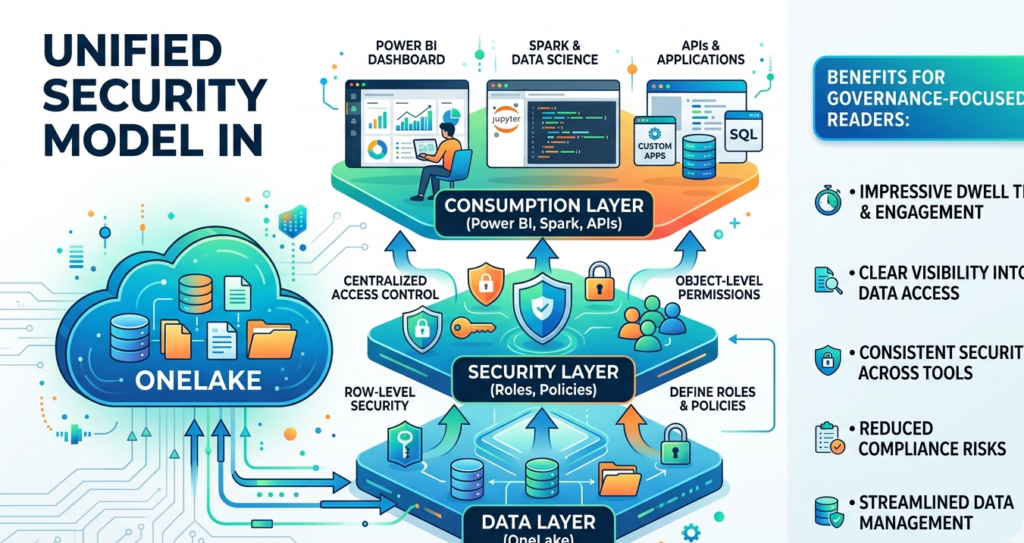
One of the most practical—and arguably most enterprise-critical—announcements in the Microsoft OneLake updates 2026 was the general availability of its unified security model.
At FabCon, this wasn’t just presented as a feature—it was framed as a foundational shift in how governance operates in modern data platforms.
Traditionally, security models have been fragmented:
- Warehouse-level permissions
- BI-layer access controls
- Separate policies for notebooks and APIs
OneLake consolidates this into a single, consistent security layer that follows the data across:
- Power BI
- Spark workloads
- Fabric data agents
- External query engines
This means governance is no longer an afterthought—it is embedded into the data lifecycle.
Fine-Grained Controls at Scale
The ability to define:
- Row-level security
- Column-level security
- Role-based access
…within a unified model fundamentally changes how enterprises enforce compliance.
At FabCon, several enterprise architects pointed out that this reduces:
- Policy duplication
- Security drift
- Audit complexity
Network Security Enhancements: Enterprise-Grade Protection
The introduction of:
- Resource Instance Rules
- Workspace-level IP firewalls
- Extended outbound access protection
…signals that Microsoft is addressing real-world enterprise security concerns, not just theoretical ones.
This is especially critical for regulated industries where:
- Data residency
- Access boundaries
- Network isolation
…are non-negotiable.
Strategic Insight
Security is evolving from:
- Reactive control → Proactive enablement
For enterprises, this means:
- Faster onboarding of data products
- Reduced friction for analytics teams
- Stronger compliance posture
To explore governance foundations further:Data Governance for Data Quality: Future-Proofing Enterprise Data.
OneLake Catalog & Discoverability: The Rise of the Data Control Plane
From Metadata Repository to Intelligence Layer
Another standout theme at FabCon was the evolution of the OneLake catalog into a true control plane for enterprise data.
According to McKinsey, organizations that effectively leverage data and AI can unlock significant productivity gains and competitive advantage, reinforcing the need for unified data platforms like OneLake.
The Microsoft OneLake updates 2026 introduce:
- Admin insights dashboards
- Workspace tagging
- AI-generated metadata descriptions
- Public APIs for discovery
This transforms the catalog from passive documentation into an active intelligence layer.
Why Discoverability Is the New Bottleneck
A recurring insight from enterprise leaders:
“We don’t lack data—we lack visibility into the right data.”
Without effective discovery:
- Data duplication increases
- Teams rebuild existing datasets
- AI models operate on suboptimal inputs
OneLake’s enhancements directly address this by enabling:
- Relevance-based search
- Metadata enrichment
- AI-assisted discovery
Traditional Catalog vs OneLake Catalog 2026
| Capability | Traditional Catalog | OneLake Catalog 2026 |
|---|---|---|
| Metadata management | Static | AI-generated, dynamic |
| Search | Keyword-based | Contextual, relevance-ranked |
| Governance visibility | Limited | Admin dashboards + insights |
| Integration | Siloed | API-driven, cross-platform |
SEO Benefit: Structured data improves featured snippet potentia
Admin Insights: From Reporting to Action
The Govern tab enhancements provide:
- Capacity utilization insights
- Data protection coverage
- Workspace activity monitoring
But what stood out was actionability:
- Recommendations
- Power BI integration
- Copilot-assisted interpretation
This marks a shift toward autonomous data governance systems.
Strategic Takeaway
For data leaders:
- Invest in metadata strategy
- Treat catalogs as strategic assets
- Align governance with discoverability
To understand how governance and discoverability intersect our AI services.
OneLake + Microsoft Ecosystem: Embedding Data into Everyday Workflows
Data Meets Productivity: Windows & Foundry Integration
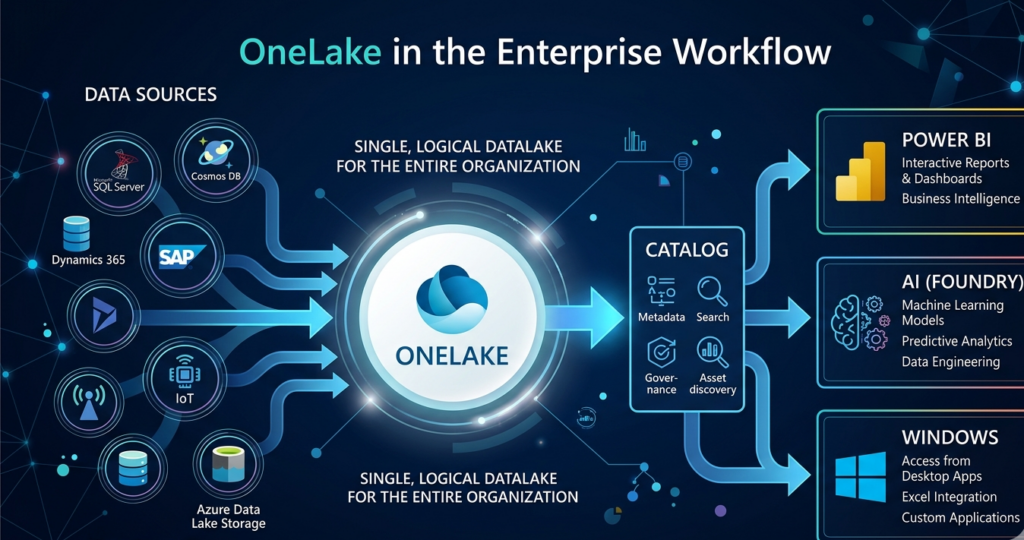
One of the most exciting announcements—especially for business adoption—was the integration of OneLake into:
- Windows File Explorer
- Microsoft Foundry
This brings enterprise data closer to where users already work.
Imagine:
- Browsing enterprise datasets like files
- Drag-and-drop data interactions
- Seamless AI model integration
This reduces the gap between:
- Technical teams
- Business users
Foundry Integration: AI-Driven Data Consumption
The integration with Microsoft Foundry enables:
- Direct access to OneLake catalog
- Data-to-AI pipeline acceleration
- Knowledge building from enterprise data
This reinforces a key message from FabCon:
“AI is only as powerful as the accessibility of your data.”
Strategic Implications
This integration signals a major shift:
- Data platforms are no longer backend systems
- They are becoming user-facing productivity layers
For enterprises, this means:
- Faster adoption
- Democratized analytics
- Increased ROI from data investments
Explore how enterprises are enabling analytics at scale: Conversational AI on Microsoft Azure: Building Intelligent Enterprise Assistants
Implementation Strategy: How Enterprises Should Approach OneLake in 2026
Step 1: Define a Unified Data Strategy
Before adopting OneLake, enterprises must align on:
- Data ownership models
- Governance policies
- AI readiness goals
This aligns with Techment’s perspective in: Azure Data and AI Stack to Microsoft Fabric
Step 2: Start with High-Impact Use Cases
Recommended entry points:
- Customer analytics
- Supply chain visibility
- Financial reporting
Avoid large-scale migrations initially—focus on incremental value delivery.
Step 3: Redesign Data Architecture
Shift from:
- Pipeline-centric architecture
To:
- Data product-centric architecture
Leverage:
- Shortcuts
- Mirroring
- Delta formats
Step 4: Strengthen Governance Early
Key priorities:
- Role-based access
- Data lineage
- Quality frameworks
Step 5: Enable Cross-Platform Interoperability
Ensure integration with:
- Snowflake
- Databricks
- Legacy systems
This avoids vendor lock-in and future-proofs architecture
Strategic Insight
The biggest risk is not adoption—it’s misaligned adoption.
Enterprises must treat OneLake as a strategic platform, not just a technical upgrade.
How Techment Helps Enterprises Operationalize OneLake
At Techment, we view the Microsoft OneLake updates 2026 not as isolated features—but as part of a broader enterprise data transformation journey.
Strategic Advisory
We help organizations:
- Define AI-ready data strategies
- Align OneLake with business objectives
- Build scalable governance models
Data ModernizationOur expertise includes:
- Migrating legacy data architectures
- Implementing lakehouse models
- Designing unified data platforms
Explore more: Microsoft Fabric vs Traditional Data Warehousing: What Leaders Need to Know.
AI Readiness & Enablement
We enable:
- Data preparation for AI workloads
- Integration with Fabric AI capabilities
- Scalable machine learning pipelines
Governance & Compliance
We implement:
- Microsoft Purview integrations
- Data quality frameworks
- Regulatory compliance models
End-to-End Execution
From roadmap to optimization, Techment supports:
- Strategy → Implementation → Scale
Learn more: Fabric AI Readiness: How to Prepare Your Data for Scalable AI Adoption .
Conclusion
Attending FabCon 2026 made one thing clear: the future of enterprise data is unified, intelligent, and AI-ready.
The Microsoft OneLake updates 2026 are not just incremental improvements—they represent a fundamental rethinking of data architecture.
By eliminating silos, enabling interoperability, and embedding governance into the core, OneLake positions itself as the foundation for next-generation enterprise data platforms.
For leaders, the opportunity is immense—but so is the responsibility.
Success will depend on:
- Strategic alignment
- Thoughtful implementation
- Strong governance
Organizations that act decisively will not just modernize their data—they will transform how they compete in an AI-driven world.
Techment stands ready to guide enterprises through this journey—turning vision into execution, and data into measurable business value.
FAQ: Microsoft OneLake Updates 2026
1. What makes Microsoft OneLake different from traditional data lakes?
OneLake provides a unified, logical data layer with zero-ETL capabilities, eliminating data duplication and enabling real-time access.
2. Is OneLake suitable for multi-cloud environments?
Yes, the Microsoft OneLake updates 2026 specifically enhance multi-cloud interoperability, supporting Azure, AWS, GCP, and more.
3. How does OneLake support AI workloads?
By providing unified, governed, and accessible data, OneLake enables faster AI model development and deployment.
4. What are the key governance features?
Unified security model, row/column-level controls, catalog insights, and network security enhancements.
5. How long does enterprise adoption take?
Typically, 3–12 months depending on scale, existing architecture, and use cases.