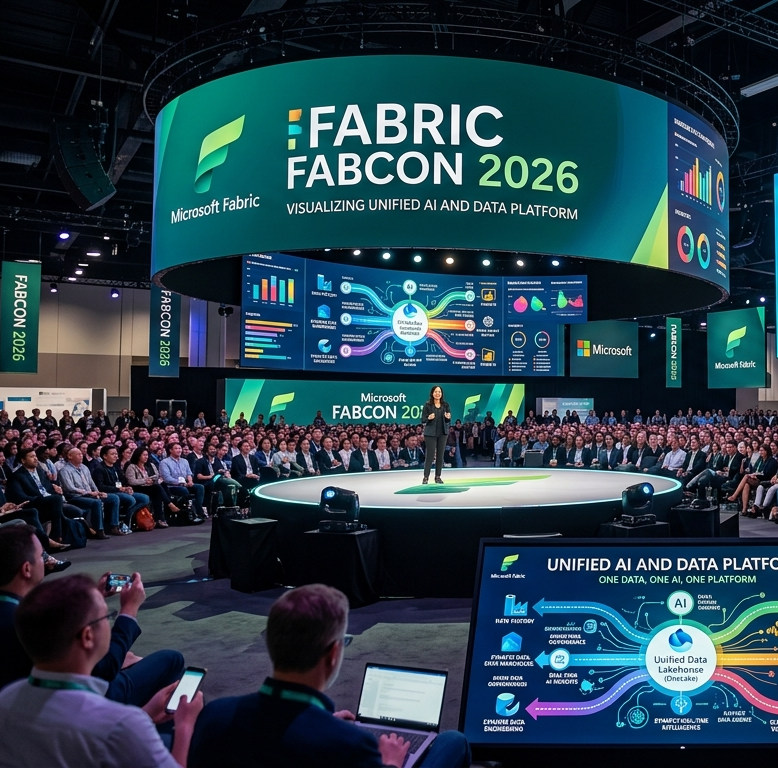
At FabCon 2026, Microsoft did not just introduce product updates—it revealed a clear architectural direction for enterprise AI and data platforms. From our vantage point at Techment, these announcements are less about incremental improvements and more about a fundamental shift in how enterprises operationalize data, AI, and decision intelligence.
The core narrative emerging from these Microsoft Fabric FabCon 2026 insights is unmistakable: data platforms are no longer passive systems of record—they are becoming active intelligence layers driving real-time, AI-powered decision-making.
This shift has profound implications. Enterprises are moving from fragmented analytics ecosystems toward unified, context-aware, AI-native platforms. Fabric is positioning itself as the convergence layer where data, AI, governance, and operations coexist.
In this blog, we go beyond summarizing announcements. We decode what FabCon 2026 truly means for enterprise leaders—covering architecture evolution, AI strategy implications, governance shifts, and how organizations should respond.
TL;DR Summary
- Microsoft Fabric is evolving from a data platform into a full enterprise intelligence layer
- FabCon 2026 signals a shift toward AI-native architectures and agent-driven operations
- Graph, Data Agents, and Fabric IQ redefine contextual intelligence for AI
- OneLake + interoperability positions Fabric as a non-lock-in data ecosystem
- Enterprises must rethink data governance, operating models, and AI readiness now
The Strategic Shift: From Data Platform to Intelligence Platform
One of the most important Microsoft Fabric FabCon 2026 insights is the transition from a unified data platform to a unified intelligence platform.
This distinction matters.
From Storage to Contextual Intelligence
Historically, platforms like data warehouses and lakehouses focused on storing and processing data. Fabric is now moving toward understanding data in business context.
This is evident in the introduction of:
- Fabric IQ
- Graph database integration
- Data Agents
- Real-time intelligence enhancements
These are not isolated features—they represent a layered intelligence architecture.
| Capability Layer | Traditional Data Platforms | Microsoft Fabric (2026) |
|---|---|---|
| Data Storage | Warehouses, Lakes | OneLake (unified) |
| Processing | Batch / Limited real-time | Real-time + streaming |
| Context | Minimal | Fabric IQ + Ontology |
| AI Integration | External / siloed | Native + embedded |
| Decision Support | Reports | AI-driven decisions |
| Governance | Fragmented | Unified (OneLake Security) |
Why This Matters for Enterprises
Enterprises have long struggled with:
- Data silos across systems
- Lack of semantic consistency
- AI models operating without context
- Delayed decision-making cycles
Microsoft Fabric: From Data Platform to Intelligence Platform
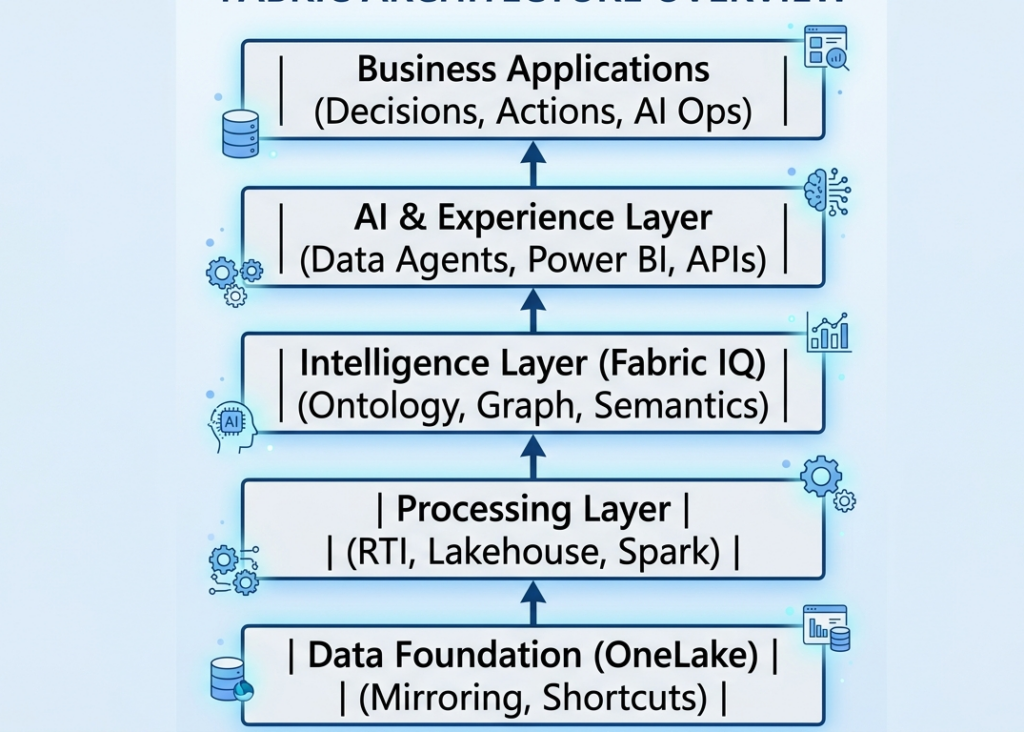
Fabric’s direction addresses these challenges by introducing:
- Semantic understanding (Ontology via Fabric IQ)
- Relationship-driven data modeling (Graph)
- AI-native interaction layers (Data Agents)
From a Techment perspective, this signals a shift from “data-driven organizations” to “intelligence-driven enterprises.”
Enterprise Implication
Organizations must now:
- Treat data platforms as decision systems, not infrastructure
- Invest in semantic modeling and ontology design
- Align AI initiatives with context-rich data ecosystems
For enterprises exploring this transition, Techment’s perspective on Enterprise AI Strategy in 2026 provides a foundational approach to aligning data with business outcomes.
Fabric Graph & Maps: Context Becomes the New Currency
A defining Microsoft Fabric FabCon 2026 insight is the elevation of contextual intelligence as a first-class capability.
Fabric Graph (GA): Relationship-Driven Intelligence
Fabric Graph introduces a scalable graph database built for modeling relationships across enterprise data.
| Capability | Before FabCon 2026 | After FabCon 2026 |
|---|---|---|
| Relationship Modeling | Limited | Native Graph DB |
| AI Context Awareness | Low | High (Ontology + Graph) |
| Geospatial Intelligence | External tools | Native (Maps GA) |
| Real-Time Context | Partial | Fully integrated |
| Decision Accuracy | Moderate | High |
Why Graph Changes the Game
Traditional data models answer:
- “What happened?”
Graph models answer:
- “How are things connected?”
This distinction is critical for:
- Supply chain optimization
- Fraud detection
- Customer journey analysis
- AI reasoning systems
Fabric Graph enables:
- Native Graph Query Language (GQL) integration
- Enhanced AI contextual understanding
- Reduced hallucinations in AI systems
Techment POV
We see Graph not as a feature—but as a foundational layer for enterprise AI accuracy.
Without relationship context, AI remains probabilistic.
With Graph, AI becomes context-aware and decision-relevant.
Maps (GA): Real-Time Intelligence Gets Spatial Context
Fabric Maps solves a long-standing gap: geospatial intelligence in real-time analytics.
Previously:
- Location data was treated as just another attribute
Now:
- It becomes a core analytical dimension
Enterprise Impact
Industries such as:
- Logistics
- Aviation
- Retail
- Smart cities
Can now:
- Visualize streaming data spatially
- Detect anomalies in real time
- Enable location-aware AI decisions
Strategic Takeaway
Fabric’s real-time intelligence is now:
- Context-aware (Graph)
- Spatially aware (Maps)
- AI-ready
This combination creates a powerful operational intelligence layer.
To operationalize such capabilities, organizations need robust foundations in data reliability—explored in Microsoft Fabric Architecture: CTO’s Guide to Modern Analytics & AI
Data Agents: The Rise of AI-Native Enterprise Interfaces
Perhaps the most transformative announcement in these Microsoft Fabric FabCon 2026 insights is the GA of Fabric Data Agents.
From Dashboards to Conversations
Data Agents shift enterprise interaction from:
- Dashboards and reports
To:
- Natural language conversations
- AI-driven recommendations
- Autonomous monitoring
BI vs AI Agents
| Feature | Traditional BI | Fabric Data Agents |
|---|---|---|
| Interaction | Dashboards | Natural language |
| Insights | Static | Dynamic + proactive |
| Monitoring | Manual | Continuous |
| Integration | Limited | Cross-platform |
| Actionability | Low | High |
What Makes Data Agents Different
Unlike traditional BI tools, Data Agents:
- Integrate across systems (SAP, Oracle, Salesforce)
- Monitor data continuously
- Provide proactive insights
- Enable multi-agent orchestration
Techment POV: This Is a Paradigm Shift
We believe Data Agents represent the next interface layer for enterprise systems.
Just as:
- GUIs replaced command lines
- Mobile apps replaced desktop-first workflows
AI agents will replace:
- Static dashboards
- Manual data exploration
Enterprise Readiness Challenges
However, adoption is not automatic.
Data Agents require:
- High-quality, governed data
- Strong semantic models
- Clear access control frameworks
Without this foundation, organizations risk:
- Incorrect insights
- Governance violations
- Loss of trust in AI systems
For enterprises preparing for this shift, Fabric AI Readiness: How to Prepare Your Data for Scalable AI Adoption outlines critical readiness steps.
Fabric IQ: The Semantic Backbone of Enterprise AI
Fabric IQ introduces a semantic intelligence layer—arguably the most strategic capability announced.
What Is Fabric IQ?
Fabric IQ provides:
- Ontologies defining business concepts
- Relationships between entities
- Rules governing interpretation
This enables AI to:
- Understand “Profit Margin” instead of raw columns
- Interpret “Customer Risk” contextually
- Align insights with business logic
Why Ontology Matters
Most AI failures in enterprises stem from:
- Lack of context
- Misaligned data definitions
- Inconsistent semantics
Fabric IQ addresses this by creating a shared version of reality.
Planning Integration: Closing the Loop
The addition of planning capabilities means:
- Analytics → Insight → Decision → Action
All happen within one platform.
Techment Perspective
This is where Fabric moves beyond analytics into:
- Decision intelligence platforms
It bridges:
- Historical data
- Real-time signals
- Future projections
Enterprise Implication
Organizations must now:
- Invest in semantic modeling capabilities
- Align business and data teams
- Treat ontology as a strategic asset
For a deeper perspective on aligning data quality with AI, refer to Data Quality for AI in 2026: The Ultimate Blueprint for Accuracy, Trust & Scalable Enterprise Adoption
Unified Platform Vision: Database Hub & OneLake Evolution
Another major Microsoft Fabric FabCon 2026 insight is the convergence of operational and analytical systems.
Database Hub: A Single Control Plane
The Database Hub introduces:
- Unified monitoring
- Cross-platform governance
- Centralized observability
Across:
- Azure SQL
- Cosmos DB
- PostgreSQL
- Fabric databases
Why This Matters
Enterprises today operate in:
- Hybrid environments
- Multi-cloud ecosystems
- Fragmented database landscapes
Database Hub simplifies this into:
- One unified view
Strategic Impact
This enables:
- Faster issue resolution
- Better governance enforcement
- AI-ready data consistency
OneLake: The Open Data Foundation
OneLake continues to evolve as:
- A zero-ETL data foundation
- An interoperable ecosystem layer
Key Advancements
- Mirroring for SAP, Oracle
- Integration with Snowflake & Databricks
- Shortcut transformations
- Excel-to-Delta onboarding
Techment POV: The End of Forced Platform Choices
Fabric’s interoperability strategy signals:
- Enterprises no longer need to choose a single platform
Instead:
- They can orchestrate across ecosystems
Enterprise Takeaway
This reduces:
- Vendor lock-in risks
- Migration complexity
- Data duplication costs
For leaders evaluating platform strategies, Microsoft Fabric vs Snowflake Data Management Showdown provides a comparative perspective.
Developer Ecosystem Transformation: AI-Assisted Engineering Becomes Reality
One of the most underappreciated yet high-impact Microsoft Fabric FabCon 2026 developments is the transformation of how data platforms are built, deployed, and operated.
Model Context Protocol (MCP): From Copilot to Autonomous Engineering
The introduction of the Model Context Protocol (MCP) fundamentally changes the developer experience in Fabric.
Instead of AI being a passive assistant, MCP enables:
- Context-aware code generation
- Direct interaction with Fabric environments
- AI-assisted deployment and execution
This creates what Microsoft calls “Agentic Development.”
What This Means in Practice
Developers can now:
- Generate pipelines using natural language
- Modify lakehouse structures through AI prompts
- Deploy workloads without manual intervention
This is not just productivity enhancement—it is workflow redefinition.
Techment POV: Engineering Becomes Intent-Driven
We see MCP as the beginning of a shift from:
- Code-first engineering
To:
- Intent-driven engineering
Where:
- Architects define what needs to be achieved
- AI determines how it is executed
Enterprise Implications
This introduces both opportunities and risks:
Opportunities
- Faster development cycles
- Reduced dependency on specialized skills
- Standardized deployment patterns
Risks
- Over-reliance on AI-generated code
- Governance gaps in automated deployments
- Need for new validation frameworks
To navigate this, enterprises must build AI-aware engineering governance models.
For organizations modernizing engineering practices,
Microsoft Azure for Enterprises: Cloud & AI Modernization outlines scalable approaches to cloud-native transformation.
Security & Governance: The True Enabler of Enterprise AI
Among all Microsoft Fabric FabCon 2026 announcements, governance may be the most critical for enterprise adoption.
OneLake Security Model (GA): Unified Governance at Scale
The OneLake security model introduces:
- Row-Level Security (RLS)
- Column-Level Security (CLS)
- Centralized policy enforcement
Across:
- Spark
- SQL
- Power BI
- AI Agents
Why This Is a Breakthrough
Historically, governance has been:
- Fragmented
- Tool-specific
- Difficult to enforce consistently
Fabric changes this with:
- “Define once, enforce everywhere”
Techment POV: Governance Is Now AI-Critical
In AI-driven systems:
- Governance is not just about compliance
- It directly impacts AI accuracy and trust
If governance is inconsistent:
- AI models access incorrect data
- Insights become unreliable
- Risk exposure increases
Network & Encryption Enhancements
FabCon 2026 also introduced:
- Private Link (GA)
- Workspace IP filtering (Preview)
- Customer Managed Keys (GA)
- Outbound Access Protection expansion
Enterprise Impact
These capabilities:
- Enable secure enterprise adoption
- Meet regulatory requirements
- Support sensitive workloads
Industries like:
- Banking
- Healthcare
- Government
Can now confidently move to Fabric.
Strategic Takeaway
Security is no longer a post-implementation concern.
It is a design-time requirement for AI platforms.
To build robust governance frameworks, enterprises should exploreData Governance for Data Quality: Future-Proofing Enterprise Data
Enterprise Risks, Trade-offs, and Adoption Realities
While the Microsoft Fabric FabCon 2026 announcements are compelling, enterprise leaders must evaluate them with strategic realism.
The Promise vs. Reality Gap
Fabric promises:
- Unified platform
- AI-native architecture
- Reduced complexity
However, enterprises face:
- Legacy system dependencies
- Organizational silos
- Skill gaps
- Governance maturity challenges
Key Trade-offs to Consider
1. Platform Consolidation vs Flexibility
- Fabric simplifies architecture
- But full consolidation may not be feasible
2. AI Automation vs Control
- Data Agents and MCP enable automation
- But require strong oversight
3. Speed vs Governance
- Faster deployments
- Increased governance complexity
Techment POV: Hybrid Strategies Will Win
We strongly believe:
- Enterprises should avoid “all-in” strategies
- Instead adopt progressive integration approaches
This includes:
- Leveraging OneLake interoperability
- Maintaining best-of-breed systems where needed
- Gradually transitioning workloads
Practical Adoption Roadmap
Phase 1: Foundation
- Data quality assessment
- Governance framework design
- Platform evaluation
Phase 2: Pilot
- Real-time intelligence POCs
- Data Agent use cases
- Interoperability testing
Phase 3: Scale
- Enterprise-wide rollout
- AI integration
- Operating model transformation
For a structured roadmap, Enterprise AI Strategy in 2026 provides actionable guidance.
How Techment Helps Enterprises Navigate Fabric Transformation
At Techment, we view Microsoft Fabric not as a tool—but as a strategic enabler of enterprise intelligence transformation.
End-to-End Fabric Enablement
We support enterprises across:
Data Modernization
- Migrating legacy systems to Fabric
- Designing lakehouse and real-time architectures
- Enabling OneLake-based ecosystems
AI Readiness
- Data quality frameworks
- Semantic modeling and ontology design
- AI governance and compliance
Platform Implementation
- Fabric deployment and optimization
- Integration with Azure, Power Platform, and external systems
- Real-time intelligence and analytics enablement
Governance & Security
- OneLake security architecture
- Compliance frameworks
- Risk management strategies
Our Differentiation
What sets Techment apart is:
- Deep expertise in enterprise data strategy
- Strong alignment with Microsoft ecosystem
- Proven experience in AI-led transformations
We don’t just implement Fabric—we help organizations:
- Define data-driven operating models
- Align technology with business outcomes
- Build future-ready intelligence platforms
To understand how unified analytics can drive enterprise value, explore
Microsoft Fabric AI Solutions for Enterprise Intelligence
Conclusion: The Beginning of AI-Native Enterprise Platforms
FabCon 2026 marks a turning point.
The Microsoft Fabric FabCon 2026 announcements are not just product updates—they represent a clear vision for the future of enterprise data and AI platforms.
From Techment’s perspective, three themes stand out:
- Context is becoming the foundation of AI
- Platforms are evolving into intelligence systems
- Governance is now central to innovation
Enterprises that recognize this shift early will:
- Accelerate AI adoption
- Improve decision-making
- Build sustainable competitive advantage
Those that delay risk:
- Fragmented architectures
- Inefficient AI initiatives
- Missed opportunities
The path forward is not about adopting Fabric—it is about reimagining how your enterprise uses data and AI to drive decisions.
Techment stands ready to partner with organizations on this journey—helping translate platform potential into real, measurable business impact.
Frequently Asked Questions
1. Is Microsoft Fabric ready for enterprise-wide adoption?
Yes, with multiple GA announcements (Data Agents, OneLake security, Graph), Fabric is now enterprise-ready. However, success depends on governance and data maturity.
2. How does Fabric compare to platforms like Snowflake or Databricks?
Fabric emphasizes unification and AI integration, while others excel in specialized areas. Interoperability now allows hybrid strategies rather than forced choices.
3. What is the biggest challenge in adopting Fabric?
The biggest challenge is not technology—it is organizational readiness, including data quality, governance, and operating models.
4. Do enterprises need to migrate everything to Fabric?
No. Fabric supports interoperability, allowing organizations to adopt a phased and hybrid approach.
5. How important is Fabric IQ for AI adoption?
Fabric IQ is critical—it provides the semantic context required for accurate and reliable AI systems.