
Google BigQuery vs Microsoft Fabric is a strategic choice between a cloud-native data warehouse and a unified analytics platform. BigQuery is designed for scalable, serverless analytics within the Google Cloud ecosystem, while Microsoft Fabric brings data engineering, data warehousing, real-time analytics, data science, and Power BI into a unified environment.
For enterprises, the right choice depends on cloud strategy, workload requirements, governance, cost, AI roadmap, existing technology investments, and operating model.
TL;DR — Google BigQuery vs Microsoft Fabric
- Microsoft Fabric is a unified analytics platform built around OneLake and tightly integrated with Power BI and the Microsoft ecosystem.
- Google BigQuery is a serverless cloud data warehouse designed for scalable SQL analytics and Google Cloud integration.
- Choose Fabric when platform consolidation, Power BI, Microsoft 365, and unified governance are priorities.
- Choose BigQuery when serverless scale, SQL analytics, GCP integration, and flexible workload scaling are priorities.
- Neither platform is universally cheaper or better. Total cost and performance depend on workload patterns, existing commitments, architecture, and team skills.
- Enterprises should evaluate architecture, pricing, scalability, governance, AI/ML, integration, and operating model before selecting a platform.
- Fabric prioritizes platform unification; BigQuery prioritizes cloud-native analytical scale.
Google BigQuery vs Microsoft Fabric: Which Is Better?
BigQuery is generally better for cloud-native, scalable SQL analytics and organizations invested in Google Cloud. Microsoft Fabric is generally better for Microsoft-centric enterprises that want a unified analytics platform with OneLake, Power BI, data engineering, and integrated AI capabilities.
If you need… Better fit Serverless analytics BigQuery Microsoft ecosystem integration Microsoft Fabric Power BI integration Microsoft Fabric GCP-native analytics BigQuery Large-scale SQL workloads BigQuery Unified data + BI platform Microsoft Fabric Multi-cloud flexibility BigQuery / evaluate alternatives Advanced data engineering Fabric / Databricks depending on workload
See how our Data Transformation Solutions ensure your data becomes the foundation for advanced analytics, machine learning, and intelligent automation with the right choice of Microsoft Fabric for Enterprise Analytics.
Why Enterprise Leaders Are Re-Evaluating Analytics Platforms
At the center of this evaluation is the growing comparison between Google BigQuery and Microsoft Fabric, alongside a broader ecosystem of Microsoft Fabric alternatives that promise flexibility, cost control, and architectural independence. While both platforms aim to simplify analytics at scale, their design philosophies, ecosystem dependencies, and enterprise implications differ significantly.
By 2026, 60% of enterprises will adopt composable architectures to enable AI‑driven agility
Gartner projects that by 2026, 60% of enterprises will have adopted composable architectures to support AI‑driven agility — indicating that the transition toward modular and interoperable data ecosystems is already well in progress. Yet many leaders struggle to determine whether an integrated platform like Fabric or a best-of-breed approach anchored by BigQuery—or other cloud data warehouse alternatives—is the right strategic fit.
This blog provides an executive-level, architecture-aware comparison of Google BigQuery vs Microsoft Fabric. We will explore market drivers, architectural trade-offs, governance and AI readiness, and decision criteria that matter most to large enterprises. The goal is not to declare a universal winner—but to help leaders make an informed, future-proof decision aligned with their operating model and business strategy.
Learn how we modernize your technology stack, integrate AI into enterprise systems, and migrate legacy applications to AI-enabled architectures with our AI-modernization services.
Market Context: Why Enterprises Are Re-Evaluating Analytics Platforms
The modern enterprise data landscape is being reshaped by three converging forces: exponential data growth, AI-driven analytics, and heightened regulatory scrutiny. Legacy BI tools and first-generation cloud data warehouses were never designed to support large-scale machine learning, real-time insights, and cross-domain governance simultaneously. As a result, enterprises are actively reassessing their analytics platforms.
According to IDC, global data volumes are expected to exceed 175 zettabytes by 2028, with a growing share generated by operational systems, IoT, and digital channels. This shift has exposed the limitations of siloed analytics architectures and fueled interest in unified platforms that can handle structured and unstructured data at scale. At the same time, AI adoption has moved from experimentation to production, placing new demands on data platforms to support feature engineering, model training, and inference workloads natively.
Cost optimization is another critical driver. Cloud analytics spend has become one of the fastest-growing line items in enterprise IT budgets. Consumption-based pricing models—while flexible—have introduced unpredictability, especially for data-intensive workloads. Many organizations exploring Microsoft Fabric alternatives are motivated by the need for clearer cost governance and workload isolation.
Governance and compliance pressures further complicate the picture. Regulations such as GDPR, HIPAA, and industry-specific mandates require tighter control over data access, lineage, and residency. Enterprises operating across regions and clouds often find that platform-level governance capabilities influence architecture decisions as much as performance benchmarks.
In this context, the debate around Google BigQuery vs Microsoft Fabric is not merely technical. It reflects broader questions about vendor lock-in, operating models, and long-term analytics strategy. Enterprises are increasingly evaluating cloud data warehouse alternatives and integrated analytics platforms through a strategic lens—seeking solutions that balance agility with control, and innovation with risk management.
Enhance your analytics outcomes and turn fragmented data with our data engineering solutions and MS Fabric capabilities.
What Is Google BigQuery?
Google BigQuery is a fully managed, serverless cloud data warehouse designed for large-scale analytical workloads. Its architecture separates compute and storage, allowing organizations to scale analytics without managing traditional warehouse infrastructure.
One of BigQuery’s core strengths lies in its ability to process massive datasets with minimal operational overhead. Its distributed architecture separates compute from storage, allowing enterprises to scale queries independently of data volume. This makes BigQuery particularly attractive for organizations dealing with petabyte-scale analytics, log data, and event-driven workloads. Native integration with GCP services such as Vertex AI, Dataflow, and Pub/Sub further enhances its appeal for AI-driven analytics.
From a performance perspective, BigQuery’s columnar storage and advanced query optimization deliver consistently fast results, even under heavy concurrency. Google’s global infrastructure also enables cross-region analytics with relatively low latency, which is valuable for multinational enterprises.
However, BigQuery’s strengths also introduce limitations that prompt enterprises to explore Microsoft Fabric alternatives and other platforms. The serverless pricing model, while flexible, can lead to unpredictable costs—particularly for ad hoc queries and exploratory analytics. Many organizations report challenges in forecasting spend and enforcing cost controls across business units.
Another consideration is ecosystem alignment. BigQuery works best within a GCP-centric environment. Enterprises heavily invested in Microsoft 365, Power BI, and Azure services may encounter integration friction or duplicated tooling. While BigQuery supports open formats and external tools, achieving seamless interoperability often requires additional engineering effort.
Governance is another nuanced area. BigQuery offers robust security features, but enterprises with complex data domains may find that end-to-end lineage, policy management, and cross-platform governance require supplementary tools. As a result, BigQuery is frequently evaluated alongside other cloud data warehouse alternatives rather than as a standalone enterprise analytics platform.
See how Microsoft Data Fabric compares against traditional data warehousing across scalability, governance, AI readiness, cost, and decision intelligence.
What Is Microsoft Fabric?
Microsoft Fabric is a unified SaaS analytics platform that combines data engineering, data warehousing, data science, real-time analytics, and Power BI within a common environment. OneLake provides the shared data foundation across these workloads.
One of Fabric’s most compelling strengths is its integration with Microsoft 365 and Azure Active Directory. For enterprises already standardized on Microsoft tools, Fabric offers a familiar security model, identity management, and user experience. This reduces adoption friction and accelerates time to value, especially for business users.
Fabric also aligns closely with Microsoft’s AI strategy. Built-in support for Copilot, Azure OpenAI Service, and AI-powered insights positions Fabric as a strong contender for organizations prioritizing AI-driven analytics. For some enterprises, this integrated AI capability reduces the need to evaluate Microsoft Fabric alternatives focused solely on analytics.
Despite these advantages, Fabric introduces trade-offs that warrant careful consideration. Its tightly coupled architecture can increase dependency on the Microsoft ecosystem, raising concerns about long-term flexibility and multi-cloud strategies. Enterprises with heterogeneous environments may find Fabric’s “all-in-one” model restrictive compared to modular platforms.
Cost transparency is another emerging concern. Fabric’s capacity-based pricing simplifies licensing at a high level but can obscure workload-specific costs. Large enterprises with diverse analytics use cases may struggle to allocate costs accurately across teams.
Finally, Fabric is still evolving. While Microsoft is investing heavily, some advanced features and enterprise-grade controls are maturing. As a result, many leaders evaluate Fabric alongside established cloud data warehouse alternatives to mitigate platform risk.
Also learn more about our partnership with Microsoft to help you make the right choice of MS Fabric adoption partner, when it comes to choosing between Google BigQuery vs Microsoft Fabric.
Google BigQuery vs Microsoft Fabric: Key Differences
When comparing Google BigQuery vs Microsoft Fabric, the most important distinction lies in architectural philosophy rather than feature parity. BigQuery is fundamentally a cloud-native data warehouse optimized for large-scale analytical queries. Fabric, by contrast, is a unified analytics platform built around a lakehouse model.
7 comparison dimensions:
- Architecture
- Performance and Scalability
- Pricing and Cost Management
- Data Integration and Engineering
- AI and Machine Learning
- Security and Governance
- Ecosystem and BI Integration
BigQuery’s architecture emphasizes decoupled compute and storage, allowing enterprises to scale analytics workloads independently and elastically. This design excels in environments where query performance, concurrency, and massive datasets are primary concerns. Fabric’s architecture, centered on OneLake, prioritizes data unification and cross-workload reuse, reducing duplication across BI, data science, and engineering teams.
From an operational standpoint, BigQuery minimizes platform management but requires integration across multiple services for end-to-end analytics. Fabric consolidates these capabilities into a single experience, simplifying operations at the cost of modularity. This difference often drives enterprises to evaluate Microsoft Fabric alternatives when flexibility and best-of-breed tooling are strategic priorities.
AI integration further highlights architectural divergence. BigQuery integrates deeply with GCP’s AI stack, enabling scalable ML workflows. Fabric embeds AI directly into the analytics experience, emphasizing accessibility for non-technical users. The choice depends on whether an enterprise prioritizes advanced ML engineering or democratized AI insights.
Ultimately, the architectural comparison of Google BigQuery vs Microsoft Fabric underscores that both platforms serve different enterprise needs. Understanding these differences is critical before evaluating broader Microsoft Fabric competitors.
While comparing Google BigQuery vs Microsoft Fabric, also explore the comparative study of Microsoft Vs Power BI to help you choose the right analytics platform.
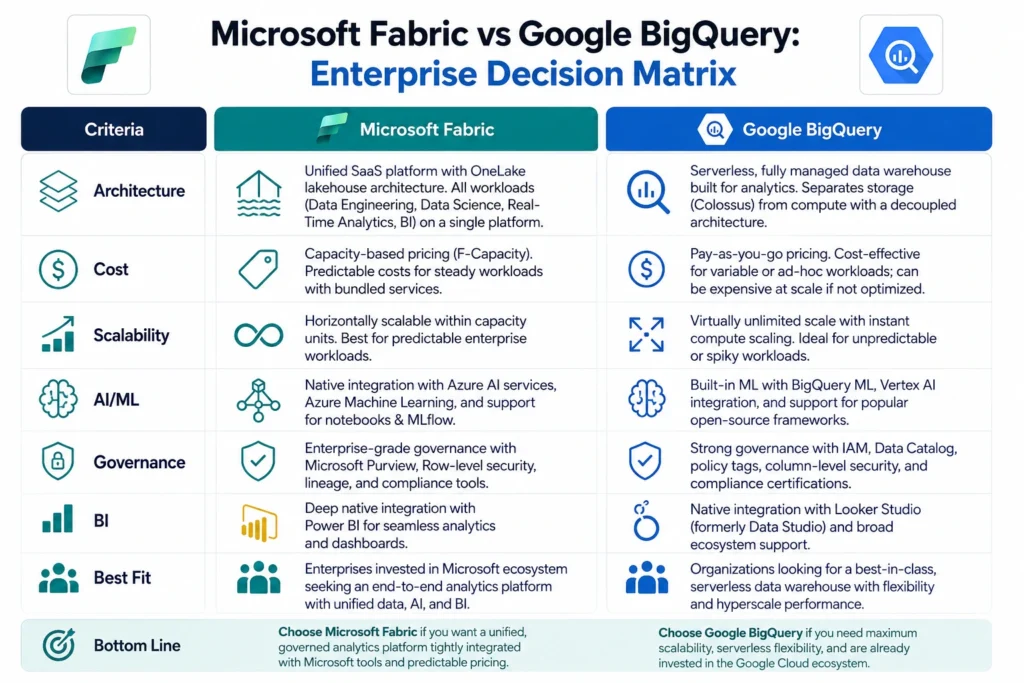
Microsoft Fabric vs Google BigQuery: Comparison at a Glance
| Feature | Microsoft Fabric | Google BigQuery |
|---|---|---|
| Platform model | Unified analytics SaaS | Serverless cloud data warehouse |
| Architecture | OneLake/lakehouse-centric | Compute-storage separation |
| Primary strength | Platform integration | Scalable analytics |
| BI | Native Power BI integration | Integrates with Looker and other BI tools |
| Data engineering | Integrated Fabric workloads | Google Cloud data services |
| AI/ML | Fabric + Azure AI ecosystem | BigQuery ML + Google AI ecosystem |
| Governance | Microsoft Purview ecosystem | Google Cloud IAM and governance services |
| Scaling | Capacity-based | Serverless / workload-based |
| Best fit | Microsoft-centric enterprises | GCP-centric and cloud-native analytics |
| Key trade-off | Microsoft ecosystem dependency | Broader service integration may be required |
Microsoft Fabric Alternatives Beyond BigQuery: The Broader Competitive Landscape
While the comparison between Google BigQuery and Microsoft Fabric dominates many executive discussions, enterprise leaders evaluating Microsoft Fabric alternatives must consider a broader ecosystem of mature, enterprise-grade analytics platforms. These alternatives often emerge in strategy conversations when flexibility, multi-cloud portability, or advanced data engineering capabilities are non-negotiable requirements.
Snowflake remains one of the most prominent Microsoft Fabric competitors. Snowflake’s architecture emphasizes separation of storage and compute, strong cross-cloud support, and a growing data application ecosystem. For enterprises operating across AWS, Azure, and GCP, Snowflake’s cloud-agnostic model reduces vendor dependency and supports centralized governance across environments. However, Snowflake typically requires integration with external BI, AI, and orchestration tools, making it less “out-of-the-box” than Fabric.
Databricks represents another major category of cloud data warehouse alternatives, particularly for data-intensive and AI-driven organizations. Built on open-source foundations such as Apache Spark and Delta Lake, Databricks pioneered the lakehouse model that blends data warehousing and data science. Enterprises favor Databricks when advanced analytics, large-scale machine learning, and open data formats are strategic priorities. Compared to Fabric, Databricks offers greater engineering flexibility but requires more platform expertise and governance maturity.
Other platforms, including Amazon Redshift, Oracle Autonomous Data Warehouse, and emerging lakehouse solutions, also factor into enterprise evaluations. What distinguishes these Microsoft Fabric alternatives is not feature parity, but alignment with enterprise operating models. Organizations with decentralized teams, multi-cloud mandates, or strong open-source strategies often prefer modular platforms over Fabric’s integrated approach.
For executives, the key insight is that Microsoft Fabric competitors tend to optimize for choice and control, while Fabric optimizes for simplicity and ecosystem alignment. Neither approach is universally superior—success depends on enterprise scale, skills, and long-term platform strategy.
Read what Microsoft Fabric is, how it works, why organizations are rapidly adopting it, and what leaders must know in our latest blog – What Is Microsoft Fabric? A Comprehensive Overview for Modern Data Leaders.
BigQuery vs Microsoft Fabric: Pricing Model
Cost transparency and scalability are among the most decisive factors when comparing Google BigQuery vs Microsoft Fabric alternatives. BigQuery’s consumption-based pricing enables elastic scaling but can introduce cost volatility for exploratory analytics and AI workloads. Fabric’s capacity-based pricing simplifies budgeting at a macro level, yet may obscure granular cost attribution across teams and workloads.
Microsoft Fabric primarily uses capacity-based pricing, while BigQuery offers consumption-based and capacity-oriented pricing options. The cheaper platform depends on workload volume, query patterns, capacity utilization, storage, data movement, and existing enterprise commitments.
Cost factor Fabric BigQuery Primary model Capacity-oriented Consumption/capacity options Cost driver Capacity utilization Data processing/workload usage Best for Predictable shared workloads Variable/ad-hoc workloads Main risk Underutilized capacity Unoptimized query consumption
Is Microsoft Fabric cheaper than BigQuery?
Neither is universally cheaper. Compare both using actual enterprise workloads, utilization, storage, data movement, licensing and existing cloud commitments. Snowflake and Databricks take different approaches. Snowflake allows fine-grained control over compute clusters, enabling teams to isolate workloads and manage spend predictably. Databricks offers workload-based pricing tied to compute usage, which can be efficient for optimized pipelines but challenging without strong governance.
Scalability, Governance, and AI Readiness: What Really Google BigQuery vs Microsoft Fabric Platforms Bring
Governance is another critical differentiator. Microsoft Fabric benefits from native integration with Azure Active Directory, Microsoft Purview, and Power BI, providing a unified security and compliance model. This is particularly compelling for regulated industries already invested in Microsoft tooling. BigQuery offers strong security primitives but often relies on supplementary governance tools to achieve enterprise-wide lineage and policy enforcement.
AI readiness increasingly shapes platform decisions. BigQuery integrates seamlessly with GCP’s AI services, supporting large-scale model training and analytics-driven ML workflows. Fabric embeds AI directly into analytics through Copilot and Azure OpenAI integration, emphasizing business-user accessibility. Databricks excels in advanced ML engineering, while Snowflake is expanding its AI capabilities through Snowpark and native ML features.
For enterprise leaders, the evaluation of Microsoft Fabric alternatives should focus less on individual features and more on how cost models, governance frameworks, and AI capabilities align with organizational maturity. Platforms succeed not because they are powerful, but because they are governable at scale.
See how leveraging AI-first data strategies and deep expertise can help unlock sspeed, accuracy in our latest whitepaper.
Should You Migrate from BigQuery to Microsoft Fabric?
Consider migration when:
- Microsoft is your strategic enterprise ecosystem.
- Power BI is becoming the standard BI layer.
- You want to consolidate analytics workloads.
- OneLake aligns with your target architecture.
- Current platform fragmentation creates operational overhead.
Consider staying with BigQuery when:
- GCP is your strategic cloud.
- Existing BigQuery workloads perform well.
- Your AI/ML ecosystem is heavily invested in Google Cloud.
- Migration costs outweigh expected benefits.
Consider hybrid architecture when:
Different workloads benefit from different platforms.
Both clouds are strategic.
Existing BigQuery workloads cannot be migrated economically.
Microsoft Fabric vs BigQuery: When Should You Choose Each?
Choose Microsoft Fabric When:
- Your enterprise is heavily invested in Microsoft Azure and Microsoft 365.
- Power BI is your primary BI platform.
- You want data engineering, warehousing, BI and analytics in one environment.
- OneLake fits your target data architecture.
- Platform consolidation is more important than cloud neutrality.
Choose BigQuery When:
- Your organization is GCP-first.
- Serverless analytics is a priority.
- SQL-based analytical workloads dominate.
- You need elastic scaling without capacity management.
- Large-scale or ad-hoc analytics is a major requirement.
Snowflake is frequently chosen by enterprises with multi-cloud strategies, decentralized analytics teams, and strong data governance requirements. Its flexibility and ecosystem neutrality make it a common choice among Microsoft Fabric competitors.
Databricks fits organizations where advanced analytics, machine learning, and open data architectures are core to the business model. It is particularly effective for enterprises with mature data engineering capabilities and a willingness to invest in platform expertise.
For executives, the critical question is not “Which platform is best?” but “Which platform best fits our operating model, risk tolerance, and growth strategy?” This reframing helps leaders navigate the expanding landscape of cloud data warehouse alternatives with clarity.
Our latest blog is your end-to-end roadmap to understand Microsoft Fabric architecture, evaluating its advantages, comparing it with traditional systems, and charting a modernization strategy fit for the AI-first enterprise.
Risks, Trade-Offs, and Decision Criteria for Enterprise Leaders
Selecting an enterprise analytics platform or diving deep into Google BigQuery vs Microsoft Fabric is a long-term strategic commitment. Each option introduces trade-offs that must be explicitly acknowledged at the leadership level.
Vendor lock-in is a common concern with integrated platforms like Microsoft Fabric. While integration accelerates value, it can limit future flexibility. Conversely, modular platforms increase architectural freedom but shift complexity onto internal teams.
Skill availability is another risk factor. Platforms such as Databricks require specialized expertise, while Fabric lowers the barrier for business users. BigQuery sits between these extremes, offering simplicity with advanced capabilities.
Governance maturity often determines success more than platform choice. Enterprises that underestimate governance requirements may struggle regardless of technology. This is why many organizations exploring Microsoft Fabric alternatives also reassess their data operating model, not just tooling.
Ultimately, decision criteria should include alignment with enterprise architecture, regulatory requirements, cost governance, and AI roadmap. Leaders who approach platform selection as an organizational transformation—not a technology purchase—are far more likely to succeed.
Explore more on our Microservices Architecture service ensures your enterprise moves from tightly coupled codebases to lean, autonomous services with full observability.
Techment Partner Perspective: Enabling Confident Analytics Platform Decisions
As a trusted Microsoft Partner, Techment helps enterprises navigate complex decisions around Microsoft Fabric, Google BigQuery, and broader Microsoft Fabric alternatives with clarity and confidence.
Techment supports organizations across the full analytics lifecycle—from data strategy and platform selection to Fabric modernization, migration, and optimization. Our teams specialize in aligning Microsoft Fabric implementations with enterprise governance, AI readiness, and business outcomes, ensuring that integration does not come at the cost of control.
For enterprises evaluating Fabric against cloud data warehouse alternatives, Techment provides architecture assessments, cost modeling, and migration roadmaps tailored to enterprise scale. We also help organizations integrate Fabric with existing data platforms, enabling hybrid and phased modernization strategies.
Beyond implementation, Techment focuses on long-term value realization. This includes data governance with Microsoft Purview, AI enablement using Azure OpenAI, and operating model design that supports sustainable analytics growth.
Our role is not to advocate for a single platform, but to help leaders make informed decisions—and execute them effectively.
Learn how Techment utilizes advanced technologies to modernize legacy systems and deliver a future-ready, scalable platform in our latest case study.
Conclusion: Executive Takeaways on Google BigQuery vs Microsoft Fabric and Microsoft Fabric Alternatives
The debate around Google BigQuery vs Microsoft Fabric alternatives reflects a broader shift in enterprise analytics strategy. Platforms are no longer judged solely on performance, but on their ability to support governance, AI, cost control, and organizational change.
Microsoft Fabric offers compelling integration and accessibility, particularly for Microsoft-centric enterprises. BigQuery delivers unmatched scalability for cloud-native analytics. Other Microsoft Fabric competitors provide flexibility and openness for complex, multi-cloud environments.
For enterprise leaders, the right choice is contextual. Success lies in aligning platform capabilities with business strategy, data maturity, and long-term vision. With the right guidance and execution, analytics platforms become enablers of competitive advantage—not constraints.
Learn how our Microsoft Fabric Readiness Assessment explores your full data lifecycle across five critical dimensions:
FAQ: Enterprise Questions About Microsoft Fabric Alternatives
1. What is the main difference between Microsoft Fabric and Google BigQuery?
Microsoft Fabric is a unified analytics platform that combines data engineering, data warehousing, real-time analytics, data science, and Power BI, while Google BigQuery is a serverless cloud data warehouse focused on scalable analytical workloads. Fabric emphasizes platform integration through OneLake, while BigQuery emphasizes serverless scale and Google Cloud integration.
2. Is Microsoft Fabric better than BigQuery?
Neither platform is universally better. Microsoft Fabric is generally a stronger fit for Microsoft-centric enterprises that prioritize Power BI, OneLake, unified analytics, and Microsoft ecosystem integration. BigQuery is often better suited to GCP-centric organizations that prioritize serverless, large-scale SQL analytics and flexible workload scaling.
3. What is the Microsoft equivalent of Google BigQuery?
Microsoft Fabric is the closest broad Microsoft equivalent to Google BigQuery for modern enterprise analytics, although the platforms are not identical. Fabric includes data warehousing alongside data engineering, real-time analytics, data science, OneLake, and Power BI, whereas BigQuery primarily focuses on cloud data warehousing and analytics.
4. Which is cheaper: Microsoft Fabric or Google BigQuery?
Neither Microsoft Fabric nor BigQuery is universally cheaper. Fabric uses a capacity-oriented model, while BigQuery offers consumption-based and capacity options. Actual cost depends on query volume, workload patterns, storage, capacity utilization, data movement, licensing, and existing enterprise cloud commitments.
5. Should I migrate from BigQuery to Microsoft Fabric?
Not automatically. Migration makes sense when Microsoft is the strategic enterprise ecosystem, Power BI is central to analytics, platform consolidation has clear business value, and Fabric meets workload and governance requirements. Organizations with mature GCP investments and well-performing BigQuery workloads may be better served by staying on BigQuery or adopting a hybrid architecture.
Related Reads
- What Is Microsoft Fabric? A Comprehensive Overview for Enterprise Leaders
- Microsoft Fabric vs Snowflake: A Data Management Showdown
- AI-Ready Enterprise Checklist with Microsoft Fabric
- Microsoft Fabric FabCon 2026 Insights: Key Announcements Driving Real Business Impact in AI & Data
- Microsoft Fabric Architecture: A CTO’s Guide to Modern Analytics & AI
- Data Quality for AI in 2026: Enterprise Guide
- Best Practices for Generative AI Implementation in Business
- Microsoft Fabric OneLake Best Practices: A Practical Enterprise Guide
- Microsoft Fabric for Agentic Apps: Building AI Applications on a Unified Data Foundation
- Microsoft Fabric Security for Enterprise AI: Best Practices, Architecture & Governance