Introduction
The introduction of Artificial Intelligence into software testing has already transformed how enterprises design, execute, and scale quality engineering practices. Early AI implementations focused heavily on accelerating automation—primarily through script generation—helping teams reduce manual coding effort and improve testing velocity.
However, this approach only addressed a fraction of the broader testing lifecycle.
Today, a more profound shift is underway: Agentic AI in Testing. This emerging paradigm redefines AI from a passive assistant into an active, autonomous participant capable of orchestrating the entire testing lifecycle. Instead of generating isolated test scripts, AI systems now plan, execute, adapt, and continuously optimize testing strategies with minimal human intervention.
This transition is not incremental—it is transformational.
For enterprise QA leaders, this means rethinking testing from a task-driven activity to a goal-driven, intelligent system. Agentic AI introduces capabilities that resemble a virtual QA engineer—one that understands requirements, identifies risks, executes tests, diagnoses failures, and evolves over time.
In this blog, we will explore how Agentic AI in Testing moves beyond script generation to full orchestration, its architectural implications, business impact, challenges, and what it means for the future of enterprise quality engineering.
TL;DR Summary
- Agentic AI in Testing moves beyond script generation to full lifecycle orchestration
- Enables autonomous planning, execution, debugging, and optimization
- Reduces manual QA effort while improving coverage and speed
- Transforms QA engineers into strategic quality architects
- Introduces governance, trust, and integration challenges for enterprises
The Evolution of AI in Testing: Why Agentic AI Matters Now
From Automation Scripts to Intelligent Systems
Traditional test automation frameworks were built on deterministic logic. Scripts followed predefined steps, and any change in application behavior often required manual updates. While AI-assisted tools improved script creation, they still operated within a human-defined boundary.
Agentic AI in Testing breaks this limitation.
Instead of relying on explicit instructions, agentic systems operate with intent and objectives. They dynamically determine how to achieve testing goals based on system behavior, historical data, and contextual insights.
This aligns with broader enterprise AI trends highlighted in strategic frameworks like AI-first operating models, where systems are expected to act, not just assist.
Why Enterprises Are Moving Toward Orchestration
Several macro forces are accelerating the adoption of Agentic AI:
- Complex application ecosystems (microservices, APIs, cloud-native architectures)
- Continuous delivery expectations requiring rapid validation cycles
- Explosion of test scenarios across devices, platforms, and user journeys
- Cost pressures on QA teams to deliver more with fewer resources
According to industry benchmarks (Gartner, IDC), enterprises are shifting toward autonomous operations models, where AI reduces manual intervention across IT functions—including testing.
Agentic AI in Testing fits directly into this transformation.
Strategic Implication for CTOs and QA Leaders
Testing is no longer a bottleneck—it is becoming a competitive differentiator.
Organizations that adopt AI-driven orchestration can:
- Release faster with higher confidence
- Detect issues earlier in the lifecycle
- Reduce operational overhead
- Improve customer experience
For deeper insights into enterprise data and AI strategy foundations, explore: Enterprise AI strategy in 2026.
Understanding Agentic AI in Testing
What Is Agentic AI?
Agentic AI refers to systems capable of:
- Making decisions independently
- Executing multi-step tasks
- Adapting based on outcomes
- Learning continuously
Unlike traditional AI tools that require prompts, agentic systems operate with defined goals and determine the steps needed to achieve them.
How Agentic AI Works in Testing
In the context of software testing, Agentic AI in Testing behaves like a virtual QA engineer.
It can:
- Understand application requirements
- Identify test scenarios
- Generate and execute tests
- Monitor outcomes
- Debug failures
- Improve test strategies over time
This creates a closed-loop intelligent system rather than a fragmented testing process.
Core Capabilities of Agentic AI in Testing
Goal-Oriented Planning
Instead of executing predefined scripts, AI identifies what needs to be tested based on risk and impact.
Autonomous Execution
Tests are executed dynamically across environments without manual scheduling.
Context Awareness
AI understands system dependencies, APIs, and user flows.
Continuous Learning
Each execution cycle improves future testing decisions.
Enterprise Perspective
Agentic AI is not just a tooling upgrade—it represents a shift in operating model.
Organizations must move from:
- Test case management → Test intelligence systems
- Manual orchestration → AI-driven orchestration
- Reactive debugging → Predictive quality engineering

For organizations building strong data foundations to enable such AI systems, refer to: Data Quality For AI in 2026
The Limitations of Traditional AI Test Generation
The Illusion of Progress
Many AI-powered testing tools today focus on script generation—automatically creating test scripts from UI interactions or requirements.
While this reduces initial effort, it creates a false sense of maturity.
Script generation addresses only a single stage in the testing lifecycle.
Key Challenges in Current AI Testing Approaches
1. Persistent Maintenance Overhead
Generated scripts still break when:
- UI elements change
- APIs evolve
- Workflows are updated
This leads to ongoing maintenance burdens.
2. Incomplete Test Coverage
AI-generated scripts often focus on:
- Happy paths
- Visible UI interactions
They miss:
- Edge cases
- Integration failures
- Performance scenarios
3. Manual Failure Analysis
When tests fail:
- Logs must be analyzed manually
- Root causes are unclear
- Debugging becomes time-consuming
4. Static Execution Models
Test execution remains:
- Scheduled
- Environment-dependent
- Non-adaptive
There is no intelligence in deciding what to test next.
5. Fragmented Toolchains
Testing ecosystems often involve:
- Multiple tools
- Manual integrations
- Disconnected workflows
Why This Model Does Not Scale
As systems grow more complex, script-based approaches become:
- Fragile
- Costly
- Inefficient
This is where Agentic AI in Testing introduces a paradigm shift—from automation to orchestration.
For insights into scalable enterprise architectures supporting such transformations, see: Microsoft Fabric Architecture CTO’s guide to Modern Analytics and AI
From Script Generation to Full Test Orchestration
The Shift to Intelligent Orchestration
Agentic AI transforms testing into a self-managing system.
Instead of isolated tasks, AI coordinates the entire lifecycle—from planning to optimization.
1. Intelligent Test Planning
Agentic AI analyzes:
- Requirements
- Code changes
- Historical defects
It identifies:
- High-risk areas
- Critical user journeys
- Priority test scenarios
This enables risk-based testing at scale.
2. Autonomous Test Creation
AI generates:
- UI tests
- API tests
- Integration tests
These are not static scripts—they are adaptive test models.
3. Smart Test Execution
Execution becomes dynamic:
- Tests are prioritized based on impact
- Environments are selected automatically
- Execution timing is optimized
4. Self-Healing Automation
One of the most impactful capabilities:
- AI detects UI changes
- Updates selectors automatically
- Prevents test failures due to minor changes
5. Intelligent Failure Analysis
Agentic AI correlates:
- Logs
- Network calls
- System metrics
It identifies root causes, not just symptoms.
6. Continuous Learning
The system improves over time by:
- Learning from past failures
- Expanding coverage
- Refining prioritization
Strategic Outcome
Testing evolves into:
- A self-optimizing system
- A continuous intelligence loop
- A business-aligned quality function
Business Impact of Agentic AI in Testing
or enterprises modernizing analytics and AI ecosystems to support such orchestration, explore: Microsoft Fabric AI solutions
Faster Release Cycles
By automating planning, execution, and debugging:
- Testing cycles shrink dramatically
- CI/CD pipelines accelerate
- Time-to-market improves
Reduced Maintenance Costs
Self-healing and adaptive systems eliminate:
- Script rewrites
- Manual updates
- Redundant testing
Improved Test Coverage
Agentic AI ensures:
Enhanced Insights
AI provides:
- Root cause analysis
- Predictive defect trends
- Quality metrics aligned with business KPIs
Higher Team Productivity
QA teams shift focus to:
- Strategy
- Architecture
- Governance
Enterprise Value
The impact extends beyond QA:
- Improved customer experience
- Reduced production defects
- Lower operational costs
- Stronger compliance
Architecture of Agentic AI in Testing: A Deep Dive
Building Blocks of an Autonomous QA System
Agentic AI in Testing is not a single tool—it is an ecosystem of interconnected capabilities that work together to deliver full lifecycle orchestration. For enterprise adoption, understanding this architecture is critical.
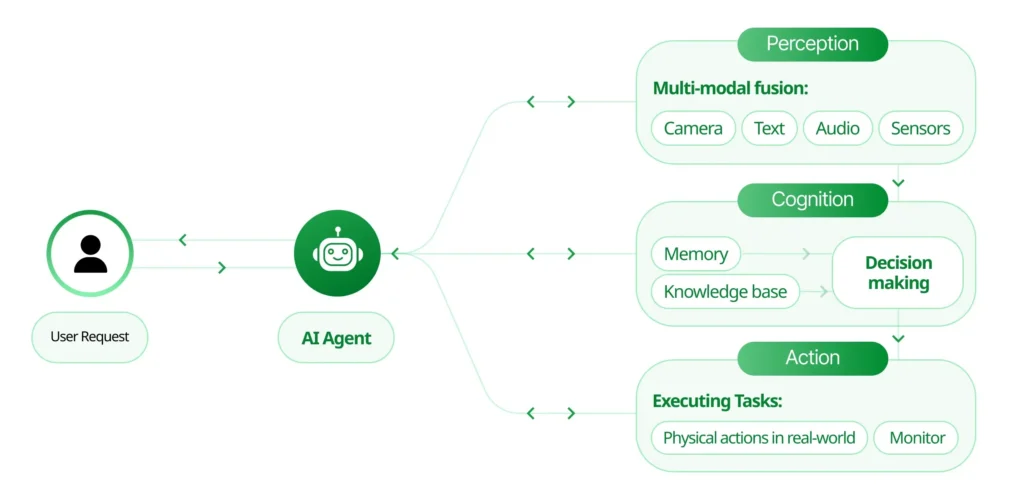
At a high level, an agentic testing system consists of five core layers:
1. Data & Context Layer
This layer provides the foundation of intelligence.
It includes:
- Application requirements
- User behavior data
- Historical defect logs
- System telemetry
- Test execution history
Without high-quality, governed data, Agentic AI cannot make reliable decisions.
This reinforces the importance of strong data governance and quality frameworks, as outlined in: Data Governance for Data Quality.

2. Intelligence Layer
This is where AI models operate.
Capabilities include:
- Natural language understanding (requirements parsing)
- Pattern recognition (defect trends)
- Predictive analytics (risk-based prioritization)
This layer powers decision-making across the testing lifecycle.
3. Agent Layer
The defining feature of Agentic AI in Testing.
Agents are responsible for:
- Planning test strategies
- Generating test cases
- Executing workflows
- Adapting to system changes
Each agent operates independently but collaborates within the ecosystem.
4. Orchestration Layer
This layer coordinates:
- Test execution pipelines
- Environment provisioning
- Tool integrations
It ensures that all agents work toward a unified goal.
5. Feedback & Learning Loop
The system continuously improves by:
- Learning from failures
- Updating test strategies
- Refining prioritization
Enterprise Architecture Visualization

Strategic Insight
This architecture mirrors modern data and AI platforms, where intelligence is embedded into operations rather than layered on top.
For organizations aligning testing with enterprise AI platforms, refer to:
https://www.techment.com/blogs/what-is-microsoft-fabric-comprehensive-overview/
The Future Role of QA Engineers: From Testers to Quality Architects
The Shift in Responsibilities
As Agentic AI in Testing becomes mainstream, the role of QA engineers will undergo a fundamental transformation.
Traditional responsibilities included:
- Writing test cases
- Executing scripts
- Reporting defects
These activities will increasingly be handled by AI.
The Rise of Quality Architects
QA professionals will evolve into Quality Architects, focusing on:
- Defining testing strategies
- Setting quality benchmarks
- Governing AI systems
- Validating AI decisions
New Skill Requirements
To thrive in an agentic AI-driven environment, QA engineers must develop:
1. Systems Thinking
Understanding how applications, data, and AI systems interact.
2. AI Literacy
Basic knowledge of machine learning models and decision-making processes.
3. Data Analysis Skills
Interpreting AI-generated insights and metrics.
4. Governance Expertise
Ensuring compliance, fairness, and reliability.
Human + AI Collaboration Model
Agentic AI does not replace QA engineers—it augments them.
The model becomes:
- AI handles execution and optimization
- Humans focus on strategy and oversight
Organizational Impact
Enterprises must:
- Redefine QA roles
- Upskill teams
- Align incentives with quality outcomes

Governance, Trust, and Risk Management in Agentic AI Testing
Why Governance Is Critical
Agentic AI introduces autonomy, which raises important questions:
- Can we trust AI decisions?
- How do we ensure compliance?
- What happens when AI makes mistakes?
Without governance, autonomous systems can become unpredictable and risky.
Key Governance Challenges
1. Trust in AI Decisions
Enterprises must ensure:
- Explainability of AI actions
- Transparency in decision-making
2. Data Privacy and Security
Agentic systems rely heavily on data.
Risks include:
- Exposure of sensitive data
- Compliance violations (GDPR, HIPAA)
3. Integration Complexity
Agentic AI must integrate with:
- CI/CD pipelines
- DevOps tools
- Legacy systems
4. Bias and Incomplete Coverage
AI models may:
- Miss critical scenarios
- Prioritize incorrectly
Governance Framework for Agentic AI
To mitigate risks, enterprises should implement:
Policy Layer
Defines rules, compliance requirements, and constraints.
Monitoring Layer
Tracks AI decisions and system behavior.
Audit Layer
Ensures traceability of actions and outcomes.
Governance Model Visualization

Strategic Takeaway
Agentic AI in Testing must be treated as a governed system, not just a productivity tool.
For enterprises building governance-first data ecosystems, refer to:
https://www.techment.com/blogs/data-governance-for-data-quality-future-proofing-enterprise-data/
Implementation Roadmap: How Enterprises Can Adopt Agentic AI in Testing
Phase 1: Foundation
Focus on:
- Data quality improvement
- Test data management
- Centralized test repositories
Phase 2: AI-Assisted Testing
Introduce:
- AI-based test generation
- Self-healing capabilities
- Intelligent test selection
Phase 3: Partial Orchestration
Enable:
- Automated test execution pipelines
- AI-driven prioritization
- Integrated analytics
Phase 4: Full Agentic Orchestration
Achieve:
- Autonomous test planning
- End-to-end lifecycle management
- Continuous learning systems
Implementation Journey Visualization


Critical Success Factors
- Strong data foundation
- Cross-functional collaboration
- Governance-first approach
- Incremental adoption strategy
Enterprise Insight
Organizations that attempt to jump directly to full autonomy often fail. A phased approach ensures scalability and trust.
For guidance on AI readiness and enterprise transformation, explore:
https://www.techment.com/blogs/ai-ready-enterprise-checklist-microsoft-fabric
How Techment Helps Enterprises Adopt Agentic AI in Testing
Techment enables enterprises to transition from traditional QA models to AI-driven, orchestrated testing ecosystems through a structured, outcome-focused approach.
Data Modernization for AI-Driven Testing
Agentic AI depends on high-quality, governed data.
Techment helps organizations:
- Build scalable data platforms
- Ensure data reliability and accessibility
- Enable AI-ready architectures
Explore: Data Quality for Enterprises
AI Readiness and Strategy
Techment works with enterprise leaders to:
- Define AI adoption roadmaps
- Align testing with business goals
- Identify high-impact use cases
Platform Implementation
Techment supports:
- AI and analytics platforms (including Microsoft ecosystems)
- Integration with DevOps and CI/CD pipelines
- Unified data and testing environments
Governance and Compliance
Techment ensures:
- Responsible AI implementation
- Data privacy and security compliance
- Transparent and auditable AI systems
End-to-End Transformation
From strategy to execution, Techment delivers:
- Roadmap design
- Implementation
- Optimization and scaling
Strategic Positioning
Techment acts as a trusted partner, helping enterprises not just adopt Agentic AI in Testing—but operationalize it for measurable business impact.
Conclusion
Agentic AI in Testing represents the next major evolution in software quality engineering.
By moving beyond script generation to full test orchestration, it fundamentally transforms how testing is planned, executed, and optimized. Enterprises can achieve faster releases, improved quality, and reduced operational overhead—while enabling QA teams to focus on strategic outcomes.
However, this transformation requires more than adopting new tools. It demands a shift in architecture, operating models, governance, and workforce capabilities.
The future of testing is not just automated—it is intelligent, autonomous, and orchestrated.
Organizations that embrace Agentic AI early will gain a significant competitive advantage in delivering high-quality digital experiences at scale.
Techment stands ready to help enterprises navigate this transformation—bridging strategy, technology, and execution to unlock the full potential of AI-driven testing.
FAQs
1. What is Agentic AI in Testing?
Agentic AI in Testing refers to autonomous AI systems that can plan, execute, analyze, and optimize the entire testing lifecycle without constant human intervention.
2. How is Agentic AI different from traditional test automation?
Traditional automation focuses on executing predefined scripts, while Agentic AI enables intelligent orchestration, decision-making, and continuous learning.
3. Is Agentic AI suitable for all enterprises?
It is most beneficial for enterprises with complex systems, large-scale testing needs, and mature data infrastructure.
4. What skills are required to adopt Agentic AI in QA?
Organizations need expertise in AI, data engineering, QA strategy, and governance.
5. What are the biggest risks of Agentic AI in Testing?
Key risks include lack of trust, data privacy concerns, integration complexity, and governance challenges
Related Read
- Ultimate Guide to Optimizing Spark Workloads in Microsoft Fabric for Data Engineers
- Microsoft Fabric Architecture: CTO’s Guide to Modern Analytics & AI
- Data Governance for Data Quality: Future-Proofing Enterprise Data
- Data Quality for AI in 2026: Enterprise Guide
- Microsoft Fabric vs Power BI: Understanding the Difference
- Microsoft Fabric vs Snowflake: Data Management Showdown
- AI-Ready Enterprise Checklist for Microsoft Fabric Microsoft Fabric vs Power BI: Understanding the Difference
- Microsoft Fabric vs Snowflake: Data Management Showdown
- AI-Ready Enterprise Checklist for Microsoft Fabric