Enterprise data leaders are under relentless pressure to deliver faster insights, reliable analytics, and AI-ready data platforms—yet many organizations still struggle with inconsistent metrics, brittle pipelines, and low trust in reporting. At the center of these challenges lies a frequently underestimated discipline: data modeling best practices.
TL;DR Summary
-
Data modeling best practices are foundational to scalable analytics, AI, and enterprise decision-making
-
Poor data models silently undermine data quality, governance, and business trust
-
Modern enterprises must evolve beyond basic database design to analytics-driven modeling
-
Strong conceptual, logical, and physical data modeling enables speed, reliability, and scale
-
Operating models, governance, and architecture matter as much as tools
Despite massive investments in cloud platforms, analytics tools, and AI initiatives, enterprises often fail to realize value because foundational data models were never designed to scale, adapt, or govern complexity. Instead of enabling transformation, poorly structured models become hidden bottlenecks that slow innovation, fragment insights, and erode executive confidence.
This blog examines data modeling best practices through an enterprise lens—moving beyond textbook definitions to address real-world complexity, governance trade-offs, and strategic outcomes. We explore modern data modeling techniques, optimization strategies, and implementation guidance tailored for large-scale analytics, BI, and AI-driven organizations.
For CTOs, CDOs, data architects, and analytics leaders, this is not a technical deep dive alone—it is a strategic playbook for building data foundations that actually drive business transformation.
What is Data Modeling?
Data modeling is that software engineering process that provides a blueprint for building a new database or re-engineering legacy applications. The process provides downstream results, knowledge of best data practices, and the best tools to access it. The model creates a whole information system that communicates about the connection between data points and structure.
Hence, it’s a predictable way of defining data resources, supporting business processes, and planning IT architecture across an organization and beyond.
Because of its high level abstraction, data modeling has been divided into three categories which are performed in following sequence:
- Conceptual Data Models (Domain Models): Model contains overview of what a system will contain, how it will be organized, and what business rules are involved.
- Logical Data Models: This model provides greater detail about concepts but not technical system requirements. This helps in procedural implementation environments or for data-oriented projects.
- Physical Data Models: This provides schema for how the data will be stored in the database. Also, this offers final design to be implemented as a relational database.
Build a future-ready data foundation: Data Management for Enterprises: Roadmap
Why Data Modeling Best Practices Matter More Than Ever
Enterprise analytics has outgrown legacy modeling approaches
For decades, data modeling was treated as a one-time design activity—create a schema, deploy a database, and move on. That mindset no longer works. Modern enterprises operate in environments defined by real-time data, diverse sources, regulatory scrutiny, and AI-driven decisioning.
According to Gartner, poor data quality costs organizations an average of $12.9 million per year. A significant portion of that cost traces back to flawed or inconsistent data models that fail to enforce meaning, relationships, and business logic at scale. Without strong data modeling best practices, enterprises end up compensating downstream through manual fixes, reconciliation layers, and duplicated logic.
Data modeling today must support:
-
Continuous schema evolution
-
Multiple consumption patterns (BI, ML, operational analytics)
-
Governance and lineage requirements
-
Cross-domain data sharing
This shift elevates data modeling from a technical task to a strategic capability.
Data modeling as a strategic enabler, not a backend artifact
High-performing organizations treat data models as shared enterprise assets. They enable common definitions, reusable analytics, and trusted insights across business units. Conversely, weak modeling practices lead to conflicting KPIs, slow onboarding of new data sources, and fragile analytics pipelines.
Enterprises pursuing large-scale analytics modernization often rediscover this truth mid-journey. Cloud platforms amplify both good and bad design decisions. Without disciplined data modeling best practices, cloud migrations simply accelerate chaos at a higher cost.
Organizations that succeed embed data modeling into their operating model—linking architecture, governance, and analytics strategy from the start. This alignment is critical for sustained transformation, not just short-term reporting wins.
Related insight: Unified Data Platform in 2026: How It Works, Why It Matters, and How Microsoft Fabric Enables It
Core Data Modeling Techniques Every Enterprise Must Master
Conceptual, logical, and physical data modeling explained
Effective data modeling best practices start with understanding the distinct roles of conceptual, logical, and physical models—each serving a different strategic purpose.
Conceptual data modeling focuses on business meaning. It defines key entities, relationships, and terminology without technical constraints. For executives and domain leaders, conceptual models create alignment around “what the data represents” before debating “how it is stored.”
Logical data modeling translates business concepts into structured attributes, keys, and relationships. It introduces normalization, cardinality, and rules while remaining platform-agnostic. This layer is essential for maintaining consistency across multiple systems and analytics platforms.
Physical data modeling implements logical designs within specific technologies—cloud data warehouses, lakehouses, or operational databases. Performance, partitioning, and platform constraints dominate this stage.
Enterprises that skip or compress these layers often pay the price later. Logical shortcuts lead to brittle schemas that cannot evolve with business needs.
Modern data modeling techniques for analytics and BI
Analytics-driven organizations increasingly adopt modeling techniques optimized for consumption, not just storage. Dimensional modeling, data vaults, and hybrid lakehouse patterns reflect this evolution.
Dimensional models support fast, intuitive BI and executive reporting. Data vaults prioritize auditability, lineage, and adaptability—critical for regulated industries. Hybrid approaches combine flexibility with performance.
The key takeaway: there is no single “best” technique. Strong data modeling best practices involve selecting and combining approaches based on business goals, scale, and governance requirements—not tool popularity.
Related insight: Driving Reliable Enterprise Data
Best Practices for Database Design in Enterprise Environments
Designing for scale, performance, and change
Database design remains foundational, but enterprise requirements have shifted dramatically. Traditional normalization alone no longer guarantees success. Modern best practices for database design must balance flexibility, performance, and cost efficiency.
Enterprises should design schemas that anticipate:
-
High-volume analytical queries
-
Schema evolution without downtime
-
Separation of compute and storage
-
Multi-tenant or domain-oriented access
Over-normalized models may reduce redundancy but often degrade analytics performance. Over-denormalized models improve speed but introduce governance and maintenance risks. Effective data modeling best practices strike a pragmatic balance, guided by usage patterns rather than theory.
Aligning database design with business domains
A growing best practice is aligning data models with business domains instead of technical systems. Domain-oriented modeling supports clearer ownership, better governance, and faster innovation.
This approach aligns naturally with data mesh and federated analytics strategies. However, it requires disciplined standards, shared definitions, and strong architectural oversight to avoid fragmentation.
Enterprises that succeed treat database design as an evolving product—versioned, documented, and continuously optimized.
Related insight: Why Data Quality Matters in Business Decisions: A Strategic Imperative for Modern Enterprises
Data Model Optimization Strategies for Analytics at Scale
Optimizing models for performance and cost efficiency
As analytics workloads scale, inefficient data models quickly translate into rising cloud costs and degraded performance. Data model optimization strategies focus on minimizing unnecessary complexity while maximizing query efficiency.
Common optimization levers include:
-
Strategic denormalization for high-value queries
-
Partitioning and clustering aligned to access patterns
-
Eliminating unused attributes and tables
-
Standardizing surrogate keys and hierarchies
Optimization is not a one-time exercise. Enterprises must continuously monitor usage patterns and adjust models accordingly. This requires tight collaboration between data engineering, analytics, and platform teams.
Improving data quality and reliability through modeling
Strong data modeling practices that improve data quality and reliability embed validation, constraints, and business rules directly into the model. This reduces downstream errors and manual corrections.
Clear definitions, enforced relationships, and standardized reference data improve trust across analytics and AI initiatives. Executives care less about schemas and more about confidence in decisions—data models quietly determine that confidence.
Organizations that neglect modeling discipline often attempt to “fix quality” downstream with tools and processes, increasing complexity without addressing root causes.
Read further on how to transform your data migration into a catalyst for AI-driven growth with our data migration services.
How Should Organizations Boost Data Modeling?
Data modeling is crucial in AI projects as it requires high data quality. Here are the ways to boost data modeling:
- Visualizing Data to be Modeled:The countless data rows and columns are challenging to model,whereas the graphical representations are easy to interpret and detect anomalies. Data visualization makes data clean, consistent, and error-free and spots different data types at the same time. Data modeling ensures that data is stored in a database and accurately represented.
- Segregating Business Enquiries:Understanding business requires identifying parameters like historical sales data, feedback, etc., which are important. Segregating dimensions, facts, filters, and orders are essential to organizing data. Before data modeling, collecting the data and creating tables for facts and dimensionsfacilitates the analytical behavior and answers the business intelligence (BI) questions well.
- Using Only Workable Data:Not all data generated is of use to the organization. Data modeling wastes can be avoided byidentifying the correct data that needs to be modeled and eliminating the rest. Enterprise architects can create high-level data structures that support organizations’ software infrastructure and business intelligence (BI) processes.
- Verifying Each Stage Before Modeling:Verification is necessary while modeling as lots of finer details are required for smooth running of the subsequent processes. To identify each data record, attributes like the primary key must be chosen for data sets.
For instance, ProductID in the dataset will be the primary key for historical sales data. Such identifiers also help in eliminating duplicate data.
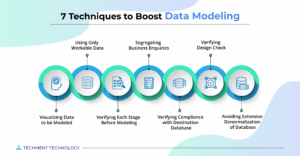
- Verifying Design Check:Data models are built, keeping track of the source and destination databases, so the model must meet specific rules, statistical tests, and standards. While modeling for source and destination databases, different verification validations are needed, like field level mismatch between source & destination, indexes, columns, tables, etc.
- Verifying Compliance with Destination Database:While modeling for a data warehouse, the schema script mustcomply with destination database providers like Snowflake, Oracle, Azure, or others.
- Avoiding Extensive Denormalization of Database:Denormalizing refers to adding redundant data to data query performance and eliminating complex join operations. But excessive denormalization should be avoided as it hampers data integrity and can be inconsistent. This may also limit the usefulness of different analytics applications. This process is seen more in business intelligence (BI) applications than in data warehouses.
Updating data models from time to time is necessary because business priorities change continuously. Hence, initial data models must be preserved, for easy expansion & modification in the future.
Real-World Enterprise Applications of Data Modeling Best Practices
How modern enterprises apply data modeling in practice
While theory provides structure, data modeling best practices only deliver value when applied to real enterprise scenarios. In practice, leading organizations use data modeling as an orchestration layer between business strategy and technology execution.
In large enterprises, data rarely originates from a single system. ERP platforms, CRM tools, operational databases, SaaS applications, IoT feeds, and third-party data all converge into shared analytics environments. Without disciplined modeling, this convergence produces duplication, conflicting metrics, and fragmented insights.
Effective enterprises apply data modeling techniques that:
-
Standardize core business entities such as customer, product, and transaction
-
Isolate source-system volatility from analytics consumption
-
Enable consistent KPIs across business units
-
Support multiple analytical use cases without reengineering
For example, global organizations often use logical data models to harmonize customer definitions across regions, while allowing physical implementations to vary by platform or workload. This separation is a hallmark of mature data modeling best practices.
Data modeling for analytics and BI at scale
Analytics and BI place unique demands on data models. Executives expect fast, consistent answers—regardless of data source complexity. That expectation can only be met when models are designed with consumption in mind.
High-performing analytics teams design models that:
-
Reflect how business users think, not how systems store data
-
Abstract complexity through curated semantic layers
-
Support self-service analytics without sacrificing governance
This approach reduces dependency on engineering teams while maintaining trust. Importantly, it requires close collaboration between data architects and analytics stakeholders—modeling decisions are business decisions.
Related insight:
Unleashing the Power of Data: Building a Winning Data Strategy
Common Data Modeling Mistakes and How Enterprises Avoid Them
Where most organizations go wrong
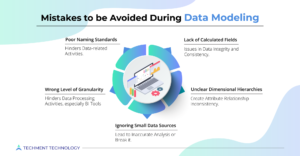
Despite widespread awareness, many enterprises repeat the same data modeling mistakes—often unintentionally. These issues rarely surface immediately; instead, they accumulate quietly until analytics becomes slow, inconsistent, or untrusted.
Common pitfalls include:
-
Treating data models as static artifacts
-
Skipping conceptual and logical modeling phases
-
Designing purely for storage, not analytics consumption
-
Allowing each team to define its own metrics and entities
-
Failing to document assumptions and definitions
These mistakes undermine even the most advanced platforms. Cloud-native architectures do not compensate for weak modeling discipline—they amplify its consequences.
Strong data modeling best practices explicitly address these risks by embedding modeling into governance, change management, and delivery workflows.
How leading enterprises course-correct
Organizations that recover from modeling debt typically follow a phased approach. Rather than attempting wholesale redesigns, they focus on high-impact domains and gradually re-establish modeling standards.
Key corrective actions include:
-
Establishing shared enterprise data definitions
-
Introducing formal model review and approval processes
-
Aligning data modeling standards with analytics strategy
-
Treating models as versioned, governed assets
Crucially, these changes are organizational as much as technical. Enterprises that succeed assign clear ownership for data models and make accountability visible across teams.
Enhance your analytics outcomes and turn fragmented data with our data engineering solutions and MS Fabric capabilities.
Step-by-Step Guide to Implementing Data Modeling Best Practices in Enterprise Systems
Step 1: Anchor data modeling to business outcomes
Effective data modeling best practices begin with clarity on purpose. Enterprises must define which decisions, analytics, and transformations the data model is meant to support.
This step involves aligning stakeholders around:
-
Priority business domains
-
Critical metrics and KPIs
-
Regulatory and governance requirements
-
Analytics and AI ambitions
Without this alignment, models drift toward technical convenience instead of business value.
Step 2: Establish modeling standards and governance
Enterprises must define clear modeling standards covering naming conventions, relationships, documentation, and versioning. These standards should apply consistently across platforms and teams.
Governance does not mean rigidity. Mature organizations balance guardrails with flexibility, allowing teams to innovate within a shared framework. Data modeling governance should integrate with broader data governance and quality initiatives.
Step 3: Design conceptual and logical models collaboratively
Conceptual and logical data modeling should involve both business and technical stakeholders. Workshops, whiteboards, and iterative reviews help surface assumptions early.
This collaborative approach improves adoption and reduces rework. It also ensures that data models reflect how the enterprise actually operates—not how systems happen to store data.
Step 4: Implement and optimize physical models
Physical data models should be optimized for specific platforms and workloads. Performance tuning, partitioning strategies, and cost considerations become central at this stage.
Optimization is continuous. Enterprises must monitor usage patterns and evolve models as analytics demands change.
We addresse this challenge through Data Governance For Data Quality that surface hidden dependencies before migration begins.
Data Modeling Standards and Documentation Best Practices
Why documentation is a force multiplier
Documentation is often neglected, yet it is one of the most powerful accelerators of scale. Clear documentation transforms data models from tribal knowledge into enterprise assets.
Strong documentation practices include:
-
Business definitions for every core entity
-
Lineage and dependency mapping
-
Clear explanations of modeling decisions
-
Change history and ownership
These practices reduce onboarding time, improve trust, and support compliance requirements. They are essential for enterprises operating at scale.
Embedding documentation into daily workflows
Leading organizations embed documentation into modeling tools and delivery pipelines. Documentation is updated as part of change processes, not after the fact.
This discipline reinforces data modeling best practices as living capabilities rather than static diagrams. Over time, it creates a shared language across business, analytics, and engineering teams.
Explore the best practices, architecture, and governance principles that power enterprise-grade data quality frameworks in our blog.
Governance, Operating Models, and Organizational Alignment
Data modeling as an operating model decision
Data modeling does not exist in isolation. It intersects with governance, ownership, and organizational structure. Enterprises must decide who owns models, who approves changes, and how conflicts are resolved.
Centralized models promote consistency but can slow innovation. Decentralized models enable agility but risk fragmentation. Mature enterprises adopt hybrid approaches—central standards with domain-level execution.
Aligning data modeling with enterprise governance
Strong data modeling best practices align tightly with governance frameworks. Metadata management, lineage tracking, and access controls depend on well-defined models.
This alignment becomes critical as enterprises expand analytics and AI initiatives. Regulators, auditors, and executives increasingly demand transparency into how data is structured and used.
Techment’s perspective on Fabric AI Readiness: How to Prepare Your Data for Scalable AI Adoption provides a practical blueprint.
Future Trends in Data Modeling for Analytics and AI
How data modeling is evolving
Data modeling continues to evolve alongside analytics and AI. Emerging trends include:
-
Semantic modeling for AI-driven analytics
-
Greater emphasis on business-centric models
-
Increased automation in model generation
-
Deeper integration with governance and quality tools
Despite these advances, the fundamentals remain unchanged. Enterprises that master core data modeling best practices are best positioned to adopt new capabilities without disruption.
Preparing for AI-ready data platforms
AI initiatives amplify the importance of modeling. Machine learning depends on consistent, well-defined data structures. Poor modeling leads to biased models, unreliable predictions, and regulatory risk.
Enterprises preparing for AI must treat data modeling as a strategic prerequisite—not a downstream concern.
Read our blog on Data Quality for AI in 2026: The Ultimate Enterprise Guide
How Techment Helps Enterprises
Techment supports enterprises in establishing and scaling data modeling best practices as part of broader data modernization and analytics transformation initiatives.
Our approach goes beyond technical implementation. We work with data leaders to align modeling strategy with business outcomes, governance requirements, and platform roadmaps.
Techment helps organizations:
-
Define enterprise-wide data modeling standards
-
Design conceptual, logical, and physical data models
-
Optimize models for analytics, BI, and AI workloads
-
Integrate modeling with data governance and quality frameworks
-
Enable scalable analytics on modern cloud platforms
By combining strategic advisory with hands-on execution, Techment helps enterprises turn data models into durable foundations for insight, innovation, and growth.
Conclusion
Data modeling best practices are no longer optional for enterprises pursuing scalable analytics, AI readiness, and data-driven decision-making. They form the invisible architecture that determines whether data investments deliver lasting value or ongoing frustration.
Organizations that treat data modeling as a strategic capability—aligned to business outcomes, governance, and operating models—gain clarity, trust, and speed. Those that neglect it face compounding complexity and diminishing returns.
As analytics and AI continue to evolve, strong data modeling will remain a decisive differentiator. Enterprises that invest now build foundations that adapt, scale, and endure. Techment partners with data leaders on this journey—helping transform data models into engines of enterprise transformation.
FAQ Section
How long does it take to implement data modeling best practices in an enterprise?
Timelines vary, but most organizations see meaningful improvements within 3–6 months when focusing on priority domains.
Do data modeling best practices slow down analytics teams?
When implemented correctly, they accelerate analytics by reducing rework, confusion, and inconsistent metrics.
Are modern data platforms enough without strong data modeling?
No. Platforms amplify design quality. Without strong modeling, issues scale faster and cost more.
How does data modeling support AI initiatives?
Consistent models improve training data quality, reduce bias, and support explainability and governance.
Who should own data models in large organizations?
Ownership is typically shared—central standards with domain-level accountability work best at scale.