Introduction
AI agents are rapidly evolving from experimental prototypes to strategic enterprise assets. From autonomous copilots to multi-agent orchestration systems, organizations are increasingly investing in AI agents to automate decision-making, enhance productivity, and unlock new business value. However, despite this momentum, enterprise AI agent adoption challenges remain a significant barrier to scaling these systems effectively.
According to industry research from McKinsey and Gartner, over 70% of enterprises are piloting AI initiatives—but fewer than 20% successfully scale them across the organization. The gap lies not in ambition, but in execution. AI agents introduce a fundamentally new paradigm: autonomous systems interacting with enterprise data, workflows, and decision layers.
This blog explores the most critical enterprise AI agent adoption challenges, including data readiness, governance complexity, orchestration issues, ROI ambiguity, and organizational resistance. More importantly, it provides a strategic lens for enterprise leaders—CTOs, CDOs, and architects—to navigate these challenges and build scalable, trustworthy AI ecosystems.
TL;DR Summary
- Enterprise AI agent adoption challenges go far beyond model performance—they are architectural and organizational
- Data quality, governance, and orchestration are the biggest bottlenecks
- ROI remains unclear due to fragmented implementation and lack of measurable outcomes
- Security, compliance, and explainability risks slow down enterprise-scale deployment
- A structured operating model and AI-ready data foundation are critical for success
The Rise of AI Agents in Enterprise Strategy
From Models to Autonomous Systems
AI adoption has moved beyond predictive models and dashboards into the realm of autonomous agents. These agents can:
- Interpret context
- Execute multi-step workflows
- Interact with APIs and systems
- Continuously learn and adapt
This shift transforms AI from a passive analytics tool into an active participant in enterprise operations.
However, this evolution introduces new layers of complexity. Unlike traditional AI systems, agents require:
- Persistent memory
- Real-time data access
- Workflow orchestration
- Governance oversight
These requirements amplify existing enterprise AI agent adoption challenges.
Explore the architectural, operational, and strategic differences between Multi-Agent Systems vs Single-Agent Architectures, helping you make informed decisions aligned with scalability, governance, and AI maturity.
AI Agent vs Generative AI vs Automation
| Capability | Automation | Generative AI | AI Agents |
|---|---|---|---|
| Task Execution | Rule-based | Content generation | Autonomous workflows |
| Decision Making | Limited | Context-aware | Multi-step reasoning |
| Adaptability | Low | Medium | High |
| Integration | Static | Semi-dynamic | Fully dynamic |
| Enterprise Complexity | Low | Medium | Very High |
Why Enterprises Are Investing in AI Agents
Enterprises are adopting AI agents for several strategic reasons:
- Operational efficiency: Automating repetitive workflows
- Decision augmentation: Supporting real-time decision-making
- Customer experience: Personalized, intelligent interactions
- Cost optimization: Reducing manual effort and errors
Yet, the promise of AI agents often clashes with enterprise realities—legacy systems, fragmented data, and strict compliance requirements.
For a deeper understanding of enterprise AI strategy foundations, explore: Enterprise AI Strategy in 2026
Core Enterprise AI Agent Adoption Challenges
1. Data Readiness and Fragmentation
AI agents are only as effective as the data they access. Unfortunately, most enterprises operate with:
- Siloed data systems
- Inconsistent data quality
- Lack of real-time data pipelines
This creates a fundamental barrier to agent performance.
Key Insight:
AI agents require contextual, high-quality, and governed data—not just large datasets.
Without a unified data layer, agents produce unreliable outputs, leading to mistrust and low adoption.
To understand how data quality impacts AI success, refer to: Data Quality for AI
2. Governance and Compliance Complexity
AI agents operate autonomously, which raises critical governance questions:
- Who is accountable for agent decisions?
- How are decisions audited?
- How is bias mitigated?
Enterprises must align AI agents with:
- Regulatory frameworks (GDPR, HIPAA, etc.)
- Internal governance policies
- Ethical AI standards
Challenge:
Traditional governance models are not designed for autonomous systems.
This creates friction in enterprise AI agent adoption, especially in regulated industries.
Learn more about governance frameworks here: Data Governance for Enterprise Data
3. Orchestration and System Integration
AI agents rarely operate in isolation. They must integrate with:
- ERP systems
- CRM platforms
- Data warehouses
- APIs and microservices
This introduces orchestration challenges:
- Managing agent workflows
- Ensuring system compatibility
- Handling failure scenarios
Enterprise Reality:
Most organizations lack a unified orchestration layer for AI agents.
This leads to fragmented implementations and scalability issues.
4. Security and Risk Management
AI agents introduce new attack surfaces:
- Prompt injection attacks
- Data leakage risks
- Unauthorized system access
Security teams must address:
- Identity and access management
- Secure data pipelines
- Monitoring and anomaly detection
Key Risk:
Autonomous agents can amplify security vulnerabilities if not properly controlled.
5. ROI and Business Value Uncertainty
One of the biggest enterprise AI agent adoption challenges is proving ROI.
Common issues include:
- Lack of measurable KPIs
- High implementation costs
Executive Concern:
“Is this a scalable investment or just another pilot?”
Without clear value metrics, AI agent initiatives struggle to secure long-term funding.
6. Architecture Challenges in Scaling AI Agents
The Need for AI-Ready Enterprise Architecture
Scaling AI agents requires a modern architecture that includes:
- Unified data platforms
- Real-time processing
- API-first design
- Observability frameworks
Legacy systems often lack these capabilities.
To explore how modern platforms enable this shift, read Microsoft Fabric Architecture: A CTO’s Guide to Modern Analytics & AI
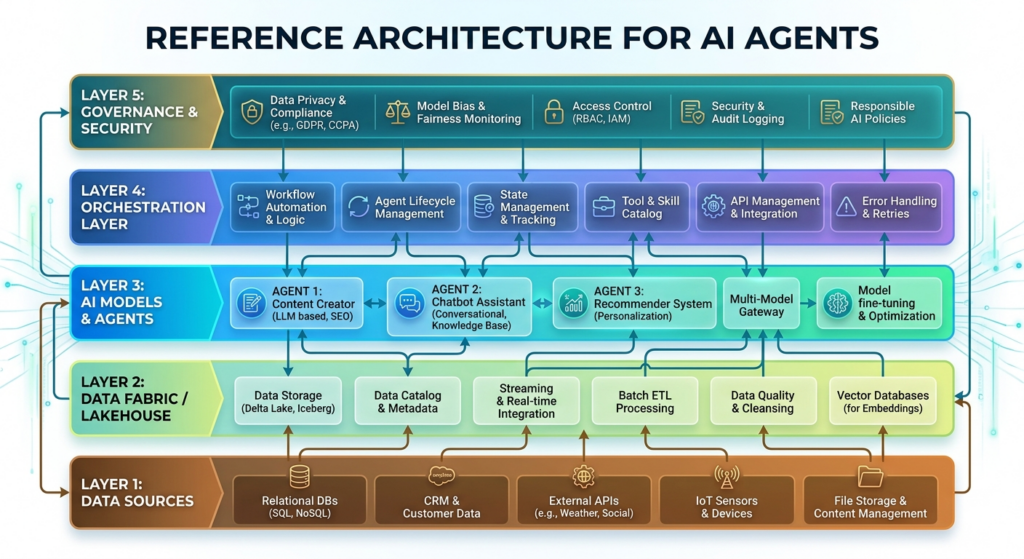
This architecture aligns with modern platforms like Microsoft Fabric.
To understand how enterprises can overcome these challenges, explore 7 Proven Strategies to Build Secure, Scalable AI with Microsoft Azure
Key Architectural Bottlenecks
1. Data Latency
Agents require real-time data, but many enterprises rely on batch processing.
2. Lack of Observability
Enterprises struggle to monitor agent behavior and performance.
3. Integration Complexity
Connecting agents to legacy systems increases implementation time and cost.
7. Organizational and Cultural Barriers
Resistance to Change
AI agents disrupt traditional workflows, leading to:
- Employee resistance
- Fear of job displacement
- Lack of trust in AI decisions
Skills Gap
Enterprises face a shortage of:
- AI engineers
- Data scientists
- AI governance experts
This slows down adoption and increases dependency on external partners.
Operating Model Challenges
AI agents require new operating models:
- Cross-functional collaboration
- Continuous monitoring
- Agile experimentation
Traditional IT structures are not designed for this.
Comparison: Traditional AI vs AI Agents
| Dimension | Traditional AI | AI Agents |
|---|---|---|
| Functionality | Predictive insights | Autonomous actions |
| Interaction | Static | Dynamic |
| Data Dependency | Batch | Real-time |
| Governance | Model-level | System-level |
| Complexity | Moderate | High |
Insight:
AI agents are not an extension of traditional AI—they represent a paradigm shift.
Challenges in Enterprise AI Agent Development
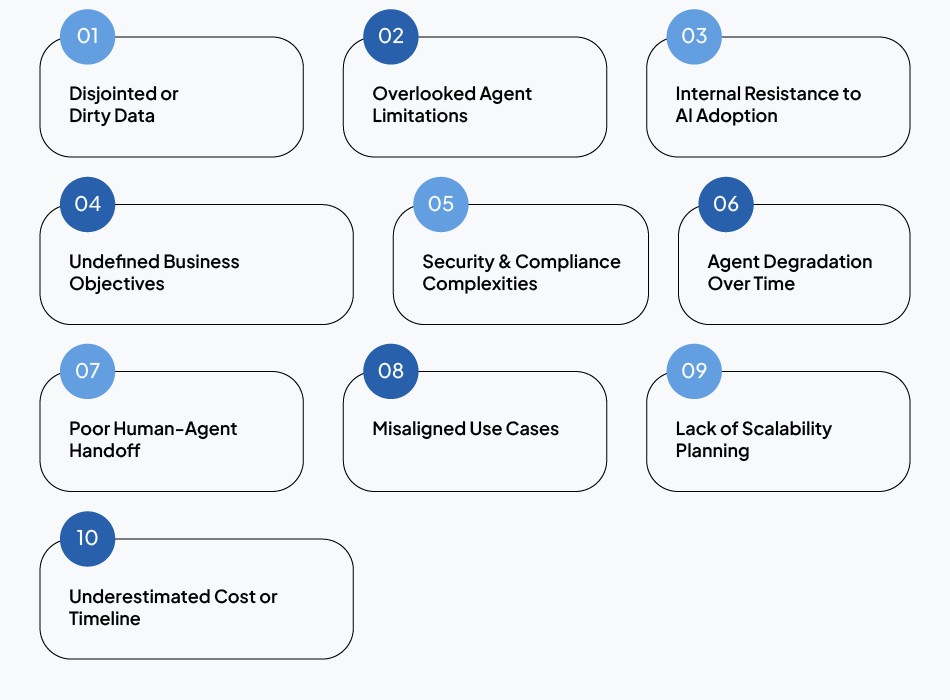
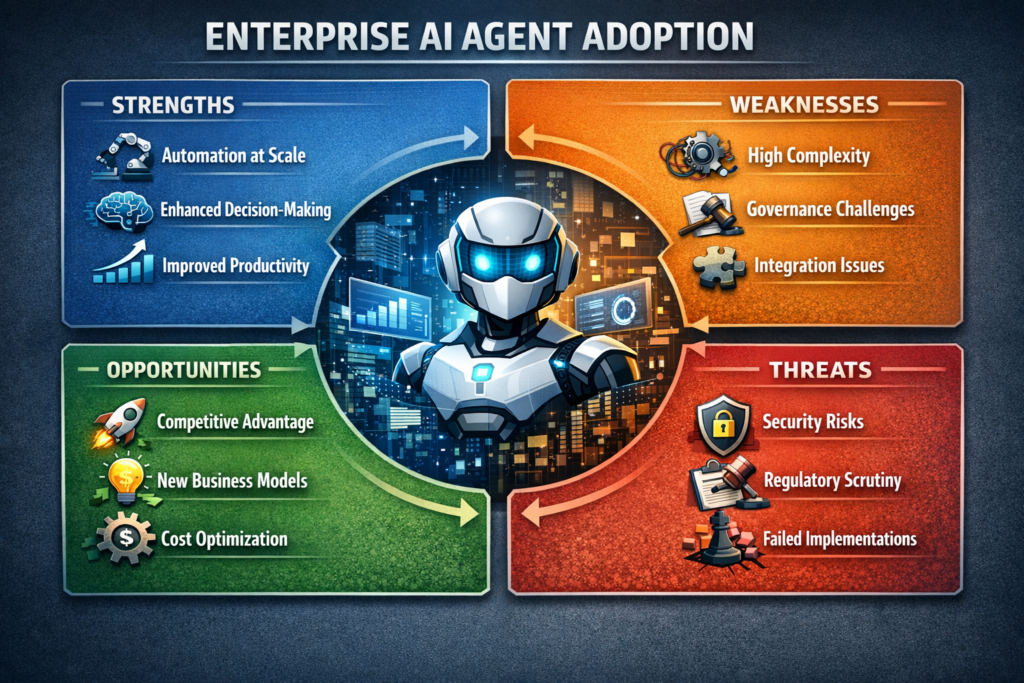
Battle Card: Enterprise AI Agent Adoption
Industry Use Cases and Challenges
Customer Service AI Agents
- Automate support interactions
- Improve response times
Challenge: Maintaining accuracy and context
Explore:
Conversational AI for Customer Service: A Step-by-Step Enterprise Guide
Finance and Risk Management
- Fraud detection
- Automated compliance
Challenge: Regulatory compliance and explainability
Supply Chain Optimization
- Demand forecasting
- Inventory management
Challenge: Data integration across systems
Implementation Framework to Overcome Enterprise AI Agent Adoption Challenges
Moving from Pilots to Scalable Systems
A major reason enterprise AI initiatives fail is the inability to transition from pilot to production. According to IBM insights, 42% of organizations struggle with financial justification, while another 42% cite lack of expertise as a key barrier.
To overcome these enterprise AI agent adoption challenges, organizations must adopt a structured implementation framework.
A 5-Layer Enterprise AI Agent Adoption Framework
1. Data Foundation Layer
- Unified data platform (lakehouse or data fabric)
- Data quality pipelines
- Metadata and lineage tracking
2. Model & Agent Layer
- LLMs and domain-specific models
- Agent orchestration frameworks
- Memory and context management
3. Orchestration Layer
- Workflow engines
- API integration
- Event-driven architecture
4. Governance Layer
- AI ethics policies
- Compliance frameworks
- Risk monitoring
5. Business Value Layer
- KPI tracking
- ROI measurement
- Continuous optimization
Strategic Insight:
Enterprises that treat AI agents as platform capabilities—not isolated tools—achieve higher scalability and ROI.
To further understand how reliable data drives enterprise outcomes, refer to Designing Scalable Data Architectures for Enterprise Data Platforms
Enterprise AI Agent Cost Structure Breakdown
Where Enterprises Actually Spend
| Cost Component | Description | % of Total Cost |
|---|---|---|
| Data Infrastructure | Storage, pipelines, processing | 25–35% |
| Model & Compute | LLM usage, inference costs | 20–30% |
| Integration | APIs, system connectivity | 15–25% |
| Governance & Security | Compliance, monitoring | 10–15% |
| Talent & Operations | Teams, training | 15–20% |
Governance and Operating Model for AI Agents
Why Governance is the #1 Success Factor
Nearly 45% of enterprises cite data accuracy and bias as top concerns in AI adoption.
AI agents amplify these risks because they act autonomously.
Enterprise AI Governance Model
Core Components:
- Policy Layer: Defines ethical and compliance standards
- Control Layer: Access management and security policies
- Monitoring Layer: Real-time tracking of agent decisions
- Audit Layer: Explainability and traceability
Operating Model Shift
Traditional IT → AI-driven enterprise
| Traditional Model | AI Agent Operating Model |
|---|---|
| Centralized IT control | Distributed AI governance |
| Static workflows | Dynamic, adaptive workflows |
| Periodic audits | Continuous monitoring |
Key Insight:
Governance must be embedded into the AI lifecycle, not added later.
To explore how modern platforms enable this shift, read Microsoft Fabric Architecture: A CTO’s Guide to Modern Analytics & AI
Security, Privacy, and Ethical Risks in AI Agents
Expanding Risk Surface
AI agents introduce new vulnerabilities:
- Prompt injection attacks
- Data exfiltration
- Unauthorized actions
According to IBM data, 40% of enterprises cite privacy concerns as a major barrier.
Enterprise Security Framework for AI Agents
Key Controls:
- Role-based access control (RBAC)
- Data anonymization and encryption
- Secure API gateways
- Continuous threat monitoring
Ethical AI Considerations
- Bias detection and mitigation
- Explainability
- Transparency
Critical Insight:
AI agents must be auditable, explainable, and controllable to gain enterprise trust.
Enterprise AI Agent Adoption Challenges by Maturity Stage
Why Most Enterprises Misdiagnose AI Agent Problems
A critical gap in addressing enterprise AI agent adoption challenges is treating all challenges equally—regardless of maturity stage.
In reality, challenges evolve across the AI lifecycle.
AI Agent Adoption Maturity Model
| Stage | Characteristics | Key Challenges | Success Criteria |
|---|---|---|---|
| Stage 1: Exploration | Pilots, PoCs | अस्पष्ट use cases, lack of ROI clarity | Defined business case |
| Stage 2: Experimentation | Multiple pilots | Data inconsistency, integration gaps | Repeatable architecture |
| Stage 3: Scaling | Cross-functional deployment | Governance, orchestration complexity | Standardized frameworks |
| Stage 4: Optimization | Enterprise-wide adoption | Cost optimization, performance tuning | Measurable ROI |
| Stage 5: AI-Native | AI-first processes | Continuous innovation challenges | Competitive advantage |
ROI Measurement and Business Value Realization
Why ROI is Hard to Prove
One of the biggest enterprise AI agent adoption challenges is unclear ROI.
Common pitfalls:
- No baseline metrics
- अस्पष्ट use cases
- Lack of business alignment
Enterprise ROI Framework
1. Efficiency Metrics
- Reduction in manual effort
- प्रक्रिया automation rates
2. Revenue Impact
- Increased conversions
- Faster time-to-market
3. Risk Reduction
- Fraud detection improvements
- Compliance cost savings
ROI increases significantly after standardization and scaling, not during pilots.
Advanced Challenges: Multi-Agent Systems and Coordination
The Rise of Multi-Agent Architectures
Enterprises are moving toward multi-agent ecosystems, where multiple AI agents collaborate.
Use Cases:
- Supply chain orchestration
- Autonomous IT operations
- Financial risk modeling
Key Challenges
1. Coordination Complexity
Agents must communicate effectively without conflicts
2. Latency Issues
Real-time decision-making requires low latency
3. Debugging Difficulty
Tracing errors across multiple agents is complex
Diagram Suggestion
- Multiple agents connected via orchestration layer
- Central governance and monitoring system
Insight:
Multi-agent systems require enterprise-grade orchestration platforms, not ad hoc integrations.
Future Trends Shaping Enterprise AI Agent Adoption
1. AI-Native Enterprises
Organizations will redesign processes around AI agents rather than embedding AI into existing workflows.
2. Rise of AI Control Planes
Dedicated platforms for:
- Monitoring
- Governance
- Optimization
3. Integration with Data Fabrics
AI agents will increasingly rely on unified data platforms like Microsoft Fabric.
To compare modern vs traditional approaches, explore Microsoft Data Fabric vs Traditional Data Warehousing
4. Low-Code AI Agent Development
To address skill gaps, enterprises will adopt:
- Low-code platforms
- Pre-built agent templates
This directly addresses the 42% skills gap challenge highlighted earlier.
How Techment Helps Enterprises Overcome AI Agent Adoption Challenges
Techment enables enterprises to navigate enterprise AI agent adoption challenges through a structured, end-to-end approach.
Strategic Capabilities
1. AI Readiness & Data Modernization
- Data quality frameworks
- Unified data platforms
- AI-ready architectures
2. AI Agent Implementation
- Use case identification
- Agent design and orchestration
- Integration with enterprise systems
3. Governance & Compliance
- Responsible AI frameworks
- Data governance implementation
- Risk and compliance management
4. Scalable Architecture Design
- Microsoft Fabric-based solutions
- Real-time analytics platforms
- Secure, scalable infrastructure
5. Continuous Optimization
- Performance monitoring
- ROI tracking
- Iterative improvement
To see how AI readiness impacts enterprise outcomes, refer to AI-Ready Enterprise Checklist with Microsoft Fabric
Enterprise AI Agent Risk Matrix
Mapping Risk vs Impact vs Mitigation
| Risk Category | Impact Level | Probability | Mitigation Strategy |
|---|---|---|---|
| Data Quality Issues | High | High | Data governance + validation pipelines |
| Bias & Fairness | High | Medium | Ethical AI frameworks |
| Security Breaches | Critical | Medium | Zero-trust architecture |
| Integration Failure | High | High | API-first architecture |
| ROI Failure | High | Medium | KPI-driven implementation |
| Compliance Violations | Critical | Low | Regulatory alignment |
Conclusion
Enterprise AI agents represent a transformative shift in how organizations operate, make decisions, and deliver value. However, the journey is far from straightforward. The most pressing enterprise AI agent adoption challenges—data fragmentation, governance complexity, integration hurdles, and ROI ambiguity—require a strategic, enterprise-wide approach.
The organizations that succeed will not be those that experiment the most, but those that architect AI systematically, embed governance deeply, and align AI initiatives with measurable business outcomes.
As AI agents evolve into core enterprise capabilities, the focus must shift from isolated pilots to scalable, governed, and value-driven ecosystems.
Techment stands as a strategic partner in this journey—helping enterprises transform AI ambition into measurable impact.
Whether you are shaping your data strategy, or planning AI-driven innovation, Contact Techment experts to help you move forward with clarity and confidence.
FAQ: Enterprise AI Agent Adoption Challenges
1. What are the biggest enterprise AI agent adoption challenges?
Data readiness, governance, integration complexity, ROI uncertainty, and security risks are the top challenges.
2. How can enterprises scale AI agents successfully?
By adopting a platform-based approach with strong data foundations, governance, and orchestration layers.
3. Why is governance critical for AI agents?
Because agents act autonomously, requiring accountability, transparency, and compliance with regulations.
4. How do enterprises measure ROI for AI agents?
Through efficiency gains, revenue impact, and risk reduction metrics aligned with business objectives.
5. What skills are required for AI agent adoption?
AI engineering, data science, governance expertise, and domain knowledge
Related Reads
- What Is Microsoft Fabric? A Comprehensive Overview for Modern Data Leaders.
- Data Management for Enterprises: Roadmap
- Enterprise Data Quality Framework: Best Practices for Reliable Analytics and AI
- Essential Design Patterns in Modern Data Pipelines
- How to Assess Data Quality Maturity: Your Enterprise Roadmap
- Data Migration
- Data Transformation
- Data Pipeline Engineering
- Data Cleansing & Cataloging
- Data Governance & Quality