
Enterprise data and AI leaders face a paradox today: on the one hand, data volumes, diversity and speed of change are exploding; on the other hand, many organisations still rely on legacy infrastructures, manual pipelines and fragmented tools. If you’re the CTO, Data Engineering Head or Product Director striving to turn data into reliable, trusted, enterprise-scale intelligence — you recognize the urgency.
According to recent industry analyses, organizations that embrace modern, modular and AI-enabled data ecosystems are pulling ahead in time-to-insight, cost efficiency and innovation.
But the challenge is not just technological — it’s strategic, operational, and cultural. That’s why the concept of a modern data stack is no longer a luxury, but a strategic imperative for 2025 and beyond.
Here’s a TL;DR of what you’ll gain by reading on:
- Insight into why “Modern Data Stack 2025: Tools & Trends to Watch” matters now.
- A clear, actionable definition of the modern data stack and its key components.
- Frameworks for governance, orchestration, metrics, and automation.
- Best practices and leadership takeaways for building reliable, scalable systems.
- A step-by-step roadmap to get started (or level up).
- KPI and ROI measurement tactics that resonate with executives.
- Emerging trends — AI agents, data products, data mesh, observability — to keep on your radar.
- Techment’s point of view: how we help enterprises adopt mature modern data stacks.
Learn how Techment empowers data-driven enterprises in Data Management for Enterprises: Roadmap
Let’s begin.
Understand The Basics Of Modern Data Stack 2025
Organizations can’t afford to treat data engineering and analytics as afterthoughts. In 2025, the stakes are rising: AI-driven products, low-latency operations, multi-cloud and hybrid environments, regulatory pressure (privacy, compliance, traceability), and business users demanding faster, self-service access to trustworthy insights.
Industry research shows that AI and analytics investments are paying off: over 90% of organizations reported measurable value from data and analytics in 2023. By contrast, firms that rely on rigid, legacy ETL pipelines and monolithic data stacks struggle with time-to-insight, cost overruns, and data quality breakdowns.
If you don’t modernize your data stack, you risk:
- Slow/batch-only pipelines that can’t support real-time use cases (fraud detection, personalization, edge analytics).
- Tool sprawl and inefficiencies: dozens of point solutions that don’t integrate.
- Data trust issues: no clear lineage, quality, observability, governance.
- Rising cloud costs and uncontrolled consumption models.
- Inability to support data-centric AI applications — foundational models, retrieval-augmented generation, intelligent automations.
The business impact is real: reduced agility, lower innovation velocity, higher risk, poor data ROI. In short — the modern data stack isn’t optional anymore. It’s mission critical.
Explore real-world insights in Why Data Integrity Is Critical Across Industries
Defining the Modern Data Stack
A clear, common understanding of what constitutes a modern data stack is essential for alignment at leadership level. In our framing:
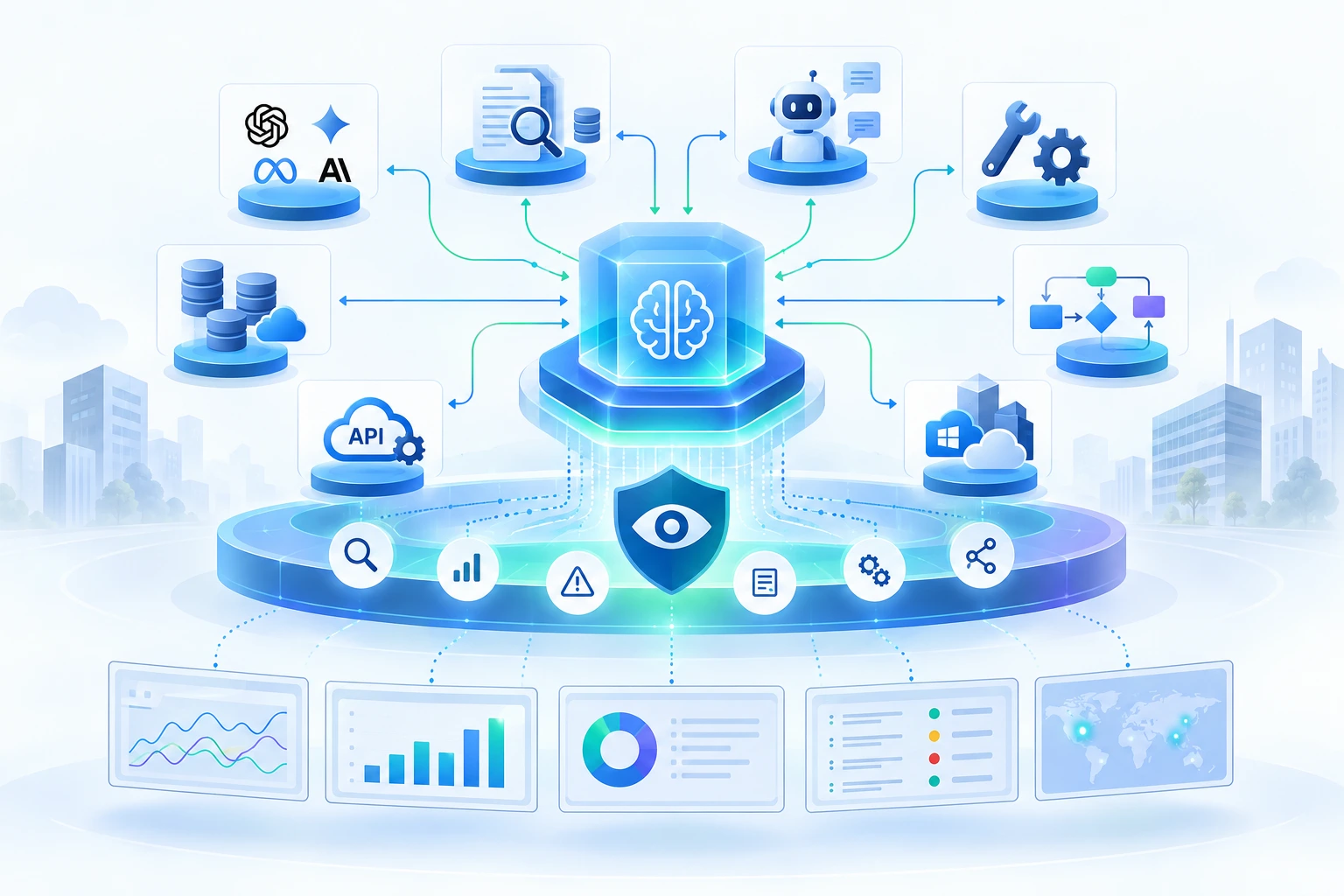
Modern Data Stack (MDS) = a modular, cloud-native (or hybrid) ecosystem of tools, processes, and governance that enable seamless ingestion, transformation, storage, serving and operationalization of data — with enterprise-grade reliability, observability, AI readiness and business-centric outcomes.
Let’s break that down into core dimensions:
- Ingestion / integration: Tools that reliably capture data (batch, streaming, change data capture (CDC)), integrate across sources (databases, applications, IoT, third-party feeds).
- Storage & compute: Cloud (or hybrid) data warehouses, data lakes, data lakehouses, data marts, often decoupled compute + storage.
- Transformation / orchestration: ELT / ETL pipelines, transformation logic, scheduling/orchestration, automation. Note: the shift to ELT (extract → load → transform) is foundational
- Serving & consumption: BI dashboards, embedded analytics, reverse ETL (making data actionable back in apps), feature stores for ML, data products.
- Governance, observability & quality: Metadata/catalogue, lineage, data contracts, data mesh/fabric, monitoring of data pipelines (freshness, schema drift, SLA adherence, anomaly detection).
- AI / intelligent layer: Supports AI/ML workloads (feature engineering, model training, inference pipelines), and increasingly AI-enabled automations (agents, semantic layers, conversational analytics).
- Measurement & culture: Metrics, KPIs, data literacy, organizational alignment and value extraction.
Dive deeper into AI-driven data frameworks in Data Quality Framework for AI and Analytics
Key Components of a Robust Modern Data Stack
Below we map the major layers/components and highlight strategic considerations.
- Ingestion & Integration :Examples: CDC tools, streaming platforms (Kafka, Kinesis), ingestion services (Fivetran, Airbyte). A robust ingestion strategy handles schema evolution, error-handling, data enrichment and metadata capture.
- Key metrics: ingestion latency, failed records %, schema drift events, cost per TB ingested.
- Automation tips: self-serving connectors, template pipelines, data contracts between providers & consumers.
- Storage & Compute: Modern stacks favour decoupled, elastic compute + storage (e.g., Snowflake, BigQuery, Databricks lakehouse) to scale independently and optimise cost/performance.
- Key metrics: query latency, concurrency, cost per query, cost per GB stored/processed.
- Strategic note: align storage/compute choices with business use-cases (real-time vs batch vs ML vs interactive dashboards).
- Transformation & Orchestration :Pipeline tools (e.g., DAG orchestration, workflow scheduling, transformation libraries like dbt), plus ELT logic. The aim is to produce, reproduce, and perform data flows.
Automation insight: auto-generated lineage, templated models, validation/QA steps baked into pipelines.
- Serving & Consumption :Once data is processed, you need efficient access: dashboards, embedded analytics, reverse ETL (moving insights back into operational systems), feature stores for ML, data products. The trend is to turn data into directly usable products.
Key metrics: user adoption rates, time to insight for business users, number of data products, rate of data gifted back to operational systems.
- Governance, Observability & Quality: This is often the differentiator between data-rich and data-trusted organizations. Key capabilities: data lineage, metadata/catalogue, SLA monitoring, anomaly/drift detection, data contracts, domain-centric data mesh/fabric. Emerging tooling supports AI-powered tagging, PII detection, impact analysis, and even self-serving governance.
- AI & Intelligence Layer: Here the stack supports ML/AI pipelines: feature engineering, training, inference and model monitoring (drift, explainability). Increasingly, automated “agentic” layers (AI agents that recommend queries, detect anomalies, auto-document pipelines) are becoming core.
- Metrics, Culture & Value: Even the best architecture fails without culture, metrics and alignment.
Key practices: define business-centric KPIs (not just technical), ensure data literacy, encourage cross-functional teams (data + product + engineering + business). Trends like metrics stores (single source of truth for metrics definitions) are rising.
See how Techment implemented scalable data automation in Unleashing the Power of Data Whitepaper
Best Practices for Reliable, Scalable & Intelligent Data Systems
Here are proven strategies tailored for senior data & technology leaders:
- Adopt modular, interoperable tools — avoid vendor lock-in and ensure APIs, metadata and orchestration layers integrate cleanly.
- Automate upstream governance & observability — build governance and quality checks into pipelines rather than bolting them on after production.
- Prioritise data products, not just reports — treat data as a product: discoverable, dependable, consumable by non-engineers.
- Align data engineering with business outcomes — define KPIs that tie directly back to value (e.g., faster time to decision, improved customer metrics, cost savings).
- Ensure AI readiness — pipeline maturity, robust feature stores, model monitoring, built-in drift detection and explainability.
- Empower data literacy & cross-functional alignment — data teams must collaborate with product, engineering and business units; include training, documentation, and self-service features.
- Cost governance — monitor cloud/consumption costs continuously, model total cost of ownership, adopt efficient compute/storage strategies and avoid uncontrolled tool sprawl.
Explore how Techment drives reliability through automation in Intelligent Test Automation: The Next Frontier in QA
Implementation Roadmap: Step-by-Step Guide
Here’s a practical roadmap you can use to build or mature your modern data stack in 2025:
Assessment & Baseline
- Inventory current pipelines, tools, data silos, quality issues, costs.
- Map high-value use cases (analytics, AI, operational insights).
- Identify gaps in governance, observability, automation and data products.
- Pro tip: Secure executive sponsorship and ensure alignment across product, engineering, data & business teams.
Define Target Architecture & Tooling Strategy
- Choose core platforms (data warehouse/lakehouse, ingestion/integration, transformation, orchestration, observability tooling).
- Define a modular “composable” architecture to allow incremental build-out.
- Configure domains/data products and plan for metrics & observability layers.
- Avoid “big bang” rollouts where possible.
Pilot & Incremental Build
- Start with 1–2 high-impact use cases (e.g., real-time analytics + ML model serving).
- Build ingestion → storage → transformation → serving pipelines with governance & monitoring baked in.
- Develop first data products, feature store, and internal self-service dashboards.
- Pitfall: over-customisation early, lack of reusability, neglect of monitoring.
Scale & Operationalise
- Expand to more domains, add streaming/real-time as needed, adopt data mesh/domains.
- Automate tests, schema evolution, data contracts and deployment pipelines (CI/CD for data).
- Incorporate AI-enabled tooling (agents, semantic layers, conversational analytics).
Measure, Optimise & Govern
- Establish KPIs: ingestion latency, pipeline success %, SLA adherence, query latency, cost per insight, model drift rates, business outcome metrics.
- Monitor tool utilisation, user adoption of data products, data literacy metrics.
- Put in place continual improvement loops and cost governance.
- Mature & Innovate
- Move toward proactive anomaly detection, autonomous data agents, dynamic data contracts, metrics stores, data-driven culture.
- Explore advanced architectures (data mesh + fabric hybrid, semantic layers, edge/IoT analytics, Foundation Model/LLM enablement).
Read how Techment streamlined governance in Streamlining Operations with Reporting Case Study
Measuring Impact & ROI
Quantifying the value of your modern data stack is essential to secure ongoing funding, stakeholder buy-in and continuous improvement.
Key metrics:
- Accuracy & quality: % of successful pipeline runs, % of data errors/invalid records.
- Latency & freshness: time from ingestion to dashboard insight or model input.
- Usage & adoption: number of active business users, self-service queries, data products consumed.
- Operational cost efficiency: cost per TB processed, compute cost per query, pipeline cost per month.
- Business outcomes: increased revenue from analytics/AI, improved decision speed, reduced fraud/loss, improved customer metrics.
- Model performance metrics: drift rates, false positive/negative rates, uptime of ML systems, ROI of AI initiatives.
Mini case study snapshot:
A mid-sized enterprise implemented a refreshed ingestion + transformation + observability pipeline, reduced average pipeline latency from 4 hours to 15 minutes, cut data error incidents by 70 %, and improved business user self-service adoption by 2×. The resulting incremental revenue uplift (via faster campaign decisions) and cost avoidance (manual rework) achieved payback in under 12 months.
Discover measurable outcomes in Optimizing Payment Gateway Testing Case Study
Emerging Trends and Future Outlook
Looking ahead, here are the key trends shaping the modern data stack in 2025 and beyond:
- Data mesh + data fabric hybrid architectures: decentralised data domain ownership (mesh) supported by integrated meta- & orchestrational backbone (fabric).
- Agentic AI layers & semantic layers: AI agents assisting/automating data workflows (pipeline generation, anomaly detection, root-cause analysis), retrieval-augmented generation (RAG), knowledge-augmented generation (KAG).
- Metrics stores & shared semantic KPIs: standardised, embeddable metric definitions across tools, domains, applications.
- Real-time, streaming and edge analytics: IoT, mobile, event-driven architectures, edge AI processing.
- Consumption-based tooling cost governance: as cloud tools increase, cost control and observability become non-negotiable.
- Trusted data ecosystems: very strong emphasis on data lineage, privacy/PII detection, compliance automation, “data as product” with high trust.
- Unified analytics & AI platforms: the modern stack is evolving from “stack” to “system” of trust, agility and value.
Explore next-gen data thinking in Data Cloud Continuum: Value-Based Care Whitepaper
Techment’s Perspective
At Techment, we view the modern data stack not merely as a collection of tools, but as an enterprise transformation vector: aligning data, AI, engineering and business to deliver trusted intelligence at scale.
Our proprietary approach emphasises:
- Strategic alignment — connecting data architecture to business outcomes.
- Modular yet integrated tooling — enabling flexible, incremental adoption with enterprise robustness.
- Governance and observability by design — not as add-ons.
- Data-product mindset — focusing on usable, consumable and trusted data assets.
- Metrics-driven execution — clear KPIs, business value tracking, cost governance.
- Continuous innovation — supporting emerging trends (AI agents, semantic layers, edge analytics) so you’re not just “catching up”, but staying ahead.
We believe that the future of enterprise intelligence lies in data ecosystems that are reliable, composable and purpose-driven. The modern data stack of 2025 is the infrastructure of competitive advantage.
Get started with a free consultation in Unleashing the Power of Data Whitepaper
Conclusion
The concept of the Modern Data Stack 2025: Tools & Trends to Watch is no longer a buzzword — it’s a board-level agenda item. Enterprises that invest in modular, AI-enabled, governance-first data ecosystems will not only survive, but lead in agility, insight velocity and innovation.
For CTOs, Data Engineering Leaders, Product Managers and Engineering Heads: now is the time to act. Begin with strategy, build with discipline, measure with outcomes and govern with trust.
Schedule a free Data Discovery Assessment with Techment at https://www.techment.com/contact
Strategic Recommendations
- Automate governance and observability from day one.
- Define your metrics store and unambiguous business KPIs upfront.
- Align data engineers, product teams and business users in a shared roadmap.
- Keep cost governance top of mind — tools + consumption can escalate fast.
- Foster a culture of data literacy and self-service analytics to maximise ROI.
Data & Stats Snapshot
- Over 90% of organisations achieved measurable value from data and analytics in 2023.
- The global data analytics market is projected to reach US$132.9 billion by 2026, growing at a CAGR of ~30%.
- Key trends shaping data management in 2025: AI automation, real-time analytics, data mesh architectures, adaptive governance.
- Many teams are tired of juggling 20+ data tools and are seeking simplification/unification.
- In 2025, modern stacks increasingly include AI-powered tagging, PII detection and impact analysis baked into observability & governance tooling.
FAQ
Q1. What is the ROI of “Modern Data Stack 2025: Tools & Trends to Watch”?
A: ROI comes from faster insight, improved data trust/quality, lower manual overhead, reduced errors, improved business actions (e.g., faster campaigns, personalization, cost avoidance) and cost governance of tooling + cloud.
Q2. How can enterprises measure success of their modern data stack?
A: Through metrics such as pipeline latency, error/failure rates, user adoption, cost per insight/query, model drift rates, business outcome impact.
Q3. What tools enable scalability of modern data stacks?
A: Cloud data warehouses (Snowflake, BigQuery, Firebolt etc), orchestration platforms (Airflow, Prefect), ingestion/CDC tools, observability & data catalog tools, feature stores, AI-enabled agents.
Q4. How to integrate with existing data ecosystems / legacy stacks?
A: Adopt modular strategy: connect ingestion from legacy sources, use ELT to load raw data, gradually migrate transformation layers, implement governance/monitoring first, build bridges (reverse ETL, data products) rather than full rip-and-replace.
Q5. What governance challenges arise with modern data stacks?
A: Key challenges: data lineage/traceability, schema drift, data contracts between producers/consumers, managing data mesh domains (ownership/responsibility), cost governance of cloud consumption, embedding privacy/PII/compliance controls.