Enterprise data leaders are entering a decisive phase of platform rationalization. As organizations push toward AI-driven decision-making, real-time analytics, and governed self-service at scale, the debate around Microsoft Fabric vs Azure Data Stack has become central to data strategy conversations for 2026.
For years, the traditional Azure data stack—built from services like Azure Data Factory, Synapse, Data Lake, and Power BI—has offered flexibility and best-of-breed control. Yet that flexibility has also introduced architectural sprawl, operational overhead, and fragmented governance. Microsoft Fabric challenges this model with a unified, SaaS-style analytics platform designed to simplify analytics, accelerate AI readiness, and reduce time-to-value.
For CTOs, CDOs, and data architects, this is not a question of “new versus old.” It is a strategic decision about operating models, organizational maturity, and long-term scalability. Choosing between Microsoft Fabric vs Azure Data Stack impacts cost predictability, governance posture, talent strategy, and the enterprise’s ability to operationalize AI.
This article provides a deep, enterprise-grade analysis of Microsoft Fabric vs Azure Data Stack—examining architecture, governance, cost, risks, and future readiness—so technology leaders can make informed platform decisions heading into 2026.
Begin your journey by learning more about our partnership with Microsoft to help you make the right choice for MS Fabric adoption partner.
TL;DR – Executive Summary
- Microsoft Fabric vs Azure Data Stack is a strategic platform decision, not a tooling comparison.
- Fabric prioritizes unification, AI readiness, and speed, while the traditional Azure data stack emphasizes modularity and architectural control.
- By 2026, operating model maturity, governance complexity, and AI ambitions will determine the right choice.
- Enterprises rarely choose one exclusively—hybrid coexistence is emerging as the dominant pattern.
- CTOs must evaluate cost models, organizational readiness, and data governance at scale before committing.
Microsoft Fabric vs Azure Data Stack: Why This Decision Matters in 2026
The urgency behind the Microsoft Fabric vs Azure Data Stack discussion is driven by forces far beyond analytics modernization. Enterprises are now operating in an environment defined by AI acceleration, regulatory scrutiny, and cost accountability.
The Enterprise Data Context Is Fundamentally Changing
By 2026, most large organizations will manage:
- Hundreds of data domains
- Thousands of analytical consumers
- Dozens of AI and machine learning pipelines
- Increasing regulatory and data residency obligations
In this environment, fragmented platforms become liabilities. Traditional Azure data stacks were architected for flexibility at a time when analytics was largely centralized and batch-driven. Today’s enterprises demand real-time insights, governed self-service, and AI-ready data products.
This is where Microsoft Fabric positions itself as a response to architectural fatigue. Rather than assembling analytics capabilities piece by piece, Fabric offers a tightly integrated experience across ingestion, engineering, warehousing, BI, and AI.
Why CTOs Are Re-evaluating the Traditional Azure Data Stack
The traditional Azure data stack remains powerful, but it introduces challenges at scale:
- Complex cross-service governance
- Toolchain fragmentation across teams
- Rising operational and integration costs
- Slower onboarding for new analytics and AI use cases
In the Microsoft Fabric vs Azure Data Stack debate, enterprises are not abandoning Azure services wholesale. Instead, they are questioning whether maximum flexibility still outweighs simplicity and speed.
Strategic Implications Beyond Technology
This decision affects:
- Operating models: Centralized platforms vs federated teams
- Talent strategy: Platform engineers vs analytics consumers
- Cost governance: Consumption sprawl vs capacity-based control
- AI readiness: Data fragmentation vs unified semantic layers
Enterprises that treat Microsoft Fabric vs Azure Data Stack as a pure technical comparison risk misalignment between architecture and business goals.
Read our Microsoft Data and AI Partner blog explores the strategic value a Microsoft Data and AI Partner brings to enterprises
Understanding the Traditional Azure Data Stack
Before evaluating Microsoft Fabric vs Azure Data Stack, it is essential to understand what the “traditional” Azure approach actually represents in modern enterprises.
Core Components of the Traditional Azure Data Stack
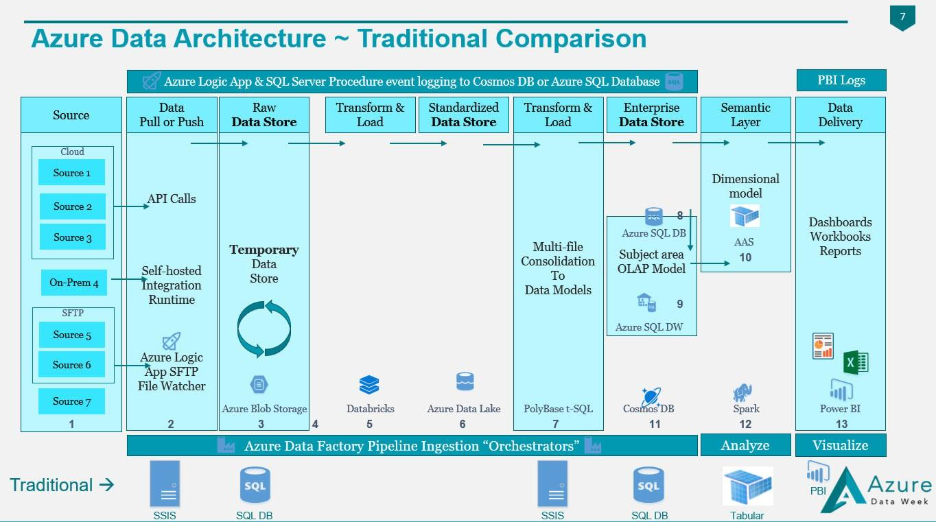
A conventional Azure analytics architecture typically includes:
- Azure Data Factory or Synapse Pipelines for ingestion
- Azure Data Lake Storage Gen2 for raw and curated data
- Azure Synapse Analytics (SQL pools, Spark) for processing
- Azure Databricks for advanced analytics and ML (often optional)
- Power BI for visualization and reporting
- Azure Purview (now Microsoft Purview) for governance
This modular architecture allows organizations to adopt services incrementally and tailor solutions to specific workloads.
Strengths of the Traditional Azure Data Stack
From an enterprise architecture perspective, the traditional Azure data stack excels in several areas:
- Granular control: Architects can fine-tune performance, security, and networking.
- Best-of-breed selection: Teams can substitute or enhance components as needed.
- Mature enterprise patterns: Proven designs for large-scale, regulated environments.
For organizations with strong platform engineering teams, the Azure data stack remains a robust foundation.
Where Complexity Becomes a Constraint
However, as deployments scale, complexity compounds. Each service introduces its own:
- Security model
- Monitoring framework
- Cost structure
- Metadata and lineage approach
In practice, many enterprises struggle to maintain consistent governance across the stack. In the Microsoft Fabric vs Azure Data Stack evaluation, this fragmentation is often cited as the primary pain point—not lack of capability.
See how Microsoft Data Fabric compares against traditional data warehousing across scalability, governance, AI readiness, cost, and decision intelligence.
What Microsoft Fabric Changes in the Equation
Microsoft Fabric represents a deliberate shift away from modular assembly toward platform unification.
Fabric as a Unified Analytics SaaS Platform
Microsoft Fabric consolidates data engineering, data science, real-time analytics, warehousing, and BI into a single experience. At the core of this model is OneLake—a logical data lake that underpins all workloads.
Rather than moving data between services, Fabric encourages reuse through shared storage and semantics. This fundamentally alters how enterprises think about pipelines, duplication, and ownership.
Key Architectural Differences
In the Microsoft Fabric vs Azure Data Stack comparison, several architectural shifts stand out:
- One storage layer instead of multiple data lakes
- Shared security and governance model
- Capacity-based pricing rather than per-service consumption
- Native integration with Power BI and Copilot experiences
For organizations struggling with sprawl, this simplification is compelling. However, it also introduces new constraints around customization and workload isolation.
Why Fabric Appeals to Business-Driven Analytics
Fabric lowers the barrier for analytics consumption. Business teams gain faster access to governed data products, while central teams reduce the burden of maintaining integrations.
This explains why Microsoft Fabric vs Azure Data Stack is often framed as speed versus control. Fabric prioritizes acceleration and standardization; the traditional Azure data stack prioritizes architectural freedom.
Begin your transformation journey and automate governance across all platforms with our data solutions.
Microsoft Fabric vs Azure Data Stack: Architectural Comparison
At an enterprise level, architecture determines scalability, resilience, and governance. Comparing Microsoft Fabric vs Azure Data Stack through this lens reveals meaningful trade-offs.
Data Ingestion and Processing
Traditional Azure architectures rely on explicit pipelines and processing engines. Data flows are well-defined but often brittle when requirements change.
Fabric simplifies ingestion through integrated pipelines and notebooks that write directly to OneLake. This reduces data movement but can obscure lineage if governance is not enforced rigorously.
Storage and Data Duplication
Azure data stacks frequently suffer from data duplication across lakes, warehouses, and marts. Fabric’s OneLake approach addresses this by promoting a single logical copy.
In Microsoft Fabric vs Azure Data Stack discussions, OneLake is often cited as the most transformative feature—yet it also requires disciplined domain ownership to avoid becoming a monolith.
Analytics and Semantic Layer
The traditional Azure approach typically treats semantic models as downstream artifacts. Fabric elevates the semantic layer as a shared enterprise asset, enabling reuse across reports and AI workloads.
This architectural choice aligns strongly with AI enablement strategies heading into 2026.
Read more about Microsoft Fabric architecture, evaluate its advantages, compare it with traditional systems to leverage it to the fullest.
Governance and Security Implications
Governance is where many Microsoft Fabric vs Azure Data Stack decisions are ultimately won or lost.
Centralized vs Federated Governance
Azure’s modular model supports highly customized governance frameworks but demands significant effort to maintain consistency.
Fabric offers centralized governance out of the box, simplifying compliance but limiting bespoke controls. Enterprises must assess whether this trade-off aligns with regulatory and risk requirements.
Metadata, Lineage, and Discoverability
Fabric integrates metadata management directly into the analytics experience. In contrast, traditional stacks often rely on separate governance tools and manual integration.
For CDOs prioritizing data democratization with trust, this difference is substantial.
Explore how enterprise reliability improves with governance-forward architecture in our data governance solution offerings.
Cost Models and Financial Predictability
Cost transparency is a growing concern in the Microsoft Fabric vs Azure Data Stack debate.
Consumption-Based vs Capacity-Based Pricing
Traditional Azure services charge independently, making it difficult to predict aggregate spend. Fabric’s capacity-based model simplifies forecasting but requires careful capacity planning.
For enterprises seeking financial predictability, Fabric’s model is attractive—provided utilization is actively managed.
We help enterprises build governance-by-design foundations, know more about our data services here.
AI Readiness and Copilot Enablement: A 2026 Differentiator
By 2026, the Microsoft Fabric vs Azure Data Stack decision will increasingly be judged through one lens: AI readiness at enterprise scale. Analytics platforms are no longer evaluated only on reporting or batch analytics. They are now foundational layers for copilots, agentic workflows, and decision intelligence.
Why AI Changes the Platform Conversation
Traditional analytics stacks were designed for human consumption—dashboards, SQL queries, and periodic reports. AI-driven enterprises require something different:
- High-quality, well-governed data at semantic depth
- Real-time access patterns
- Tight integration between analytics, ML, and business context
In this context, Microsoft Fabric vs Azure Data Stack becomes less about feature parity and more about how easily AI systems can reason over enterprise data.
Learn how we can help with intelligent automation, human-like interactions, and scalable business intelligence though our AI-powered solutions.
Microsoft Fabric’s Native AI Advantage
Microsoft Fabric embeds AI enablement directly into the platform. Unified storage through OneLake, shared semantic models, and deep Power BI integration make Fabric inherently Copilot-friendly. This reduces friction between data preparation and AI consumption.
From an architectural standpoint, Fabric aligns closely with Microsoft’s broader AI ecosystem, particularly across:
- Embedded Copilot experiences
- Natural language query over governed datasets
- Reusable enterprise semantic layers
This design shortens the path from data to AI-powered insight—an increasingly critical KPI for executive teams.
Azure Data Stack and Advanced AI Flexibility
The traditional Azure data stack, while more complex, offers unparalleled flexibility for advanced AI and ML workloads. Enterprises can:
- Combine Azure Synapse, Azure Databricks, and Azure Machine Learning
- Customize feature stores and model pipelines
- Integrate non-Microsoft AI frameworks with precision
In the Microsoft Fabric vs Azure Data Stack comparison, this flexibility matters most for organizations building bespoke AI platforms rather than standardized copilots.
Strategic Implication for CTOs
The choice hinges on intent. If AI adoption is primarily about democratized intelligence and business productivity, Fabric offers a faster route. If AI is a core differentiator requiring deep customization, the Azure data stack retains an edge.
Learn in our blog on Microsoft Azure for Enterprises: The Backbone of AI-Driven Modernization how it provides a cohesive, enterprise-grade ecosystem to integrate infrastructure, data, security, AI, and governance under a unified architectural vision.
Operating Model and Organizational Impact
Technology platforms inevitably shape how teams work. In Microsoft Fabric vs Azure Data Stack decisions, operating model alignment often determines long-term success more than architecture diagrams.
Centralized Platforms vs Federated Teams
Microsoft Fabric encourages a more centralized analytics platform model. Shared capacity, unified governance, and standardized tooling reduce duplication and simplify onboarding.
This model works well for enterprises aiming to:
- Enforce global data standards
- Accelerate self-service analytics
- Reduce reliance on specialized platform engineers
However, it can create tension in organizations with highly autonomous domain teams.
Azure Data Stack and Domain Autonomy
The traditional Azure data stack supports federated ownership. Individual teams can select tools, optimize pipelines, and tailor architectures to domain needs.
In Microsoft Fabric vs Azure Data Stack evaluations, this autonomy is often valued by engineering-led organizations—but it comes at the cost of higher coordination overhead and governance complexity.
Skills and Talent Implications
Fabric lowers the skill barrier for analytics consumers but increases dependency on Microsoft’s platform abstractions. The Azure data stack requires deeper engineering expertise but offers broader career portability.
Enterprise leaders must consider not only current talent, but how skills will scale over the next five years.
Discover how we integrated Azure services for efficient data ingestion, transformation, and reporting, ensuring scalability and reliability through our case study.
Risk, Trade-Offs, and Hidden Constraints
No platform decision is without risk. A balanced Microsoft Fabric vs Azure Data Stack analysis must address what can go wrong.
Vendor Lock-In Considerations
Fabric’s tight integration is both its strength and its risk. Enterprises become more dependent on Microsoft’s roadmap, pricing, and feature evolution.
The Azure data stack, while still Microsoft-centric, allows for selective substitution and hybrid architectures.
Performance and Workload Isolation
In Fabric’s shared capacity model, poorly governed workloads can impact performance across teams. Traditional Azure architectures allow stronger isolation at the cost of higher management overhead.
Governance at Scale
Fabric simplifies governance but assumes alignment with Microsoft’s governance paradigms. Highly regulated industries may require controls that exceed Fabric’s current abstractions.
In Microsoft Fabric vs Azure Data Stack discussions, risk tolerance often becomes the deciding factor.
Read our Microsoft Data and AI Partner blog explores the strategic value a Microsoft Data and AI Partner brings to enterprises
Coexistence and Hybrid Patterns Are the New Normal
A critical insight for 2026 is that most enterprises will not choose exclusively between Microsoft Fabric vs Azure Data Stack.
Common Coexistence Scenarios
Leading organizations are adopting hybrid models such as:
- Fabric for enterprise BI, self-service analytics, and Copilot enablement
- Traditional Azure data stack for advanced engineering, ML, and real-time workloads
- Shared governance through Microsoft Purview
This approach balances speed with control—though it requires disciplined architecture management.
Migration as a Journey, Not an Event
Few enterprises will “rip and replace” existing Azure investments. Instead, Fabric is often introduced incrementally, aligned to new use cases or business units.
In Microsoft Fabric vs Azure Data Stack strategy, coexistence is not compromise—it is pragmatism.
For deeper context on transforming enterprise data systems before AI deployment, explore our data engineering services.
How Techment Helps Enterprises Navigate Microsoft Fabric vs Azure Data Stack
Choosing between Microsoft Fabric vs Azure Data Stack is not a tooling decision—it is a strategic transformation. This is where Techment partners with enterprises as a trusted advisor.
Strategy-Led Platform Evaluation
Techment helps CTOs and CDOs assess:
- Business priorities and AI ambition
- Organizational readiness and operating models
- Governance, compliance, and risk posture
Rather than recommending platforms in isolation, Techment aligns architecture decisions to enterprise strategy through proven data modernization frameworks.
Transform your enterprise with a Microsoft Azure service adoption partner trusted by industry leaders. Contact us.
Architecture, Implementation, and Coexistence
Techment designs and implements:
- Microsoft Fabric architectures optimized for scale and governance
- Traditional Azure data stacks for advanced analytics and ML
- Hybrid coexistence models that maximize existing investments
With deep experience across Microsoft’s data ecosystem, Techment ensures platforms evolve without disrupting business outcomes.
Governance, Quality, and AI Readiness
AI success depends on trust. Techment embeds governance, data quality automation, and metadata management into every platform engagement—ensuring analytics and AI are reliable, compliant, and scalable.
End-to-End Partnership
From roadmap to optimization, Techment supports enterprises across:
- Data modernization and cloud migration
- AI readiness and Copilot enablement
- Platform governance and operating model transformation
The result is not just a platform decision—but a future-ready data foundation.
Learn how Techment helps organizations build conversational and generative AI capabilities through our Conversational AI offerings.
Conclusion: Making the Right Enterprise Choice for 2026
The Microsoft Fabric vs Azure Data Stack decision is not about choosing the “better” platform—it is about choosing the right operating model for your enterprise’s future.
Microsoft Fabric offers speed, unification, and AI enablement that aligns with business-driven analytics and Copilot adoption. The traditional Azure data stack provides flexibility, control, and architectural depth for complex, engineering-led environments.
By 2026, successful enterprises will be those that:
- Align platform choices with strategic intent
- Embrace coexistence where it adds value
- Invest equally in governance, quality, and operating models
With the right guidance, Microsoft Fabric vs Azure Data Stack becomes not a dilemma—but a powerful lever for enterprise transformation. Techment stands ready to help organizations navigate this decision with clarity, confidence, and measurable impact.
Frequently Asked Questions
Is Microsoft Fabric replacing the Azure data stack?
No. Microsoft Fabric complements the Azure data stack. Most enterprises will adopt hybrid models rather than full replacement.
Which is better for AI initiatives in 2026?
For standardized, business-facing AI, Fabric accelerates adoption. For advanced, custom AI platforms, the Azure data stack offers greater flexibility.
How does cost compare between Microsoft Fabric vs Azure Data Stack?
Fabric’s capacity-based pricing improves predictability, while Azure’s consumption model offers granular control but higher variability.
Can regulated industries adopt Microsoft Fabric?
Yes, but governance design is critical. Some highly regulated workloads may still require traditional Azure architectures.
How long does migration typically take?
Migration is incremental. Enterprises often introduce Fabric over 6–18 months alongside existing Azure platforms.