In 2026, executive decision-making is no longer defined by static dashboards, quarterly reports, or delayed insights. It is increasingly shaped by AI Copilots for executive decision-making—intelligent, context-aware systems that sit alongside leaders, synthesizing data, predicting outcomes, and recommending actions in real time.
For CEOs, CTOs, and data leaders, this shift represents more than another wave of AI adoption. It marks a fundamental redefinition of how strategy is formed, evaluated, and executed. AI-powered decision making is moving from operational efficiency to the heart of enterprise leadership, influencing capital allocation, risk posture, market entry, M&A decisions, and long-term growth planning.
Yet, despite the hype surrounding executive AI tools, most enterprises struggle to translate copilots into strategic advantage. The reason is simple: decision intelligence requires far more than generative interfaces. It demands trusted data, governed architectures, domain context, and organizational alignment.
This blog explores how AI copilots for enterprises are transforming executive leadership in 2026—what’s changing, why it matters, and how forward-looking organizations are building copilots that elevate judgment rather than replace it.
TL;DR Summary
- AI copilots are becoming core decision infrastructure for executives in 2026
- They shift leadership from intuition-led to evidence-amplified decision-making
- Success depends on data quality, governance, and operating models, not tools alone
- Enterprises must design copilots for strategic reasoning, not task automation
- CTOs and CDOs now own the decision intelligence stack, not just analytics platforms
The Executive Decision Crisis AI Copilots Are Addressing
Why Traditional Executive Decision Models Are Breaking Down
Enterprise leaders today face a paradox. They have access to more data than ever before, yet confidence in decisions is declining. Fragmented systems, lagging indicators, and siloed analytics leave executives reacting rather than anticipating. By the time insights reach the boardroom, market conditions have already shifted.
This breakdown is not due to lack of intelligence, but lack of decision velocity. Traditional BI models were designed for analysis, not leadership cognition. They answer predefined questions but fail to support exploratory reasoning—the kind executives rely on when navigating ambiguity.
AI Copilots for executive decision-making address this gap by transforming analytics from a reporting function into a continuous reasoning layer. Instead of asking, “What happened?”, leaders can explore “What’s likely to happen?”, “What if we intervene?”, and “Where should we focus now?”
This evolution matters because executive decisions are increasingly irreversible and high-impact. Strategy windows are shrinking. Competitive moats are temporary. Leaders need AI systems that reason at the speed of the business.
Related reading: Enterprise AI Strategy in 2026: A Proven Roadmap for Future-Ready Enterprises
From Information Overload to Decision Intelligence
The defining capability of modern AI copilots is not data access—it is signal extraction. Executives do not need more metrics; they need clarity on what matters now and what will matter next.
AI copilots achieve this by combining:
- Predictive analytics across enterprise domains
- Natural language interfaces for executive exploration
- Scenario modeling aligned to strategic objectives
- Continuous learning from outcomes and feedback
Unlike dashboards, copilots adapt to executive intent. A CEO exploring margin pressure receives a different analytical narrative than a CFO examining cash flow resilience. Context becomes the organizing principle.
This shift enables AI-driven leadership decisions that are explainable, defensible, and timely. It also reduces cognitive load, allowing executives to focus on judgment rather than data wrangling.
Related reading: Microsoft Fabric Architecture: A CTO’s Guide to Modern Analytics & AI
What AI Copilots Really Mean for Executive Leadership in 2026
Beyond Chatbots: The Rise of Strategic AI Companions
One of the most dangerous misconceptions in the market is equating AI copilots with conversational chat interfaces. While natural language interaction is important, it is merely the surface layer.
In 2026, AI Copilots for CEOs function as strategic companions. They integrate enterprise data, external signals, and organizational knowledge to assist leaders in:
- Evaluating trade-offs across competing priorities
- Stress-testing strategic assumptions
- Identifying second- and third-order effects
- Aligning decisions with long-term objectives
These copilots do not replace executive judgment; they augment it. The most successful implementations are designed to challenge thinking, not simply confirm it.
This is where many enterprises fail—deploying copilots as productivity tools rather than leadership systems.
How AI Changes the Nature of Executive Judgment
Executive judgment has traditionally been shaped by experience, intuition, and selective data interpretation. AI copilots introduce a new dimension: probabilistic reasoning at scale.
Instead of relying on historical analogies, leaders can evaluate future states with quantified confidence levels. Decisions become less about certainty and more about managing calculated risk.
This transformation has profound implications:
- Strategy becomes iterative rather than episodic
- Decisions are continuously refined as signals evolve
- Leadership teams align around shared evidence
- Biases are surfaced and challenged systematically
AI in business strategy is no longer an analytics function; it is a governance function. Enterprises that recognize this are redesigning decision forums, operating models, and accountability structures accordingly.
Related reading: What a Microsoft Data and AI Partner Brings to Your Data Strategy
The Architecture Behind Effective Executive AI Copilots
Why Data Architecture Determines Copilot Value
No AI copilot can outperform the data foundation it relies on. In 2026, the differentiator between impactful copilots and failed experiments is not model sophistication—it is data architecture maturity.
Executive copilots require:
- Unified, governed data products
- Real-time and batch data integration
- Semantic layers aligned to business language
- Strong metadata and lineage tracking
Without these elements, copilots hallucinate, mislead, or oversimplify. This is why CTOs and CDOs must treat executive copilots as platform capabilities, not standalone tools.
Modern data fabrics and lakehouse architectures are emerging as the backbone for AI copilots for enterprises, enabling scalable reasoning across domains.
Related reading: Microsoft Data Fabric vs Traditional Data Warehousing
Governance, Trust, and Explainability at the Executive Level
Trust is non-negotiable in executive decision-making. Leaders must be able to explain not just what a copilot recommends, but why.
This introduces new governance requirements:
- Transparent reasoning paths
- Traceability to underlying data sources
- Policy-aligned recommendations
- Auditability for regulatory scrutiny
Executive AI tools that lack explainability quickly lose credibility, regardless of their technical sophistication. In regulated industries, this becomes an existential risk.
Forward-thinking enterprises embed governance directly into their copilot architectures, ensuring alignment with risk, compliance, and ethics frameworks from day one.
Related reading: Data Governance for Data Quality: Future-Proofing Enterprise Data
How Different Executives Use AI Copilots Differently
AI Copilots for CEOs: Navigating Strategy and Uncertainty
For CEOs, AI copilots function as strategic radar systems. They synthesize signals across markets, operations, and finance to highlight emerging risks and opportunities.
Common CEO use cases include:
- Market expansion scenario modeling
- Competitive threat analysis
- Portfolio optimization
- Long-term growth forecasting
The most effective copilots help CEOs see around corners, enabling proactive rather than reactive leadership.
AI Copilots for CTOs and CDOs: Orchestrating the Decision Stack
For technology and data leaders, copilots are both a capability and a responsibility. CTOs and CDOs oversee the decision intelligence stack, ensuring copilots are scalable, secure, and aligned with enterprise strategy.
Their focus areas include:
- Data readiness for AI-powered decision making
- Platform integration and performance
- Model governance and lifecycle management
- Organizational adoption and literacy
In many enterprises, the success of executive AI tools depends less on executive enthusiasm and more on architectural discipline.
Related reading: Fabric AI Readiness: How to Prepare Your Data for Scalable AI Adoption
Enterprise Implementation Models for Executive AI Copilots
Why Most Enterprises Fail at Scaling Executive Copilots
By 2026, many organizations will claim to have deployed executive AI tools. As per research reports from Gartner, “By 2027, 35% of countries will be locked into region-specific AI platforms using proprietary contextual data.” Far fewer will realize sustained strategic value from them. The gap is not caused by technology limitations, but by flawed implementation models that underestimate the complexity of executive decision-making.
Most failed initiatives share common traits:
- Copilots built as isolated pilots rather than enterprise platforms
- Overreliance on generic LLM capabilities without business context
- Weak integration with core data, governance, and planning systems
- No clear ownership between IT, data, and executive leadership
AI Copilots for executive decision-making cannot be treated as another analytics feature. They must be designed as decision systems, embedded directly into how leadership teams think, plan, and act.
Enterprises that succeed approach copilots as long-term strategic capabilities—similar to ERP or financial planning platforms—rather than short-term innovation experiments.
Related reading: Enterprise AI Strategy in 2026
The Three Proven Operating Models for Executive AI Copilots
In practice, leading organizations are converging around three enterprise-grade implementation models. Each reflects different levels of maturity and risk tolerance.
Centralized Decision Intelligence Model
In this model, executive copilots are owned centrally by the data and AI organization. They serve the C-suite with unified logic, shared data products, and standardized governance.
This approach works well for:
- Highly regulated industries
- Enterprises with strong data centralization
- Organizations prioritizing consistency over experimentation
Federated Strategic Copilot Model
Here, a core copilot platform is centrally governed, but domain-specific copilots are tailored for different executives—CEO, CFO, COO, and business unit leaders.
This model balances scale with contextual relevance and is increasingly favored by global enterprises.
Executive-Led Innovation Model
In digitally native or fast-moving organizations, individual executives sponsor copilots aligned to their priorities. While innovation accelerates, governance risks increase unless architectural guardrails are enforced.
The most resilient enterprises evolve toward a federated model—combining central trust with decentralized insight.
Risks, Trade-Offs, and Failure Patterns Leaders Must Anticipate
The Hidden Risks of AI-Driven Leadership Decisions
While AI-driven leadership decisions offer speed and clarity, they also introduce new categories of risk that boards and executives must actively manage.
Key risks include:
- Automation bias: Over-trusting AI recommendations without sufficient challenge
- Data bias amplification: Scaling flawed assumptions embedded in historical data
- Strategic over-optimization: Prioritizing short-term efficiency at the expense of long-term resilience
- Opaque reasoning: Inability to explain decisions to regulators, boards, or stakeholders
These risks are not theoretical. As AI copilots influence capital allocation, workforce strategy, and market entry, their recommendations increasingly carry fiduciary implications.
This is why executive copilots must be designed to support deliberation, not replace it.
Related reading: Data Quality for AI in 2026: The Ultimate Blueprint
Why “Smarter” Copilots Can Lead to Worse Decisions
A counterintuitive pattern is emerging in 2026: the more sophisticated the copilot, the greater the potential for strategic misalignment.
Highly optimized AI models can recommend decisions that are locally optimal but globally harmful—cutting investment in innovation, underestimating cultural impact, or eroding long-term brand equity.
This occurs when copilots lack:
- Explicit strategic objectives
- Ethical and organizational constraints
- Human-in-the-loop validation
AI in business strategy must therefore be anchored in enterprise values, not just metrics. The most mature organizations encode strategic principles directly into their decision logic, ensuring copilots reason within acceptable boundaries.
Cultural and Organizational Implications of Executive AI Copilots
Redefining the Role of Executive Teams
As AI Copilots for CEOs and other leaders become embedded in daily workflows, executive roles themselves begin to change.
Leadership shifts from:
- Reviewing reports → Exploring scenarios
- Defending intuition → Testing hypotheses
- Isolated judgment → Collective intelligence
This evolution requires new executive capabilities. Leaders must learn how to interrogate AI reasoning, challenge assumptions, and integrate human judgment with machine insight.
Organizations that ignore this cultural transition often see resistance or superficial adoption, regardless of technical quality.
Decision Literacy as a Core Leadership Skill
In 2026, data literacy is no longer sufficient. Enterprises now require decision literacy—the ability to understand how decisions are constructed, influenced, and optimized by AI systems.
This includes:
- Understanding probabilistic outputs
- Interpreting confidence intervals and trade-offs
- Recognizing model limitations
- Knowing when to override recommendations
Forward-looking enterprises invest in executive enablement programs that focus not on AI features, but on AI-augmented leadership behaviors.
Related reading: Best Practices for Generative AI Implementation in Business
Technology Foundations That Separate Leaders from Laggards
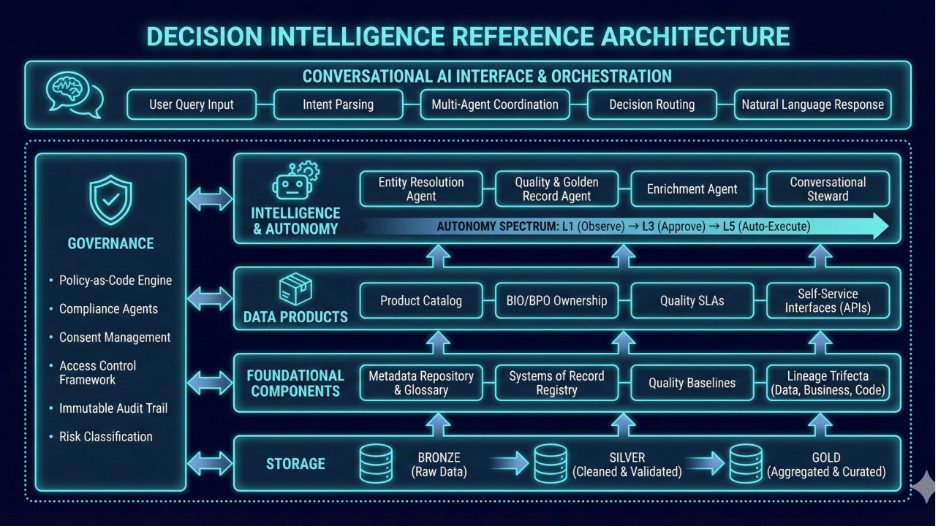
Why Executive Copilots Depend on Data Quality and Governance
No amount of AI sophistication can compensate for unreliable data. In fact, executive copilots amplify data issues faster than any previous analytics system.
Critical foundations include:
- Automated data quality monitoring
- Strong master data management
- Clear ownership of data products
- Active metadata and lineage tracking
Without these, AI-powered decision making becomes a liability rather than an advantage.
This is why many enterprises are modernizing their data platforms before—or alongside—executive copilot initiatives.
Related reading: Unified Data Platform in 2026: How It Works, Why It Matters, and How Microsoft Fabric Enables It
The Role of Modern Analytics Platforms
Modern platforms such as unified data fabrics and lakehouse architectures enable copilots to reason across structured and unstructured data at scale.
Key capabilities include:
- Real-time analytics for time-sensitive decisions
- Integrated AI services for prediction and simulation
- Secure data sharing across business domains
- Native governance and compliance controls
For CTOs and data architects, platform selection is a strategic decision that shapes the long-term viability of AI copilots for enterprises.
How Techment Helps Enterprises Build Decision-Grade AI Copilots
From AI Ambition to Executive Impact – Techment partners with enterprises to move beyond experimentation and build decision-grade AI copilots that executives trust.
Our approach focuses on outcomes, not tools:
- Aligning AI copilots with enterprise strategy
- Designing scalable decision intelligence architectures
- Ensuring data quality, governance, and compliance
- Embedding copilots into executive workflows
We help organizations avoid common pitfalls by treating executive AI as a business capability, not a technology deployment.
Techment’s End-to-End Executive Copilot Framework
Techment supports enterprises across the full lifecycle:
Strategy & Readiness
We assess decision maturity, data readiness, and leadership objectives to define where AI copilots will deliver the highest strategic value.
Architecture & Platform Design
Our teams design modern analytics and AI architectures that support scalable, governed executive decision-making.
Implementation & Integration
We integrate copilots with enterprise systems, ensuring real-time access to trusted data and contextual intelligence.
Governance & Optimization
We establish operating models, governance frameworks, and continuous improvement processes to keep copilots aligned with evolving strategy.
Related reading: Microsoft Fabric AI Solutions for Enterprise Intelligence
Conclusion
In 2026, AI Copilots for executive decision-making are no longer optional innovations—they are becoming foundational to how enterprises compete, adapt, and lead. As uncertainty accelerates and strategic windows narrow, executives need more than data. They need intelligence that reasons with them, challenges assumptions, and illuminates consequences.
The enterprises that succeed will be those that approach AI-powered decision making with discipline and intent—grounding copilots in trusted data, robust governance, and human judgment. Those that chase speed without structure will struggle to trust the very systems they deploy.
For CTOs, CDOs, and executive leaders, the question is no longer whether to adopt AI copilots, but how to build them responsibly, strategically, and at enterprise scale. With the right foundations and partners, AI copilots can become one of the most powerful leadership enablers of the decade.
Frequently Asked Questions (FAQ)
Are AI copilots replacing executive decision-making?
No. AI copilots augment executive judgment by providing faster, deeper insights, but accountability and final decisions remain human responsibilities.
How long does it take to implement an executive AI copilot?
Initial pilots can take 8–12 weeks, but enterprise-scale, decision-grade copilots typically evolve over 6–12 months.
What skills do executives need to work effectively with AI copilots?
Executives need decision literacy—understanding AI reasoning, limitations, and when to challenge or override recommendations.
Do AI copilots work across industries?
Yes, but they must be tailored. Industry context, regulatory requirements, and decision dynamics significantly influence copilot design.
What is the biggest risk in executive AI adoption?
Treating copilots as generic tools rather than strategic decision systems aligned to enterprise objectives.
Related Reads