
Why Agentic AI Is the Next Enterprise Inflection Point
Enterprise AI is entering a decisive new phase.
For years, organizations pursued efficiency through automation, analytics, and conversational AI. Robotic Process Automation reduced manual work but struggled with exceptions. Generative AI improved how employees searched, wrote, and interacted with systems but rarely completed real business processes end to end.
6 Agentic AI use cases represent a fundamental shift in how work gets done.
Instead of automating isolated tasks, agentic AI systems are designed to understand objectives, decompose goals, orchestrate actions across multiple enterprise platforms, and adapt dynamically when conditions change. These autonomous AI agents do not simply assist humans—they execute real operational work within clearly defined governance boundaries.
Across IT operations, HR service delivery, finance operations, cybersecurity, and customer service, enterprises are deploying agentic AI to eliminate coordination overhead that previously required constant human involvement. The result is faster execution, lower operational cost, and more predictable outcomes.
According to Gartner, autonomous and agent-based AI systems are expected to be among the most impactful enterprise technologies of the next decade as organizations move from AI-assisted work to AI-executed workflows (source: Gartner AI research – outbound reference:
This blog provides a deep, enterprise-focused exploration of agentic AI use cases, how agentic AI differs from traditional automation and generative AI, and how enterprises can scale autonomous AI responsibly.
TL;DR Summary
- Agentic AI use cases move beyond automation to enable autonomous enterprise execution
- AI agents reason, plan, execute, and adapt across multiple systems
- Enterprises are deploying agentic AI in IT, HR, finance, security, and customer service
- Governance, policy boundaries, and observability are critical for safe autonomy
- Agentic AI is becoming foundational to the autonomous enterprise operating model
What Is Agentic AI?
Agentic AI refers to AI systems capable of autonomously executing multi-step actions toward a defined business goal.
Unlike traditional automation, which follows rigid scripts, or generative AI, which produces outputs without execution, agentic AI systems possess agency—the ability to decide how to complete work and then act across enterprise systems.
An agentic AI system can receive an objective such as “resolve this access issue,” “complete employee onboarding,” or “close this customer case,” and independently determine the required steps, tools, and sequence of actions.
Related Insight: Get a clear, enterprise-grade comparison of agentic vs copilot AI, grounded in process maturity, risk tolerance, and operational readiness.
Core Capabilities of Agentic AI
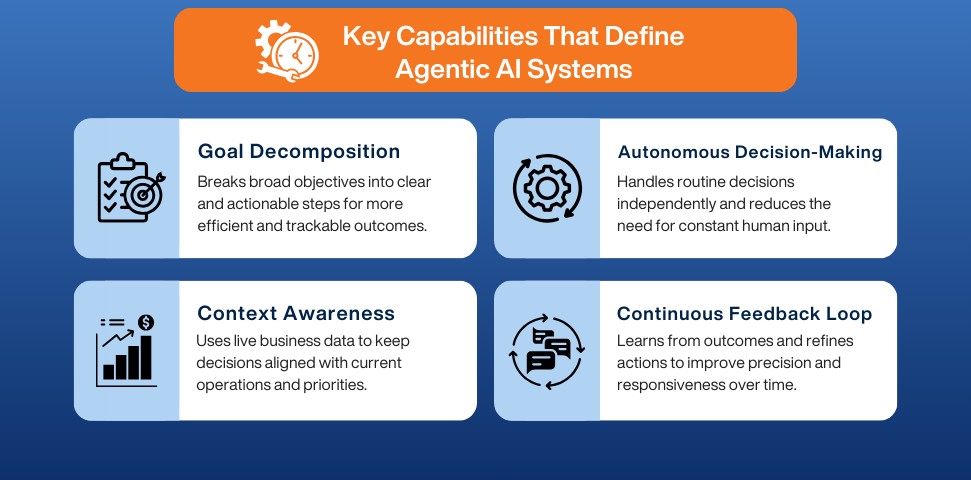
Goal Decomposition
Agentic AI systems break complex objectives into smaller, executable tasks. This allows them to handle workflows that span departments and platforms.
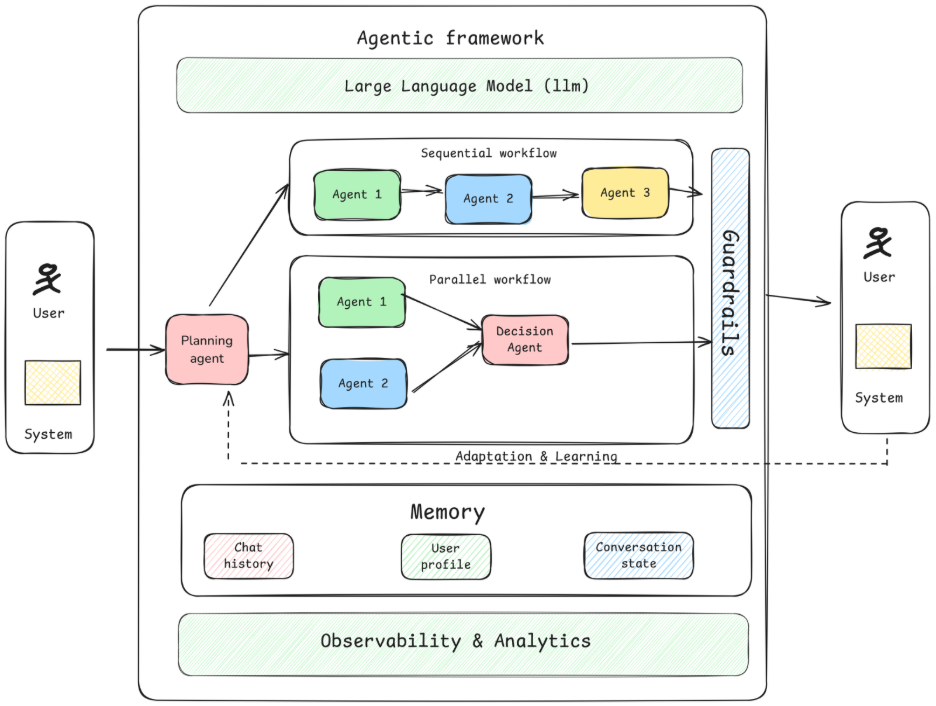
Reasoning and Planning – Unlike rule-based automation, agentic AI reasons about the current state, evaluates options, and plans the optimal execution path.
Tool and System Orchestration – Agents interact directly with enterprise systems—ITSM platforms, ERP systems, identity providers, CRM tools, and cloud services—via APIs and workflows.
Continuous Feedback and Adaptation – Agentic AI monitors outcomes, detects failures or exceptions, and replans dynamically to ensure completion.
Policy and Context Awareness – Enterprise policies, security rules, and compliance constraints are embedded into agent behavior, ensuring safe autonomy.
Together, these capabilities allow agentic AI to operate as a digital enterprise operator, not just an assistant.
Related Insights: Learn how we enable organizations to operationalize AI through RAG architectures and autonomous AI Agents that are secure, governed, and actionable at scale.
Why Agentic AI Matters for the Enterprise
Enterprise work is inherently cross-functional and fragmented.
A single business request often requires coordination across multiple systems of record. For example, onboarding a new employee may involve HR platforms, identity systems, device provisioning tools, finance approvals, and facilities access.
Traditional automation fails in these environments because:
- Workflows break when exceptions occur
- Data is fragmented across systems
- Manual handoffs slow execution
- Humans must coordinate between tools
Agentic AI use cases directly address this coordination challenge.
By acting as a unifying intelligence layer, agentic AI ensures continuity across systems. Instead of automating one step at a time, AI agents manage entire workflows from initiation to resolution.
Enterprise-Level Benefits of Agentic AI
- Reduced operational overhead by eliminating manual coordination
- Faster service delivery through autonomous execution
- Improved accuracy and compliance via policy-aware actions
- Higher employee and customer satisfaction
For leadership teams, agentic AI enables a shift from reactive operations to predictable, outcome-driven execution.
Related Insight: Explore what defines an AI-First Enterprise, how Copilot and intelligent business apps transform workflows, and how Techment helps organizations chart their roadmap from pilot to scale.
Agentic AI vs Traditional Automation vs Generative AI
Understanding how agentic AI use cases differ from existing technologies is critical for enterprise adoption.
Traditional Automation
Traditional automation tools execute predefined scripts. They work well for stable, repeatable tasks but fail when conditions change. Exceptions require manual intervention, limiting scalability.
Generative AI
Generative AI excels at producing text, code, summaries, and insights. However, it typically operates in an advisory capacity. Humans still execute actions across systems.
Agentic AI
Agentic AI combines reasoning, planning, and execution. It adapts to real-world complexity, handles exceptions, and orchestrates actions across multiple platforms with minimal human involvement.
This makes agentic AI uniquely suited for enterprise environments where ambiguity and exceptions are common.
| Capability | Traditional Automation | Generative AI | Agentic AI |
| Goal decomposition | ❌ | ❌ | ✅ |
| Dynamic reasoning | ❌ | ⚠️ Limited | ✅ |
| Multi-system execution | ⚠️ | ❌ | ✅ |
| Exception handling | ❌ | ❌ | ✅ |
| Policy enforcement | ⚠️ | ❌ | ✅ |
Related Insights: For a deeper perspective on aligning AI initiatives with enterprise strategy, see Techment’s guide on Enterprise AI Strategy in 2026.
High-Impact Real-World Applications of Agentic AI
Use Case 1: Agentic AI in IT Operations
IT teams face relentless pressure from service requests, access issues, and incident management. Despite modern ITSM platforms, human effort is still required to triage, coordinate, and resolve issues.
Agentic AI use cases are transforming IT operations from reactive to autonomous.
Key IT Agentic AI Use Cases
Autonomous Incident Resolution
Agentic AI continuously monitors infrastructure and applications, correlates alerts across monitoring tools, identifies root causes, and executes remediation actions such as restarting services, updating configurations, or rolling back deployments.
Policy-Driven Access Provisioning
When employees change roles or join the organization, AI agents automatically provision or revoke access across identity systems, SaaS platforms, and data environments based on enterprise policies.
Self-Service Technical Support
Through conversational interfaces, agentic AI diagnoses issues and executes fixes such as password resets, device compliance checks, or VPN configuration updates.
Change Validation and Rollback
Agents monitor post-change metrics and automatically roll back changes if anomalies are detected.
The result is reduced ticket volume, faster resolution times, and IT teams freed to focus on strategic modernization initiatives.
Related Insight: For a deeper dive into scalable automation foundations, reference Techment’s perspective on Manual Data Quality Checks vs Automation.
Use Case 2: Agentic AI in Human Resources
HR organizations manage high volumes of policy-driven interactions that are structured but coordination-heavy. Manual workflows slow response times and introduce inconsistencies.
Agentic AI use cases enable HR to scale service delivery without scaling headcount.
Top HR Agentic AI Use Cases
Autonomous Employee Self-Service
AI agents answer benefits, PTO, and policy questions using contextual employee data such as role, location, and tenure.
End-to-End Onboarding Orchestration
Agentic AI coordinates onboarding tasks across HR systems, IT provisioning tools, payroll platforms, and facilities management systems—ensuring a seamless first-day experience.
Policy Interpretation and Eligibility Checks
Agents apply complex HR rules consistently across geographies and employment types, reducing errors and compliance risk.
By eliminating operational friction, HR leaders can redirect effort toward talent development, workforce planning, and employee engagement.
Use Case 3: Agentic AI in Finance
Finance functions require precision, compliance, and auditability, yet many processes remain manual and fragmented across systems.
Agentic AI use cases introduce autonomous control into finance operations.
High-Value Finance Agentic AI Use Cases
Autonomous Invoice Processing
AI agents extract invoice data, validate against contracts and purchase orders, route approvals, and flag anomalies automatically.
Automated Expense Management
Agents assemble compliant expense reports from receipts and transactions while enforcing policy rules in real time.
Real-Time Financial Insights
Executives receive instant answers to budget, accrual, and spend questions directly from ERP systems without manual analysis.
These capabilities reduce close-cycle delays, improve financial visibility, and enhance compliance.
Use Case 4: Agentic AI in Security Operations
Enterprise security operations are defined by speed, scale, and complexity. Security teams must monitor thousands of signals across endpoints, identities, networks, cloud workloads, and SaaS platforms—often with limited human capacity. Traditional SOAR tools automate responses only when conditions are predictable. Anything ambiguous requires manual triage.
Agentic AI use cases fundamentally change the security operating model.
Instead of static playbooks, agentic AI systems reason over context, correlate signals across tools, and autonomously execute containment and remediation actions while remaining within strict governance boundaries.
Core Security Agentic AI Use Cases
Autonomous Anomaly Detection
Agentic AI continuously analyzes behavioral patterns across users, devices, and workloads. When deviations occur, agents evaluate risk in context rather than triggering isolated alerts.
Intelligent Alert Triage and Prioritization
Instead of flooding analysts with low-value alerts, agentic AI correlates signals across SIEM, IAM, EDR, and cloud security platforms to surface only high-confidence threats.
Cross-System Incident Response
Once a threat is validated, agents can disable compromised accounts, isolate endpoints, rotate credentials, and update firewall rules—coordinating actions across security tools autonomously.
Adaptive Policy Enforcement
Security policies are enforced dynamically based on real-time risk context, such as user behavior, device posture, or geolocation anomalies.
For CISOs, these agentic AI use cases reduce mean time to detect (MTTD) and mean time to respond (MTTR) while preserving analyst oversight for critical decisions.
Related Insights: Read our blog that explores how AI copilots for enterprises are transforming executive leadership in 2026.
Use Case 5: Agentic AI in Customer Service Operations
Customer service has long been an early adopter of AI, but most deployments stop at chatbots and routing automation. These systems assist customers but rarely resolve issues end to end.
Agentic AI use cases enable true resolution, not just conversation.
Agentic AI systems can understand customer intent, gather context across systems, execute actions, and confirm outcomes—all without human intervention for common scenarios.
High-Impact Customer Service Agentic AI Use Cases
Autonomous Case Classification and Resolution
Agents analyze incoming requests, determine intent, retrieve relevant customer context, and execute resolutions such as refunds, account updates, or order modifications.
Customer Context Aggregation
Agentic AI automatically assembles CRM history, transaction data, prior tickets, and sentiment signals, eliminating manual context gathering.
Proactive Issue Prevention
By monitoring usage patterns and sentiment, agents can proactively reach out to customers before issues escalate or churn risk increases.
Omnichannel Continuity
Agentic systems maintain context across chat, email, voice, and self-service channels, ensuring seamless customer experiences.
These agentic AI use cases reduce ticket volumes, improve first-contact resolution, and elevate customer satisfaction while lowering service costs.
Use Case 6: Agentic AI for Workplace Productivity
Agentic AI is quickly becoming the digital teammate every employee wishes they had. Instead of simply assisting with isolated tasks, agentic systems actively coordinate workflows, retrieve knowledge, and execute operational actions across enterprise systems.
Agentic AI use cases in the workplace are already transforming how teams in finance, HR, IT, and marketing operate. According to industry research, nearly one-third of organizations consider workplace AI among their highest-priority deployments because of its potential to accelerate productivity and decision-making.
Agentic systems work by understanding user intent, accessing enterprise data sources, and autonomously completing multi-step processes that previously required manual coordination.
High-Impact Workplace Agentic AI Use Cases
Autonomous Meeting Coordination
Agentic AI systems analyze team calendars, resolve scheduling conflicts, and automatically propose optimized meeting slots. If a key stakeholder becomes unavailable, the agent can reprioritize participants, suggest alternative times, and send updated invitations without manual intervention.
Enterprise Meeting Intelligence
Agentic platforms can manage the entire meeting lifecycle—from agenda preparation and document gathering to capturing decisions and tracking action items. These agents help leadership teams ensure that discussions translate into measurable outcomes.
AI-Powered HR Support
Agentic AI systems streamline employee onboarding, HR inquiries, and compliance processes. Agents can retrieve benefits information, update HRMS records, and escalate complex questions while delivering personalized responses to employees.
Enterprise Knowledge Retrieval
Employees can ask natural language questions and receive contextual answers drawn from company wikis, CRM systems, communication platforms, and policy documentation. Agentic AI significantly reduces time spent searching for internal information while improving operational efficiency.
Intelligent Procurement Workflows
Agentic systems can triage sourcing requests, identify preferred suppliers, validate contracts, and guide procurement teams through policy-compliant purchasing decisions while maintaining real-time visibility into cost, risk, and supplier performance.
These agentic AI use cases help organizations eliminate operational friction, reduce administrative workloads, and allow employees to focus on strategic, high-impact work rather than routine coordination tasks.
Related Insights: Enterprise AI Strategy in 2026: A Practical Guide for CIOs and Data Leaders
Use Case 7: Agentic AI for Business Process Optimization
Business process automation has long been a priority for enterprises, but traditional automation often struggles with dynamic decision-making and cross-system orchestration. Most legacy automation tools rely on predefined rules and static workflows that require human intervention when conditions change.
Agentic AI use cases introduce a new model of operational intelligence. Instead of simply executing scripted tasks, agentic systems can interpret signals, coordinate multiple systems, and autonomously resolve operational events across complex workflows.
Industry data shows that process optimization is one of the most valuable enterprise applications of AI, with many organizations prioritizing it as a core transformation initiative. Agentic AI systems act as orchestration layers that continuously monitor operations, diagnose issues, and execute corrective actions in real time.
High-Impact Agentic AI Use Cases for Business Process Optimization
Autonomous DevOps Pipeline Management
Agentic systems can manage complex CI/CD pipelines by reviewing code changes, running automated tests, triggering deployments, and identifying release risks. If a deployment fails during staging or production, the agent can isolate the faulty component, roll back the build, notify the engineering team, and initiate corrective workflows. This helps engineering teams maintain rapid release cycles while minimizing disruption.
Intelligent Supply Chain Coordination
Agentic AI can monitor inventory levels, demand patterns, logistics constraints, and supplier performance in real time. When disruptions occur—such as shipment delays, demand spikes, or supplier shortages—agents can automatically reroute logistics, adjust procurement schedules, and rebalance inventory across distribution centers. This level of orchestration improves supply chain resilience while reducing operational costs.
Automated Compliance and Audit Preparation
Agentic AI systems can interpret regulatory frameworks, continuously scan enterprise systems for compliance gaps, and automatically generate audit-ready documentation. If new regulatory policies are introduced, the agent can analyze existing data assets, flag non-compliant records, and recommend remediation actions. This reduces compliance risk while eliminating last-minute audit preparation.
Autonomous Quality Assurance Monitoring
In manufacturing and production environments, agentic AI can analyze sensor streams, production metrics, and quality test results to detect anomalies early in the lifecycle. When deviations occur, agents can adjust production parameters, trigger quality checks, and reroute workflows to prevent defective outputs. This ensures consistent product quality while minimizing operational waste.
These agentic AI use cases position AI as the silent orchestrator behind enterprise operations—continuously monitoring systems, resolving disruptions, and enabling organizations to operate with greater efficiency, agility, and resilience.
Enterprise Architecture for Agentic AI
Scaling agentic AI use cases requires more than deploying individual agents. Enterprises must design a supporting architecture that balances autonomy with control.
Key Architectural Components
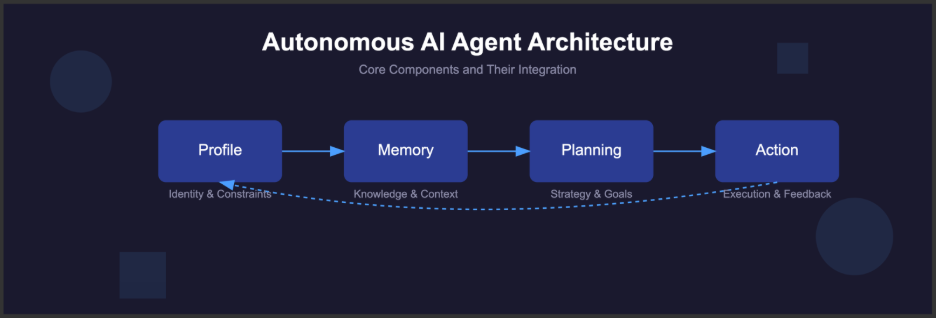
Agent Orchestration Layer
Coordinates multiple agents, manages task dependencies, and ensures consistent execution across workflows.
Enterprise Integration Fabric
Provides secure, governed access to systems of record such as ERP, CRM, HRIS, ITSM, and identity platforms.
Policy and Guardrail Engine
Encodes business rules, security constraints, approval thresholds, and escalation paths that govern agent behavior.
Observability and Audit Layer
Captures agent decisions, actions, and outcomes to support compliance, explainability, and continuous improvement.
Human-in-the-Loop Interfaces
Enable human review, override, and intervention for high-risk or ambiguous scenarios.
Without this foundation, agentic AI initiatives risk becoming fragmented or unsafe at scale.
Related Insights: Data Quality for AI: The Ultimate 2026 Blueprint for Trustworthy & High-Performing Enterprise AI
Operating Model Implications of Agentic AI
Agentic AI does not simply augment existing processes—it reshapes enterprise operating models.
From Task Ownership to Outcome Ownership
Instead of assigning humans to tasks, enterprises define desired outcomes and allow agents to determine execution paths.
From Manual Coordination to Policy-Driven Autonomy
Coordination logic moves from people into policy engines that guide agent behavior.
From Exception Handling to Exception Learning
Each exception handled by an agent becomes training data for future improvement.
New Roles Emerge
- AI operations managers
- Agent governance leads
- Policy and risk architects
Organizations that fail to adapt operating models often struggle to realize full ROI from agentic AI use cases.
Related Insight: Is Your Enterprise AI-Ready? A Fabric-Focused Readiness Checklist
Governance, Risk, and Compliance for Agentic AI
Autonomy without governance creates risk. Enterprises must embed trust mechanisms from day one.
Core Governance Principles
Explicit Autonomy Boundaries – Clearly define which actions agents can execute independently and which require human approval.
Policy Transparency – Ensure agent decisions are explainable and traceable to business rules.
Auditability – Maintain comprehensive logs of agent actions for compliance and forensic analysis.
Access Control and Least Privilege – Agents should have only the permissions required for their assigned objectives.
Ethical and Regulatory Alignment – Agentic AI must comply with data privacy, security, and industry regulations.
Strong governance is what enables enterprises to scale agentic AI use cases confidently.
Related Insight: For real-world examples of copilots embedded into enterprise platforms, see Techment’s work on Conversational AI on Microsoft Azure.
Measuring ROI from Agentic AI Use Cases
The business value of agentic AI is best measured across four dimensions:
1. Time Efficiency
- Reduced resolution times
- Faster onboarding and service delivery
2. Cost Reduction
- Lower manual effort
- Reduced rework and escalations
3. Quality and Compliance
- Fewer errors
- Improved audit outcomes
4. Experience
- Higher employee productivity
- Improved customer satisfaction
Enterprises see the strongest ROI where coordination—not decision quality—was the primary bottleneck.
| Dimension | Metric | Expected Impact |
| Time | MTTR | 30–60% reduction |
| Cost | Manual effort | 25–40% reduction |
| Quality | Error rates | 20–35% improvement |
| Experience | CSAT | 10–20% lift |
The Future of Agentic AI in the Enterprise
Agentic AI is evolving rapidly toward multi-agent ecosystems, where specialized agents collaborate across domains.
Future-state enterprises will treat agentic AI as:
- Core operational infrastructure
- A digital workforce operating alongside humans
- A continuous optimization engine for enterprise execution
As highlighted by leading industry analysts, autonomous AI systems will increasingly underpin enterprise competitiveness in the next decade.
The organizations that succeed will be those that design for autonomy with control, align agent behavior with business policy, and invest in long-term governance frameworks.
Related reading: Microsoft Fabric Architecture: A CTO’s Guide to Modern Analytics & AI
Conclusion: Agentic AI as the Foundation of the Autonomous Enterprise
Agentic AI use cases mark the transition from automation that assists to intelligence that acts.
By enabling systems to reason, plan, and execute across the enterprise, agentic AI unlocks a new operating model—one where work flows end to end, outcomes are predictable, and humans focus on strategy rather than coordination.
For enterprises ready to move beyond AI pilots and fragmented automation, agentic AI is no longer experimental. It is the foundation of the autonomous enterprise.
The question is no longer if enterprises will adopt agentic AI use cases—but how quickly they will operationalize them at scale.
Related Insights: To understand what a strategic data and AI partner brings, explore What a Microsoft Data and AI Partner Brings to Your Data Strategy.
FAQs on Agentic AI Use Cases
1.How is agentic AI different from RPA?
RPA follows static scripts. Agentic AI reasons, adapts, and orchestrates actions dynamically across systems.
2. Can agentic AI coexist with existing automation?
Yes. Agentic AI often orchestrates RPA bots, APIs, and workflows rather than replacing them.
3. What governance is required for agentic AI?
Clear policies, auditability, human-in-the-loop controls, and least-privilege access.
4. Which teams benefit first from agentic AI use cases?
IT, HR, finance, security, and customer service typically see the fastest ROI.
5.What are agentic AI use cases in enterprise operations?
Unlike traditional automation, agentic AI orchestrates actions across IT, HR, finance, security, and customer service platforms while adapting dynamically to exceptions and policy constraints.
Frequently Asked Questions
How is agentic AI different from RPA?