Enterprise data is growing faster than accuracy can keep up. As data ecosystems become more complex, traditional rules-based approaches to data quality management are failing to detect errors, maintain consistency, and ensure trustworthy insights at scale. The result is disconnected systems, unreliable analytics, compliance exposure, and AI models trained on flawed data.
This is where AI in data quality management changes the equation.
By combining adaptive data quality, machine learning, and real-time automation, organizations can continuously monitor, correct, and improve data accuracy across distributed environments. AI not only detects anomalies faster—it understands context, strengthens data connectivity, and prevents quality issues before they impact decisions.
In this guide, we break down how AI improves data quality accuracy, what enterprise teams should look for in AI-based data quality tools, and how automation is reshaping data governance, compliance, and operational trust in 2026 and beyond.
AI in data quality management Tranforming Enterprises
In the digital battleground of 2026, data is not just an asset—it’s the ultimate weapon. The quality of business insights hinges on how well the data is organized, cleansed, and kept ready for action. With global data volumes expected to reach a staggering 181 zettabytes by 2025, organizations face the critical challenge of how to ensure data quality. With 95% of businesses recognizing data quality as critical to their digital transformation efforts, artificial intelligence (AI) is no longer an optional upgrade—it’s a mission-critical necessity.
In this deep-dive exploration, we’ll unravel how AI is reshaping data quality management (DQM), offering enterprises unprecedented insights, efficiency, and a competitive edge in the data-driven landscape of 2025 and beyond.
TLDR
- The economic impact of AI in data quality management challenges
- How AI is revolutionizing data governance
- Practical strategies for implementing AI-driven data management
- Real-world case studies of transformative data intelligence
Why Data Quality Fails at Enterprise Scale
Enterprise data environments are no longer centralized or predictable. Data flows across cloud platforms, SaaS tools, legacy systems, APIs, and partner ecosystems—often in real time. As scale increases, traditional data quality processes fail to keep pace with volume, velocity, and variety.
Manual checks, static validation rules, and periodic audits were not designed for distributed architectures or continuous data ingestion. This leads to blind spots where errors propagate unnoticed across analytics, reporting, and AI models.
Cost of Poor Data Quality
Poor data quality is not just a technical issue—it is a measurable business liability. Enterprises routinely lose millions annually due to inaccurate reporting, rework, delayed decisions, and failed automation initiatives. Operational inefficiencies increase as teams spend time reconciling data instead of acting on insights.
In AI-driven environments, low-quality data compounds risk by producing unreliable predictions, biased outcomes, and unstable models—directly undermining ROI from analytics and machine learning investments.
Compliance, Revenue, and Trust Risks
Inaccurate or incomplete data exposes organizations to regulatory violations, especially in industries with strict data governance requirements. Reporting errors, missing audit trails, and inconsistent records increase compliance risk while eroding internal and external trust.
Over time, persistent data quality issues damage customer confidence, slow innovation, and weaken decision-making at the executive level.
What Is Adaptive Data Quality?
Adaptive data quality is an AI-driven approach to maintaining data accuracy, consistency, and reliability in dynamic environments. Unlike static rule-based systems, adaptive data quality continuously learns from data patterns, usage behavior, and historical outcomes.
Instead of enforcing fixed thresholds, adaptive systems adjust quality checks in real time based on context, data source behavior, and downstream impact.
Why Static Rules No Longer Work
Static rules assume stable data structures and predictable inputs—conditions that rarely exist in modern enterprises. As schemas change, sources evolve, and data volumes fluctuate, fixed rules generate false positives or miss critical anomalies entirely.
Adaptive data quality replaces rigidity with intelligence, allowing quality controls to evolve alongside the data ecosystem.
Importance of AI In data quality management
It is no coincidence that data professionals are investing heavily in data preparation and quality as poor data quality can derail strategic decisions, lead to compliance issues, and even hurt customer trust. According to reports, poor data quality is a $3.1 trillion annual drain on the US economy, with enterprises losing up to 20-30% of their revenue due to data-related inefficiencies. companies an average of $12.9 million every year. It can be a silent but significant business risk to rely on inaccurate or incomplete data.
Traditional data management approaches are rapidly becoming obsolete. The new paradigm demands intelligent, adaptive systems that can not only detect and cleanse data in real-time but also predict and prevent data quality issues before they emerge. AI’s ability to process massive datasets, detect patterns, and automate tasks is transforming data quality management and data governance. No wonder, that the AI in data quality management market is projected to hit $30.5 billion by 2026 as organizations turn to it for integrating AI data governance into enterprise data management strategy.
The Role of AI in Data Quality Management – Benefits of AI Automation
AI’s role in data governance and data quality management extends beyond operational efficiency. It drives better decision-making, fosters innovation, and strengthens compliance with ever-evolving data privacy regulations like GDPR and CCPA. It’s essential to understand the broader benefits AI offers to data quality management and governance.
Scalability: AI in data quality management solutions can handle vast data sets with ease, making them scalable for businesses that continue to grow in size and data complexity.
Increase in Efficiency: AI in data quality management helps automate repetitive tasks such as data cleansing, validation, and profiling, freeing up valuable human resources and accelerating workflows.
Improvement in Accuracy: Human errors in manual data management can lead to significant costs. AI in data quality management ensures accuracy by automatically identifying and resolving inconsistencies in real time.
Cost Reduction: AI in data quality management lowers the cost of managing and maintaining high-quality data by reducing human intervention and minimizing errors. According to McKinsey & Company, businesses using AI in quality control have seen at least a significant reduction in product defects and improved quality.
How AI In Data Quality Management Improves Accuracy and Connectivity
AI in data quality management is monitored, enforced, and improved across enterprise systems.
Pattern Detection
Machine learning models analyze historical and real-time data to detect anomalies, inconsistencies, and outliers that traditional checks cannot identify. These models recognize subtle patterns that signal quality degradation before it impacts reporting or analytics.
Cross-System Data Alignment
AI improves data connectivity by mapping relationships across disparate systems. It identifies mismatches in identifiers, formats, and semantics—ensuring that data remains consistent as it moves between platforms, applications, and domains.
AI Accuracy Monitoring
Rather than relying on periodic audits, AI enables continuous accuracy monitoring. Quality metrics are evaluated in real time, allowing teams to intervene proactively instead of reacting after errors surface downstream.
Traditional methods of data quality management often fall short when handling the scale and complexity of modern data ecosystems. AI in data quality management address these limitations by combining cutting-edge technology with operational efficiency. Ensuring high-quality data is a complex process involving cleansing, validation, monitoring, and analytics. Here’s how AI redefines these processes:
- Automated Data Cleansing, Standardization and Validation: AI algorithms identify and correct errors in data sets, ensuring consistency without manual intervention.
- Real-Time Data Monitoring and Quality Assurance: AI enables continuous tracking of data flows, immediately flagging anomalies or inconsistencies.
- Predictive Analytics: By analyzing historical trends, AI anticipates potential data quality issues, allowing proactive measures.
- Data Governance and Compliance: AI automation streamline compliance by automatically verifying adherence to data governance policies and regulations. Thus it provides clear audit trails, ensuring transparency and accountability in data management practices.
AI and Machine Learning in Quality Management
AI and machine learning introduce automation and intelligence across the full data quality lifecycle.
Automated Cleansing and Validation
AI-driven automation standardizes formats, resolves duplicates, validates values, and corrects errors without manual intervention. This reduces human effort while increasing consistency across large datasets.
Predictive Quality Scoring
Machine learning models assign quality scores based on historical performance, usage patterns, and risk indicators. These scores help prioritize remediation efforts and guide governance decisions.
AI-Based Data Quality Tools and Automation
Modern AI-based data quality tools go beyond basic profiling and validation.
Core Capabilities Enterprises Should Evaluate
Enterprises should look for tools that offer:
-
Adaptive rule learning
-
Real-time anomaly detection
-
Cross-system lineage visibility
-
AI-driven root cause analysis
-
Scalable automation across data pipelines
These capabilities enable continuous quality enforcement rather than reactive fixes.
Real-Time vs Batch Quality Enforcement
Batch-based quality checks are insufficient for real-time analytics and AI workloads. AI-powered systems support both modes—enforcing quality controls instantly where needed while maintaining batch oversight for historical data.
AI-Driven Data Governance and Compliance
AI strengthens data governance by embedding quality and compliance controls directly into data workflows.
Policy Enforcement
AI automates the enforcement of governance policies by continuously validating data against defined standards. Violations are flagged instantly, reducing reliance on manual reviews.
Audit Readiness
With AI-generated logs and traceability, organizations maintain clear audit trails. This simplifies regulatory reporting and improves transparency across data operations.
Regulatory Alignment
AI-driven governance adapts to evolving regulations by updating controls dynamically—helping enterprises stay compliant without disrupting operations.
Industry Use Cases for AI Quality Management
Retail AI Assurance
In retail environments, AI ensures product, pricing, and customer data remain accurate across channels. This improves personalization, inventory planning, and demand forecasting while reducing operational errors.
Financial Services Compliance
Financial institutions use AI to validate transactional data, monitor anomalies, and ensure reporting accuracy. Continuous quality checks reduce compliance risk and improve confidence in regulatory submissions.
Telecom and Large-Scale Data Operations
Telecom providers rely on AI to manage massive data volumes generated by networks and customers. AI-driven quality management improves network analytics, customer experience, and operational resilience.
Challenges in AI Data Quality Implementation
Data Privacy
AI systems require access to large datasets, increasing privacy and security concerns. Strong governance and access controls are essential to protect sensitive information.
Legacy Integration
Integrating AI with legacy systems can be complex due to outdated architectures and data silos. Successful adoption requires a phased approach and modernization strategy.
Skills Gap
AI-driven quality management demands expertise in data engineering, machine learning, and governance. Organizations must invest in upskilling to maximize value.
Best Practices for Adopting AI in Data Quality Management
Governance-First Approach
Define governance frameworks before deploying AI. Clear ownership, policies, and accountability ensure automation enhances trust rather than creating risk.
Tool Selection Criteria
Choose AI-based data quality tools that align with enterprise architecture, scale with data growth, and support adaptive learning—not just static rules.
Operating Model
Successful teams embed AI-driven quality checks into daily operations, data pipelines, and analytics workflows instead of treating quality as a separate initiative.
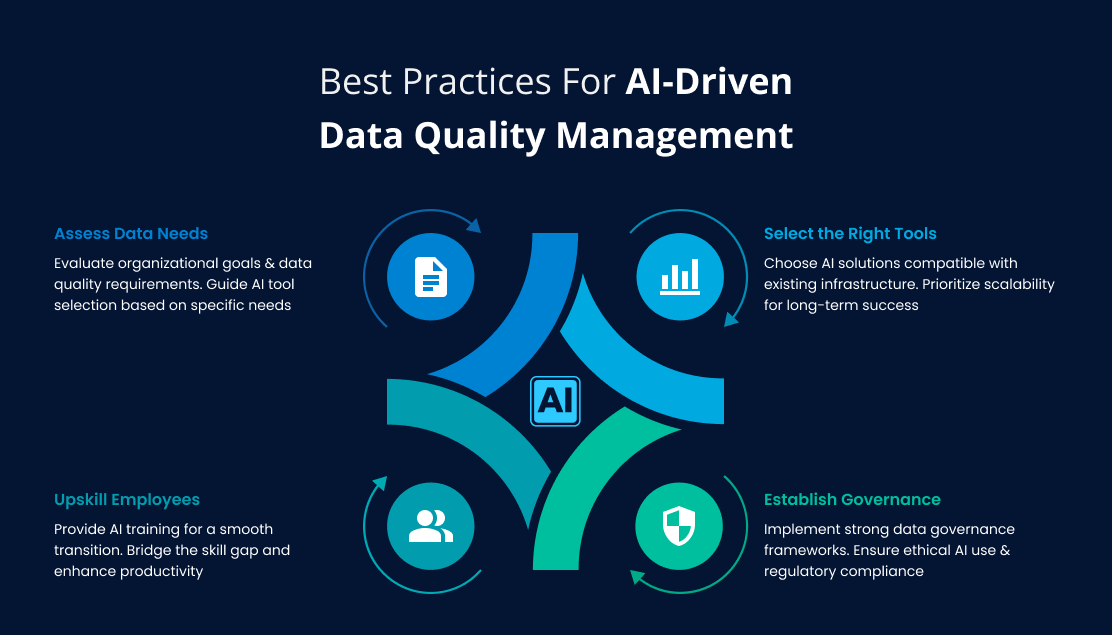
- Assess data needs – Evaluate your organizational objectives and data quality goals. Understanding the specific requirements of your business will guide the selection of appropriate AI tools and strategies. A study by Gartner suggests that organizations that regularly assess their data needs are 3.5 times more likely to achieve their data quality goals.
- Select the right tools – Choosing AI solutions that align with your existing infrastructure is vital for successful implementation. Compatibility and scalability should be at the forefront of your decision-making process. According to McKinsey, companies that carefully select AI tools see a 20% increase in operational efficiency.
- Upskill employees – Investing in employee training ensures a smooth transition to AI-powered tools. Providing comprehensive training programs helps bridge the skill gap and empowers your team to leverage AI effectively. A report by PwC highlights that companies that invest in upskilling their workforce experience a 15% boost in productivity.
- Establish governance – Implementing strong data governance frameworks is essential to ensure ethical AI use and regulatory compliance. Clear policies and procedures help maintain data integrity and build trust with stakeholders. The International Data Corporation (IDC) notes that robust data governance can reduce compliance costs by up to 30%.
Future Trends and Outlook: The Evolving Role of AI in Data Quality
The role of AI in data quality management is set to grow exponentially, driven by several key factors. Rapid advancements in AI algorithms and tools are paving the way for enhanced data management. Improved accuracy, speed, and efficiency are just a few benefits of the latest AI technologies. The global AI in data quality market is projected to reach $6.6 billion by 2033, growing at a CAGR of 22.10%. This growth reflects the increasing reliance on AI to drive data quality initiatives and improve overall business performance.
Adaptive Systems
Future systems will continuously learn from data behavior, automatically adjusting quality controls as environments change.
Self-Healing Data Pipelines
AI will not only detect issues but automatically correct them—rerouting data, fixing inconsistencies, and restoring accuracy without human intervention.
Trust-Based AI Assurance
As AI adoption accelerates, data quality will become the foundation of trust. Enterprises that invest in adaptive, AI-driven quality management will gain a lasting competitive advantage.
Conclusion
AI-powered automation is more than just a buzzword; it’s a transformative approach to ensuring data quality in the modern enterprise. By enhancing accuracy, driving cost efficiency, and simplifying data management, AI provides a significant competitive edge. As organizations continue to digitize, adopting AI in data quality management isn’t just an option—it’s a necessity.
Let’s discuss how AI can drive your business forward. Get in touch with us today!