Introduction: Why Agentic AI Orchestration Defines AI Success in 2026
In 2026, the enterprise AI conversation has fundamentally shifted. Organizations are no longer debating whether to adopt AI—they are deciding how to operationalize autonomy at scale. The breakthrough enabling this shift is agentic AI orchestration.
Single AI models generating content are yesterday’s story. Today’s competitive advantage comes from coordinated systems of AI agents that plan, reason, act, collaborate, and adapt across enterprise workflows. But without structured coordination, these agents become fragmented, expensive, and risky.
That is precisely why agentic AI orchestration has emerged as the critical control layer for scalable AI in 2026. It connects agents, manages memory and context, enforces governance, optimizes cost, and ensures accountability.
According to insights from Gartner, autonomous agents are among the most transformative technology trends shaping enterprise architecture. Meanwhile, McKinsey & Company estimates that AI-driven automation could unlock trillions in annual productivity—but only if deployed with operational discipline.
This blog examines:
- What agentic AI orchestration truly means
- Why it is central to AI tech stack readiness in 2026
- Core architectural components
- Framework landscape and trade-offs
- Governance, risks, and cost implications
- A strategic roadmap for enterprise implementation
For CTOs, CDOs, and AI platform leaders, the message is clear: AI autonomy without orchestration is chaos. Orchestration without strategy is waste. The future belongs to enterprises that master both.
TL;DR — Executive Snapshot
- Agentic AI orchestration is the control plane that enables scalable, governed multi-agent AI systems.
- Without orchestration, enterprises face agent sprawl, cost overruns, and governance failures.
- In 2026, orchestration determines AI tech stack readiness and enterprise-scale ROI.
- Leading frameworks include LangGraph, AutoGen, Semantic Kernel, and enterprise-native platforms.
- CTOs must treat orchestration as infrastructure—not experimentation.
The 2026 Reality: From AI Demos to Autonomous Enterprise Systems
The Post-Hype Inflection Point
Between 2023 and 2025, enterprises experimented heavily with generative AI pilots. Chatbots. Code assistants. Internal copilots.
By 2026, expectations have changed.
Boards now demand measurable ROI. CFOs scrutinize inference costs. CISOs demand traceability. Operations leaders expect resilience—not novelty.
This is where agentic AI orchestration becomes mission-critical.
Unlike isolated generative tools, agentic systems execute multi-step workflows:
- Diagnosing IT incidents
- Managing supply chain rerouting
- Coordinating software delivery pipelines
- Conducting compliance audits
- Handling end-to-end customer issue resolution
These workflows span systems, teams, APIs, and data layers. Without orchestration, agents operate in silos, duplicating tasks or losing context.
Complexity Is Rising Faster Than Control
Modern enterprise workflows now average 40–60 system touchpoints per process. Integration complexity increases annually, driven by:
- Hybrid cloud environments
- Microservices architectures
- Data mesh adoption
- API proliferation
- Security overlays
As highlighted in Techment’s Enterprise AI Strategy in 2026, scaling AI requires aligning data, governance, and infrastructure before automation expands.
Without agentic AI orchestration, enterprises face:
- Agent sprawl
- Inconsistent decisions
- Uncontrolled API usage
- Escalating compute bills
- Governance blind spots
Orchestration transforms distributed intelligence into coordinated capability.
What Is Agentic AI Orchestration? A Deep Architectural View
Beyond “AI Agents” — The Control Plane Concept
An AI agent is a goal-driven system that can:
- Plan tasks
- Use tools
- Make decisions
- Maintain context
- Reflect and adapt
But one agent alone cannot manage enterprise-scale processes.
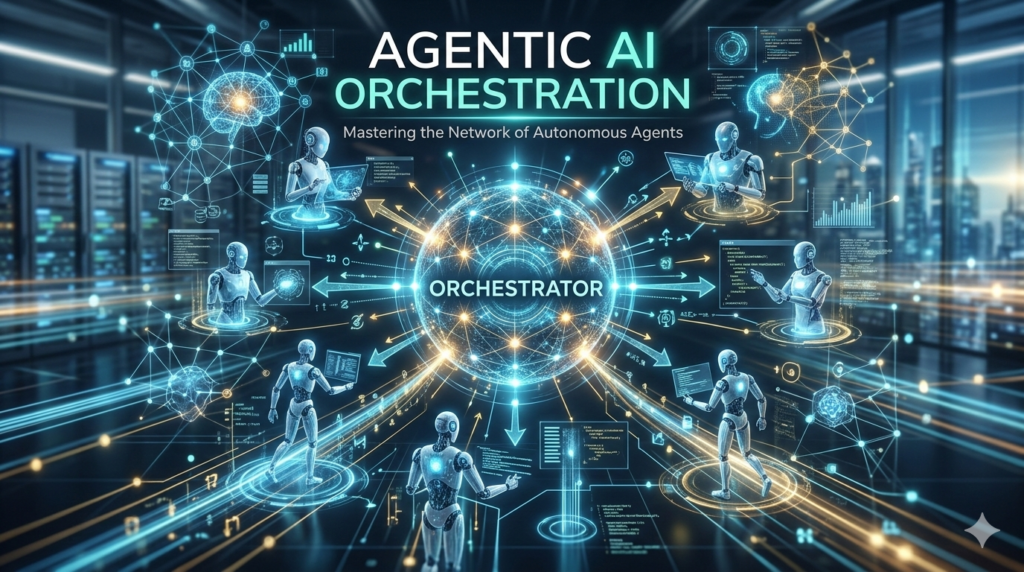
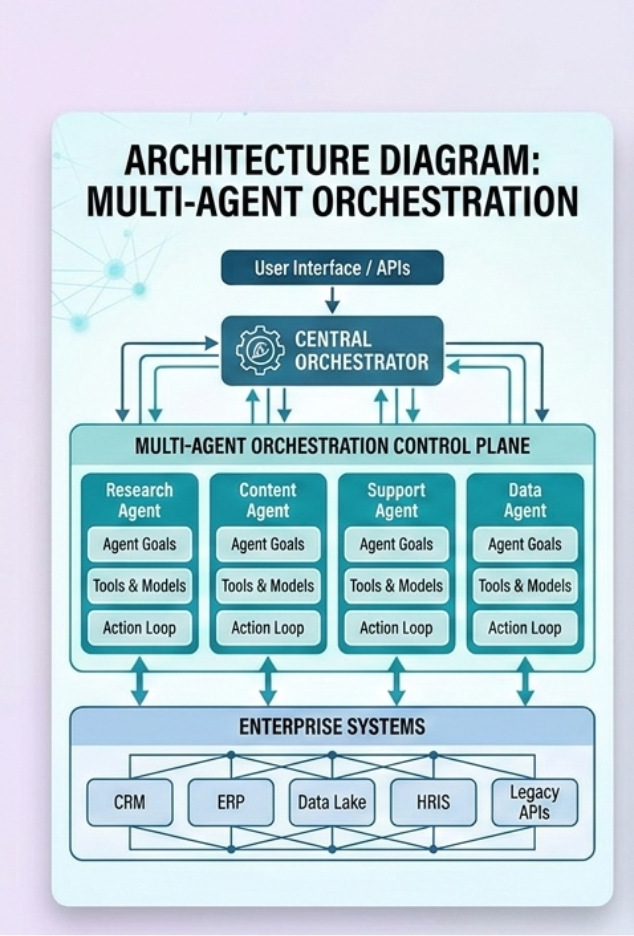
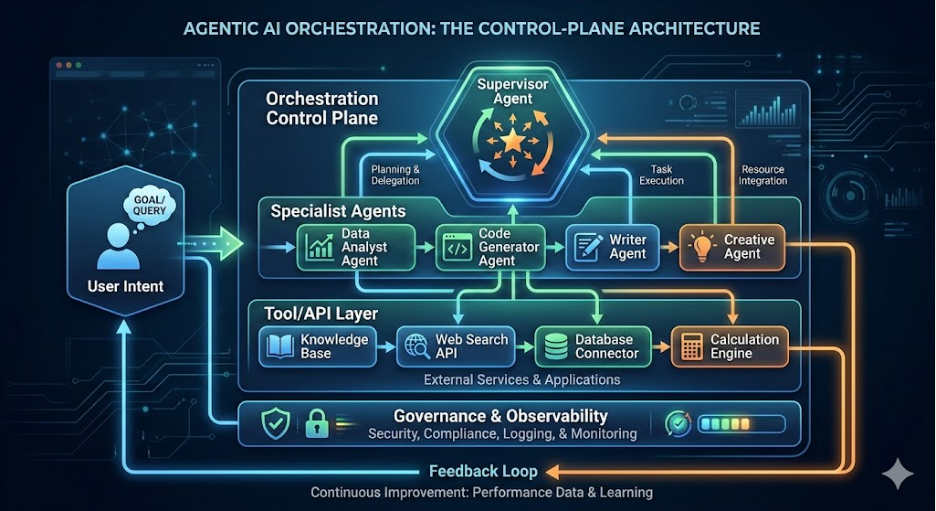
Agentic AI orchestration is the architectural control plane that:
- Coordinates multiple agents
- Manages task routing
- Preserves memory state
- Enforces policy
- Monitors performance
- Resolves conflicts
Think of it as air traffic control for AI autonomy.
Core Capabilities of Agentic AI Orchestration
1. Goal Decomposition & Planning
Breaks high-level objectives into executable subtasks.
2. Context & Memory Management
Combines short-term context windows with persistent knowledge stores.
3. Tool & API Integration
Securely connects agents to enterprise systems.
4. Multi-Agent Coordination Models
Hierarchical, collaborative, or swarm-based patterns.
5. Governance & Observability
Logging, policy enforcement, audit trails, and cost monitoring.
This orchestration layer determines whether AI becomes enterprise infrastructure—or remains experimentation.
For deeper context on AI readiness foundations, see Techment’s Fabric AI Readiness: How to Prepare Your Data for Scalable AI Adoption.
5 Core Architectural Components of Agentic AI Orchestration
1. Planning & Reasoning Engine
Modern frontier models enable inference-time scaling—allocating additional compute during reasoning steps. Orchestration frameworks leverage this to:
- Break tasks into dynamic plans
- Reflect on intermediate outputs
- Re-route failed subtasks
Without this capability, multi-agent systems degrade quickly.
2. Memory & State Layer
Enterprise workflows are not stateless.
Effective agentic AI orchestration integrates:
- Vector databases
- Knowledge graphs
- Structured data stores
- Conversation memory layers
This ensures agents retain context across sessions and systems.
3. Multi-Agent Coordination Patterns
Three dominant models in 2026:
Hierarchical:
Supervisor agent delegates to specialists.
Collaborative:
Peer agents negotiate and share context.
Dynamic Swarm:
Agents self-organize based on expertise.
Each has trade-offs in cost, latency, and control.
4. Tool Integration & Secure Execution
Protocols standardize function calling and tool access. Enterprise-grade orchestration must:
- Validate inputs
- Authenticate calls
- Enforce access controls
- Monitor outputs
This ties directly into governance frameworks outlined in Techment’s Data Governance for Data Quality.
5. Governance & Observability
AI decisions must be:
- Traceable
- Auditable
- Explainable
- Cost-accountable
According to a study, the primary differentiator between AI pilots and production‑grade deployments is talent maturity, not governance maturity. Their research shows that top-performing AI “front‑runners” have four times higher talent maturity than other organizations, making it the most critical factor in successfully scaling AI.
Explore how enterprise reliability improves with governance-forward architecture in our data governance solution offerings.
Top Agentic AI Orchestration Frameworks in 2026
The 2026 landscape includes both open-source innovation and enterprise-native platforms.
LangGraph
Graph-based orchestration for stateful workflows. Strong customization and deterministic control.
AutoGen (Microsoft)
Modular multi-agent conversations suitable for research-to-production transitions.
Semantic Kernel
Enterprise-aligned orchestration integrated with Azure ecosystems.
Google Agent Development Kit
Deep integration with Vertex AI and enterprise security frameworks.
CrewAI
Rapid role-based agent teams for prototyping and mid-scale applications.
Many enterprises adopt hybrid models—open frameworks for flexibility, enterprise platforms for compliance.
Get a clear, enterprise-grade comparison of agentic vs copilot AI, grounded in process maturity, risk tolerance, and operational readiness.
Why CTOs Must Treat Agentic AI Orchestration as Infrastructure
ROI Depends on Coordination
AI agents promise 10–20x productivity improvements in:
- Engineering
- Operations
- Finance
- Procurement
But without orchestration:
- Latency increases
- Redundant calls multiply
- Cost spirals
- Accountability fades
Governance Is Non-Negotiable
Uncontrolled agent behavior risks:
- Regulatory violations
- Data leakage
- Brand damage
- Financial exposure
IDC predicts that by 2026, 60% of AI failures will stem from governance gaps—not model performance.
Agentic AI orchestration embeds governance at execution level.
Get a deep, enterprise-focused exploration of agentic AI use cases, how agentic AI differs from traditional automation and generative AI, and how enterprises can scale autonomous AI responsibly.
A 7-Step Enterprise Roadmap to Implement Agentic AI Orchestration in 2026
Enterprise-scale agentic AI orchestration does not begin with tools. It begins with clarity.
CTOs who succeed in 2026 follow a phased, architecture-first roadmap that balances autonomy with governance.
Step 1: Map High-Impact Multi-Step Workflows
Start with workflows that:
- Span multiple systems
- Require decision-making across stages
- Have measurable KPIs
- Suffer from latency or coordination gaps
Ideal candidates include:
- Incident management
- Procurement approvals
- Customer support escalation
- DevOps CI/CD automation
- Regulatory compliance reporting
Without high-quality data inputs, autonomy becomes risky. Enterprises investing in Agentic AI must prioritize strong data foundations — as outlined in Data Quality for AI in 2026: The Ultimate Blueprint .
Step 2: Assess AI Tech Stack Readiness
Before deploying agentic AI orchestration, evaluate:
- Data quality maturity
- API availability
- Security frameworks
- Identity and access controls
- Observability systems
Without clean, governed data pipelines, orchestration magnifies chaos.
Step 3: Select a Governance-Ready Orchestration Framework
Framework choice should align with:
- Enterprise compliance requirements
- Engineering maturity
- Cloud ecosystem alignment
- Long-term extensibility
CTOs should evaluate:
- Control over agent decision trees
- Memory management flexibility
- Audit logging capabilities
- Cost monitoring integration
A hybrid stack often proves optimal—open frameworks for innovation, enterprise platforms for control.
Read Enterprise AI Strategy in 2026: A Practical Guide for CIOs and Data Leaders
Step 4: Design a Multi-Agent Architecture Blueprint
This stage defines:
- Agent roles
- Delegation patterns
- Memory structure
- Tool access policies
- Escalation thresholds
Step 5: Embed Observability from Day One
Key metrics to track:
- Task completion rate
- Average decision latency
- Cost per workflow
- Exception frequency
- Human intervention rate
According to McKinsey & Company, measurable feedback loops are the difference between scaling AI and stagnating it.
Orchestration without telemetry is blind automation.
Step 6: Introduce Human-in-the-Loop Governance
Full autonomy is not the goal—controlled autonomy is.
Embed:
- Policy guardrails
- Approval triggers
- Exception escalation
- Compliance validation
This ensures agentic AI orchestration supports—not overrides—enterprise governance models.
Explore Data Quality for AI: The Ultimate 2026 Blueprint for Trustworthy & High-Performing Enterprise AI
Step 7: Scale Horizontally with Standardized Playbooks
Once validated in one domain:
- Reuse orchestration templates
- Standardize memory schemas
- Expand to adjacent workflows
- Centralize orchestration governance
This creates an enterprise AI control plane—rather than isolated orchestration pockets.
Also read our top 10 AI data analytics trends in 2026 for deeper insights.
Cost Optimization in Agentic AI Orchestration: Preventing Budget Blowouts
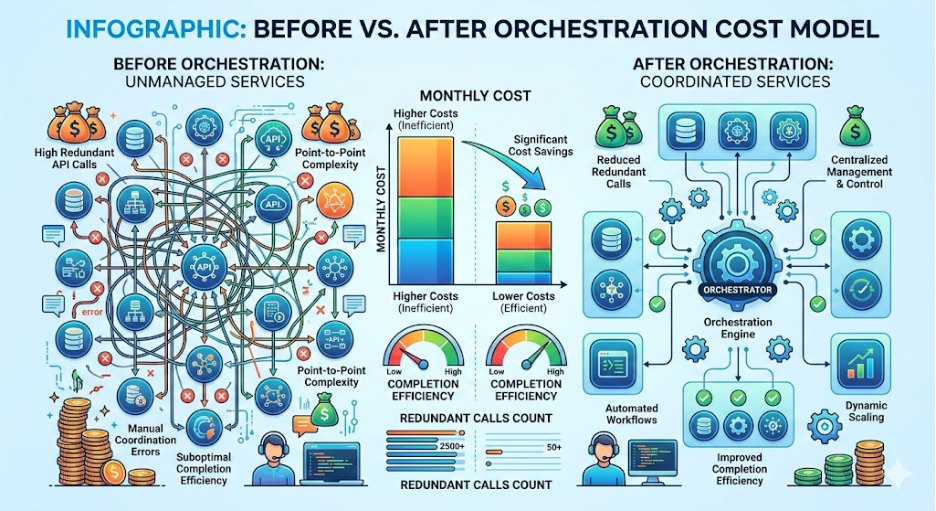
One of the biggest misconceptions about agentic AI orchestration is that more agents equal higher cost.
In reality, orchestration reduces waste.
Where Costs Escalate Without Orchestration
- Redundant model calls
- Inefficient tool routing
- Repeated context reconstruction
- Infinite reasoning loops
- Overuse of high-tier models
Gartner highlights inference optimization as a primary 2026 AI efficiency driver.
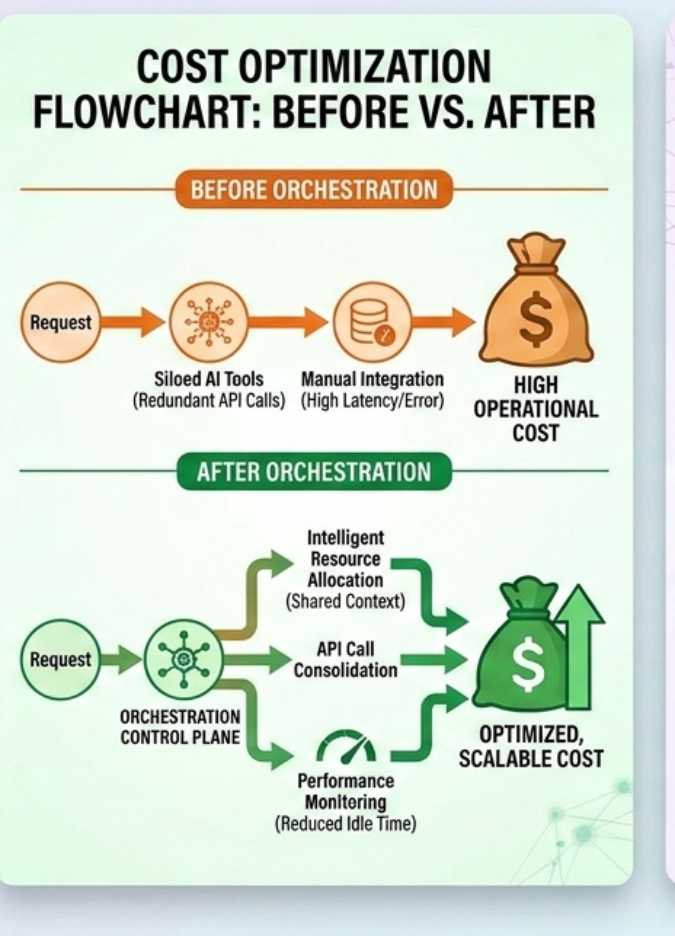
How Orchestration Reduces Cost
1. Smart Routing
Lightweight agents handle simple tasks. Heavy models reserved for complex reasoning.
2. Context Compression
Memory layers reduce repeated prompt length.
3. Supervisory Planning
Prevents unnecessary subtask generation.
4. Adaptive Scaling
Dynamic compute allocation based on complexity.
Enterprises report up to 30–40% cost efficiency improvements when orchestration layers are optimized.
Governance, Risk, and Security in Agentic AI Orchestration
AI autonomy introduces new risk surfaces.
Without structured agentic AI orchestration, enterprises face:
- Data leakage
- Unauthorized API calls
- Compliance violations
- Audit failures
- Brand risk
Research predicts governance gaps—not model errors—will drive most enterprise AI failures by 2026.
Governance Pillars for Agentic Systems
1. Identity-Based Agent Permissions
Agents must operate under scoped credentials.
2. Policy-Aware Decision Engines
Rules enforced before action execution.
3. Immutable Audit Trails
Every decision logged.
4. Ethical Guardrails
Bias detection and outcome validation.
5. Compliance Alignment
GDPR, HIPAA, SOC2 mapping.
For real-world examples of copilots embedded into enterprise platforms, see Techment’s work on Conversational AI on Microsoft Azure.
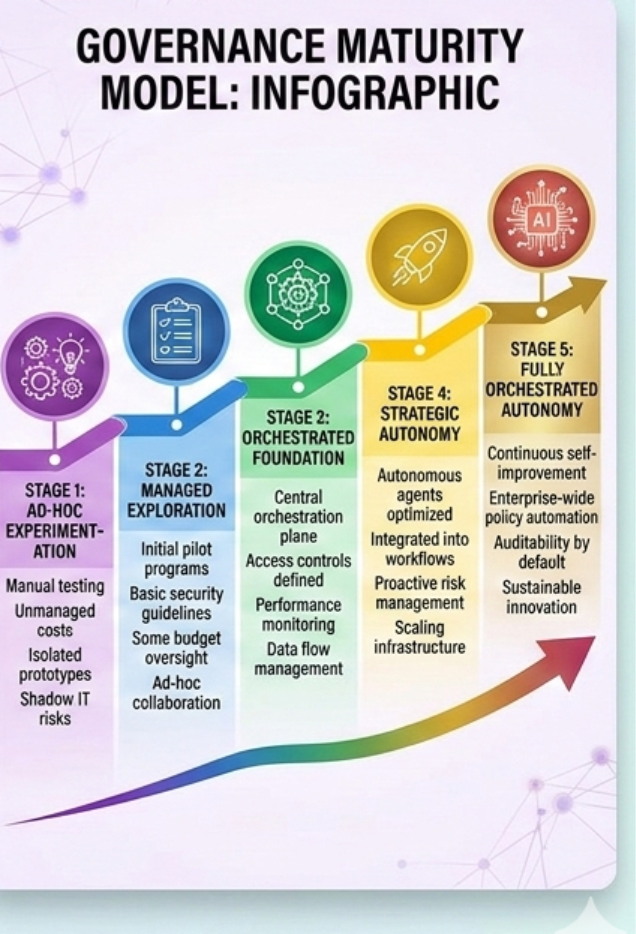
Orchestration operationalizes governance—not just documents it.
Strategic Trade-Offs: Autonomy vs Control
No enterprise AI strategy is without trade-offs.
Trade-Off 1: Speed vs Oversight
More autonomy increases velocity—but may reduce explainability.
Trade-Off 2: Open Source vs Enterprise Platforms
Open systems offer flexibility.
Enterprise systems offer built-in governance.
Trade-Off 3: Decentralized vs Centralized Orchestration
Decentralization promotes agility.
Centralization ensures policy consistency.
Successful agentic AI orchestration balances these tensions deliberately.
How Techment Helps Enterprises Implement Agentic AI Orchestration
Scaling agentic AI orchestration requires more than technical configuration—it demands architectural strategy.
Techment partners with enterprises across:
- AI modernization
- Data transformation
- Cloud-native platform design
- Governance automation
- Microsoft Fabric ecosystem implementation
Through integrated services spanning:
- Data discovery
- Data quality automation
- AI-ready architecture design
- Enterprise AI operating models
Techment helps organizations move from fragmented pilots to orchestrated autonomy.
From roadmap design to implementation and optimization, the focus remains:
- Measurable ROI
- Governance-first deployment
- Platform scalability
- Long-term maintainability
Agentic AI orchestration becomes sustainable when embedded into enterprise architecture—not layered on top of it.
Know all about Agentic AI in our enterprise guide.
The Future of Agentic AI Orchestration Beyond 2026
The trajectory is clear.
By 2027–2028, we expect:
- Self-optimizing orchestration layers
- Cross-enterprise agent collaboration
- Industry-specific orchestration templates
- AI-native operating models
Autonomous supply chains.
Self-healing infrastructure.
Continuous compliance auditing.
But these advances rely on mastering agentic AI orchestration today.
The enterprises building control planes now will define the competitive landscape tomorrow.
Also read about what is RAG in LLM – definition and implementation guide.
Conclusion: Orchestrate Now or Fall Behind
Agentic AI orchestration is no longer optional. It is the foundation of scalable AI in 2026.
Enterprises that:
- Invest in orchestration control planes
- Embed governance into execution layers
- Optimize cost through intelligent routing
- Standardize multi-agent architectures
Will achieve sustained competitive advantage.
Those that treat orchestration as an afterthought will face fragmented pilots, ballooning costs, and compliance risk.
The path forward is clear:
Audit your architecture.
Strengthen your data foundations.
Deploy governed orchestration.
Scale deliberately.
Techment stands ready to guide enterprises through that transformation—ensuring AI autonomy delivers measurable business impact, not operational chaos.
Explore what defines an AI-First Enterprise, how Copilot and intelligent business apps transform workflows, and how Techment helps organizations chart their roadmap from pilot to scale.
FAQs
1. What is agentic AI orchestration in simple terms?
Agentic AI orchestration coordinates multiple autonomous AI agents so they can collaborate reliably, securely, and at scale within enterprise workflows.
2. Why is agentic AI orchestration critical for AI tech stack readiness in 2026?
Without orchestration, multi-agent systems create fragmentation, cost inefficiencies, and governance risk—undermining AI scalability.
3. How long does enterprise implementation take?
Initial pilots can launch in 8–12 weeks. Enterprise-wide orchestration maturity may require 6–12 months.
4. Can agentic AI orchestration integrate with legacy systems?
Yes. Through API layers, secure connectors, and structured orchestration protocols.
5. Is full autonomy realistic in 2026?
Controlled autonomy is realistic. Fully unsupervised autonomy remains risky in regulated environments.