In today’s hyper-digital economy, software quality assurance (QA) has moved from being a back-office function to a critical driver of customer satisfaction, compliance, and business competitiveness. Enterprises deploying complex digital solutions rely on robust testing frameworks to ensure faster releases, improved user experience, and minimized risks. Yet, despite automation and agile practices, many organizations struggle to scale testing maturity.
This is where a Test Maturity Assessment Partner plays a crucial role. By evaluating the current state of testing practices, frameworks, and governance, such a partner helps enterprises design a roadmap for optimized test automation, governance, and quality strategy.
But not all partners are created equal. Choosing the wrong partner can lead to wasted investments, misaligned KPIs, and testing gaps. This blog provides a comprehensive checklist for CTOs, QA leaders, and product managers to identify the right assessment partner.
TL;DR
- Ensure the partner leverages recognized test maturity models (e.g., TMMi, CMMI).
- Evaluate domain expertise and proven industry experience.
- Assess the partner’s ability to provide data-driven insights and roadmap alignment.
- Look for tool-agnostic assessments to avoid vendor lock-in.
- Prioritize scalability, governance, and compliance expertise.
- Demand actionable recommendations, not just audits.
Step-by-Step Guide: What to Look for in a Test Maturity Assessment Partner
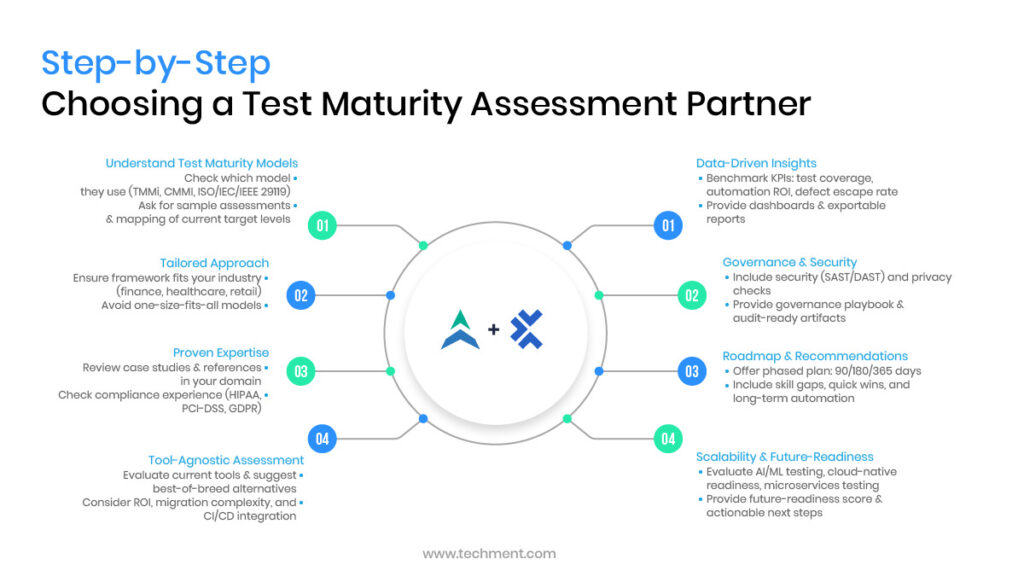
- Understanding Test Maturity Models
Actionable checks:
- Confirm which maturity models the partner uses (e.g., TMMi, CMMI, ISO/IEC/IEEE 29119). Ask for a sample assessment artifact that maps findings to model levels.
- Request examples showing how they adapt the model to an organization’s size and delivery cadence (waterfall, agile, DevOps).
Deliverable to expect: A maturity-mapping matrix that shows current vs. target maturity levels, gaps, and prioritized remediation items.
Sample questions: “How do you map test practices to TMMi levels?”; “Show one example where a client moved from level X to Y—what changed operationally?”
Learn how Techment’s QA services are aligned with global test maturity practices.
Example: According to Gartner, organizations using structured test maturity assessments improve release velocity by up to 25%.
1.2 Customized vs. Generic Models
Your partner should tailor the framework to your domain (finance, healthcare, retail, etc.) rather than using one-size-fits-all models.
- Proven Industry and Domain Expertise
Actionable checks:
- Ask for 2–3 case studies in your industry and request references you can call. A good partner will provide references and data-driven results.
- Verify compliance experience (HIPAA, PCI-DSS, GDPR) through past engagement summaries.
Deliverable to expect: Industry-specific risk register and compliance checklist tied to QA practices.
Example: If you are in insurance, expect the partner to include policy-data integrity tests and claims workflow validation as part of the maturity map. Forrester notes that regulated enterprises face 40% higher QA costs if compliance is overlooked.
Learn how Techment helps enterprises assess and accelerate test automation maturity.
- Tool-Agnostic Assessments
Actionable checks:
- Ask the partner to evaluate your current toolchain and recommend a best-of-breed stack rather than a single-vendor solution.
- Request a cost-benefit analysis comparing retained tools vs. suggested alternatives.
Deliverable to expect: Tool rationalization report listing ROI, licensing impacts, migration complexity, and integration touchpoints (CI/CD, issue trackers).
Practical tip: Ask them to run a 2-week pilot on a representative module using recommended tools—proof beats slides.
Example: Capgemini’s World Quality Report highlights that 54% of enterprises cite over-reliance on single-tool ecosystems as a risk factor.
- Data-Driven Insights and Reporting
Actionable checks:
- Ensure the assessment includes benchmarking against industry KPIs: test coverage, automation ROI, defect escape rate, and cycle time.
- Ask how they will collect and visualize data (integrations with Jira, Azure DevOps, or equivalent).
Deliverable to expect: Live dashboard prototype with drill-down for teams, builds, and releases; exportable CSV/PowerPoint for stakeholder reporting
Example: According to McKinsey, data-driven QA teams reduce defect leakage by 30%.
Learn how Techment enables data-driven testing.
- Governance, Compliance & Security
Actionable checks:
- Confirm inclusion of security testing (SAST/DAST) and privacy impact checks in the assessment scope.
- Ask for a template of the governance model they recommend (roles, SLAs, escalation paths).
Deliverable to expect: A governance playbook with sample test policies, an audit-ready traceability matrix, and compliance test cases.
Example: IDC notes that compliance gaps are the top QA challenge for 65% of enterprises.
Read: Vision AI… Transforming Test Automation
- Roadmap and Actionable Recommendations
Actionable checks:
- Demand a phased roadmap with timelines, resource estimates, and measurable milestones (quick wins, capability build, long-term automation).
- Ask them to pair recommendations with required organizational changes (skill gaps, hiring, center-of-excellence setup).
Deliverable to expect: A 90/180/365-day implementation plan with owner assignments and cost estimates.
Practical tip: Negotiate a success-based clause—e.g., delivery tied to measurable improvements in a chosen KPI.
Learn how Techment drives QA transformation.
- Scalability and Future-Readiness
Actionable checks:
- Validate AI/ML capabilities (predictive defect models, flakiness detection) and ask for sample models or demos.
- Confirm the partner’s approach to cloud-native testing and microservices contract testing.
Deliverable to expect: A future-readiness assessment that scores AI adoption, cloud maturity, and test orchestration readiness.
Interview checklist for shortlisted partners:
- Can you provide a pilot with measurable KPIs?
- How will your findings integrate into our sprint cadence?
- What change-management support do you offer?
Final acceptance criteria (example):
- Clear gap map with remediation prioritized by risk and value.
- One pilot implementation that demonstrates at least one measurable KPI improvement (e.g., 15–20% reduction in regression cycle time).
- Governance artifacts and a 12-month roadmap with assigned owners.
Example: BrowserStack highlights AI as the top driver of next-gen testing scalability.
Data & Stats Snapshot
- 25% faster release velocity for enterprises adopting structured test maturity assessments (Gartner)
- 40% higher QA costs for regulated industries without compliance assurance (Forrester)
- 54% of enterprises see over-reliance on single-tool ecosystems as a risk (Capgemini)
- 30% reduction in defect leakage for data-driven QA teams (McKinsey)
- 65% of enterprises cite compliance gaps as top QA challenge (IDC)
FAQ Section
Q1. What is a Test Maturity Assessment?
A structured evaluation of an organization’s QA processes, tools, and governance aligned to maturity models like TMMi or CMMI.
Q2. Why do I need a Test Maturity Assessment Partner?
Because external experts bring independent benchmarking, industry best practices, and actionable roadmaps.
Q3. How long does a typical assessment take?
Depends on scope—small organizations may take 4–6 weeks, while large enterprises require 10–12 weeks.
Q4. What are the costs involved?
According to Global App Testing, costs vary based on complexity but ROI is realized within 6–12 months.
Q5. How does AI influence Test Maturity Assessments?
AI enables predictive defect analysis, accelerates automation coverage, and improves governance.
Q6. Can assessments be customized for industries?
Yes, mature partners tailor frameworks for domain-specific compliance and regulatory needs.
Q7. What happens after the assessment?
Enterprises receive a roadmap with short, medium, and long-term action plans to enhance QA maturity.
Challenges & Solutions
- Challenge: One-size-fits-all models Many partners rely on rigid frameworks that don’t reflect the nuances of your industry. This can lead to irrelevant benchmarks and misaligned strategies.
- Solution: Demand industry-tailored frameworks that align with your domain-specific challenges, compliance needs, and business objectives.
- Challenge: Tool/vendor lock-in Some providers push proprietary tools or vendor-specific ecosystems, limiting your flexibility and increasing long-term costs.
- Solution: Prioritize tool-agnostic assessments that evaluate your current ecosystem and recommend improvements without locking you into a single vendor.
- Challenge: Lack of actionable outcomes Too often, assessments end with a lengthy audit report that lacks a clear direction for implementation.
- Solution: Ensure your partner delivers a practical roadmap with milestones, measurable KPIs, and a phased execution plan—not just audit results.
- Challenge: Compliance blind spots :Overlooking regulatory testing requirements (GDPR, HIPAA, ISO, etc.) can expose organizations to significant risks.
Solution: Validate that your partner has proven regulatory testing capabilities and frameworks tailored to your compliance landscape. - Challenge: Limited scalability : As enterprises grow, static testing strategies fail to keep pace with evolving technologies and workloads.
- Solution: Ask for readiness in AI, ML, and cloud-native testing to future-proof your QA maturity and enable seamless scalability.
Conclusion
Selecting the right Test Maturity Assessment Partner is no longer optional—it’s a strategic business imperative. The ideal partner goes beyond audits to deliver actionable insights, compliance assurance, and future-ready QA strategies. By using this checklist, CTOs and QA leaders can minimize risks, accelerate releases, and ensure long-term testing success.
Contact us to implement test automation at scale.
Related Reads
- Mobile Testing Without Limits: Accelerate Quality with AI-powered Test Automation
- Boosting Test Automation Resilience with Testim & Tricentis
- Top Software Testing Trends 2025: AI & ML Take Charge