Introduction: From Hype to Measurable Enterprise Value
For over a decade, predictions about AI in insurance have oscillated between revolutionary automation and existential disruption. Yet enterprise leaders—CTOs, CDOs, underwriting heads, actuarial leads, and digital transformation executives—are no longer asking whether artificial intelligence will matter. They are asking where it delivers measurable value, how it scales responsibly, and how it reshapes competitive positioning.
Insurance operates on data, probability, and trust. Artificial intelligence enhances all three.
Today’s implementations of AI in insurance are primarily narrow AI models: purpose-built systems trained to solve specific problems such as claims classification, underwriting triage, fraud detection, or pricing optimization. These systems are already reshaping operational efficiency, risk differentiation, and customer experience.
But the strategic opportunity is broader.
AI is not merely automating paperwork. It is enabling insurers to:
- Convert unstructured data into structured intelligence
- Improve risk segmentation and pricing precision
- Reduce fraud leakage
- Accelerate claims payouts
- Expand into parametric and usage-based products
- Improve portfolio steering and capital allocation
The transformation is uneven across the insurance value chain. The winners will be those who integrate AI into enterprise architecture, governance, and operating models—not those who experiment in isolation.
For decision-makers shaping 2026 roadmaps, AI in insurance is no longer optional—it is structural.
TL;DR – Executive Brief
- AI in insurance today is largely narrow AI, delivering measurable ROI in underwriting, claims, and fraud detection.
- The strongest benefits of AI in insurance emerge from augmenting human expertise, not replacing it.
- AI use cases in insurance vary across the value chain, with underwriting triage and claims automation leading ROI.
- Responsible AI governance, data quality, and operating model redesign determine scalability.
- Insurers treating AI as enterprise infrastructure—not experimentation—are building durable competitive advantage.
The Strategic Imperative: Why AI in Insurance Matters Now
Margin Pressure and Risk Complexity
The insurance sector faces mounting structural pressure:
- Climate volatility increasing catastrophic losses
- Inflation driving claims severity
- Fraud becoming more sophisticated
- Customer expectations shifting to instant digital experiences
- Regulatory scrutiny intensifying globally
According to McKinsey, AI-driven automation and analytics could generate substantial economic impact across underwriting and claims functions. Meanwhile, prominent research reports that data-driven decisioning is now a primary competitive differentiator in financial services.
In this environment, the benefits of AI in insurance extend beyond efficiency—they influence loss ratios, pricing competitiveness, and capital efficiency.
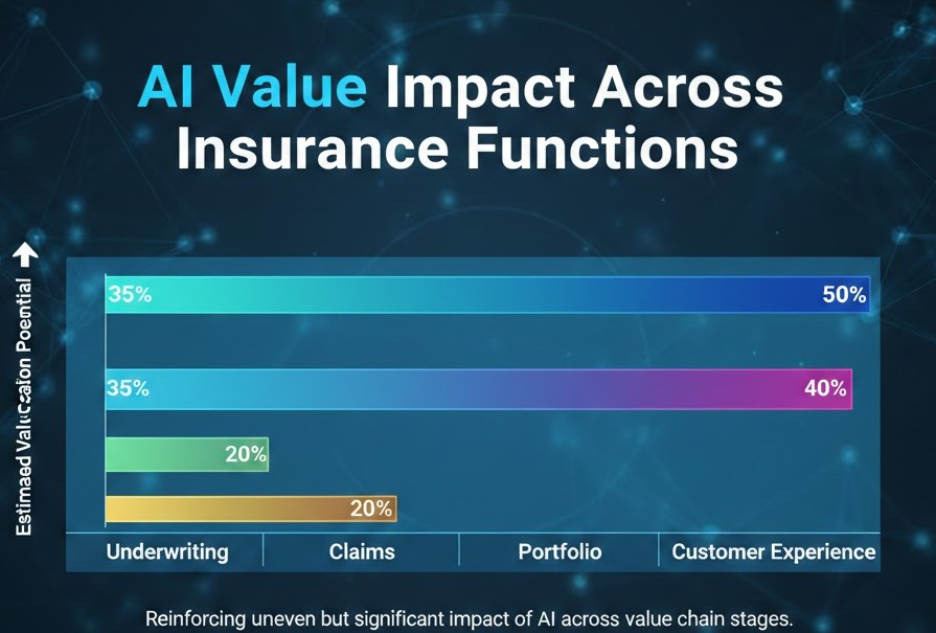
Uneven Impact Across the Value Chain
AI does not affect all insurance processes equally.
Highest impact areas today:
- Underwriting triage and risk scoring
- Claims automation and fraud detection
- Document ingestion via NLP
- Computer vision for damage assessment
- Portfolio risk analytics
Moderate impact areas:
- Distribution optimization
- Customer service automation
- Product personalization
Emerging impact areas:
- Parametric insurance
- Autonomous underwriting ecosystems
- Real-time portfolio steering
Insurers must therefore prioritize AI use cases in insurance based on economic return and data readiness.
Organizations pursuing this journey benefit from structured AI roadmaps such as those outlined in Techment’s Enterprise AI Strategy in 2026.
Narrow AI in Insurance: Understanding the Present Reality
What Is Narrow AI?
AI refers to mathematical models that learn patterns from data and enable automated or accelerated decisions.
Two broad categories exist:
- Narrow AI in insurance: Task-specific models designed for defined outcomes
- General AI: Hypothetical human-level intelligence across domains
Despite media narratives around generative AI, insurance applications remain largely narrow.
Examples include:
- Claims classification models
- Underwriting risk scoring systems
- Fraud anomaly detection engines
- Natural language processing for document ingestion
These systems are bounded, measurable, and auditable.
Why Narrow AI Dominates Insurance
Insurance is a regulated, capital-intensive industry. Decision explainability and model transparency are non-negotiable.
Narrow AI in insurance offers:
- Predictable performance
- Easier compliance validation
- Clear KPIs
- Controlled operational scope
The enterprise lesson: AI value emerges when integrated into workflows alongside human oversight.
As Techment discusses in Data Quality for AI in 2026: The Ultimate Blueprint, scalable AI depends on trusted data foundations.
AI in Insurance Underwriting: Precision, Speed, Differentiation
Data Explosion in Underwriting
Modern underwriting now incorporates:
- Telematics data
- IoT sensors
- Satellite imagery
- Wearables and health data
- Behavioral and transactional data
AI in insurance underwriting converts these diverse datasets into predictive risk scores.
Supervised machine learning models enable:
- Smarter triaging
- Automated document review
- Risk segmentation
- Dynamic pricing adjustments
Business Benefits of AI in Insurance Underwriting
- Reduced turnaround time
- Improved risk differentiation
- Lower adverse selection
- Enhanced customer experience
- Scalable growth without linear cost increases
AI risk assessment in insurance improves portfolio quality when combined with actuarial oversight.
However, risks include:
- Algorithmic bias
- Model drift
- Regulatory challenges
Therefore, governance structures—such as those described in Data Governance for Data Quality: Future-Proofing Enterprise Data—are essential.
AI in Insurance Claims: Operational Transformation
Claims processing is one of the highest operational cost centers in insurance.
Core AI Use Cases in Insurance Claims
- NLP for document ingestion
- Computer vision for damage assessment
- Fraud detection via anomaly detection
- Predictive severity modeling
- Automated settlement recommendations
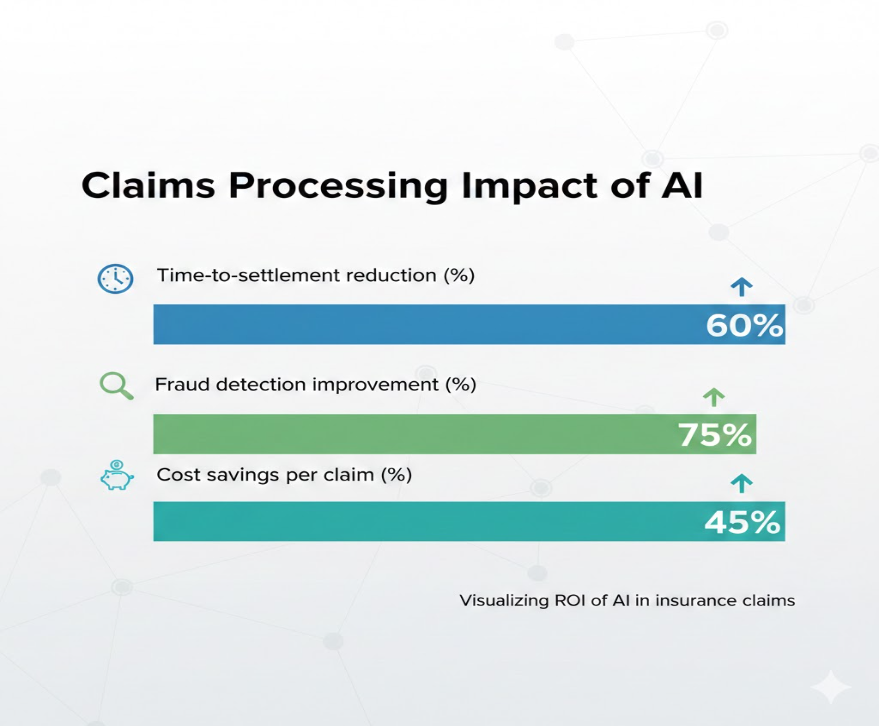
The benefits of AI in insurance claims include:
- Faster payouts
- Reduced leakage
- Fraud reduction
- Higher customer satisfaction
Parametric Insurance: Redefining Claims
AI-powered parametric insurance eliminates the traditional claim submission process.
Example scenarios:
- Flight delay compensation
- Weather-triggered crop insurance
- Natural catastrophe coverage
Once predefined parameters are met, payout occurs automatically.
This shifts insurance from reimbursement to real-time response.
Strategic Trade-offs
Benefits:
- Reduced administrative overhead
- Enhanced transparency
- Improved trust
Challenges:
- Trigger accuracy
- Model validation
- Capital implications
- Regulatory scrutiny
AI claims automation must be supported by robust enterprise architecture. Techment’s AI-Ready Enterprise Checklist with Microsoft Fabric outlines readiness considerations.
Computer Vision & Edge AI in Motor Insurance
The convergence of edge computing and AI unlocks new motor insurance capabilities.
Capabilities
- Real-time video capture
- Encrypted cloud transmission
- Computer vision accident reconstruction
- Driving style analysis
- Fraud flagging
AI in insurance motor lines supports usage-based pricing and fraud prevention.
Compliance Considerations
- GDPR data anonymization
- Secure data transmission
- Legal admissibility of AI-derived evidence
This is a prime example of AI use cases in insurance delivering measurable impact while requiring governance maturity.
Portfolio Steering & Risk Intelligence
AI in insurance extends beyond transactional processes into strategic portfolio management.
AI Risk Assessment Insurance Applications
- Exposure aggregation
- Climate risk modeling
- Capital optimization
- Reinsurance structuring
- Catastrophe prediction
Advanced machine learning models allow insurers to simulate portfolio outcomes under various risk scenarios.
Benefits:
- Improved capital allocation
- More resilient portfolios
- Strategic pricing decisions
This represents a shift from reactive underwriting to proactive portfolio intelligence.
Responsible AI in Insurance: Governance as Competitive Advantage
AI adoption at scale introduces new enterprise risks:
- Algorithmic discrimination
- Model opacity
- Cybersecurity vulnerabilities
- Regulatory non-compliance
According to global regulatory trends, explainability is becoming mandatory for automated decisions in financial services.
Core Pillars of Responsible AI in Insurance
- Model transparency
- Human oversight
- Continuous monitoring
- Data lineage tracking
- Bias detection
Responsible AI is not a compliance burden—it is a trust enabler.
Organizations investing early in governance build reputational resilience.
The Operating Model Shift Required for AI in Insurance
AI cannot scale within traditional siloed structures.
Enterprise adoption requires:
- Cross-functional collaboration
- Centralized data platforms
- MLOps capabilities
- Cloud-native infrastructure
- Model lifecycle governance
Insurers that treat AI initiatives as IT experiments struggle to move beyond pilots.
The future belongs to organizations that embed AI into core operations.
Enterprise Implementation Roadmap for AI in Insurance
The strategic promise of AI in insurance becomes tangible only when organizations move from experimentation to structured enterprise execution. Many insurers have dozens of AI pilots—but few have scaled AI across underwriting, claims, and portfolio management in a coordinated manner.
The difference lies in execution maturity.
Phase 1: Data Foundation & AI Readiness
Before scaling AI use cases in insurance, insurers must assess:
- Data quality and completeness
- Availability of historical labeled data
- Governance maturity
- Regulatory alignment
- Cloud and infrastructure scalability
AI risk assessment insurance models are only as reliable as the data that feeds them. Fragmented legacy systems often hinder progress.
A structured modernization journey—such as those outlined in Techment’s Enterprise AI Strategy in 2026 is often the starting point.
Key deliverables in this phase:
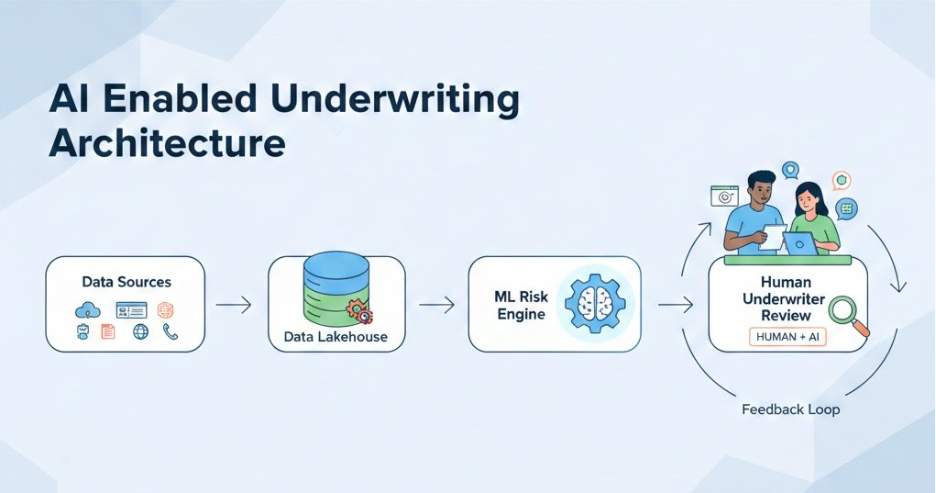
- Unified data lakehouse architecture
- Data catalog and lineage mapping
- Master data management
- AI governance framework
- Executive sponsorship and budget alignment
Without these foundations, AI in insurance initiatives remain isolated pilots.
Phase 2: High-Impact Use Case Prioritization
Enterprise leaders should prioritize AI use cases in insurance based on:
- Economic impact (loss ratio improvement, cost reduction)
- Feasibility (data availability, regulatory complexity)
- Strategic differentiation
- Customer experience value
Typical first-wave use cases include:
- Claims triage automation
- Underwriting document classification
- Fraud detection
- Severity prediction
Organizations that attempt to implement advanced generative AI before stabilizing narrow AI in insurance often face governance and trust challenges.
Phase 3: Scalable Architecture & MLOps
To sustain AI in insurance, insurers must establish:
- Model development pipelines
- Version control
- Continuous integration / deployment
- Model monitoring and drift detection
- Retraining workflows
MLOps transforms AI from experimentation into operational infrastructure.
Technology enablers such as cloud-native platforms and integrated analytics ecosystems become essential here. Techment’s AI-Ready Enterprise Checklist with Microsoft Fabric highlights architectural readiness considerations.
Phase 4: Governance & Risk Management Integration
Responsible AI in insurance must be embedded into:
- Compliance review boards
- Model risk committees
- Internal audit processes
- Legal oversight
Governance maturity becomes a competitive differentiator.
Data Architecture Blueprint for AI in Insurance
AI in insurance depends on unified, governed data architecture.
Core Architectural Components
1. Data Ingestion Layer
Structured and unstructured data sources including:
- Policy systems
- Claims platforms
- Telematics
- IoT sensors
- External weather and satellite data
2. Lakehouse or Unified Data Platform
Central repository for scalable storage and processing.
3. Feature Engineering Layer
Transforms raw data into model-ready features.
4. Model Layer
Machine learning and NLP models trained for specific use cases.
5. Orchestration Layer
Integration into underwriting and claims workflows.
6. Monitoring & Governance Layer
Ensures performance tracking, bias detection, explainability.
Without unified architecture, AI in insurance remains siloed.
Techment’s perspective in Driving Reliable Enterprise Data emphasizes that AI success depends on trusted pipelines.
Benefits of AI in Insurance: Beyond Efficiency
While automation is often the headline benefit, the strategic benefits of AI in insurance are broader.
1. Risk Differentiation Advantage
AI risk assessment insurance models allow granular segmentation. Insurers can price more precisely, reduce cross-subsidization, and enter niche markets confidently.
2. Customer Experience Transformation
AI claims processing insurance shortens settlement cycles from weeks to hours in some cases.
Faster payouts build trust and retention.
3. Fraud Reduction
Machine learning detects subtle anomalies beyond rule-based systems.
Reduced fraud improves combined ratios directly.
4. Operational Scalability
AI augments workforce productivity, allowing insurers to grow without proportional cost expansion.
5. Innovation Enablement
AI-powered parametric insurance products create new revenue streams.
Risks & Trade-offs of AI in Insurance
Enterprise leaders must balance opportunity with risk.
Algorithmic Bias
Biased training data can result in discriminatory underwriting decisions.
Mitigation:
- Bias audits
- Diverse training datasets
- Explainability tools
Model Drift
Risk patterns evolve due to climate, demographics, economic shifts.
Mitigation:
- Continuous monitoring
- Retraining pipelines
Regulatory Scrutiny
Financial services regulators increasingly demand transparency.
Mitigation:
- Model documentation
- Clear decision logs
- Human-in-the-loop processes
Cybersecurity Risks
AI systems introduce new attack vectors.
Mitigation:
- Secure cloud architecture
- Data encryption
- Access controls
Responsible AI in insurance requires structured governance frameworks.
Human + AI: The Augmentation Model
Despite automation narratives, the most successful AI use cases in insurance follow an augmentation model.
AI performs:
- Pattern recognition
- Data processing
- Risk scoring
Humans perform:
- Contextual judgment
- Ethical decision-making
- Exception handling
- Customer relationship management
The future of AI in insurance is collaborative intelligence.
Insurers who remove humans entirely risk reputational and compliance exposure.
Industry Outlook: 2026–2030
The next five years will reshape AI in insurance.
Generative AI Integration
Large language models will enhance:
- Policy document summarization
- Claims communication drafting
- Regulatory report preparation
- Internal knowledge assistants
However, generative AI introduces hallucination risk and governance complexity.
Narrow AI in insurance will remain dominant for core decision-making.
Climate Risk Modeling Acceleration
AI-driven catastrophe modeling will become central as climate volatility increases.
Predictive modeling sophistication will influence reinsurance negotiations and capital reserves.
Embedded & Usage-Based Insurance Growth
Telematics and IoT-enabled AI risk assessment insurance models will support dynamic pricing.
Consumers may accept real-time premium adjustments in exchange for transparency and fairness.
Regulatory Expansion
Expect stronger AI governance mandates across jurisdictions.
Explainability and bias detection capabilities will become mandatory.
Measuring ROI of AI in Insurance
Enterprise leaders must quantify impact.
Key Performance Indicators
Underwriting:
- Quote-to-bind time
- Risk classification accuracy
- Loss ratio improvement
Claims:
- Settlement cycle time
- Fraud detection rate
- Cost per claim
Portfolio:
- Capital efficiency
- Catastrophe exposure modeling accuracy
Customer:
- Net promoter score
- Retention rate
AI in insurance must demonstrate measurable business value—not experimental novelty.
How Techment Helps Enterprises Scale AI in Insurance
Scaling AI in insurance requires:
- Data modernization
- Platform integration
- Governance alignment
- AI lifecycle management
- Change management
Techment partners with insurers to design enterprise AI strategy across:
- Modern data lakehouse architecture
- Microsoft Fabric and Azure AI implementation
- Data governance and compliance frameworks
- AI readiness assessments
- Responsible AI operating models
- End-to-end transformation roadmaps
Techment combines business strategy, architecture expertise, and AI engineering to move insurers from fragmented pilots to enterprise-scale AI ecosystems.
The goal is not isolated AI use cases—but sustainable competitive advantage.
Conclusion: The Strategic Future of AI in Insurance
AI in insurance is no longer a future vision—it is a present capability delivering measurable value across underwriting, claims, fraud detection, and portfolio management.
But the real transformation lies not in automation alone.
It lies in:
- Smarter risk differentiation
- Faster and fairer claims outcomes
- New product innovation
- Stronger governance frameworks
- Scalable enterprise architecture
The insurers who will lead 2026–2030 are those who treat AI as strategic infrastructure—embedded into data, workflows, governance, and culture.
Narrow AI in insurance will continue delivering immediate ROI. Responsible AI in insurance will ensure long-term trust. And enterprise AI strategy will determine competitive positioning.
Techment partners with forward-thinking insurers to design, build, and scale AI ecosystems responsibly—bridging technology capability with business transformation.
The future of insurance will not be purely automated.
It will be intelligently augmented.
Frequently Asked Questions
1. What are the primary benefits of AI in insurance?
The benefits of AI in insurance include improved underwriting accuracy, faster claims processing, fraud reduction, operational efficiency, and enhanced customer experience.
2. Is AI replacing insurance professionals?
No. AI in insurance augments professionals by handling repetitive tasks and providing predictive insights.
3. What is narrow AI in insurance?
Narrow AI in insurance refers to task-specific machine learning models designed for defined use cases such as claims classification or risk scoring.
4. What are the biggest risks of AI in insurance?
Bias, model drift, regulatory non-compliance, cybersecurity vulnerabilities, and poor data quality.
5. How long does it take to implement enterprise AI in insurance?
Typically 12–36 months for full-scale transformation, depending on data maturity and organizational readiness.